


The Big Picture | <><> |
- Esquire Takes a Shot at Roger Ailes and Misses
- A Few Thoughts on Steve Jobs / Apple
- Honey Bee Extinction
- By the Numbers: Internet 2010
- Sports Betting: Billy Walters
- Inflation Annual % Change
- Economic data: Home builder survey, NY Fed survey
- Dylan Ratigan on the Wikileaks-Tax Cheat
- 2010 Investing Mea Culpas
- Shanghai Breaks 200-day, Commodities Next to Roll?
Posted: 18 Jan 2011 05:30 PM PST Okay, so fewer than two weeks after the Arizona massacre, when America is still reeling from the look in the mirror the violence provoked, a look that caused even Roger Ailes to suggest his network tone down some of the invective, Esquire publishes a profile of Fox News’s presiding genius. This should be good, right? Juicy subject; fraught moment. But what we get from Esquire’s lead writer, Tom Junod, is such a mannered, over-written piece of nonsense that we’re reminded again how much the world of writing and reporting has been changed by the internet. I’d quote from Junod’s piece to make my point, but I can’t because you’ll never finish reading the post. Let me describe an example of the problem: Junod takes nearly 700 convoluted words to tell us that Ailes doesn’t have a Blackberry because he got into too many email fights with angry members of the public. That’s great bit. But Junod buries it in so much vamping that you never get any of the good details. Giving Junod some allowances for having written the story long before the shootings, it’s still an inflated, rambling, backwards-talking attempt to cover the fact that magazine and writer have little to say about Ailes. The best insight we get is a good summation of Ailes’s strength as an uber-producer. He pays attention to every detail of the product and finds talent that can perform and fit his objectives: creating an idealized universe of pretty and pumped-up news readers who sell a seamless worldview. Here’s Junod quoting Columbia Journalism school’s Dick Wald: He used to be the president of NBC News. He likes Roger Ailes. And if you ask him the secret of Mr. Ailes’s success, he’ll say it’s pretty simple: “Roger, in many ways, is just more competent. He just does it better. The anchors are better. The crispness of the reporting is better. The anchors don’t interrupt, the shows move along, and the point of view is clear. It’s just a good product. Roger found an area in which he could reach each audience member individually. That’s the big difference between Fox and CNN.”Wald’s points are fascinating. But Junod misses the big question. Ailes is the acknowledge master of making news fit a political point of view. He really is just better at making television news more entertaining than anyone who worries about journalistic neutrality. So why then is his business channel the opposite of everything Wald describes about the Fox News? What works on Fox News undermines Fox Business. Why? Is it Ailes’s lack of interest in the subject matter, he simply doesn’t have enough to drive his competitive metabolism? Or is it that business is already inherently closer to Fox’s world view and Ailes’s version of the realm cannot gain contrast? I’d say the problem lies in the nature of business news, especially a channel that follows the markets. Prices are too fact-based for Ailes’s mastery of spin. One can argue about political remedies for the economy but the day-to-day news of the markets can’t be re-written. In other words, business is immune to Ailes’s alchemy and the constituency has to face reality. (You could add that CNBC has already done everything possible to make the markets seem like a conversation rather than numbers floating in space.) Facing reality is the problem that bedevils Esquire too. Junod’s piece is a classic bit of magazine writing. Lots of stylized writing and a hip tone. Isolated in an issue of Esquire, it might read well. (Yes, where something appears affects how it reads.) But on the internet, it just seems lazy and irrelevant. Worse, over-taken by events, it seems a wasted opportunity to ask better questions about Ailes’s pugnacity. We’re back at those emails again. In our spin-saturated world, it’s pretty hard to get a leg up with snark. The web, twitter, all flavors of cable news positioning make what Junod does with words here in Esquire not only redundant but boring. Source: Why Does Roger Aile Hate America? (Esquire) by TOM JUNOD Esquire; January 18, 2011 http://www.esquire.com/features/roger-ailes-0211-2#ixzz1BPQ7oLbb |
Posted: 18 Jan 2011 01:00 PM PST The announcement yesterday that Steve Jobs is taking a leave of absence from Apple is one of those events that leads to a reflexive spasm of half thought out commentary. The mad rush to publish something often leads to some pretty silly statements making the rounds. As a long standing Apple fan, I deferred piling on yesterday, waiting until I after a few hours of quiet contemplation had passed. Thus, I have some thoughts to share with you: 1. Timing of the announcement: I heard a few accusations from the tinfoil hat crowd that this was a purposeful holiday release. I doubt that was the case here. I suspect that in response to some triggering event over the weekend (Saturday) — a medical test, a doctor’s advice — Jobs reached out to his COO and the Board (Sunday). The next day was when the announcement was made. Consider the alternative — had they waited a day until the market was open, the delay itself could have been an SEC issue. And, the chance of a leak from outside Apple (i.e, the medical side) was a distinct possibility. (Note: The sleaziest corporate announcements are late Friday afternoon on a 3 day weekend. Those are, by design, attempts to bury bad news) . 2. Apple has a deep bench: It may come as a surprise, but the world’s largest Tech company is not a one man operation. -Jonathan Ive: Chief Industrial Designer If you love the looks of your iPad, MacBook or iPod, Ives is your guy.There’s lots more talent at Apple behind Jobs. 3. Why Wouldn’t you use Jobs? Someone asked “With all this talent, why didn’t Apple trot out these guys more often?” Let me phrase it this way: If you owned/managed a Consumer products company, and your CEO was a cross between PT Barnum and Henry Ford, why on earth would you ever use anyone else? 4. Apple needs a 10 Year Plan: No, Apple does not, as one analyst suggested, need a 2-3 year plan. Apple has managed to place itself at the nexus of media, consumer gadgets and technology. What made Jobs contribution so brilliant was his ability to see just beyond what was possible today to conceive of things for mass consumption devices. Regardless of the outcome of this recent scare, one day, Apple will have to operate without Jobs. They need to continue identifying products that are both just possible to create as well as highly desirable. How they can do that without Jobs remains a valid concern. 5. The Bigger Risk in Apple Remains that Momentum Traders Fall out of Love: Back out the cash, and Apple trades at a reasonable P/E. That’s why fundie guys like David Einhorn own it. But when you see the list of less fundamentally-driven Hedge funds that own Apple, there can be little doubt that momo players are big in the name. The risk to stock price is that they simultaneously fall out of love. If that happens, and the stock gets hit, some of the shine could come off of the Apple halo. THAT is never good for sales . . . 6. This introduces a new Uncertainty: Not to be morbid, but when Jobs first got ill, we learned what the various parameters were of his ailments. The latest claims of uncertainty are silly. We know what Pancreatic Cancer survivor tables look like, we know what Liver Transplant survivorship math is. The longevity tables for a liver transplant recipient/pancreatic cancer survivor are not unknown. My point is, there isn’t a lot of uncertainty here > See also (some of the less hysterical coverage of Apple): • Without Jobs it’ll be Apple 4.0 (Fortune) • Apple's Comeback: 3 Reasons Stock Has Bounced From Lows (Marketbeat) • The CEO's previous leaves have not had a long term negative effect on the stock (Alphaville) • Top Hedge Funds That Own Apple (AAPL) (Marketfolly) • Apple Is More Than Just Steve Jobs (Forbes) • Bizarre: Christopher Bonavico says Apple “is destroying value by sitting on its cash hoard” (WSJ) • Buying Blind: Should Jobs Disclose More to Investors About His Personal Health ? (Slate) > Previously: Popular or Best? (ATPM January 1998) Analysts Still Underestimate Apple (Real Money, Jan 13, 2005) Is Disney/Pixar the sequel to Apple/NeXT ? (January 30th, 2004) Apple morphs into a Consumer Electronics Co (April 25th, 2004) Apple to Music Industry: Monetize Your IP (April 28th, 2004) |
Posted: 18 Jan 2011 11:36 AM PST Given all of the interest in AG these days, perhaps we should look at something that might lead to some extreme scarcity: Honey Bees. Or more specifically, the decreasing number of them. Daily Infographic has today’s digital delight: This monstrous graphic looks at the mystery of the Honeybee die offs: This is the first 10% of it:  full graphic after the jump click for larger image  http://dailyinfographic.com/the-mysterious-honey-bee-extinction-infographic |
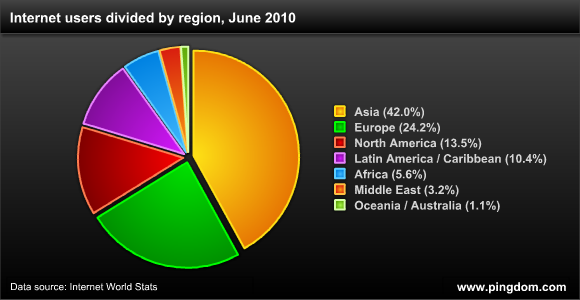
Posted: 18 Jan 2011 09:30 AM PST Pingdom did some mad calculations on the numbers; Prepare for a information overload:
Websites
Web servers
Domain names
Internet users
 Social media
Videos
Images
|
Posted: 18 Jan 2011 09:29 AM PST I found this report quite fascinating; he seemed to me more a hedged trader than a straight dice roller: |
Posted: 18 Jan 2011 08:30 AM PST Another interesting chart from Visualizing Economics: > Nominal vs Real 3-Month Interest Rate: 1934-2010click for ginormous chart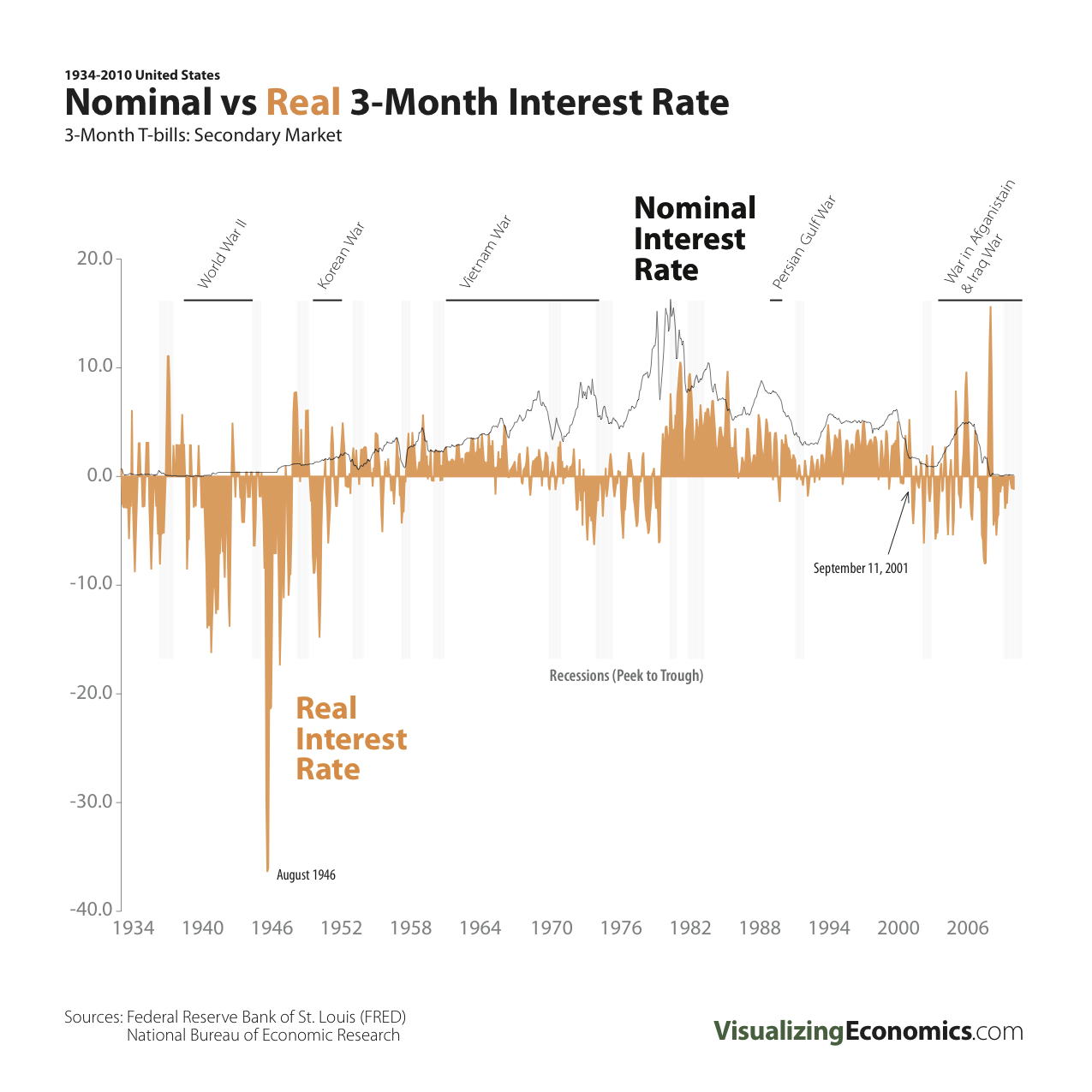 |
Posted: 18 Jan 2011 07:46 AM PST Home builder survey punk but we know that already The Jan NAHB home builder survey came in at 16, 1 pt below expectations and flat with Dec and Nov. Both the Present Conditions and Future Expectations components were unchanged too with Dec and Nov. Prospective Buyers Traffic inched up 1 pt to 12. To put all these figures into perspective, 50 is the breakeven between expansion and contraction. NAHB Chairman said “a severe lack of construction financing, and widespread difficulties in obtaining accurate appraisal values, continue to limit builders’ ability to prepare for anticipated improvements in buyer demand in 2011.” Certainly in parts of the West and South, they also have the still competitive threat from foreclosures. Bottom line, we know housing remains depressed in many areas of the country and thus the data is neither a surprise nor market moving. NY Fed survey about in line The Jan NY Fed survey at 11.9 was about in line with expectations of 12.5 and up from 9.9 in Dec. The data is typically volatile and thus becomes much less of a market mover. For example, New Orders rose from +2 to +12.4 but was -23.8 in Nov and +10 in Oct. Backlogs rose 7 pts but is below zero for a 10th straight month. Employment rose almost 12 pts to 8.4 but was 9.1 in Nov. Inflation pressures were clearly apparent as Prices Paid rose 7 pts to 35.8, the most since May ’10 and Prices Received were up by 12 pts to the highest since Oct ’08 at 15.8. The overall 6 month outlook rose 10 pts to the best since Apr ’04. Bottom line, notwithstanding the monthly bounce around of this figure, the expansion in mfr’g in the NY region continues but let’s wait to see other regional indexes and the ISM in order to draw conclusions on the degree. |
Posted: 18 Jan 2011 06:51 AM PST |
Posted: 18 Jan 2011 06:30 AM PST January is halfway over, so it is once again time to look at the various errors, mistakes and wrong headedness that I succumbed to (damn human!) working in the asset management business in 2010. My mea culpas for 2009 can be found here. Assessing the performance figures in 2010, there were plenty of things to be pleased with: The Macro calls and stock selection were both on target. We avoided most of the April to July downturn, caught most of the August to December rally. However, in terms of managing assets, and the business of managing assets, there is lots of room for improvement. Even though these are two very different skill sets, they closely related. Let’s have at it: 1. Running an Asset Management Business vs Running Assets: This may seem obvious, but it is far more complex than you might imagine. Running an asset management business involves personnel decisions, marketing, raising assets, organization, scheduling, communications, accounting, legal, planning, follow through. I know plenty of great asset managers who are terrible business people, and terrible asset managers who are great business people, lots who are awful at both — and very few who excel at each.This is certainly not an exhaustive list — there are many other areas I hope to improve upon in 2011; Trust me when I tell you my list gets longer every year. However, it is what I have been thinking about over the past few months. As always, ideas, suggestions, and hints for improving are always welcome! |
Posted: 18 Jan 2011 05:00 AM PST Global Macro Monitor produces informed opinion about markets and the global economy. This was originally published on January 17, 2011 ~~~  During the 1990's when the emerging markets were still emerging a friend of ours wrote a research report on pre-restructured busted Russian debt titled, No Rush to Buy, No Russians Buying. The point was the Russians knew the prospects for the debt much better given the country's lack of transparency and the general relative ignorance of foreigners. During the 1990's when the emerging markets were still emerging a friend of ours wrote a research report on pre-restructured busted Russian debt titled, No Rush to Buy, No Russians Buying. The point was the Russians knew the prospects for the debt much better given the country's lack of transparency and the general relative ignorance of foreigners.Back then the market also traded Nigerian debt and Brady Bonds based on whether or not the country's generals were actively buying the debt as the military was the ultimate insider as to whether the next coupon would be paid. The same concept – insiders know best — applies for those who closely follow the buying and selling of stocks by company insiders or management. Given our confessed lack of ignorance on what is really happening in China's economy, we look at visible indicators to get a sense of what it truly going on, such as the stock market. Market indicators are far from perfect and not always reliable, but it sure the heck beats guessing, "shooting in the dark," or trusting your capital to the market cheerleaders. Last night the Shanghai Composite broke key support of the 200-day moving average and the neckline of a technical head and shoulders (H&S) pattern. The chart below shows the price point of the current break is lower than the penetration of the 200-day in late December, which is reflective of the short-term downtrend. The next key support level is 2, 600. The markets have been flakey of late, however, as there have been several recent H&S topping patterns, including in the Hang Seng and the $/Euro, which have proved unreliable sell signals. Given the seriousness of Asian policymakers to fight inflation and to limit property bubbles, however, we give the Shanghai H&S and 200-day cross a higher probability of following through. P&G must be minting coin with all the traders reaching for the H&S these days!  This leads to our next concern. Given the commodity story is driven and dominated primarily by the China theme, we think there is a pretty good chance this sector could roll over in the near term. Commodities are a very crowded trade and our sense is the levered community is massively long. This leads to our next concern. Given the commodity story is driven and dominated primarily by the China theme, we think there is a pretty good chance this sector could roll over in the near term. Commodities are a very crowded trade and our sense is the levered community is massively long.Recent price action exhibits all the characteristics of a blow-off top and some of the leaders already seem to be trading at stall speed. Furthermore, as the chart below illustrates, since November the Shanghai and commodities, which have in the past tracked each other relatively well, are in a huge Willey E. Coyote divergence. Finally, we find the last chart on China's money supply growth very interesting. Not unlike other countries, when the growth of the broad money supply outpaces nominal GDP growth, asset bubbles and eventually price pressures tend to develop throughout economy. China's rapid money growth in excess of nominal GDP growth in 2005/6 helped to inflate the Shanghai Composite, which rose from around 1,100 in mid-2005 to an intraday high of over 6,100 in October 2007. At the close on Monday, the Shanghai is down 56 percent from its all-time intraday high. The monetary expansion which drove the Shanghai is minuscule compared to what took place after the financial crisis, however. The Fed is often demonized, including, sometimes by us, for printing money to help stabilize the financial and economic crisis. But take a look at what happened in China. In the U.S., the central bank printed and created money through the expansion of its balance sheet. In China, the government pressured the banks to create money through expanding and directing credit to specific sectors. The chart illustrates as nominal GDP growth was collapsing in 2009, the broad money supply in China was growing close to 30 percent by the end of 2009. This helped the Shanghai Composite recover a bit, but inflated other bubbles, including and mainly in the real estate markets. We hear rumors of, and see pictures of empty Chinese shopping malls and cities pinging around the internet, which is the result of the easy and nonmarket credit included in the latest round of China's monetary expansion. Doesn't this sound a little familiar? First a stock bubble, then a monetary driven real estate and construction bubble to stimulate growth? We're not saying China is going to collapse anytime soon and they do have almost $3 trillion in foreign exchange reserves to help cushion any hardship as monetary policy downshifts. But we know that a 30 percent growth in the broad money supply, coupled with just 10 percent nominal GDP growth, must have given birth to many bodies swimming naked, which will be exposed as the credit tide goes out. Whether they're allowed to officially surface for all is an open question. We just hope the markets will be a clear enough signal as to their size and magnitude. Like everyone else, we are flying almost blind in this dimly lit world of the markets. We realize our model and view of the world could be wrong and learned to try and have as little of our ego as possible vested in our models and views. The only thing we're certain of is the markets, as they have in the past and will continue to do so in the future, beat our egos like a drum. We'll have no problem revising or ditching our view all together if we lack market confirmation. We always try and heed the words of the great Todd Harrison over at Minyanville.com, "discipline always trumps conviction!" Stay tuned!    |
 The Big Picture (ritholtz)
.


0 comments:
Post a Comment