.

{2} GoogleTranslate (H)

English French German Spanish Italian Dutch Russian Portuguese Japanese Korean Arabic Chinese Simplified

Our New Stuff

{3} up AdBrite + eToro

Your Ad Here

Saturday, April 30, 2011

The Big Picture

The Big Picture


Lamborghini LP700-4 Aventador

Posted: 30 Apr 2011 02:00 AM PDT

Redonkulous:

Production: Sehsucht GmbH Hamburg, Germany

Has the Fed Decided to Fight Inflation Instead of Unemployment?

Posted: 29 Apr 2011 11:00 PM PDT

Washington's Blog strives to provide real-time, well-researched and actionable information.  George – the head writer at Washington's Blog – is a busy professional and a former adjunct professor.

~~~

William Alden writes in a Huffington Post liveblog entitled “Inflation Vs. Jobs”:

Bernanke’s argument about inflation isn’t consistent, economist Paul Krugman says.

The Fed’s asset-purchase strategy is partially intended to promote maximum unemployment, but some experts are concerned that it will ultimately spark inflation once the recovery takes hold and the system remains awash in liquidity. In this view, there’s a tradeoff between jobs and prices.

Bernanke, however, doesn’t take this view: He said in the press conference that core inflation, or, as Krugman says, “inflation inertia,” isn’t a concern — and that expansionary monetary policy doesn’t stoke these forces.

But then, Bernanke is also saying that any further expansion would risk provoking inflation, Krugman notes. He continues:

This doesn't make any sense in terms of his own expressed economic framework. I think the only way to read it is to say that he has been intimidated by the inflationistas, and is looking for excuses not to act.

And I agree with Mr. Krugman when he writes today:

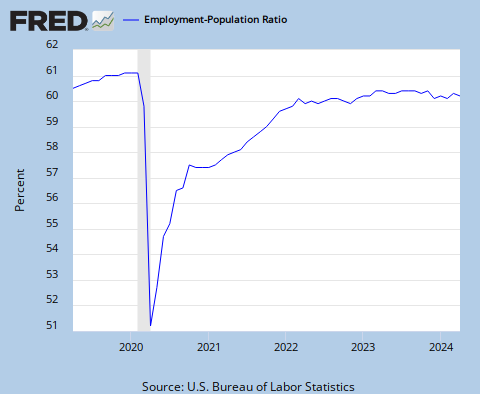
Also, [Bernanke's] assertions that the job market is "gradually improving" are suspect. Yes, the official unemployment rate has fallen. But this is the result less of job creation than of a fall in the labor force participation rate; the employment-population ratio has been flat:

DESCRIPTION

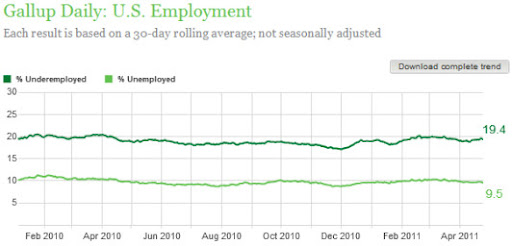
And I like to look at the Gallup polling data as a possible check on the BLS data; no sign there that things have improved:

DESCRIPTION

The Fed Has Intentionally Discouraged Banks From Lending

It’s true – as I pointed out in 2009 – that the Fed has purposefully been encouraging banks to deposit their excess reserves at the Fed (for a profit), rather than loan them out to Main Street:

The Federal Reserve is mandated by law to maximize employment. The relevant statute states:

The Board of Governors of the Federal Reserve System and the Federal Open Market Committee shall maintain long run growth of the monetary and credit aggregates commensurate with the economy’s long run potential to increase production, so as to promote effectively the goals of maximum employment, stable prices, and moderate long-term interest rates.

However, PhD economist Dean Baker says:

The country now has almost 25 million people who are unemployed or underemployed as a result of the Fed’s disastrous policies. Millions of people are losing their homes and tens of millions are losing their life savings. The country is likely to lose more than $6 trillion in output ($20,000 per person) due to the Fed’s inept job performance.

The Fed could have stemmed the unemployment crisis by demanding that banks lend more as a condition to the various government assistance programs, but Mr. Bernanke failed to do so.

Ryan Grim argues that the Fed might have broken the law by letting unemployment rise in order to keep inflation low:

The Fed is mandated by law to maximize employment, but focuses on inflation — and “expected inflation” — at the expense of job creation. At its most recent meeting, board members bluntly stated that they feared banks might increase lending, which they worried could lead to inflation.

Board members expressed concern “that banks might seek to reduce appreciably their excess reserves as the economy improves by purchasing securities or by easing credit standards and expanding their lending substantially. Such a development, if not offset by Federal Reserve actions, could give additional impetus to spending and, potentially, to actual and expected inflation.” That summary was spotted by Naked Capitalism and is included in a summary of the minutes of the most recent meeting…

Suffering high unemployment in order to keep inflation low cuts against the Fed’s legal mandate. Or, to put it more bluntly, it may be illegal.

In fact, the unemployment situation is getting worse, and many leading economists say that – under Mr. Bernanke’s leadership – America is suffering a permanent destruction of jobs.For example, JPMorgan Chase's Chief Economist Bruce Kasman told Bloomberg:

[We've had a] permanent destruction of hundreds of thousands of jobs in industries from housing to finance.

The chief economists for Wells Fargo Securities, John Silvia, says:

Companies "really have diminished their willingness to hire labor for any production level," Silvia said. "It's really a strategic change," where companies will be keeping fewer employees for any particular level of sales, in good times and bad, he said.

And former Merrill Lynch chief economist David Rosenberg writes:

The number of people not on temporary layoff surged 220,000 in August and the level continues to reach new highs, now at 8.1 million. This accounts for 53.9% of the unemployed — again a record high — and this is a proxy for permanent job loss, in other words, these jobs are not coming back. Against that backdrop, the number of people who have been looking for a job for at least six months with no success rose a further half-percent in August, to stand at 5 million — the long-term unemployed now represent a record 33% of the total pool of joblessness.

And see this.

Given that the law mandates that the Fed maximize employment, but that unemployment is instead becoming catastrophic under Mr. Bernanke’s watch, how can Mr. Bernanke justify his actions to date?

I explained last year:

Ben Bernanke has said that the Fed is trying to promote inflation, increase lending, reduce unemployment, and stimulate the economy.

However, the Fed has … been working against all of these goals.

As I reported in March, the Fed has been paying the big banks high enough interest on the funds which they deposit at the Fed to discourage banks from making loans. Indeed, the Fed has explicitly stated that – in order to prevent inflation – it wants to ensure that the banks don’t loan out money into the economy, but instead deposit it at the Fed …

Would More Stimulus Help?

But I disagree when Krugman writes today:

Whatever your take, a robust job recovery this is not. All in all, this is an economy crying out for more stimulus, wherever you can get it.

We don’t need more stimulus … at least not the kind we’ve had to date, which has only stimulated bonuses for the big banksters and big defense contractors.

As I wrote last year:

“Deficit doves” – i.e. Keynesians like Paul Krugman – say that unless we spend much more on stimulus, we’ll slide into a depression. And yet the government isn’t spending money on the types of stimulus that will have the most bang for the buck … let alone rebuilding America’s manufacturing base. See this, this and this. [Indeed, as Steve Keen demonstrated last year, it is the American citizen who needs stimulus, not the big banks.]

***

Today, however, Bernanke … and the rest of the boys haven’t fixed any of the major structural defects in the economy. So even if Keynesianism were the answer, it cannot work without the implementation of structural reforms to the financial system.
A little extra water in the plumbing can’t fix pipes that have been corroded and are thoroughly rotten. The government hasn’t even tried to replace the leaking sections of pipe in our economy.

In truth and in fact, the government’s policies are not only not working to stem the rising tide of unemployment, they are making it worse.

Forget the whole “Keynesian” versus “deficit hawk” debate. The real debate is between good and bad policy.

I noted in 2009 (footnotes in original):

The government has committed to give trillions to the financial industry. President Obama’s stimulus bill was $787 billion, which is less than a tenth of the money pledged to the banks and the financial system.

Of the $787 billion, little more than perhaps 10% has been spent as of this writing.

The Government Accountability Office says that the $787 billion stimulus package is not being used for stimulus. Instead, the states are in such dire financial straights that the stimulus money is instead being used to “cushion” state budgets, prevent teacher layoffs, make more Medicaid payments and head off other fiscal problems. So even the money which is actually earmarked to help the states stimulate their economies is not being used for that purpose.

Indeed, much of the $787 billion was earmarked pork, not for anything which could actually stimulate the economy.

Mark Zandi – chief economist for Moody’s – has calculated which stimulus programs give the most bang for the buck in terms of the economy:

But very little of the stimulus funds are actually going to high-value stimulus projects.

Indeed, as the Los Angeles Times points out:

Critics say the [stimulus money reaching California] is being used for projects that would have been built anyway, instead of on ways to change how Californians live. Case in point: Army latrines, not high-speed rail.

***
Critics say those aren’t the types of projects with lasting effects on the economy.

“Whether it’s talking about building a new [military] hospital or bachelor’s quarters, there isn’t that return on investment that you’d find on something that increases efficiency like a road or transit project,” said Ellis of Taxpayers for Common Sense.

Job creation is another question. A recent survey by the Associated General Contractors of America found that slightly more than one-third of the companies awarded stimulus projects planned to hire new employees. But about one-third of the companies that weren’t awarded stimulus projects also planned to hire new employees.

“While the construction portion of the stimulus is having an impact, it is far from delivering its full promise and potential,” said Stephen E. Sandherr, chief executive of the contractors group.

It’s unclear how many jobs will be created through the Defense Department projects. Most of the construction jobs are awarded through multiple award contracts, in which the department guarantees a minimum amount of business to certain contractors, and lets only those contractors bid on projects.

That means many of the contractors working on stimulus projects already have been busy at work on government projects.even the stimulus money which is being spent

David Rosenberg writes:

Our advice to the Obama team would be to create and nurture a fiscal backdrop that tackles this jobs crisis with some permanent solutions rather than recurring populist short-term fiscal goodies that are only inducing households to add to their burdensome debt loads with no long-term multiplier impacts. The problem is not that we have an insufficient number of vehicles on the road or homes on the market; the problem is that we have insufficient labour demand.

Donald W. Riegle Jr. – former chair of the Senate Banking Committee from 1989 to 1994 – wrote (along with the former CEO of AT&T Broadband and the international president of the United Steelworkers union):

It’s almost as if the administration is opting for a rose-colored-glasses PR strategy rather than taking a hard-nose look at actual consumer and employment figures and their trends, and modifying its economic policies accordingly.

As I noted in 2008:

This is not a question of big government versus small government, or republican versus democrat. It is not even a question of Keynes versus Friedman (two influential, competing economic thinkers).

It is a question of focusing any government funding which is made to the majority of poker players – instead of the titans of finance – so that the game can continue. If the hundreds of billions or trillions spent on bailouts had instead been given to ease the burden of consumers, we would have already recovered from the financial crisis.

In reality, the entire debate regarding more-versus-less stimulus misses the mark. As painful as it is to think about, the Fed’s policies – like those of the Treasury, White House and Congress – have been geared towards redistributing wealth upwards. See this, this, this, this, this and this.

Succinct Summation of Week’s Events (4.29.11)

Posted: 29 Apr 2011 12:30 PM PDT

Succinct summation of week’s events:

Positives:

1) Bernanke in his press conference implicitly says, “party on wayne, party on garth” as the end of QE2 in no way means tightening soon to follow
2) UoM and Conference Board confidence #’s up a touch in April
3) New Home Sales a punk 300k but higher than expected
4) Pending Home Sales rise 5.1%
5) Milwaukee joins NY mfr’g survey as exceeding forecasts
6) China HSBC pmi holds steady

Negatives:

1) Bernanke implicitly says asset price speculation with an eroding currency is the path to prosperity while it destroys the living standard of the lower and middle class that isn’t speculating in markets
2) Chicago, Dallas and Richmond mfr’g surveys below estimates
3) Initial Claims disappoint for 3rd week, 4 week avg back above 400k
4) Durable goods orders ex transports bit below est (but prior month revised up)
5) MBA said purchases fell 13.6% to 2 month low
6) Inflation expectations in confidence data remain elevated
7) Gasoline prices up another .05 to within .20 of record high
8) Euro zone CPI up to 2.8% 9) PIG yields continue to spike

Distressed RE: Residential, Commercial Have Yet to Hit Bottom

Posted: 29 Apr 2011 11:33 AM PDT

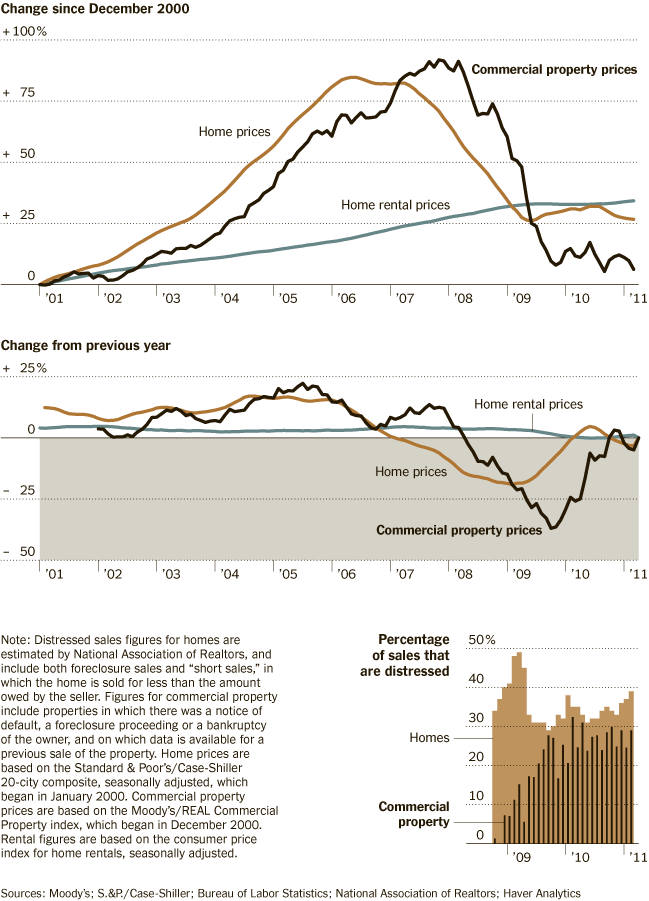
Floyd Norris Saturday NYT column is out now: After Mild Gains, Another Reversal for Real Estate;

I am sucker for the charts:

>
click for larger graphic

Female Outperformers in the World of Hedge Funds

Posted: 29 Apr 2011 11:03 AM PDT

Hedge funds managed by women outperformed those managed by men over the past nine years.

autostart video after the jump

via Bloomberg

(Hat tip kottke)

EUROPEAN FINANCIAL STABILITY AND INTEGRATION REPORT 2010

Posted: 29 Apr 2011 10:28 AM PDT

Here are the Dow Jones headlines:

15:52 29Apr11 DJN-DJ EU PAPER: LARGE PARTS OF BANK RESTRUCTURINGS YET TO COME
15:54 29Apr11 DJN-DJ EU: “DISTINCT VULNERABILITIES REMAIN” IN EU BANK SECTOR
15:55 29Apr11 DJN-DJ EU: ROLL-OVER RISK STILL PRESENT IN SOVEREIGN DEBT MARKETS
16:05 29Apr11 DJN-DJ EU: EXIT FROM GOVERNMENT BANK BAILOUTS MAY SPUR M&A WAVE
16:13 29Apr11 DJN-DJ EU: THREAT OF PRIVATE CREDITOR LIABILITY “BADLY RECEIVED”

The full report is below:

EUROPEAN FINANCIAL STABILITY AND INTEGRATION REPORT 2010

Are Long-Term Earnings Projections Getting Worse?

Posted: 29 Apr 2011 10:00 AM PDT

Yesterday we noted:

Now that companies have to disclose to all at the same time, we believe their investor relations departments are masters at guiding analysts just below actual earnings. This way the companies "beat" expectations and get the positive press and accolades that come with it. Further, it seems that everyone is happy with this apparent gaming of the system.

And:

In recent quarters, however, revenues are showing an upside bias. Is this because companies are genuinely reporting good numbers or are the investor relations departments now gaming these numbers as well? It's hard to tell. But we can say in our unscientific review of earnings releases that companies are highlighting revenue beats more now than ever. This is a red flag that these numbers are also being gamed.

If expectations are being gamed on quarterly earnings, what about long-term earnings? Are they a better measure of economic health?

After 25 Years, Are We Getting Better?

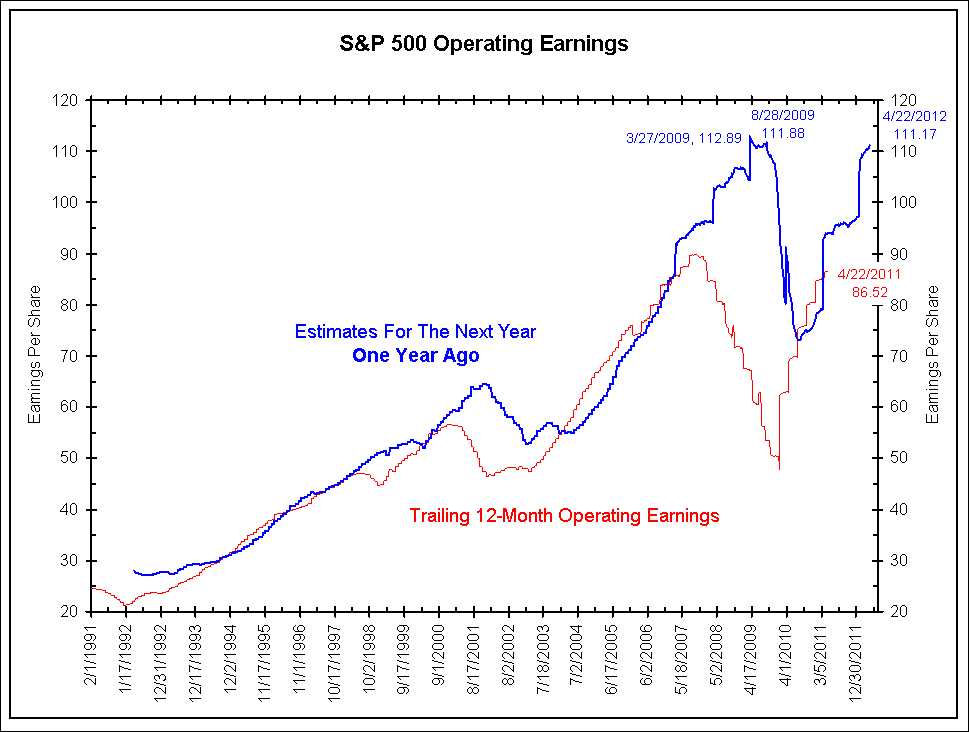
In the chart below, the red line shows actual 12-month operating earnings for the S&P 500. The blue line shows the 12-month forward estimate lagged on year. In other words, the red line shows earnings over the previous 12 months and the blue line shows what analysts expected these earnings to look like. The blue bars in the second chart show the difference between these two measures. The source for this data is S&P and Bloomberg and it is calculated on a "bottom up" basis (more on this below).

Note the variance in earnings versus expectations above. The Great Recession caused a massive divergence between expectations and actual earnings. Historically it seems as though the variability between these measures is growing. Whenever analysts miss, their error rate seems to be larger than it was the last time they missed.

Top Down Versus Bottom Up

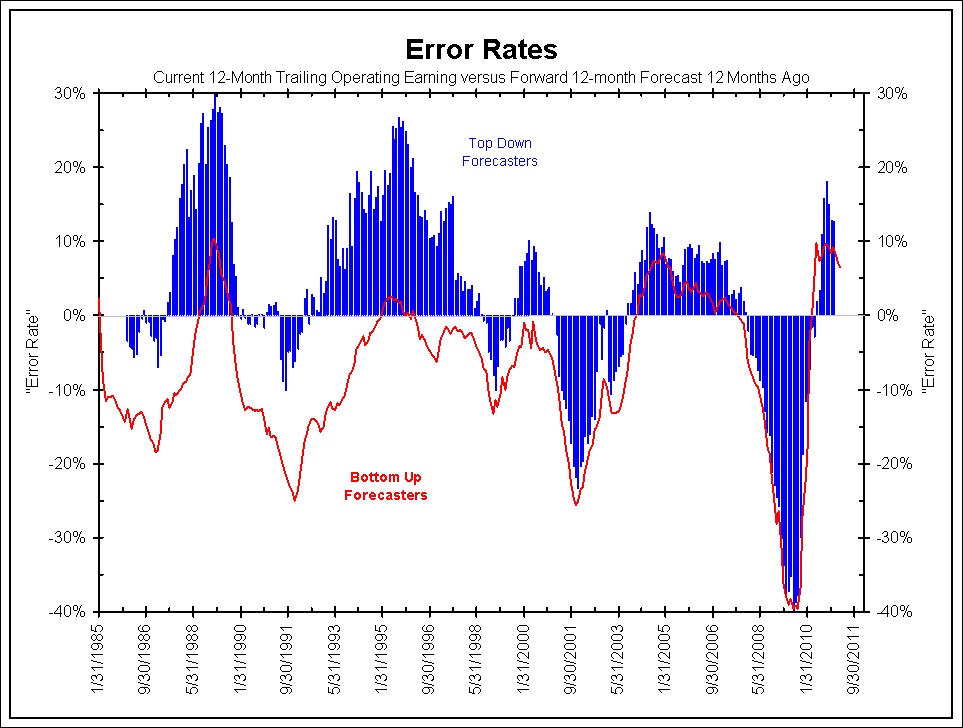
The next chart comes from IBES data. The two measures show the same error rates as explained above. The red line shows the error rate for bottom up forecasters. This is the sum of the earnings estimates for the 500 companies of the S&P 500. The blue bars show the error rate for top down forecasters, or strategists.

From 1985 to 2000 the error rates of top down and bottom up estimates varied greatly. Much of that period the top down forecasters were offering earnings guesses that were below the actual results (resulting in a positive divergence). The bottom up forecasters were often too optimistic and their guesses were above actual results (resulting in a negative divergence).

Since 2000, however, the top down and bottom up forecasts have been in synch with each other. And since 2000, the error rates are the largest we have seen in the last quarter century.

Conclusion

Earlier this month we suggested that U.S. Equities Remain Undervalued. This is completely correct if one can trust earnings estimates. The charts above suggest the estimates "work until they do not." Restated, earnings estimates often miss when the economy goes into recession. Investing off estimates will usually result in profitability as the economy expands and losses when a recession hits.

Ten Presentation Tips for Movie Lovers

Posted: 29 Apr 2011 09:00 AM PDT

Austan Goolsbee Interview About U.S. Economy

Posted: 29 Apr 2011 09:00 AM PDT

Austan Goolsbee, chairman of the White House Council of Economic Advisers, talks about today’s report showing the U.S. economy slowed more than forecast in the first quarter. Gross domestic product rose at a 1.8 percent annual rate from January through March after a 3.1 percent pace in the final three months of 2010, the Commerce Department said in Washington. Economists projected 2 percent growth, according to the median estimate in a Bloomberg News survey. Goolsbee speaks with Hans Nichols on Bloomberg Television’s “Bottom Line.”

autostart video after the jump

April 28 (Bloomberg)

Economic Data Update

Posted: 29 Apr 2011 08:45 AM PDT

Chicago PMI moderates from still high levels

Following a better than expected April NY mfr’g survey and weaker than forecasted Philly, Richmond and Dallas mfr’g indices, the Chicago PMI at 67.6 was a touch below estimates of 68.2, down from 70.6 in Mar and the lowest since Dec but still is at a high level. New Orders led the decline as it fell from 74.5 to 66.3 and Backlogs were down 7.2 pts to 62.4. Employment fell almost 2 pts to 63.7 and Prices Paid moderated slightly to 81.8 from 83.4. Inventories fell 7 pts to 53.5. Bottom line, mfr’g in April seems to have moderated somewhat but from very healthy levels as likely the persistent cost pressures and uncertainty related to the Japanese disaster were the catalysts. The ISM out on Monday will reconcile all the regional surveys.

~~~

Confidence/inflation expectations/what’s next

Final April UoM confidence was about in line with expectations at 69.8, up from 69.6 in the preliminary reading and vs 67.5 in March but is still down from 77.5 in Feb. The gain from March was solely led by the Outlook component which rose a slight.4 pts while Current Conditions were unchanged. Importantly, one year inflation expectations remained very elevated at 4.6%, unchanged with both the preliminary report and with March but compares with the 20 year average of 2.9%. In terms of a rise in consumer prices and its impact on confidence and spending, a multitude of companies have said they will raise prices over the next few months and with respect to the argument over it being transitory or not will be put to the test to see what price hikes stick and which don’t because of consumer pushback. Either way, the cost pressures will be felt by someone.

.

0 comments:

Post a Comment

previous home Next

{8} chatroll


{9} AdBrite FOOTER

{8} Nice Blogs (Adgetize)