


The Big Picture |

- Michael Burry: “Inside the Doomsday Machine”
- Are Oil Prices Driven by Speculators?
- Beige Book as expected/price pressures; 10 Year Auction
- Sheinkopf: Deficits Matter, But Won’t Hurt Obama in ’12
- Musicians@Google: WNYC’s Radiolab + Zoë Keating
- Superboom Chapter
- The Cost of College
- What is REALLY Rising/Falling in Price: Items +/- 5.0
- Hoenig: The New GSEs Are Citi, Bank of America
- Interest On The Debt
| Michael Burry: “Inside the Doomsday Machine” Posted: 14 Apr 2011 01:30 AM PDT Michael Burry: "Inside the Doomsday Machine with the Outsider who Predicted and Profited from America's Financial Armageddon" src="http://www.vanderbilt.edu/asset/video/flash/vuplayer.swf" name="vandyplayer" |
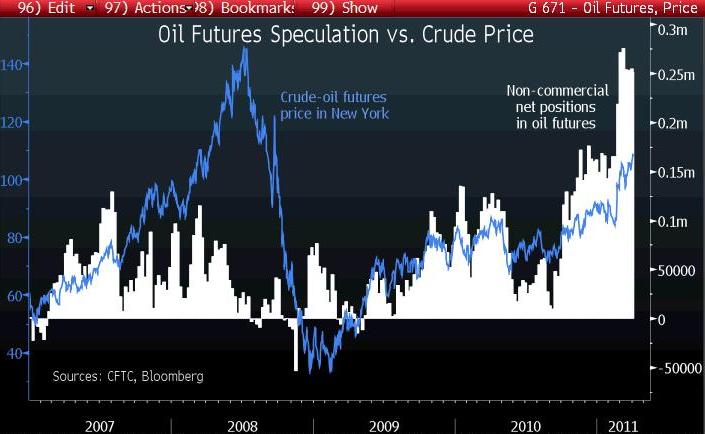
| Are Oil Prices Driven by Speculators? Posted: 13 Apr 2011 01:30 PM PDT
> Fascinating chart above via David Wilson of Bloomberg. It very much suggests that while Speculators may not have been the prime mover on the 2008 Oil peak, the specs seem to be a very large portion of the current push. By comparing the net number of contracts owned by non-commercial oil traders (Source: Commodity Futures Trading Commission). Crude 5.8% the first two days of this week, suggested that speculative demand for oil may be declining. |
| Beige Book as expected/price pressures; 10 Year Auction Posted: 13 Apr 2011 01:13 PM PDT The Fed’s Beige Book said the economy “generally continued to improve.” “While many Districts described the improvements as only moderate, most Districts stated that gains were widespread across sectors…Manufacturing continued to lead…often with reports of increased hiring…Most Districts experienced at least slight gains in consumer spending (NY cited robust sales)… Business services improved in most Districts…Loan demand was either unchanged or up slightly in most Districts.” CRE was mixed and half the districts noted “pockets of weakening” in residential real estate markets. A few districts “noted actual or expected disruptions to sales and production as a result of the tragedy in Japan.” “Most Districts reported signs of improvement in at least some of their labor markets…Wage pressures were described by most Districts as weak or subdued, but higher commodity costs were widely reported to be putting increasing pressure on prices. Energy prices were cited most often, but raw materials in general were an increasing concern of businesses. The ability to pass thru cost increases varied, with mfr’s generally finding less resistance to price increases than either retail or construction.” The 10 yr note auction was somewhat weak as the yield of 3.494% was a touch above the when issued of 3.48-3.49%. The bid to cover at 3.13 was slightly below the 12 month average of 3.15 and the lowest since Dec. Treasuries are now in a game of multiple tugs of war. With the backdrop of T minus 2 1/2 months to the end of the Fed’s latest asset purchase program, Treasuries are torn by building inflation trends on one hand and the economically contractionary nature of the rise on the other. Inflation expectations in the 10 yr TIPS are just off a 5 year high at 2.64%. Bottom line, treasuries have come off their highs in response. |
| Sheinkopf: Deficits Matter, But Won’t Hurt Obama in ’12 Posted: 13 Apr 2011 01:06 PM PDT ~~~ Source: |
| Musicians@Google: WNYC’s Radiolab + Zoë Keating Posted: 13 Apr 2011 12:53 PM PDT Jad Abumrad and Robert Krulwich, hosts of WNYC’s ‘Radiolab’, join avant-cellist Zoë Keating for a discussion on the creative process. For more information about WNYC’s Radiolab, please visit http://radiolab.org For more information about Zoë Keating, please visit http://zoekeating.com/ This event took place on March 25, 2011 at The Googleplex in Mountain View, CA. Hat tip Paul |
| Posted: 13 Apr 2011 12:12 PM PDT |
| Posted: 13 Apr 2011 11:30 AM PDT From Zen College Life comes this bigass infoporn on the costs associated with getting a college degree. > click for larger graphic |
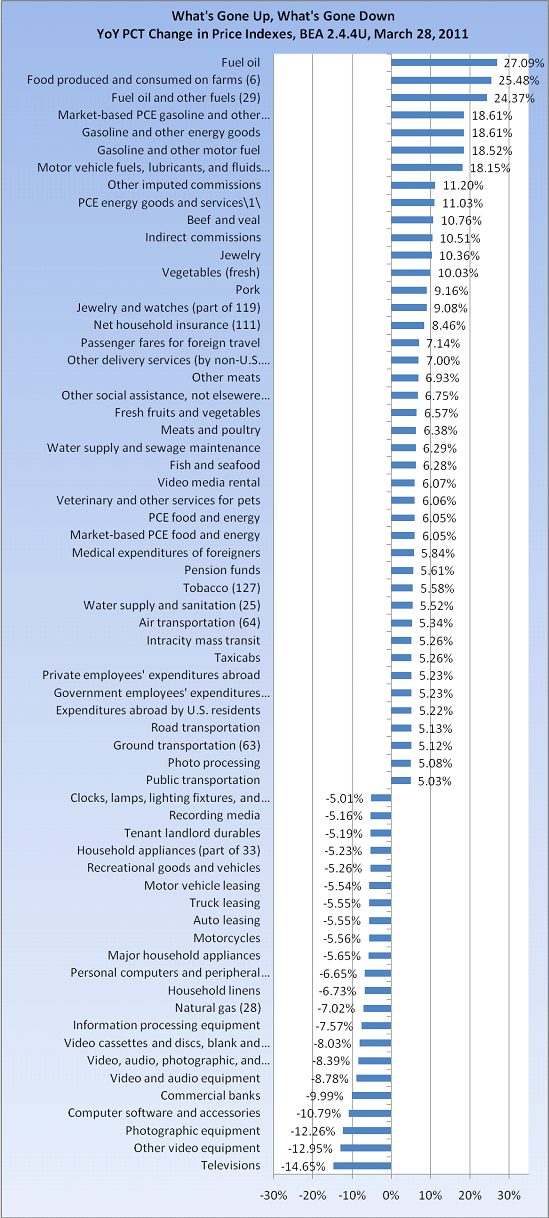
| What is REALLY Rising/Falling in Price: Items +/- 5.0 Posted: 13 Apr 2011 09:00 AM PDT The link to John Melloy’s post in our early reads caused a bit of a stir. Sure John Williams is a bit controversial, but he has been hammering on the “Official Data Understates Inflation” for decades now. Sometimes, it helps to shift your perspective ever so slightly to get a better view on things. The chart below, which only looks at price rises greater than +/- 5%, will do that. (Mad props to Invictus for the chart work) It is clearly the high-frequency items – primarily food and fuel – are creating most of the angst (Household insurance at 8.5% is one of my peeves). But we typically don't buy motorcycles, major household appliances, computers, or televisions on a weekly or monthly basis, and they have been deflating hard. (See Hackonomics take down of Hedonics as to why) > YoY Changes in Price Index Categories (+/- 5%)
> Note: We get fresh numbers Friday, so this is an early glimpse of where we are . . . |
| Hoenig: The New GSEs Are Citi, Bank of America Posted: 13 Apr 2011 07:38 AM PDT
> At yesterday’s National Association of Attorneys General meeting, the speaker who followed me was Kansas City Federal Reserve President Thomas Hoenig. He made one of the most cogent, persuasive arguments against “Too Big to Fail” I’ve heard from any public official outside of Volcker. Highlights of Hoenig’s commments:
Fascinating stuff, and a thrill to see a high placed Fed official who so totally is willing to stand up to take on the risk of the giant banks in a productive and intelligent way. > |
| Posted: 13 Apr 2011 07:29 AM PDT |

| You are subscribed to email updates from The Big Picture To stop receiving these emails, you may unsubscribe now. | Email delivery powered by Google |
| Google Inc., 20 West Kinzie, Chicago IL USA 60610 | |
 The Big Picture (ritholtz)


0 comments:
Post a Comment