


The Big Picture |

- Monetary Base, Dollar Swings
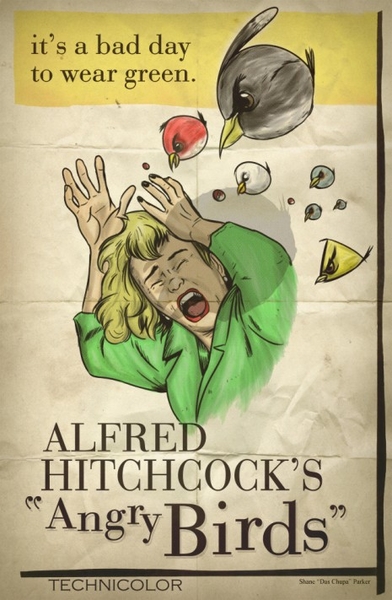
- Hitchcock’s Angry Birds
- Just Say No to Non-Embeddable Video
- Hyundai and Kia Prove Korea is the “New Japan” of Automaking
- The Dollar: Five Factors for Investors
- FDIC & Fed: more questions than answers
- On being wrong: Kathryn Schulz
- Stockman Tells the Hard Truth on Taxes & Spending
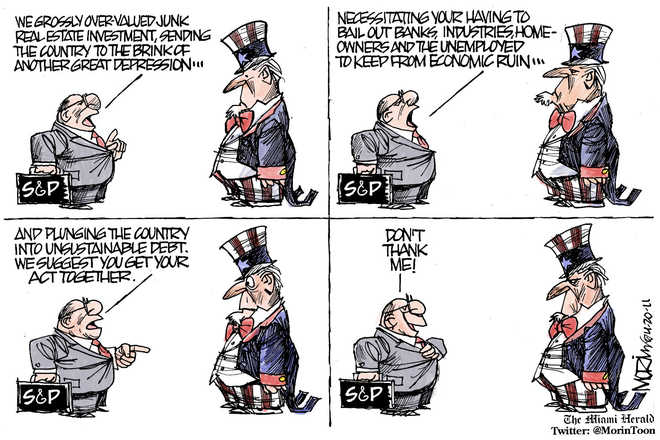
- S&P: You’re Welcome!
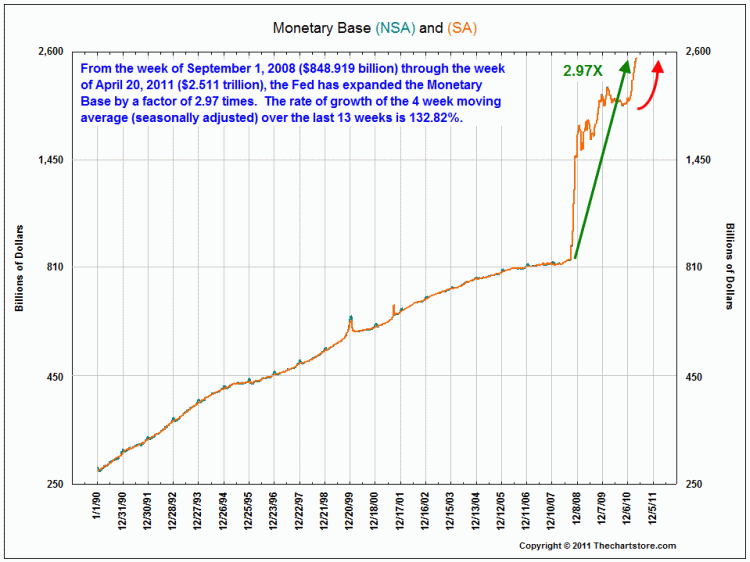
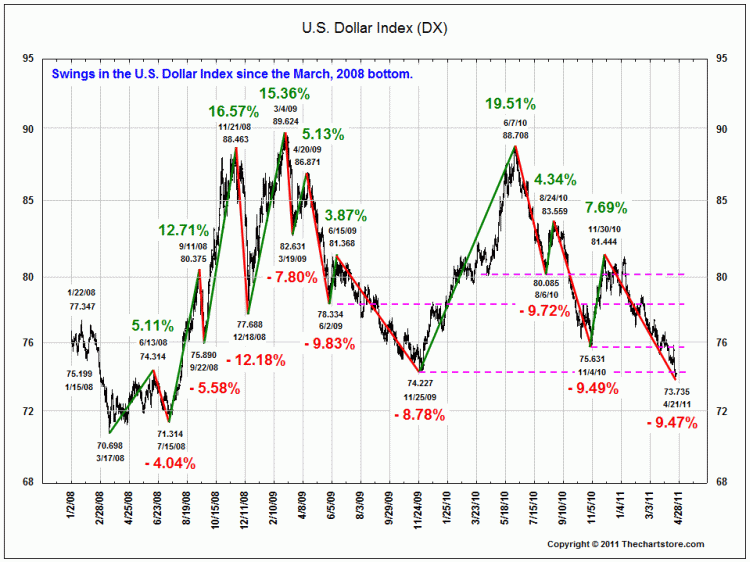
| Posted: 24 Apr 2011 04:30 PM PDT I found these two charts rather fascinating: The first shows the overall increase in the Monetary base since 1990. It was expanding for 18 years at a pretty good clip — then it exploded with the financial collapse in 2008. The 2nd chart shows swings in the dollar index since then. All charts courtesy of The Chart Store >
|
| Posted: 24 Apr 2011 03:01 PM PDT |
| Just Say No to Non-Embeddable Video Posted: 24 Apr 2011 01:00 PM PDT Attention Media flacks: If you are going to send me a PR Spam about this great new video thats posted, but your company makes it unembeddable, you are wasting everyone’s time. I certainly do not speak for every blogger, but I would hazard to say many if not most feel the same way. (The hint was the lack of links to your non-embedded videos) If I cannot embed it on the site, I am not going to mention it. That is all . . . |
| Hyundai and Kia Prove Korea is the “New Japan” of Automaking Posted: 24 Apr 2011 09:23 AM PDT ~~~ Source: |
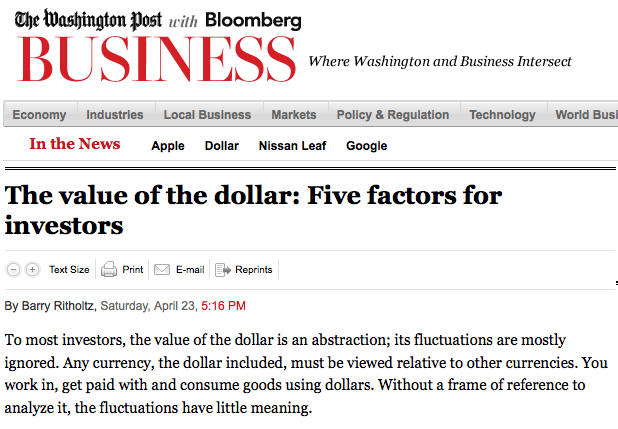
| The Dollar: Five Factors for Investors Posted: 24 Apr 2011 09:00 AM PDT My Sunday WaPo column this week is a melange of 5 factors about the dollar that all investors should know about. Its a little random, written for main street investors . . . > > Source: |
| FDIC & Fed: more questions than answers Posted: 24 Apr 2011 08:04 AM PDT FDIC & Fed: more questions than answers
> We thank readers for their kind words about Scylla and Charybdis (www.cumber.com). We also thank friends Dennis Gartman, John Mauldin and Barry Ritholtz for sharing the piece with their readers. There have been many questions and comments forwarded to us. They were specific to our articulated views about the FDIC and the Fed. Some answers are below. Q. How do you estimate that the FDIC action is going to neutralize all of QE2? A. When QE2 was announced, there were a number of estimates of impact. Ours and others centered on about 2 to 3 basis points for each $100 billion. QE2 is about $600 billion in size. At 2.5 basis points per each $100 bn, the total value of QE2 is about 15 basis points reduction in interest rates, contrasted with where the rates might otherwise be. The new FDIC fee action on April 1 creates a "wedge" by imposing a cost on the entire banking system. We estimate (as does Barclays) that the wedge is about 15 basis points. Thus, FDIC fees will offset QE2 in full. Q. Will Bernanke address this in his press conference? A. We do not know, but we hope that a reporter will ask him about it. Q. Why did the FDIC do this? A. They had no choice. This is one of the consequences of the Dodd-Frank legislation. Q. Didn't the Fed see this coming? Did they know about it when they announced and developed the QE2 policy? A. We do not know if the Fed saw it coming, but we do know that the Fed was silent on this issue. In the comments on the proposed Dodd-Frank legislation, there is not a single word about the impact of the FDIC fee. It is hard to imagine, but it is true. We surmise that the comment period was directed to the Fed's legal staff and that the impact of this issue was not thought about by the monetary economists. Furthermore, the monetary policy folks tend to think in macro terms, so this may have escaped their radar screen. Alternatively, they may have considered it and then dismissed it. There is no way to know. Perhaps Bernanke will clarify this, or some of the other members of the FOMC may do so in their speeches and comments. Q. Doesn't this hurt the smaller banks? A. Absolutely. The regs are extensive and complex. From what we can see upon reading them, there is a bias toward a smaller fee rate based upon size. The range of fees is 2.5 basis points low to 45 basis points high. We are correcting a technical error in our original piece, in which we quoted the lowest fee at ten. There are numerous adjustments needed in order to get to the final fee base for each particular bank. Clearly, banks paying a large fee rate are competitively disadvantaged. Q. Is the banking community reacting? A. Yes. There are reorganizations taking place in larger banks in order to achieve a lower fee rate. Smaller banks are adjusting their business models where they are able to do it. Q. Does this affect Munis? A. We think the answer is yes. Many small Muni issuers are sole-sourced in banks for their capital. They issue bonds under the small-issuer, bank-qualified exemption. They deposit in the local bank and the local bank buys their notes and bonds. This FDIC fee does not exempt them. Thus, the cost of finance for the smaller Muni issuers has been increased by the fee rate assessed by the FDIC on the particular bank. The result is to raise the cost of finance for smaller Muni issuers at the very time they are retrenching in their budgets. Q. What happens next? A. It takes Congress to change the law. The unintended consequences are now starting to be revealed. The Muni case is an example. The impact on Fed policy is another. There will be many more. We expect a massive debate on how much damage Dodd-Frank is actually doing and how poorly it was conceived. This is typical of a Congress that rushes to pass a major piece of legislation without full vetting and comments. As the public learns more, they will protest to their representatives and the finger pointing will begin in Washington. With enough furor, the law will be amended. ~~~ David R. Kotok, Chairman and Chief Investment Officer |
| On being wrong: Kathryn Schulz Posted: 24 Apr 2011 07:00 AM PDT Most of us will do anything to avoid being wrong. But what if we're wrong about that? "Wrongologist" Kathryn Schulz makes a compelling case for not just admitting but embracing our fallibility.(Recorded at TED2011, March 2011, in Long Beach, CA. Duration: 17:57) Kathryn Schulz is a journalist, author, and public speaker with a credible (if not necessarily enviable) claim to being the world’s leading wrongologist. Her freelance writing has appeared in the New York Times Magazine, Rolling Stone, TIME Magazine, the Boston Globe, the “Freakonomics” blog of The New York Times, The Nation, Foreign Policy, and the New York Times Book Review, among other publications. She is the former editor of the online environmental magazine Grist, and a former reporter and editor for The Santiago Times, of Santiago, Chile, where she covered environmental, labor, and human rights issues. She was a 2004 recipient of the Pew Fellowship in International Journalism (now the International Reporting Project), and has reported from throughout Central and South America, Japan, and, most recently, the Middle East. A graduate of Brown University and a former Ohioan, Oregonian and Brooklynite, she currently lives in New York’s Hudson Valley. |
| Stockman Tells the Hard Truth on Taxes & Spending Posted: 24 Apr 2011 06:00 AM PDT David Stockman, who was Ronald Reagan’s director of the Office of Management and Budget (1981 to 1985), calls out both parties for being full of crap when it comes to the deficit in a NYT OpEd. It is today’s MSM must read. As we discussed last week with Dylan, if we were serious about deficit reduction, we would be cutting spending EVERYWHERE and RAISING TAXES on not only the top 2%, but the upper and middle classes as well. (Shared sacrifice and all that). The question is when, and I agree with the anti-Austerians it should be 2-3 years out if we want to avoid another 1938 like post-depression recession. Here’s Stockman:
How did we find ourselves in this mess? Stockman observes:
Note that this is part of two specific related issues: An supportable spending/taxing regime, and a massive shift in wealth in the nation. Our tax base insufficient for our spending, and our spending is excessive for a tax base. Add to that the concern that upper income earners have benefited at the expense of everyone else:
Stockman, like Bruce Barlett and even David Frum are yet more Republicans who are pointing out the current GOP leaders are no more serious about budget reform than the Democrats are. The main difference is the GOP has better slogans and marketing, and slides into full blow demagoguery more easily. But in terms of actual strategies for intelligently addressing the issue? The most glaring truth is the lack of leadership on both sides of the aisle. > Source: |
| Posted: 24 Apr 2011 03:25 AM PDT |
| You are subscribed to email updates from The Big Picture To stop receiving these emails, you may unsubscribe now. | Email delivery powered by Google |
| Google Inc., 20 West Kinzie, Chicago IL USA 60610 | |
 The Big Picture (ritholtz)


0 comments:
Post a Comment