


The Big Picture |

- Anne Hathaway’s Lil’ Wayne Paparazzi Rap
- HP: Grow Up, Already
- Succinct summation of week’s events (08/19/11)
- Incredible Science Discoveries
- Tempers Flare on CNBC as Market Dives
- Some Hedge Funds Are KILLING It This Quarter
- How to Run the A/C Full Blast Without Paying For It
- Mortgage Rates Hit 50-Year Low
- The Poor Are Soaking America
- Post Market Whackage Morning Reads
| Anne Hathaway’s Lil’ Wayne Paparazzi Rap Posted: 19 Aug 2011 06:11 PM PDT Hilarious: |
| Posted: 19 Aug 2011 04:51 PM PDT
HP will buy Autonomy, a UK software company, for $10 billion. I understand $10 billion doesn't sound like a lot of money in today's post-trillion-dollar-bailout world, but it is plenty for HP, especially considering what that money bought. There are many ways to illustrate how expensive and meaningless to HP's future this acquisition is: $10 billion is about a fifth of HP's market capitalization, while Autonomous will contribute 0.7% to HP's revenues, and 2.7% to its earnings; and HP paid 10x revenues and about 25 times earnings. Leo Apotheker, HP's CEO, bragged about Autonomy: "Autonomy has grown its revenues at a compound annual growth rate of approximately 55% and adjusted operating profit at a rate of approximately 83% over the last 5 years." Keith Backman, a sell-side analyst from BMO Capital, asked a very pertinent question about Autonomy: "… metrics that you threw out for Autonomy, particularly on top-line growth, included a lot of acquisitions for Autonomy. What's the organic growth rate that Autonomy has achieved lately?" Leo did not have an answer, whereupon HP's stock started to drop. HP had reported an OK quarter, expectations were already low (its stock was at about 6x times 2011 estimates, which remain intact), and Dell had already lowered guidance a day before; so no one was surprised when HP lowered its revenue guidance for 2011 by a few percentage points. Management said that since it will pay for Autonomy from cash on the balance sheet, it will not be buying much of its stock in the near future, and then they mentioned that this acquisition will be accretive. Yes, accretive! Nothing to worry about. This transaction is accretive only for illiterates in economics and those short on common sense. HP is using cash on the balance sheet to pay for this transaction, and thanks to the Federal Reserve this cash yields zero and thus brings zero income. As long as Autonomy's income is greater than zero (I am oversimplifying a little) then it will be accretive (at least on a cash basis). However, this assumes that HP's cost of capital is equal to the return it receives on its cash. Which is not the case, as that would ignore such minor details as the time value of money, inflation, the risk premium (after all, unlike the US government, HP cannot print money and doesn't have nuclear weapons) and, simply, opportunity cost. Any investment HP makes today should be compared against an opportunity set that includes its own stock, which at 6x times earnings results in about a 16% yield (cost of capital). In fact, if HP used $10 billion to buy its own stock, its earnings per share and dividend would jump by 16%. Autonomy will not be able to match this return, by a long mile. I don't need to have a great imagination to envision another conference call in August 2015, where a new CEO decides that the software business is too difficult, and HP needs to come back to its roots (maybe going back to making calculators) and will spin off the software business into a new company, take an enormous charge, and then maybe announce an acquisition that the same highly pedigreed board will rubber-stamp. HP's valuation has not changed that much – the PC business only represents about 16% of operating profit, so even if HP gives it away, earnings power will not decline greatly. HP should still be able to get a decent price for it, as there has got to be a Chinese company out there swimming in US dollars that wants to put them to work before they become worthless. HP's core businesses, will be slightly impacted by the global economic weakness, but the company should maintain its earnings power largely intact. Autonomy reduced HP's value by about $3; but with my lack of confidence in management, I'd not buy HP at a P/E higher than 10, which would bring the stock to the mid to high 40s. HP's stock sold off not because the company disappointed Wall Street but because Wall Street grew tired of the overpriced "must-have" acquisitions. Wall Street has smartened up and assumed that this acquisition, as with many other "transformative" acquisitions, will do nothing of the sort. And so, today we are faced with a decision: buy, hold, or sell. At 4.6 times earnings HP is not a sell; but considering that the company is still trying to figure out what it wants to be when it grows up, it is hard to add to our holdings of the stock; so unfortunately this company has turned into a hold. Vitaliy N. Katsenelson, CFA, is Chief Investment Officer at Investment Management Associates in Denver, Colo. He is the author of The Little Book of Sideways Markets (Wiley, December 2010). To receive Vitaliy's future articles by email, click here or read his articles here.
|
| Succinct summation of week’s events (08/19/11) Posted: 19 Aug 2011 12:00 PM PDT Succinct summation of week’s events: Positives:
Negatives:
|
| Incredible Science Discoveries Posted: 19 Aug 2011 10:00 AM PDT It has been an amazing month for science. MIT researchers have succeeded in printing solar panels onto any piece of paper. Dutch company PlantLab has figured out how to triple the yield of plants using only 10% of the water typically needed:
Scientists at MIT have designed a drug that can cure virtually any viral infection. Scientists at the University of Pennsylvannia have found a way of “turning the patients’ own blood cells into assassins that hunt and destroy their [leukemia] cancer cells.” Physicists at Niels Bohr Institute maintained quantum entanglement for an hour. Quantum entanglement means that two objects should be too far apart to effect one another but – due to quantum mechanics – change to one instantly induces changes the other. Quantum entanglement will one day allow much better computer cryptography, form the backbone of quantum computing, and may allow for interstellar communication systems between spacefaring humans traveling among the stars, make it possible to store information in black holes, or even allow information to instantly pass from past to future. And for the first time ever, scientists filmed (from a spacecraft) a coronal mass ejection from the sun washing over the Earth. Watch the video (40 megs, takes a while to download; the Earth is the blue ball on the left). Click here for more amazing science discoveries. |
| Tempers Flare on CNBC as Market Dives Posted: 19 Aug 2011 08:39 AM PDT |
| Some Hedge Funds Are KILLING It This Quarter Posted: 19 Aug 2011 08:30 AM PDT I’ve spoken to a variety of Hedge fund managers and traders this week who have been ridding this market up and down. Consider this one Connecticut hedge fund manager I speak with regularly: On the long side, he is heavy into gold mining and high quality multinations; On the short side, he’s been betting against large American and European Financials, Consumer Discretionary, Home Builders and Cyclical Semis. Over the past month, we have been discussing the Economy, the Fed, the Markets and specific sectors. As to his own holdings performance, he writes:
-July, the fund was up +10% -August (to date) is plus 23.7%; Quarter (to date) 33.3%. Prior to the July/August period, the fund was down high single/low double digits. |
| How to Run the A/C Full Blast Without Paying For It Posted: 19 Aug 2011 07:49 AM PDT |
| Mortgage Rates Hit 50-Year Low Posted: 19 Aug 2011 06:45 AM PDT This is pretty amazing: 30 Year mortgages are now 4.15%; 15 year mortgages are 3.51%. Here’s the Bucks blog:
Regardless of the economy, if you own a home and can refinance, you should consider it. In NY state, we have CEMA loans (CONSOLIDATION, EXTENSION & MODIFICATION AGREEMENT) which do not require new mortgage filing taxes, a hefty 0.8% of loan amount. Note this only applies if you refi with the original sender. |
| Posted: 19 Aug 2011 06:30 AM PDT Thank God someone is standing up against Warren Buffet and the legions of the poor that are looking to take over America |
| Post Market Whackage Morning Reads Posted: 19 Aug 2011 05:00 AM PDT Hey, I was out of the office all day yesterday — did I miss anything? Meanwhile, here is what will catch you up with what’s going on:
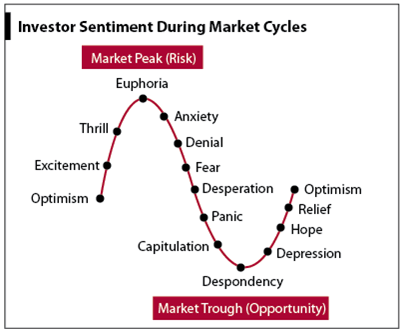
What are you reading? > Where are we in this cycle?
|


| You are subscribed to email updates from The Big Picture To stop receiving these emails, you may unsubscribe now. | Email delivery powered by Google |
| Google Inc., 20 West Kinzie, Chicago IL USA 60610 | |



0 comments:
Post a Comment