


The Big Picture |

- Gold Standard Comeback Enjoys Support
- Rebalancing the Housing Market
- Look Out Below, -5% European Version
- 10 Labor Day Afternoon Reads
- Precipitous Reduction in Bank Reserve Requirements
- Equity Scenarios: Returns Required to Regain Peak
- Labor Day, Leen’s Lodge, Employment Report
- WP: Special Report on “Breakaway Wealth”
- Kurt Vonnegut: Stories Have Shapes
- Germans who play with fire . . .
| Gold Standard Comeback Enjoys Support Posted: 06 Sep 2011 02:00 AM PDT Full article here |
| Rebalancing the Housing Market Posted: 05 Sep 2011 10:30 PM PDT Good afternoon. I’d like to join my colleagues in welcoming you to the Federal Reserve Board. This policy forum, “The Housing Market Going Forward: Lessons Learned from the Recent Crisis,” has been designed to connect lessons learned from the recent past with policy alternatives that may affect the market for years to come. Determining the key lessons and getting this connection right are important, and as you have already heard, perhaps not as easy as it might sound. I would like to offer some suggestions that I think could help. Before I begin, though, I should clarify that the ideas I will be discussing do not necessarily reflect the opinions of my colleagues on the Federal Reserve Board and that these suggestions should not be construed as policy of the Board or the Federal Open Market Committee. There are many interpretations of the key factors that led to the current state of affairs, and there are a similar number of visions of what the future should look like. But, while it is important to learn from and avoid the mistakes of the recent past, we should not forget what did work for many years in the housing and housing finance markets. So, in crafting appropriate policy responses, an important starting point is to carefully analyze what we’re solving for. Certainly we want a solution based on private capital, but the role of government in housing and mortgage markets will need to be defined before private markets will fully reengage. Any policy solution will have to be evaluated in the context of its effect on both owner-occupied and rental housing markets. And as the policy conversations progress, it will also be important to maintain a focus on the demand side of the market–which is to say, all of us, as consumers of housing. Finally, a national housing policy must also serve the needs of the segments of our society that have been historically underserved–low-income and low-wealth families, including disproportionate numbers of minorities and households headed by females. These longer-term questions are critical. But before we get to the longer-term solutions, we need to deal with the unprecedented number of loans in or still entering the foreclosure pipeline, the disposition of properties acquired through foreclosure, and the effect of a high percentage of distressed sales on home prices. Regardless of how we got here, we, as a nation, currently have a housing market that is so severely out of balance that it is hampering our economic recovery. To many, the story of the recent financial crisis and its aftereffects for the housing market is one mainly attributed to subprime lending. Although problems were concentrated initially in subprime mortgages, today about two-thirds of underwater mortgages and loans in foreclosure are actually prime or Federal Housing Administration (FHA) mortgages. This fact suggests that solutions aimed at righting the wrongs of previous reckless lending in the subprime market are not sufficient to tackle the scale of current problems. Clearly, the market is not functioning as it should. Despite near-record-low interest rates, credit conditions remain tight for many consumers and investors interested in buying or refinancing residential real estate. Moreover, the lack of sufficient numbers of buyers and sellers may limit price discovery, which heightens uncertainty about the “right” price for a given piece of real estate and further limits activity. In addition, the large number of foreclosures and a protracted foreclosure process have led to an unprecedented level of bank-owned homes, a level that is likely to persist for some time. So how do we move forward in these difficult circumstances? The economy normally has some self-correcting mechanisms. Typically, a drop in prices–whether the price of an apple or the price of a house–stimulates demand and brings new buyers into the market. In the case of houses, price declines often occur in the context of a broad-based weakness in the overall economy. In response to macroeconomic weakness, the Federal Reserve generally can lower the target federal funds rate, which would be expected to lower mortgage rates. The combination of lower prices and lower mortgage rates makes home purchase more affordable and helps revive the housing market. Indeed, most recent recoveries have been led by housing. But for a variety of reasons, these mechanisms are not working fully in today’s economy. When crafting solutions, it is helpful to first identify areas where removing some obstacles might enable these self-correcting mechanisms to operate more productively. Refinancing Existing Mortgages at Lower Rates To facilitate refinancing for borrowers who are current on their mortgages but whose equity has eroded as home prices have fallen, the Administration’s Home Affordable Refinance Program, or HARP, provides streamlined refinancing for low- or no-equity mortgages if the borrowers meet certain qualifications and if their existing mortgages are already guaranteed by Fannie Mae or Freddie Mac. So far, more than 800,000 borrowers have refinanced their mortgages through HARP. One question, however, is why more borrowers have not benefited from this program. We estimate that 4 million borrowers appear to meet the basic eligibility for HARP refinancing.1 Of course, some of these borrowers may be ineligible for reasons that we cannot observe, and others may be uninterested in refinancing. However, given the potential savings to households, the relatively low take-up on this program warrants another look at the frictions that may be impeding these refinancing transactions. Responses to our inquiries regarding impediments to HARP refinancing have revealed four possible frictions:
The common theme in all of these frictions is that, in each case, the parties to the transaction are applying standard risk-management tools that would normally apply to low- or no-equity loans–but they are applying them to risk they already own. The economics of the situation suggests that if the first mortgage becomes more affordable, the existing risk exposure of all credit risk holders actually decreases. Moreover, to the extent that more widespread refinancing reduces the overall volume of distressed mortgages, it likely reduces pressures on house prices which would, in turn, lead to lower losses on sales of foreclosed properties across all mortgage portfolios. And finally, removal of barriers to refinancing would boost the impetus to recovery provided by lower long-term interest rates. Thus, finding different approaches to the policies that are hindering refinancing would likely provide some support to the economic recovery while improving the circumstances of homeowners and reducing the overall level of credit risk borne by the various holders of the risk.
Converting Real Estate Owned to Rental REO properties are weighing heavily on the market for owner-occupied houses in at least three ways. First, REO properties increase the total inventory of properties for sale. While the numbers are difficult to measure precisely, we estimate that in the second quarter of 2011, roughly 500,000 to 600,000 of the 2 million vacant homes for sale in the United States were REO properties. This extra supply is particularly problematic because demand is quite low. High unemployment and tight credit standards are currently precluding many families from buying homes, and other potential buyers may be staying out of the market due to uncertainty about their incomes. Even ignoring the potential inventory represented by the large backlog of distressed loans that have not yet been foreclosed upon, the current inventory of existing homes for sale represents approximately nine months of sales compared with a norm of five to six months, suggesting additional pressure on house prices as the market struggles to clear the excess inventory. Second, the downward pressure on prices is compounded by the high proportion of sales considered to be distressed sales. Currently, around 40 percent of sales transactions are considered to be distressed sales–that is, short sales or sales of REO properties. And third, high vacancy rates and the low level of maintenance that often characterize foreclosed properties make a neighborhood a less desirable place to live and thus depress the value of surrounding homes.2 In contrast to the market for owner-occupied houses, the market for rental housing has been strengthening of late. For example, apartment rents have turned up in the past year, and vacancy rates on multifamily rental properties have dropped noticeably. The relative strength of the rental market reflects increased demand as families who are unable or unwilling to purchase homes because of tight mortgage conditions or income uncertainty are renting properties instead. Rental demand has also been supported by families who have lost their homes to foreclosure. The majority of these families move to rental housing, most commonly to single-family rentals.3 Unfortunately, these conditions supporting rental demand may persist for some time. The weak demand in the owner-occupied housing market and the relatively high demand in the rental housing market suggest that transitioning some REO properties to rental housing might benefit both markets. Such conversions might also be in the best interests of lienholders and guarantors if recoveries from renting out properties exceed those from outright sales. Over time, as financing conditions ease and the number of REO properties to be sold declines, the share of properties sold to owner-occupants and sold to investors for rental will adjust commensurately. Small investors are already converting some foreclosed properties to rental units on a limited scale. Larger-scale conversion, however, has been hindered by at least two factors. First, managing single-family rental homes is expensive unless the properties are concentrated within a geographic area and investors can be certain of acquiring a critical mass of properties. Second, regulatory guidance and standard servicing practices have typically encouraged GSEs, FHA, servicers, and financial institutions to actively market REO properties for sale and to consider rentals only as a short-term income generator while the properties are being marketed. In August, the Federal Housing Finance Agency (FHFA), working with the Treasury Department and the Department of Housing and Urban Development, issued a request for information seeking ideas for the disposition of REO owned by Fannie Mae, Freddie Mac, and the FHA, including ideas for turning these properties into rental housing. Together, the GSEs and the FHA hold about half of the outstanding REO inventory and so may be able to aggregate enough properties to facilitate a cost-effective rental program in many markets. In thinking through how a rental program might be structured, I want to highlight three possible design considerations. First, as I noted earlier, achieving a cost-effective program may require obtaining a critical mass of properties–perhaps a couple hundred or more–within a limited geographic area. In this respect, the comparative advantage of government is in solving the aggregation problem. The combined portfolios of the GSEs and the FHA are large enough to achieve the necessary scale in a number of markets. However, the structuring of such a program might require the flexibility for a pooling entity to acquire properties from more than one seller or to contract for the acquisition of a minimum number of properties over time. With such flexibility, the scale potential of the GSE-FHA portfolios could be supplemented with properties from servicer or financial institution portfolios. Second, it is important to ensure that such rental conversions are executed in a responsible manner and in the best interests of renters and local communities. Replacing the blight of a foreclosed home with the blight of a rundown rental property would provide little assistance to the affected neighborhoods. Examining how best to ensure that landlords keep their properties well maintained will be crucial. Third, in many markets, house prices have fallen to such an extent that better recoveries may result from renting properties rather than selling them. However, in other markets, converting REO properties to rentals may not be in the narrow best interest of financial institutions or mortgage investors but may be in the best interest of local communities. For these markets, it may be useful to consider the possible role of new incentives and, if so, what form those incentives might take. While existing statutes and regulations do not prohibit financial institutions from renting REO properties, supervisors encourage sales as the primary disposition tool. In light of the relative weakness of the owner-occupied market and strength of the rental market along with the potential for a GSE-FHA program to solve the problem of insufficient scale in some markets, conditions are unusual enough that it might also make economic sense to clarify existing expectations to recognize that in some cases converting a portion of residential REO to rental may be a reasonable option for financial institutions. Depending upon the conditions in their individual markets, I believe having such an option could allow for better outcomes for institutions–that is, a superior net present value compared with traditional disposition approaches–and could at the same time contribute to market healing. However, to be effective in promoting better outcomes, such an approach would require supervisors to clarify current supervisory guidance to address how existing standards might apply to the valuation of real estate converted to rental, the time limits applicable to such holdings, and other aspects of managing those properties. Financial institutions with large portfolios might be able to achieve scale in some markets on their own or possibly leverage the scale of a GSE-FHA program if such a program was created; smaller institutions should also have the flexibility to act in accordance with the conditions in their local markets. Responsible REO Management Low-Value Properties In recent years, local governments and community-based organizations have struggled to counter the effects of foreclosures on neighborhoods. One tool for controlling the temporary condition and ultimate disposition of REO properties is the use of a unique kind of entity known as a land bank.4 Land banks are typically public or nonprofit entities created to manage properties not dealt with adequately through the private market. The lifespan of these entities may be time-limited with sunset provisions. The notion of a land bank, as opposed to a land trust, is that properties are brought in and moved out of a land bank’s portfolio rather than permanently preserved. Using this kind of mechanism, a community can gain control of low-value properties that may otherwise sit vacant and cause problems for the surrounding neighborhood. Options available for disposing of the properties include physical rehabilitation, some period of rental, sale to new owner-occupants or responsible investors, or, in some cases, demolition. Because it likely will take several years for the overhang of vacant homes to be sold, such a strategy would help some communities deal with the short-term crisis and then ultimately allow for the disposition of properties in a manner suitable to local market conditions in the longer term. While few land banks currently have the resources to operate at significant scale, the land bank model is one that has shown some success and could help many communities stabilize troubled properties if used more extensively. However, although such an approach holds promise, the current infrastructure for land banks is limited. First, not all states have passed legislation that is needed to permit land banks. Second, this is difficult work, and existing land banks have limited capacity to handle high numbers of properties at a time. More funding and technical assistance would be needed to scale these efforts up to an adequate level. Of course, new funds are hard to come by in the current fiscal environment, but this appears to be an instance where relatively modest investments have the potential to yield significant benefits, such as reduced crime stemming from vacant properties, lower municipal costs to limit property deterioration or provide services to neighborhoods that are largely vacant, higher property tax revenue derived from property values not being unduly depressed, and other benefits that may be realized. Conclusion Thank you. Governor Elizabeth A. Duke −—– 1 This estimate is for borrowers who have mortgages guaranteed by Fannie Mae or Freddie Mac that were originated no earlier than 2003 and no later than May 31, 2009. The mortgages carry an interest rate on the first lien that is more than 75 basis points higher than the current level of mortgage rates and have loan-to-value ratios on the first-lien mortgage that are between 80 and 125 percent. The borrowers are current on their loans and have missed either no payments in the past year if guaranteed by Freddie or a maximum of one payment in the past year if guaranteed by Fannie. Return to text 2 See for instance John P. Harding, Eric Rosenblatt, and Vincent W. Yao (2009), “The Contagion Effect of Foreclosed Properties,” Journal of Urban Economics, vol. 66 (November), pp. 164-78; and John Y. Campbell, Stefano Giglio, and Parag Pathak (2011), “Forced Sales and House Prices,” American Economic Review, vol. 101 (August), pp.2108-31. Return to text 3 See Raven Molloy and Hui Shan (2011), “The Post-Foreclosure Experience of U.S. Households,” Finance and Economics Discussion Series 2011-32 (Washington: Board of Governors of the Federal Reserve System, May). Return to text 4 For more information, see Thomas J. Fitzpatrick IV (2010), “How Modern Land Banking Can Be Used to Solve REO Acquisition Problems,” in REO and Vacant Properties: Strategies for Neighborhood Stabilization (PDF), proceedings of the conference REO and Vacant Properties: Strategies for Neighborhood Stabilization cosponsored by the Federal Reserve Banks of Boston and Cleveland and the Federal Reserve Board, pp. 145-50. Return to text Source: |
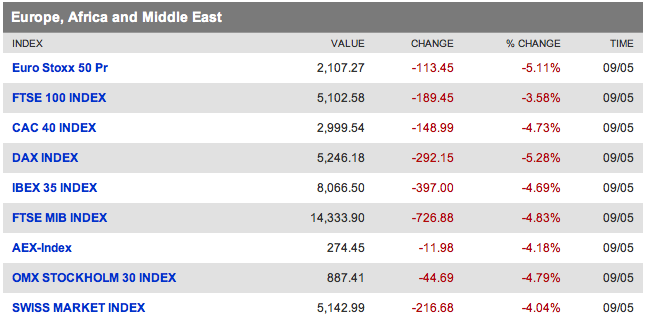
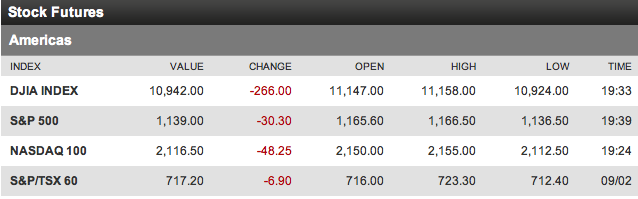
| Look Out Below, -5% European Version Posted: 05 Sep 2011 05:00 PM PDT click for live Euro market update ~~~ click for updated US futures > World indices taking a beating, with Germany off 5% and the rest of Europe down nearly as much. In the states, thing look only marginally better — down 2% to start. Add that to Friday’s whackage, and we are at Euro levels.
Feel free to discuss . . . |
| Posted: 05 Sep 2011 02:00 PM PDT Its been a hazy, lazy Labor Day, capping off a full week of outdoor activities. I am now back in my climate controlled lair, ready for a nap. I know exactly what I will read before dropping off for an afternoon siesta:
What did you read this weekend? >
|
| Precipitous Reduction in Bank Reserve Requirements Posted: 05 Sep 2011 11:30 AM PDT In Barron’s this week, Alan Abelson discusses the gradual changes in Bank reserve requirements over the years, and the impact that has had on banking, via Crosscurrents Alan Newman. Note that this is not the 2005 SEC change in leverage rules fro investment shops, but parallels the same radical deregulation and regulatory capture. Excerpt:
Interesting stuff . . . > Source: |
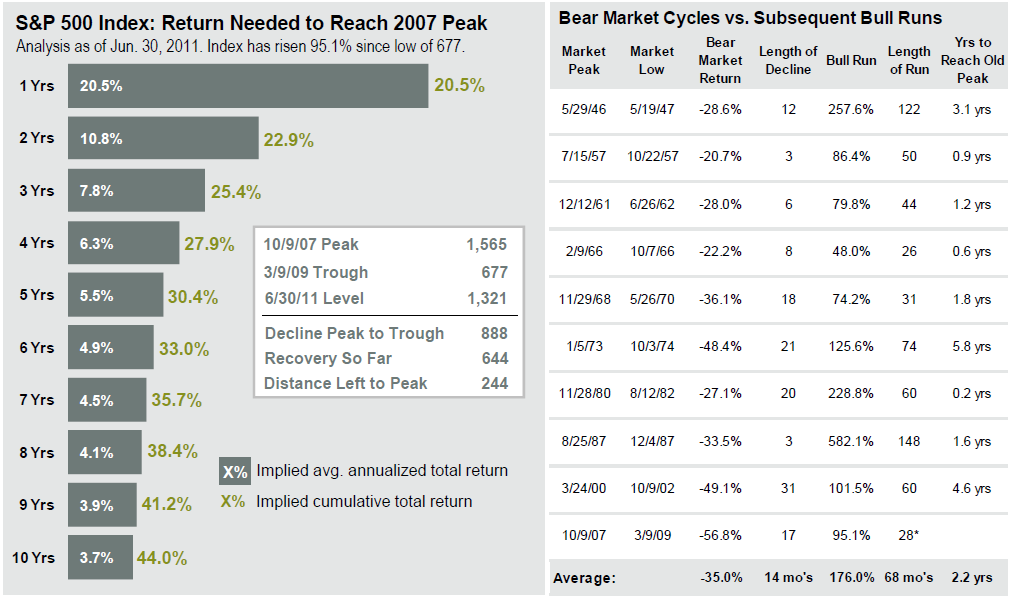
| Equity Scenarios: Returns Required to Regain Peak Posted: 05 Sep 2011 09:00 AM PDT Many investors ignore this sort of data, but its too important not to occasionally remind people about. The table below looks at the nature of asymmetrical gains and losses, especially, the returns necessary to recover from losses. A 25% loss requires 33% gains to get back to break even, a 50% loss requires a 100% gain, etc. Consider the following Bull, Bear and In-between scenarios for return to break even: >
Source: BLS, FactSet, J.P. Morgan Asset Management. Source: JP Morgan funds |
| Labor Day, Leen’s Lodge, Employment Report Posted: 05 Sep 2011 07:30 AM PDT Labor Day, Leen's Lodge, Employment Report My long-time friend and fishing guide Ray Sockabasin put the onion rings in a special beer batter concoction that he characterizes as an "old Passamaquoddy Indian recipe." With the frying pan on the fire, in went the onion rings… sizzle, sizzle, sizzle, and out they came – fabulous. They were so light you could think of them as almost floating – why, you might use one as a 'bobber' if you were bait fishing in Big Lake in Grand Lake Stream, Maine. Labor Day weekend is a quieter time in Maine. This is a place where you can read, study research reports, take some time to go fishing, have conversations, and at the same time consider some very serious issues. On Friday morning via Leen's Lodge satellite connection, the eyes were fixed on the employment report. We channel-flipped between CNBC and Bloomberg. We happened to catch the release on CNBC when another good friend and skilled economist, Bob Brusca, was guest hosting for the hour. We listened to the dialogue among Brusca, Diane Swonk, Mark Zandi, Steve Liesman, and others. Setting aside some commentary, which I would consider rather innocuous, let me focus specifically on the skilled comments that came from Liesman and the three guest economists. No matter what one does with this employment report, one has to come away with an ominous feeling. It simply was not good. Interpretation of details could suggest that it was break-even, or "not any worse than I thought," or subject to reinterpretation because of the revisions. There was nothing in it that was robust or optimistic. There is much speculation about why this is so. Some of us, myself included, expected the second and third quarters of 2011 to be particularly weak. We attributed the loss of at least a half point in GDP to the supply-chain interruptions in the manufacturing sector due to the tragedy in Japan. We cannot blame the earthquake and the hurricane for August employment data. The effects of those natural events will be seen when we get the report in early October for September. We can attribute some major employment composition changes to the changes in government policy, the debate over layoffs in Minnesota, or to the labor interruption that took place with Verizon. In addition, August is notoriously a difficult month for employment data. It is impacted by all sorts of cross currents, from vacations to auto cycles to other causes. With certainty, the employment report guarantees that interest rates will remain low and stay low for a protracted period. On the heels of the employment report, the Treasury market rallied enormously. Ten-year Treasury yields dropped by a quarter of a point, and thirty-year Treasury yields did the same. The Federal Reserve did not act in the hour preceding or following the employment report. So, when you look at this extraordinary volatility in which Treasury securities moved by more than two full points, you cannot attribute that to the Fed. You can attribute such violent moves to the high volatility applicable to Treasury securities in a climate of enormous uncertainty. Our view remains the same. We expect the fourth quarter of 2011 to be better than the second and third quarters of 2011. We expect the supply-chain interruptions to have run their course. We expect the rebuilding and recovery in states from South Carolina to Maine and Vermont to be underway in the fourth quarter. We also expect the commitments that will be made to continue that rebuilding and recovery to take place in the early part of 2012. It is a shame that the failed policies in Washington from our political leaders, both Democrat and Republican, House, Senate, and White House – that is right – failed, failed, failed – miserable policies coming from Congressmen, Senators, Democrats, Republicans, and the President – all of them carry the unemployment burden of the United States on their shoulders and in their hands. On the left, they would spend without reservation and without constraint. On the right, they would continue to subsidize very wealthy, specialized investment managers with carried interest tax at fifteen percent and subsidize ethanol production at the cost of billions of dollars a year, while failing to pay those who need help or threatening payments to those who serve in the Armed Forces of the United States. Our political system in Washington is broken. Democrats, Republicans, Congressmen, Senators, and the President have failed to lead. They all put their re-election possibilities and their personal political careers ahead of the nation's interests. The employment report should be the time that the President speaks to a joint session of Congress. That should be convened at 9:00 am on the first Friday of the month, when the unemployment statistics from the previous month are released to the public. Labor Day, Leen's Lodge, employment report. Satellite television brings the unemployment report onto the lake, into the blue sky, and into the sunshine. It interferes with the ambience of a wonderful location in Maine. We will take a little time off, but must confess, the ruminations and discussions here are on national policy issues, markets, and economics. The good news is, the fishing is terrific, and the geography of pristine waters and wonderful green surroundings survives in spite of the monsters that lurk in our government in Washington. ~~~~ David R. Kotok, Chairman and Chief Investment Officer |
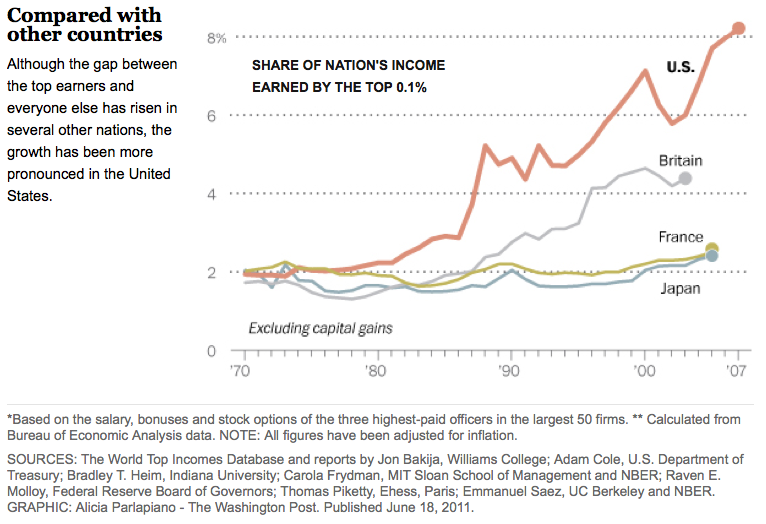
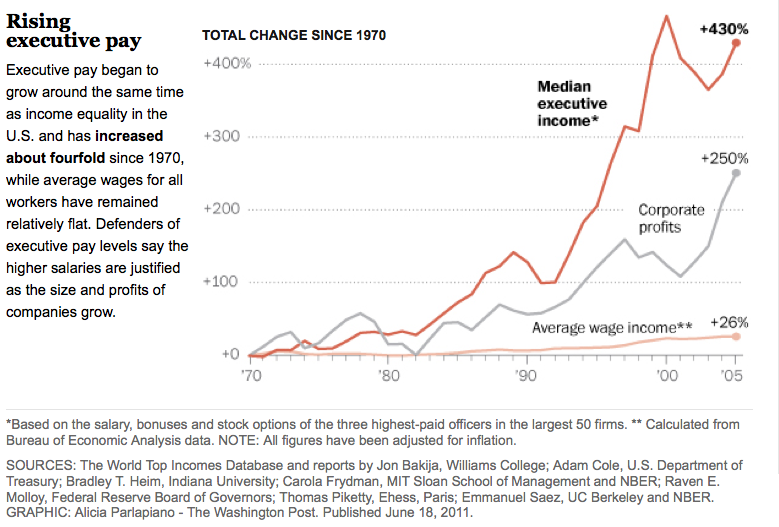
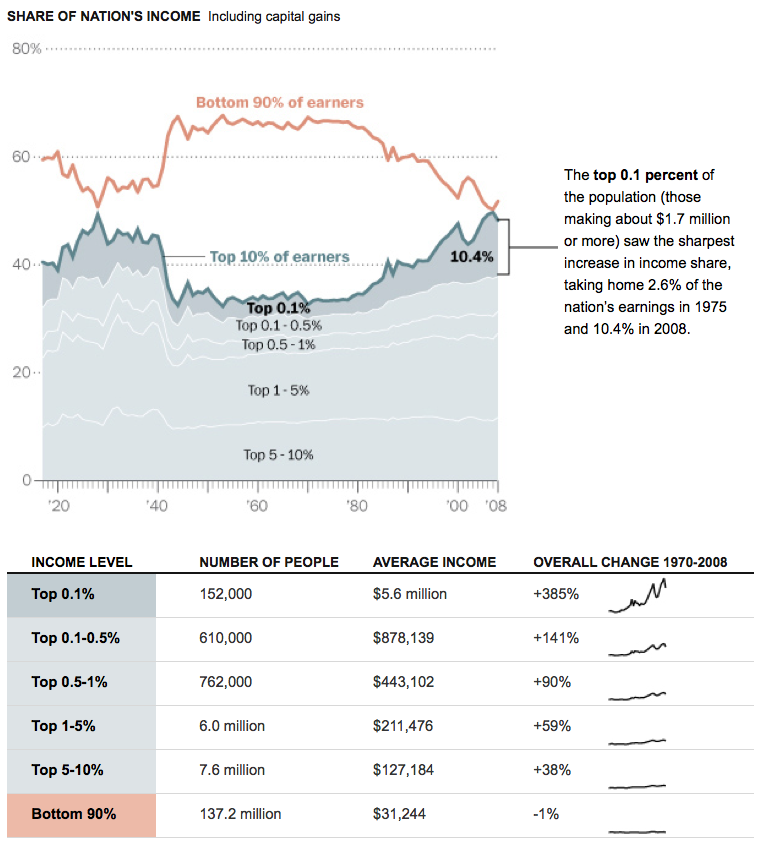
| WP: Special Report on “Breakaway Wealth” Posted: 05 Sep 2011 06:00 AM PDT There is a huge Washington Post special report on Breakaway Wealth in the US. More than most other industrialized nations, the US has seen the top 0.1% compensated in vastly disproportionate numbers versus the rest of the populace. There are at least several reasons to be concerned about this, beyond basic fairness: 1) Nations that have extremes wealth disparities tend towards social unrest. Usually, its banana republics and dictatorships, but it could happen in a corporate-owned quasi democracy as well. 2) CEOs and other company insiders have been engaging in a massive grab of shareholders wealth for decades. Its gotten appreciably worse in the 2000s. 3) Management is now trying to hide their compensation from the business owners — the firm’s shareholders Making matters even more outrageous, these CEOs are trying to pass legislation that would legally allow them to not to disclose executive compensation at public companies:
Legalized theft of shareholder assets, approved by a corrupt Congress. What little respect I had left for the GOP is now completely gone. This is not “business friendly” — its utterly corrupt theft of shareholders. The charts below (click for larger graphics) show exactly how absurd this has become. The rumors you may have heard about class warfare have been greatly exaggerated . . . > US Compared with other countries
Who makes up the top 0.1%?
Rising executive pay
Growing share of income for the rich
> Sources: Business group: Public companies shouldn't have to compare CEO and worker pay |
| Kurt Vonnegut: Stories Have Shapes Posted: 05 Sep 2011 05:00 AM PDT |
| Germans who play with fire . . . Posted: 05 Sep 2011 04:30 AM PDT People who play with fire > Exit polls in respect of the vote in Mrs Merkel’s home State of Mecklenburg-Vorpommern (hope I got the spelling right), suggest that she has been trounced, as have her coalition partners (Free Democrats), who have been so badly beaten that they could have lost all their representatives in the regional assembly. This is the 6th regional election loss this year for Mrs Merkel and her coalition – a bit careless I would have thought. Now it gets serious. The key election issue was Mrs Merkel’s handling of the Euro Zone crisis – she had tried to get tough on the Euro Zone – too little, too late. However, I suspect she will be far less tolerant from now on. As I keep banging on, Mrs Merkel is not a natural leader – she is a back room operator, cautious of taking a position unless she has achieved prior consensus. Furthermore, she does not understand markets – a common problem with most European politicians, bureaucrats and officials. The next German regional elections are in Berlin later this month. The Greeks have been ignoring all calls to get serious. They have run out of time. On Wednesday, the German Constitutional Court rules. Most believe that they will not block the bail out of the peripheral Euro Zone countries. Quite possibly, but giving a blank cheque to the executive, is also unlikely, in my humble opinion. They may, for example, insist on additional oversight by the German Parliament, which will make the EFSF and the future ESM unworkable, as decisions (which need Parliamentary approval) will take far too long to deal with market issues – basically means that it is over to you ECB/Monsieur Trichet to sort things out – and they are totally reluctant, though what choice do they have. Recently the German President accused the ECB of violating its mandate and Article 123 of the Lisbon Treaty. The head of the German Central Bank (the Bundesbank), Mr Jens Weidmann has, equally, been highly critical of the ECB – he stated that EU law was being “gutted” by the ECB bond purchases of Italian and Spanish and other PIIGS debt. No Essentially, the EU/ECB have overreached themselves and imposed their wishes (through unelected Commissioners in the case of the EU and appointed Board members in the case of the ECB) upon Europe. I seem to remember “no taxation without representation” and we all know what happened next. The French have generally exercised more political control (until the French revolt) over their people, than other Recent polls suggest that the German’s don’t necessarily want to ditch the Euro. Yes, a number want the DM back, but the majority (quite sensibly) will live with the Euro, but don’t want to bail out the entire Euro Zone, especially if they don’t meet their commitments (Greece….). I totally understand that sentiment. Indeed, I believe the Germans have been uber generous to date, but that generosity has a limit. This, off course, leads me back to the Greeks. They have totally ignored all their commitments/promises etc. Their fiscal position is unsustainable and worsening. The proposed austerity measures are unworkable and the Government has given up trying. This cannot continue. However, the Greeks will have to be allowed to default – and The Italians better reconsider their recent attempts to backslide from their commitments – they have a large debt maturity this week – some E14.6bn and E62bn by the end of September (the highest ever in a single month). In total, Italy must roll over E170bn by end December – Whoops. Italian 10 year bond spreads crept up to near 5.30% on Friday, We are coming to an end game – waffle, bluff and bluster wont work mes amis. Neither will the recent Merkel comments (and the views of the senior German politician I met last week) who told me that the markets were just getting hysterical and that they (the I still have the email address of the particular German politician. I don’t believe I’m generous enough to avoid sending him a short note in due course, though I suspect that my invitation to visit the Bundestag will be forgotten about. Oh well, still worth it – indeed, it’s irresistible. Will await the market reaction and the German Constitutional Court ruling on Wednesday, just to be sure though. ~~~ A qualified UK accountant, Kiron joined the M&A dept of N M Rothschild in London. He was then appointed head of M&A of Rothschild (Hong Kong). On his return to the UK, he was a founding member of the Rothschild international privatisation team. Subsequently headed up the Central and Eastern European ("CEE") team – rated No 1 in 4 out of 5 years (Privatisation International). On leaving Rothschild, he worked as privatisation adviser to the UK Governments Know How Fund, which was established to advise Governments in CEE on policy, privatisation, economic, financial, regulatory and other issues. Subsequently European Head of Media, Tech and Telecoms at CIBC World markets. Following CIBC, Kiron advised on telecoms and energy deals in CEE. Kiron has acted as a lead adviser in respect of over US$150bn of deals and has worked globally in both developed and emerging markets. |

| You are subscribed to email updates from The Big Picture To stop receiving these emails, you may unsubscribe now. | Email delivery powered by Google |
| Google Inc., 20 West Kinzie, Chicago IL USA 60610 | |



0 comments:
Post a Comment