


The Big Picture |

- This Time is Different . . .
- Dreamforce 2011 Social Enterprise
- Smoking Pot is “My Civil Liberty”
- Which Director’s Movies Should You Be Watching?
- Succinct summation of week’s events (09/09/11)
- Market Whackage, Weekend Edition
- Consolidation
- Greece rejects talk of default
- Is The Great Recession Really Over?
- Attention Human Trader, You Are No Longer Needed
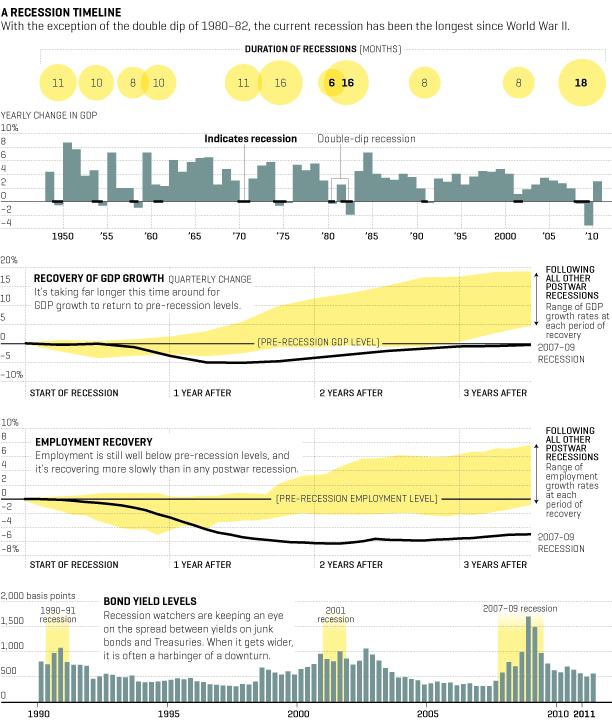
| Posted: 09 Sep 2011 11:30 PM PDT Those dreaded words you never want to hear as an investor. But check out the Fortune Magazine graphic of the this recession relative to others since the WWII. Yes it's a balance sheet problem and the economy needs more time to heal and delever. We also maintain, however, at least some, if not much of the weakness, especially in the labor market, is structural and not cyclical. Take the U.S. Postal Service (USPS) as the poster child of the current problems plaguing the U.S. labor market. The USPS has 571,566 full-time workers making it the country's second-largest civilian employer after Wal-Mart. It has eliminated 110,000 jobs in the past four years and according to the FT,
Now why is this? Not enough stimulus? Monetary policy too tight? Insufficient quantitative easing? To paraphrase James Carville, "It's technology, stupid!" The rise of the internet, e-mail, and Twitter coupled with some piss poor management, which failed to adapt to the changing times, and the result is one the nation's largest employers facing bankruptcy and mass layoffs. Borders Books Inc. is also in the process of liquidating the last of its stores, which will result in a final mass layoff of close to 11,000 employees. True, they failed because of "lack of demand" for their goods and services. But not because of cyclical forces that could be offset by fiscal and monetary expansion. The rise of the e-book, Kindle, and iPad shut them down. The Shumpeterian "creative destruction" of one sector is not being equally and instantaneously offset by job creation in the sectors benefiting from technology. This takes time, retraining, political vision and strong leadership. Companies can't hire enough software engineers in these fields because the current labor pool lacks the education, training and skills. Policymakers must recognize the global economy is sitting at the elbow of an exponential curve in technological advances that is and will uproot everything from manufacturing to how we read our mail and books to how medical services will be delivered. We've posted several pieces on the Global Macro Monitor blog about the role of transformative tech, including medical apps where smart phones can be transformed into EKG monitors and cataract detecting devices. How do you think this revolution will impact the traditional health care workforce? We haven't even touched on the mobile payments revolution, which will reduce the demand for retail salespersons and cashiers. Not a near-term positive for employment as the the BLS points out,
The painkillers of fiscal and monetary stimulus, including negative real interest rates and quantitative easing, has no doubt cushioned the blow of the great crash of 2007-08. We're the first to thank Paulson, Bernanke, Geithner and Co. that we are not all farmers living under the freeway. They all deserve the Presidential Medal of Freedom in our book for saving and stabilizing the global financial system. But the continued use of cyclical policies to deal with structural issues has created an acute addiction in the markets and economy causing more uncertainty, political angst, and volatility, in our opinion. This is especially true in the equity markets, which was evident yesterday in its reaction to Mr. Bernanke speech. The policy medicine has now become an additional disease afflicting and distorting markets and the economy, which are now hooked on the painkillers. Policies that address structural issues, though painful, will go a long way in healing the economy. A long-term credible budget plan which addresses the structural deficit will instantly reduce much of the uncertainty holding back investment. Punishing savers with negative real interest rates "for at least two more years" will not and may actually consume the rest of the decade in cleaning up the unintended consequences of the Fed's serial distorting of the relative price of money. There's now talk of the Fed targeting unemployment. How 'bout this. As part of the next quantitative easing, the Fed creates a $1,000 checking deposit for every citizen who agrees to write ten letters to friends, especially in rural parts of the country. This stimulates demand for postal services and thus eliminates, for a time, the need for mass layoffs at the USPS. In no way do we intend to be insensitive to the workers at risk of losing their jobs. But is this really where economic policy is headed? Where is the leadership?
|
| Dreamforce 2011 Social Enterprise Posted: 09 Sep 2011 10:00 PM PDT Dreamforce 2011 Social Enterprise Keynote @benioff @salesforce View more presentations from Salesforce.com |
| Smoking Pot is “My Civil Liberty” Posted: 09 Sep 2011 03:41 PM PDT “I’m a hardworking, tax-paying, kid-raising, church-going citizen of this country,” say author and PBS travel host Rick Steves, “and if I work hard all day long and want to go home and relax with a joint, that is my civil liberty.” Reason.tv caught up with Steves at Seattle Hempfest in August, where he spoke with Nick Gillespie about marijuana laws and whether his outspoken defense of legalization has effected his books sales, tour bookings, and television career. PBS Travel Guru Rick Steves Seattle Hempfest is an annual event that started in 1991 as a protest against the prohibition of marijuana, the commercial cultivation of non-psychoactive hemp for a variety of uses, and related issues. For 20 years, tens of thousands of people gather each summer to listen to speakers and bands and to show their support for legalizing pot and hemp products. About 4.15 minutes. Shot by Alex Manning and edited by Meredith Bragg. Visit Reason.tv for HD, iPod and audio versions of this video and subscribe to our YouTube Channel to receive automatic notification when new material goes live. Hat tip boingboing |
| Which Director’s Movies Should You Be Watching? Posted: 09 Sep 2011 02:00 PM PDT Click to enlarge: Source: |
| Succinct summation of week’s events (09/09/11) Posted: 09 Sep 2011 01:00 PM PDT Succinct summation of week’s events: Positives:
Negatives:
|
| Market Whackage, Weekend Edition Posted: 09 Sep 2011 11:00 AM PDT
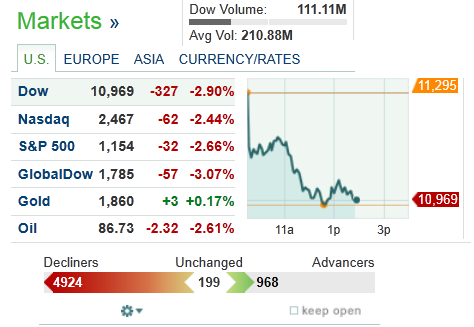
> Its an ugly day in the coal mines, as markets sell off on a variety of fears:
More to come . . . |
| Posted: 09 Sep 2011 11:00 AM PDT You’ve been sold a bill of goods. You read “The Long Tail” and believed a new era was upon us, an egalitarian one in which everybody got to play and be recognized, where music was plentiful and those making it survived financially…but this is untrue. Consolidation is always lurking. Happened with record companies. Happened in live entertainment. And it’s going to happen in the new world. Or another way of putting it is there’s only one winner online. One Google, one Facebook, one Amazon, and there’s only one iPod. As for the iPhone… Android may have penetrated the marketplace but what is fascinating is that the contenders have all collapsed, Windows, Nokia’s Symbian and RIM, and they’re not coming back. The titans can be toppled. But usually this only happens with a paradigm shift, i.e. the shift from physical to digital. It’s killing the major labels. But don’t think what eventually emerges won’t be similar, a limited number of players purveying a limited amount of music. No, it won’t look exactly like today. MTV’s out of the music game and it looks like the same thing might be happening in terrestrial radio. The new music will not sound like the old, but only a few acts will rule. I know you don’t want to hear this. But put yourself in the shoes of the listener. He’s confronted with chaos, he wants someone to make sense of the clutter, and the person/site who does this will have all the power and ultimately all the money. Hipsters will hate these people. Because what will survive won’t be edgy, different and unlistenable. A level of quality will pervade, whether the records are made by committee or by individuals breaking new ground. Skill and inspiration, what a concept. It’s what listeners want, even though players might recoil at the thought of this. Because it leaves them out. Yes, you can make your music with GarageBand, even sell it on iTunes via Tunecore. You think you’ve made it, but you’re nowhere. And with everybody able to hear your music instantly, word spreads pretty fast that you’re mediocre. You just can’t shove what people don’t want down their throats. This is a sea change in advertising, in music. The product leads, it must be intrinsically good. So, like the Army, we’re looking for a few good men and women. Very few. You’ve got to be insanely great, it’s hard to become a Navy Seal and it’s going to be almost impossible to make it in the music game. Niches will survive. You can play and get traction like in no other era. But your odds of blowing up, crossing genres, is extremely limited. Because new people understanding the new rules are going to roll up the new acts. And everybody’s interested in money. They just haven’t got time to sell what’s bad, it’s too difficult, when people can sample and move on instantly. So we’re coming to an era of consolidation. There will be a limited number of sites/players and a limited number of bands. And the public will like this. The only people left out will be the wannabes, who thought it was all going to be easier, those sour grapes individuals who always thought the man was against them. No, you just weren’t good enough. And you’re not going to be good enough tomorrow. And with good being the main criterion, it’s less important what kind of music you play than your ability to infect people and grow an audience. Anybody can make it. It’s about self-starting as opposed to getting a check from a major. But at the end of the day only a very few will triumph, will be ubiquitous. And the people in control of their exhibition will be few in number, and they’ll control all the acts. Meet the new boss. Same as the old boss. Just with less smoke and mirrors and transparent accounting. Get ready. – |
| Greece rejects talk of default Posted: 09 Sep 2011 10:29 AM PDT *GREEK FINANCE MINISTRY ISSUES STATEMENT *GREECE COMMITTED TO `FULL IMPLEMENTATION’ OF BAILOUT AGREEMENT *GREECE REJECTS TALK OF DEFAULT |
| Is The Great Recession Really Over? Posted: 09 Sep 2011 09:00 AM PDT
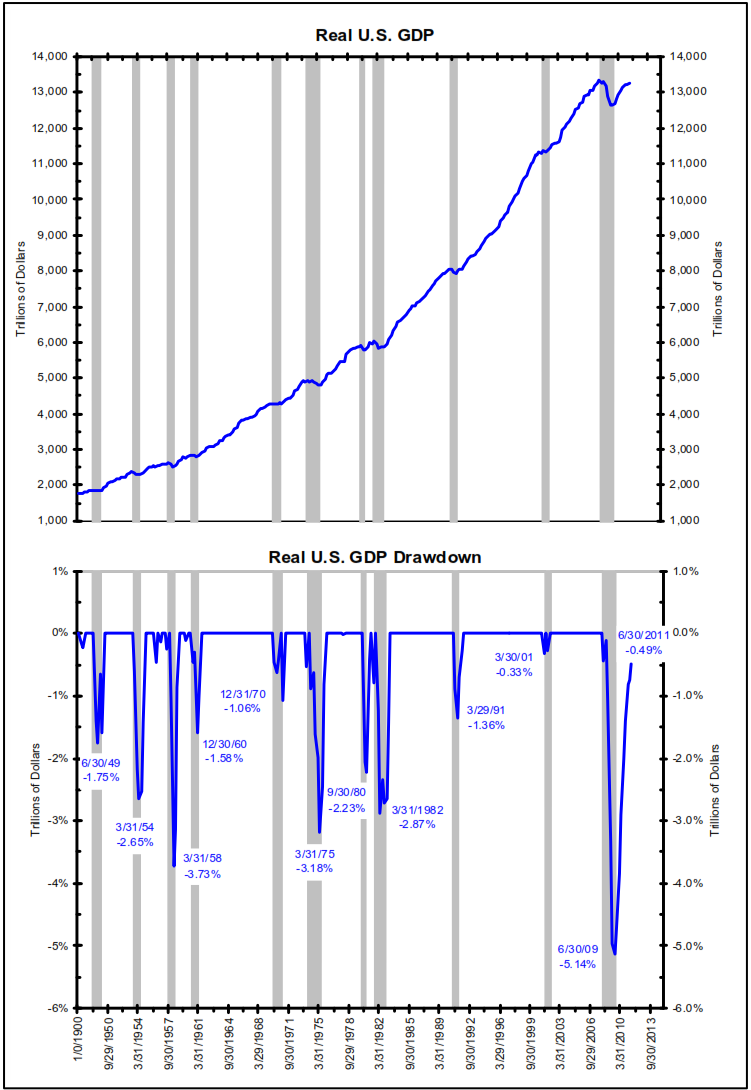
In the past we have noted that Martin Feldstein, one of the members of the business cycle dating committee, was the holdout in calling the end of the Great Recession. The committee works by consensus and Feldstein was not sure that the current economic expansion would make a new high. He relented and the Great Recession's end was dated June 2009. The official call was made on September 20, 2010. For the moment, it looks like his first instincts were partially correct as a case can be made that the Great Recession never really ended. The NBER has dated every recession back to 1854. A recession is a peak to trough in economic activity where the expansion off the trough results in a new high in real economic activity. This has been the case in every recession/depression/panic ever dated. Even the 1937 peak in economic activity (which began the 1937 recession) was above the 1929 peak (which started the Great Depression). As the chart to the right shows, real GDP had its biggest fall since the end of WW2 (see the lower panel highlighting the drawdowns). More importantly, real GDP has made a new high in economic activity. If the economy continues to falter, then this is not a "double dip" but rather a continuation of the Great Recession. Now to be clear, the ultimate trough most likely already occurred in June 2009, which is how recessions are dated (peak to trough). However, the recession does not truly end until economic activity makes a new peak. For the moment, that has not happened. One could argue that August 2011 is the 44thmonth since the Great Recession began (December 2007). Only the Great Depression (which lasted 43 months from August 1929 to March 1933) and the Panic of 1873 (65 months from October 1873 to March 1879) took longer to make a new peak in economic activity. |
| Attention Human Trader, You Are No Longer Needed Posted: 09 Sep 2011 07:30 AM PDT
> If there are any human traders still out there that happen to be reading this, the UK Foresight project team has some news for you : don't expect to be trading for much longer. Here is what the report had to say: Read Paper Here "It is reasonable to speculate that the number of human traders involved in the financial markets could fall dramatically over the next ten years. While unlikely, it is not impossible that human traders will simply no longer be required at all in some market roles. The simple fact is that we humans are made from hardware that is just too bandwidth-limited, and too slow, to compete with coming waves of computer technology." The UK Foresight project is a group of academics from over 20 countries who decided to get together and study the effects of computer based trading. Lots of familiar academics names appear in the report including the pro-HFT academic crowd of Brogaard, Angel and Hendershott. And lots of the same old, tired defenses of HFT appear in the report: no evidence that HFT increase volatility, liquidity has improved and transaction costs have been lowered. No doubt this report will be picked up by the HFT lobby and their friendly media contacts and waved around telling people that all is well in the stock market. But the report does raise some major concerns. Two of which are feedback loops and market manipulation. Six different types of feedback loops are identified: Risk, Volume, Shallowness, News, Delay and Index loops. You can read more about these on page 14 of the report but the bottom line is that many HFT systems are very similar and tend to react to each other when unexpected events occur. The report says: "The direct link between market outcomes and the fundamental events that ought to act as anchors for valuation has been severed and replaced by a complex web of iterated and nested beliefs." "A liquidity shock on one venue that might have gone unnoticed if there was one large centralised exchange can now affect prices on that venue. In normal times, the aberrant price would quickly disappear as cross-trading-venue HFTs buy low and sell high. But in stressed times, the capital of HFTs may be limited, or the HFTs themselves may start to doubt the prices (as happened during the Flash Crash) and refrain from arbitraging. Real-money investors then start to mistrust valuations across the board, and the resulting pressures mean that HFTs no longer contribute to liquidity provision, which makes price divergence across trading venues worse still. And so the shock is transmitted through the network, and its effects are reinforced by positive feedback. Trades and transactions will happen at socially inefficient prices, and mark-to-market valuations can only be done to multiple and illiquid marks. Understanding how to avoid such situations, and to contain them when they do occur, is a topic for further research." They must be kidding? They just described how flash crashes happen and then leave it by saying they need further research on how to contain them. We will save you the trouble and all the hours of research with one simple word: Fragmentation. Without fragmented markets and multiple liquidity pools, the situation that is described above does not occur. There is much more in the Foresight report but we just wanted to touch on one more subject they brought up: market manipulation. "Negative effects on efficiency can arise if HF traders pursue market manipulation strategies. Strategies such as front running, quote stuffing (placing and then immediately cancelling orders), and layering (using hidden orders on one side and visible orders on the other) can be used to manipulate prices. For example, deterministic algorithmic trading such as VWAP (volume weighted average price) strategies can be front-run by other algorithms programmed to recognise such trading. Momentum ignition strategies, which essentially induce algorithms to compete with other algorithms, can push prices away from fundamental values." So, be gone human trader. You are no longer needed as now we have a system in place which has the potential to crash at any time due to feedback loops and where market manipulation "strategies" run rampant. And, luddite, don't you dare complain or raise objections because technology is always good and always increases efficiency. Right? Source: ~~~ Joseph Saluzzi (jsaluzzi-at-ThemisTrading.com) and Sal L. Arnuk (sarnuk-at-ThemisTrading.com) are co-heads of the equity trading desk at Themis Trading LLC (www.themistrading.com), an independent, no conflict agency brokerage firm specializing in trading listed and OTC equities for institutions. Prior to founding Themis, Sal and Joe worked for more than 10 years at Instinet Corporation, pioneers in the field of electronic trading, and at Morgan Stanley. |


| You are subscribed to email updates from The Big Picture To stop receiving these emails, you may unsubscribe now. | Email delivery powered by Google |
| Google Inc., 20 West Kinzie, Chicago IL USA 60610 | |



0 comments:
Post a Comment