


The Big Picture |

- Big Banks Plead with Customers Not to Move Their Money
- OPEN THREAD: Indicators for Investing & Trading
- Occupy Wall Street
- The Myth Of The Long Tail
- Meritocracy vs. Plutocracy
- TED Conference on Behavioral Finance
- Dow Jones Industrial’s Biggest Daily & Intraday Moves
- “The party is over”
- Generation Recession: How the Recession May Change America
- Global Warming Denier Turns Out to Be Sacha Baron Cohen in Character
| Big Banks Plead with Customers Not to Move Their Money Posted: 09 Nov 2011 10:30 PM PST Yes, The Big Banks DO Care If We Move Our Money650,000 customers moved $4.5 billion dollars out of the big banks and into smaller banks and credit unions in the last month. But there is a myth making the rounds that the big banks don't really care if we move our money. For example, one line of reasoning is that no matter how many people move their money, the Fed and Treasury will just bail out the giants again. But many anecdotes show that the too big to fails do, in fact, care. Initially, of course, if the big banks really didn't care, they wouldn't have prevented protesters from closing their accounts. NBC notes that – in response to inquiries regarding how many people have moved their money – Bank of America refused to provide figures, and instead sent the following defensive email:
A writer noted at Daily Kos:
And a writer at Daily Bail pointed out:
Hundreds of similar stories are being told all over America. Even though the government may keep throwing money at the dinosaurs, the Basel regulations do have some capital requirements, and so the big banks need to bring in some actual deposits to fund their casino gambling. Moreover, if too many depositors leave, the illusion that the big banks are serving the American public will be burst, and a critical mass of consciousness will occur, so that the banks' questioned control over the American political and financial systems will start to be questioned. So moving our money is an effective step towards reclaiming America. |
| OPEN THREAD: Indicators for Investing & Trading Posted: 09 Nov 2011 03:49 PM PST I was out of the office today, did I miss anything? Today’s bloodbath is as good a time as any to announce a new project I am working on: Your favorite market, economic, trading and investing indicators. What do you think is important? What mileposts do you watch most closely? The answers to these questions may find themselves in a working paper or even a book (someday). Over the short term, they will end up posted right here. My short list includes several broad categories of factors that can impact future market returns. The caveat is that they should be easily quantifiable — turned into a numerical series or static reading — and not a squishy, subjective opinion. My broad categories looks something like this:
I have two wide question groups for y’all:
Feel free to share your deepest darkest trading secrets right here. |
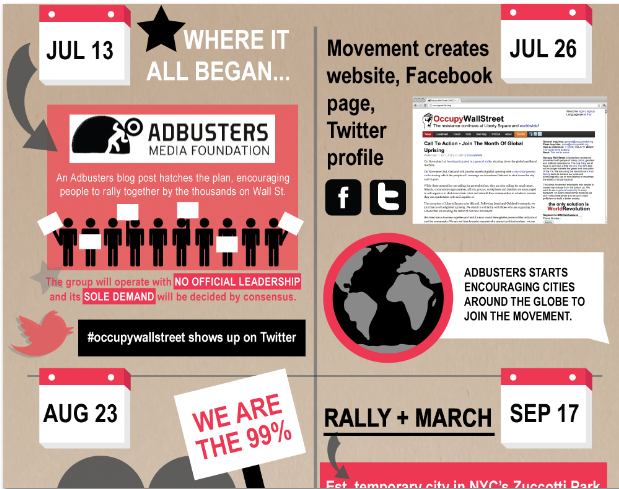
| Posted: 09 Nov 2011 11:30 AM PST From Visual Economics, comes this greattime of the
click for larger graphic
Full graphic after the jump > Occupy Wall Streetclick for larger graphic |
| Posted: 09 Nov 2011 10:00 AM PST Just because everything’s available, that does not mean anybody wants it. In other words, you can get your song on iTunes, but nobody other than your mother and your boyfriend might buy it. Furthermore, when you try and market it, you’ll find resistance. A public hyped ad infinitum has a shit detector nonpareil, but it’s even worse, you can’t even get through to them, they delete your e-mail, they block you from having access. It all comes down to distribution. There are a limited number of television channels, a limited number of radio stations, and there used to be a limited number of records for sale. Not only could you not get your indie record into a store, if per chance you did, if it sold, you couldn’t get paid. That was the power of the majors, their ability to get paid, their control of distribution. And now distribution is completely flat in music. Anybody can offer their wares for sale and get paid. And the end result is everybody just wants the best stuff. That’s what we’re doing online, all day long, searching for the best stuff. We live in a winner take all society. Just look at the video game business. Huge winners and huge losers. Now of course the flattening of distribution allows for niches to be populated that were hard to find or get to previously. But don’t expect these niches to blow up. Yes, we’ve got niches and superstars. And expect more superstars down the line, it’s human nature, we want to belong to the club, we want to be able to converse with others. You’ve been sold a bill of goods. Excited by the Net, you bought the words of charlatans, who had no familiarity with art, who thought that the proletariat was now going to triumph. You don’t want to be taught calculus by a high school dropout. And now, online, you can find out everybody’s CV, where they went to college, where they worked, the info is such that you can divine the winners. It’s tough for consumer goods. Everyone just goes online and sees what product to buy. Furthermore, it’s hard to overcharge! With comparison sites fleshing out costs instantly. And you can now find out what act is worth listening to instantly. What’s worse, so many bad acts have asked for attention that it’s hard to penetrate the public, we’re not interested when there’s a little buzz, we only care when there’s huge buzz! Look online. There’s one Google, one Amazon, one iTunes. Sure, there are competitors, but they’re also-rans. Same deal in music. When the best are so accessible, we don’t need the mediocre! It’s a race to the top. Now it’s even harder to make it! You can feel good that you’re selling your CD and MP3s, but that does not mean you’re going to make it. If you want to play the Top Forty game, the major labels have a leg up, you can’t get on radio without them, not radio that reaches anybody and means anything. The majors are a filter. And in the rest of the world, it’s every man for himself. And the only determining factor is quality. You’re a hobbyist, you’re not a professional. If you’re truly lucky, you might become a journeyman, able to pay your bills playing music. But if you’re planning on being a star, you have to be incredibly good. No one wants to hear this. Especially a generation brought up getting trophies for last place. Music is more cutthroat and competitive than ever before. The public is right there, on the other side of the computer, but it’s almost impossible to get people to care. If you’re a great marketer, good at Facebook and Twitter, hire yourself out as such. Just because you can promote a product, that does not mean it’s going to sell. Social media only works if the music is great. Good is not good enough. We’re talking great. One listen great. Fifteen seconds great. Or something so left field that our friends tell us to give it five times through and we think it’s the new “Dark Side Of The Moon”. Music is like America at large. There’s the 1% and everybody else. You may think you can make it, but you can’t. You’re part of the 99%. You’re a fan. Sure, someone makes it into the 1%. You know who? Graduates of Ivy League schools who get jobs in finance and literally work 90 hours a week. Did you pay those dues, are you truly willing to work that hard? Of course there are those who drop out of school, but are you as savvy as Steve Jobs and Bill Gates? Do your colleagues look at you with awe, are they rendered speechless when you play? If not, you’re not gonna make it. Sorry. Not only do you have to have the skills, you have to be able to innovate. It’s like getting a position with the New York Philharmonic and being able to write the score too! Just because you can buy a ticket, that does not mean you can win. Everybody can play the lottery, but almost no one wins. Almost no one wins making music. The odds are incredibly long. And if you think luck is key, you’re never going to win. You make your own luck. Through hard work! So good luck. Know that no one wants to hear your music other than you and your relatives. It’s ultimately got to be so good that people find you, as opposed to the opposite. Are you really that good? – http://www.twitter.com/lefsetz – http://www.lefsetz.com/lists/?p=subscribe&id=1 |
| Posted: 09 Nov 2011 08:30 AM PST Invictus here, folks: Occupy Wall Street has been the subject of debate with friends and colleagues. Some confusion and misconceptions are out there regarding the protesters’ message: I’ve heard that the OWS movement is anti-capitalist, anti-Semitic, Pro-Socialist, Pro-Marxist, or a combination thereof. Or that they’re just — as Atrios re-popularized the phrase long ago — Dirty F*ckin’ Hippies. As Barry has described it, “there is an unfocused financial rage in the United States” — and you see it in both the Tea Party and the OWS movement. Rather than mischaracterize why so many Americans — on the Left and the Right — are unhappy, let’s go to the actual data to see what is underlying this negative general sentiment: Gini IndexLet’s start with the Gini Index, “the degree of inequality in the distribution of family income in a country.” Here’s our place in the world:
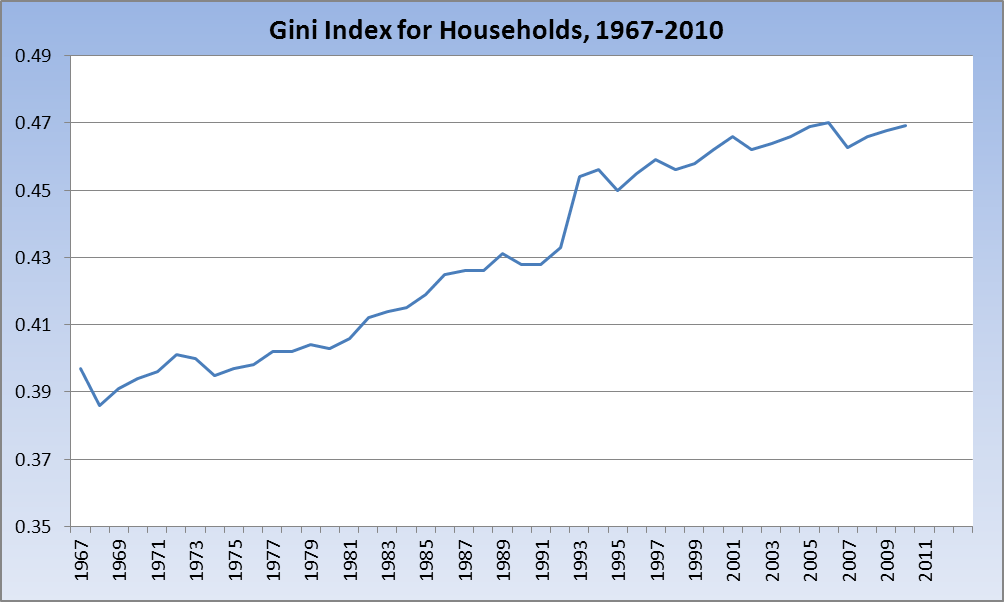
By way of comparison, Germany is #126 (of 136) with a Gini Index of 27, and Japan is #76 at 37.6. Within the United States, this is what income inequality looks like from a Gini Index perspective:
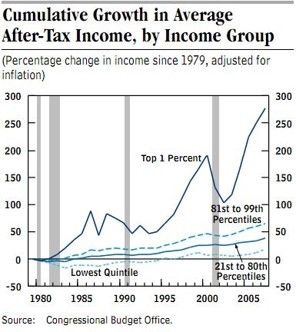
Well, How’d the Gini Index Get So Out of Whack?In brief (footnotes removed):
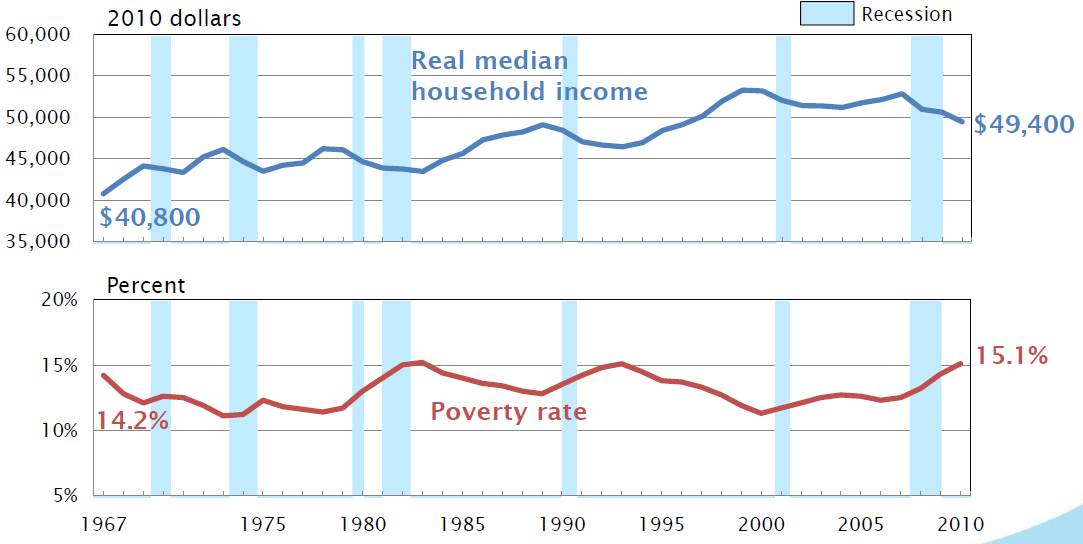
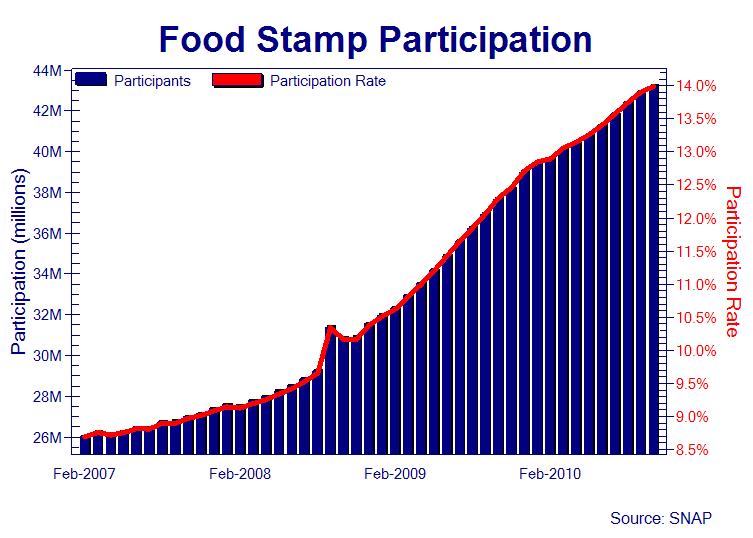
Here are some additional tables on how executive compensation has skyrocketed over the past few decades. Additionally, I’m sure Warren Buffett’s quote resonates with OWS (frankly, it should resonate with everyone — Tea Party included): “Too often, executive compensation in the U.S. is ridiculously out of line with performance. Getting fired can produce a particularly bountiful payday for a CEO. Indeed, he can "earn" more in that single day, while cleaning out his desk, than an American worker earns in a lifetime of cleaning toilets. Forget the old maxim about nothing succeeding like success: Today, in the executive suite, the all-too-prevalent rule is that nothing succeeds like failure.” A $1MM reduction in a CEO’s pay could be used to fund 13 jobs at $75k/year; nothing too complex about that math. Here are other jobs that could be created if we addressed the disparity. Meanwhile, while CEOs and other executives have feathered their nests — largely by exploiting overly-friendly relationships with all-too-compliant boards to negotiate outrageous compensation and severance packages — things have not been going quite as well for the rest of the country, as those at the top continue to rise while the remainder continue to drift: What About Everyone Else?While the top 1% have been doing just fine, thank you, median incomes have gone nowhere in over a decade while both poverty and food stamp usage have both been on the rise. Further, labor’s share of the spoils has fallen to all-time lows:
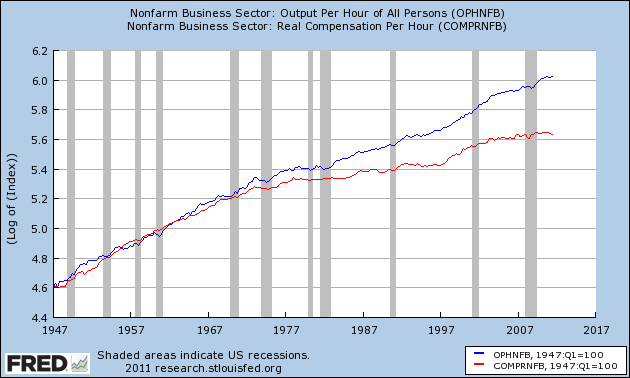
(NOTE: BLS provides (and FRED captures) this series as an Index, not a Level, with 2005 = 100. BLS advises me that the 2005 Level = 60.6. Therefore, I have taken the entire Index (Series identified above) and multiplied it by .606 to get the percent Labor Share above.) While labor’s share has been in decline, output has been outstripping compensation (natural log scale):
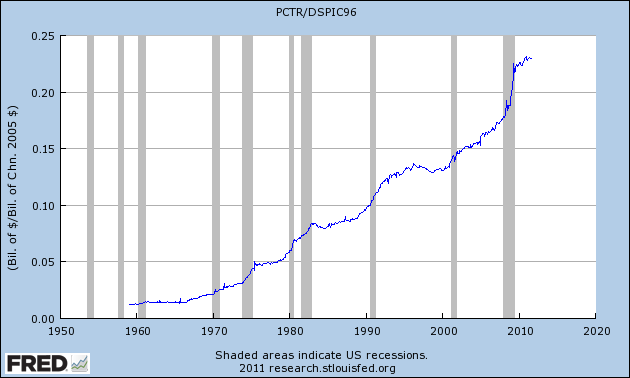
There’s been yet another resurfacing of a canard that goes something like this: An acknowledgement that there’s income inequality followed immediately by the claim that it’s not inequality that matters, but income mobility. Two examples of that argument can be seen here and here. It is refuted here, here and here, that last link being fully one decade old, showing how zombie lies truly never die. I have yet to see any signs or read any reports of any of the socialist OWS protesters demanding that Personal Current Transfer Receipts — money literally “transferred” by the government to citizens under programs like the Big Three, Unemployment Insurance, and Veterans’ Benefits — be a higher percentage of income than it already is. Have you? To the contrary, actually. I’m relatively sure OWS would like nothing more than to see this chart reverse — to have the government provide less to the people because the people are doing more for themselves.
Other FactorsSome comments on aspects of the OWS movement that are difficult, if not impossible, to quantify. I think Americans have an inherently good and reasonable sense of fair play. We’re not a people who begrudge others their wealth fairly earned — with “fairly earned” being the operative phrase. I haven’t heard many folks railing about Bill Gates, Warren Buffett or Steve Jobs. I have — and do — hear folks clamoring about the likes of Angelo Mozilo, Stan O’Neal, Lloyd “God’s Work” Blankfein. Why does Rob Gillette, former CEO of First Solar Corp., walk away with almost $40MM for 15 months (~$10,000/hr if he worked 60-hour weeks) at the helm during which the price of FSLR’s stock declined by some 60 percent? (Answer: See above quote from Warren Buffett.) From the Wired piece linked to below:
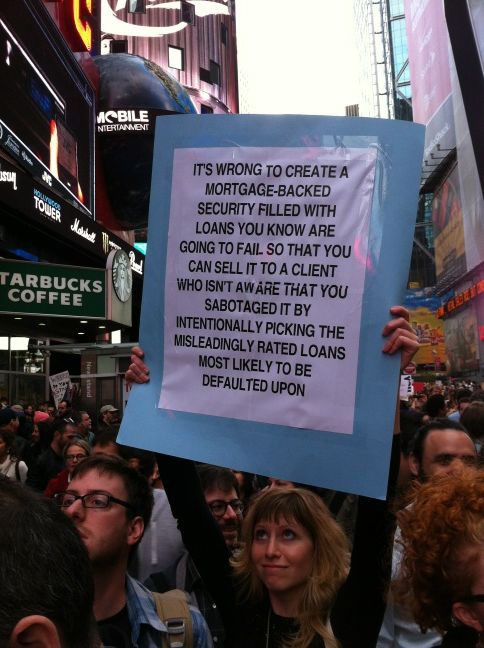
Personally, I’d argue that it’s generous to state that winners were “rewarded for no reason.” The facts at hand tell us that many have been rewarded for, at the very least, tanking our economy, and at worst criminal behavior; “no reason at all” would be an uptick. Americans don’t condone making crappy products and then pawning them off on unsuspecting buyers, a la Goldman Sachs, et al: “Boy, that Timberwolf was one shitty deal.” In the real world, companies are held accountable for even inadvertently producing a defective product. On Wall St., doing so is apparently grounds for a round of yucks and an outsized bonus. Personally, I believe Americans have always known the system is rigged, but it wasn’t too rigged, and while prosperity wasn’t necessarily equally shared (nor should it have been), its division was such that everyone (more or less rightly) felt as if they were benefiting. Those days are gone, the illusion of any fairness stripped away, as it’s now clear that for some enough is simply not enough. It’s as though the parasites have inexplicably (and counter to their own self-interests) determined that it’s time to kill the host, but the host is determined to live on. I believe that OWS would also like to see corporate money out of politics, as we all should. I’ll repost below a comment by Teddy Roosevelt in 1906:
OWS also might not have come to pass had financial institutions, in particular, not forgotten who bailed them out a mere three years ago and returned so quickly, and with such belligerence, to their bad behavior and bonus-happy ways. A bit of humility would have gone a long way with the American people, but none was forthcoming. As with all of corporate America, the needs of the shareholders, followed closely by the needs of the corporate executives, trumped any need to be decent corporate citizens. The “heads we win, tails you lose” mindset is still very much with us. And yes, I believe the Occupy movement would do well to situate itself outside the Capitol and the White House, neither of which have done much to change the nation’s trajectory. As John Adams so eloquently put it:
Adams is probably spinning in his grave over the uselessness of our current crop of 535, which recently found among its top priorities passing legislation reaffirming “In God We Trust” as our national motto. Important stuff, especially given the fact that no one had proposed abandoning or changing the phrase in the first place. In summary, then, OWS is not about any one thing that is wrong with either our economic or political system. It is about the many things that are wrong with both and, more to the point, the way the ills of each are exacerbating the ills of the other in a very negative feedback loop. Their message is infinitely more complex and nuanced than, say, “End the war in [insert opponent(s) here].” Right now, we’re getting the worst of both worlds — a crappy economy coupled with crappy politicians trying to fix it (though to be fair many are only pretending). As we all well know, it’s very hard to get your message across when it doesn’t fit on a bumper sticker:
My bottom line: OWS is not anti-capitalist, anti-Semitic, socialist or Marxist. It is about restoring the unfortunate but somewhat necessary accepted degree of unfairness/inequality that prevailed in this country for generations and, importantly, about demanding that the rule of law be applied uniformly (a quaint notion that exited stage “right” during the Bush administration and remains MIA during Obama’s) and not selectively on the masses while the political and Wall St. elites run amok. Also: Excellent comprehensive coverage of OWS at Fast Company. ~~~ Catch up with me on Twitter @TBPInvictus. |
| TED Conference on Behavioral Finance Posted: 09 Nov 2011 07:30 AM PST I am at the TED conference on behavioral finance today. First Session: Behavioral Finance in Action, 10:00 am (ET) Speakers:
Second Session: Behavioral Finance – Choice Matters, 2:30 pm (ET) Speakers:
Should be fun! |
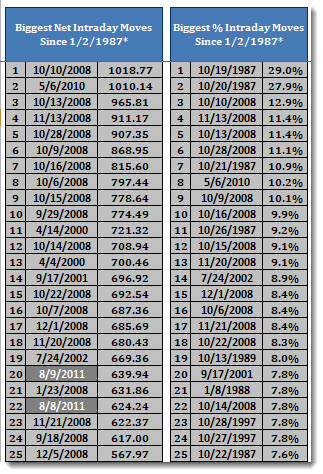
| Dow Jones Industrial’s Biggest Daily & Intraday Moves Posted: 09 Nov 2011 06:00 AM PST Today’s futures makes the latest missive from Andrew Horowitz of the Disciplined Investor all the more timely: How does all of the volatility these days compare historically to past market cycles? Looking at daily and intraday moves over a long period, 2008 has had some of the biggest daily moves, only second to the 1930′s. On a point basis, it has been significant. But from a historical perspective, the recent action does not make a big showing in the Top 25 on a percentage basis. First is a look at the biggest net point gains and percent moves on an intraday basis:
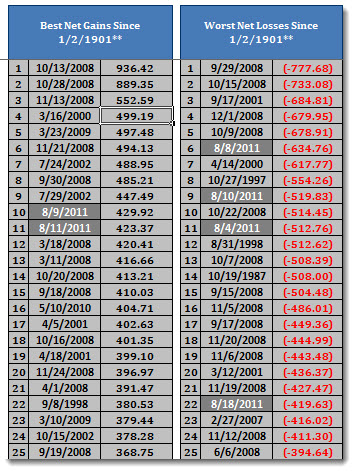
Next, the best and worst daily net point gains. Notice that there are several during 2011.
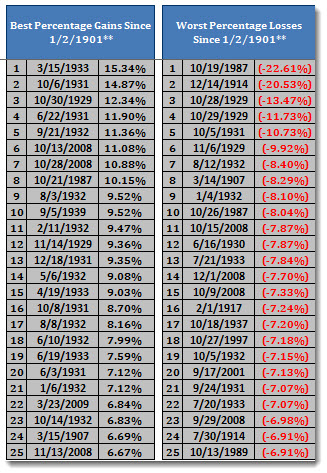
Finally, the best and worst days on a percentage basis. The 1930′s takes the award.
Source: The Disciplined Investor |
| Posted: 09 Nov 2011 05:49 AM PST Whether it was a realization that Italian politics are sclerotic regardless who the PM is or LCH Clearnet raising margin requirements for those trading all Italian government bonds, Italian yields are spiking. The moment of truth for Italy is now here with their yields 2 yrs and out firmly above 7%. As the WSJ reported today, a board member of Enel, the major Italian oil company, said it best, “It’s time to tell the truth to Italians. No.1: The party is over.” The party he’s referring to is the current Italian welfare state as the same parties are getting shut down in other countries. The bright side of this is the bond market is forcing change that can no longer be ignored. Italy is a big, wealthy country and it is in their power to liberate their economy and cut spending. In China, Oct CPI rose 5.5% y/o/y, in line with expectations but at the slowest pace in 5 months. PPI rose 5%, below the estimate of 5.8%. Both Retail Sales and IP rose solidly but slightly below the forecasts. The Shanghai index did rally on the inflation moderation but it’s still unclear at what level will satisfy Chinese officials to get them to ease policy as inflation is still very elevated. In the US, refi’s rose 12.1% in response to a further drop in mortgage rates to 4.22%. Purchases rose for a 3rd week to a 3 month high by 4.8%. II: Bulls 44.2 v 43.2 Bears 34.7 v 36.8 |
| Generation Recession: How the Recession May Change America Posted: 09 Nov 2011 05:30 AM PST |
| Global Warming Denier Turns Out to Be Sacha Baron Cohen in Character Posted: 09 Nov 2011 05:00 AM PST Craig Reucassel interviews comedy genius Sacha Baron Cohen in character as his latest creation: climate skeptic Lord Christopher Monckton From boingboing:
|



| You are subscribed to email updates from The Big Picture To stop receiving these emails, you may unsubscribe now. | Email delivery powered by Google |
| Google Inc., 20 West Kinzie, Chicago IL USA 60610 | |



0 comments:
Post a Comment