


The Big Picture |

- Real Free Market Capitalists Demand that Financial Fraud Be Prosecuted
- Post 20,000!
- Shades of Greenspan: ‘Bond King’ Bill Gross Finds Huge Flaw in Global Economy
- The US economy: A lost decade?
- Succinct Summation Of Week’s Events (11/18/2011)
- Fannie, Freddie and the Foreclosure Crisis
- Eurozone Debt Web: Who Owes What To Whom?
- Bad Lip Reading; Hilarity Ensues
- The Next Debt Ceiling Crisis
- Your Daily Update On European Bonds
| Real Free Market Capitalists Demand that Financial Fraud Be Prosecuted Posted: 18 Nov 2011 10:30 PM PST Adam Smith, Leading Austrian Economists and Other Free Market Advocates Are For the Prosecution of FraudThere is a widespread myth that free market supporters are against regulation or prosecuting fraud. In fact, Adam Smith – the father of free market capitalism – was for regulation of banks, and believed that trust is vital for a healthy economy. Because strong enforcement of laws against fraud is a basic prerequisite for trust, Smith would be disgusted by the lack of prosecution of Wall Street fraudsters today. Smith railed against monopolies and their corrupting influence. And Smith was pro-regulation, so long as the regulation benefited the little guy, as opposed to the wealthiest:
Richard Posner – one of the leading proponents over the course of many decades for removing the reach of the law from the economy – has now changed his mind. So has another leading proponent of deregulation and turning a blind eye towards fraud: Alan Greenspan. While some promoters of a fake version of Austrian economics are anti-regulation and against prosecuting fraud, the main Austrian economists were unambiguously for them. William K. Black – professor of economics and law, and the senior regulator during the S&L crisis – notes that leading Austrian free market economists said that fraud must be prosecuted:
Black also notes that fraud is a leading cause of financial bubbles and malinvestment – two of the greatest sins which Austrian economists rightly fight against. Unless financial fraud is prosecuted, bubbles will be blown … and when they burst, the economy will tank. Fraud – along with bad Federal Reserve policy – is what causes bubbles in the first place. The Proof Is In the Pudding: Fewer Prosecutions Equals a Worse EconomyThe economy is worse than it has been since the Great Depression, if not before. See the connection? See this and this. Everyone Supports Laws Protecting Contract and Private Property RightsEven the most radical free market advocates support laws protecting contract and private property rights. In other words, they support the judicial branch of government and the basic laws Congress passes to support such rights. There are obviously good, pro-competitive laws and bad, anti-competitive laws. Paul Craig Roberts – a true conservative, who was a Wall Street Journal editor and Assistant Secretary of the Treasury under Ronald Reagan, and is widely credited with being the "father of supply-side economics" – points out:
Do Anti-Law Advocates Really Want Anarchy?All sports need a referee. Some players will be bigger or more talented than others, which is great. They have a better chance of outcompeting the other guy and winning. But without basic rules and referees, ruthless players might use a knife or kick the other guy in the knee. Perhaps we could suspend all rules, and maybe everyone would whip out a knife break the other guy's kneecap. That's fine … but that's not the game of football. Radicals who believe that we should not have any laws against fraud are implicitly arguing for anarchy. They might not use that word, but that is what they're arguing for. But the same Founding Father who argued for periodic revolutions to keep the government honest also argued against tearing down something unless you have something better in mind to replace it? Thomas Jefferson, the most vocal advocate of the citizens' right to revolt to ensure honest government also cautioned against tearing something down unless it was for the express purpose of replacing it with something better. Real, deep-thinking anarchists (as opposed to those using fake anarchy philosophy in order to promote lawlessness by the super-elite) are not for destroying all organization. Instead, they argue for self-organization and self-regulation. See this, this and this. JP Morgan and Goldman Sachs aren't reining in one another's fraud. Bank of America and MF Global didn't police each other's fraud. Tepco and BP didn't make sure the companies made accurate reports about their safety measures. Solyndra and Koch Industries didn't guard against abuse by the other company. So if one wants to argue that the Federal government should not regulate financial players, fine (perhaps our country is too big and complex to manage, and the federal government has become too corrupt) … but who should? The states? Cities? Communities? Neighbors? Human beings have the ability to form social contracts. Our D.C. government has largely breached it social contract with the people. But we shouldn't tear down the federal government unless we replace it with something better. No one wants to tear down the state of organization so completely that we go back to monkeys (without the ability to talk), or one-celled critters . . . so the question is how do we want to organize? Do you want to live as a "savage"? In reality, the natives had survival skills, cultural traditions, and knowledge developed over many hundreds or thousands of years (including knowledge gained before the migration from Asia to America), stored in the database of oral traditions. The settlers had traditions and knowledge as well. If we tear away all of that organization, life is going to be pretty challenging. It is easy for a teenager to criticize his parents, but a lot harder to actually create a better adult life for himself. A teenager looks silly and immature when he criticizes everything his parents do without understanding the challenges he'll face as an adult. But a young person who rebels against his parents and then creates a better adult life is doing important and heroic work. In other words, anarchy as an economic model could work if economic players organized in such a way as to police against fraud and criminal behavior (the equivalent of pulling out a knife or taking out someone's kneecap in the middle of a football game). This is a long-winded way of saying that we should not stop the government from enforcing fraud laws unless we come up with a more effective way to stop fraud. |
| Posted: 18 Nov 2011 03:30 PM PST Holy, Shnikes! While I wasn’t paying attention, I just past my 20,000th post. That is beyond my imagining . . . |
| Shades of Greenspan: ‘Bond King’ Bill Gross Finds Huge Flaw in Global Economy Posted: 18 Nov 2011 01:55 PM PST |
| The US economy: A lost decade? Posted: 18 Nov 2011 12:54 PM PST BBC: |
| Succinct Summation Of Week’s Events (11/18/2011) Posted: 18 Nov 2011 12:30 PM PST Succinct summation of week’s events: Positives:
|
| Fannie, Freddie and the Foreclosure Crisis Posted: 18 Nov 2011 12:00 PM PST Here is a different view of the GSEs from Kevin Park, a doctoral student at the University of North Carolina at Chapel Hill (bio below) ~~~ The mortgage giants Fannie Mae and Freddie Mac are not blameless in the foreclosure crisis, but the case against them is also often misunderstood and exaggerated. In September of 2008, the Federal Housing Finance Agency placed Fannie Mae and Freddie Mac into conservatorship, reestablishing government control over the giants of the American housing system. Together, these institutions hold roughly $5.3 trillion in home mortgages, nearly half the entire market. The causes behind their failure have been and will continue to be much debated. Below is a discussion of facts related to Fannie and Freddie's role in the current housing crisis. The accumulation of evidence suggests that profit, not policy, pushed these players like many others into treacherous territory and risky products not borrowers led to their collapse. HistoryUnderstanding the origins of the federal government's role in the secondary mortgage market is important in discussing the cause of the current crisis. The goal to bring stability and liquidity to the housing and banking sectors is just as relevant today as it was in the 1930s.  Before the Great Depression, most Americans financed their homes using interest-only mortgages that had to be rolled-over every 3 to 15 years. The banking crisis of the early 1930s prevented many borrowers from finding the credit needed to meet the unpaid principal at the end of their loan, leading to a massive number of foreclosures. As part of the New Deal, Congress enacted the National Housing Act of 1934, which created the Federal Housing Administration (FHA) to insure mortgages. Through the assumption of credit risk and standardization of loan products and underwriting standards, the federal government enabled longer-term (20- and 30-year), self-amortizing loans with higher loan-to-value (LTV) and lower interest rates. The act also authorized FHA to create a government agency to purchase these federally-insured mortgages, thereby providing liquidity to the housing market and banking system. The Federal National Mortgage Association (“Fannie Mae”) was chartered in 1938.  For thirty years Fannie Mae operated as a government agency, then in 1968 it was converted into a private corporation in order to reduce the apparent size of the federal budget. Legislation in 1970 created Fannie Mae's twin, the Federal Home Loan Mortgage Corporation (“Freddie Mac”), and also enabled the two companies to purchase conventional (not federally-insured) mortgages. While private shareholder-owned corporations Fannie and Freddie still retained an implicit guarantee of government assistance (a guarantee that would be realized in September 2008). This implied support enabled the companies to borrow at below-market rates. How much of this effective subsidy went to lowering costs to borrowers versus increase profits for shareholders is still debated. For example, a 2001 CBO study found Fannie and Freddie retained 35%-37% of the subsidy's value. In 1971, Freddie Mac issued its first mortgage-backed security. Fannie Mae did not issue securities until 1981, but this form of finance quickly became standard practice. The share of home mortgage debt held in mortgage pools backed by Fannie, Freddie, and Ginnie Mae (a similar organization that remains a government agency) increased from 2.1% in 1971 to 40.5% in 1991. Of course, most of the growth in these implicitly subsidized government-sponsored enterprises (GSEs) came at the expense of traditional banks and thrifts, which have an explicit guarantee in the form of federal deposit insurance. CompetitionFannie and Freddie were highly profitable throughout the 1990s and their activities came to dominate the housing market. But financial innovation, such as the introduction of collateralized debt obligations, and de-regulation, such as the repeal of the Glass-Steagall Act and deliberate exclusion of credit default swaps from oversight, began creating competition from private-label securities (i.e. non-agency mortgage-backed securities).  Fannie and Freddie were losing business and market share. Without the implicit government guarantee, private-label mortgage-backed securities had always been seen as riskier investments than those issued by Fannie and Freddie. But innovative financiers discovered that by giving different levels of priority to the shares, or “tranches,” of a security, along with corresponding rates of risk and return, they could shield a particular income stream from loss. A single security would be divided into higher risk tranches that would absorb earlier losses and lower risk tranches that would be hit only once the others were exhausted. Additional insurance against losses was obtained through derivatives like credit default swaps, where for a fee one company (e.g. AIG) would compensate another for defaults in an investment. Consequently, these investments were considered “safe” enough to warrant AAA credit ratings— that is, there was virtually no predicted risk of loss, despite being built on high risk subprime mortgages. It appeared as if investors could have safety comparable to U.S. Treasury bonds, but with significantly higher returns. Not surprisingly, these new investments grew rapidly. Data from Inside Mortgage Finance shows that between 2003 and 2006, the private-label share of mortgage-backed security issuance increased from 21.6% to 56.0%, overtaking Fannie and Freddie. Over this time, the private financial sector accounted for 72.1% of the total increase in mortgage-backed securities outstanding and 54.6% of the increase in overall home mortgage debt. The increase in market share was directly at the expense of Fannie and Freddie. In part, this was due to internal issues. A 2004 investigation by the Office of Federal Housing Enterprise Oversight (OFHEO, now FHFA), found significant accounting problems and inadequate credit risk management. As a result, Fannie and Freddie were forced to accept portfolio restrictions and increased capital requirements. But more generally, Fannie and Freddie were being crowded-out by less regulated secondary mortgage market players. Over 97% of the increase in private-label securities was backed by subprime and Alt-A loans. Because these subprime and Alt-A loans accounted for most of the growth in mortgage lending during the housing bubble, Fannie and Freddie were pushed to the sidelines. Between 2003 and 2006, Fannie and Freddie (and Ginnie Mae) accounted for just 27.9% of the increase in mortgage-backed securities and 13.9% of overall home mortgage debt. Fannie and Freddie were aware early on about what the increase in competition from less regulated market players meant for their bottom-line. Fannie Mae's 2004 SEC filing states: “Potential Decrease in Earnings Resulting from Changes in Industry Trends. The manner in which we compete and the products for which we compete are affected by changing trends in our industry. If we do not effectively respond to these trends, or if our strategies to respond to these trends are not as successful as our prior business strategies, our business, earnings and total returns could be adversely affected.” [emphasis added] Between 2003 and 2006, Fannie and Freddie's combined net income was cut in half. Even among lending to low- and moderate-income borrowers, Fannie and Freddie lagged the market, despite statutory requirements to devote a certain portion of their business to such underserved borrowers (see insert). Neither Fannie nor Freddie had much trouble meeting these affordable housing goals, exceeding the Low- and Moderate-Income Goal every year until 2008. However, a review by the Federal Housing Finance Agency (FHFA) found that these goals were generally set below their estimates of the actual market between 2002 and 2006. Between 2003 and 2005, near the peak of the housing market, Fannie and Freddie exceeded their affordable housing goals but were still following the market. Moreover, FHFA's estimates of the market excluded B- and C-grade mortgages (i.e. subprime loans) that were deemed too risky for Fannie and Freddie's portfolios. Consequently, Fannie and Freddie were less concentrated in lending to low-income borrowers and neighborhoods than the private market in the years leading up to the housing crash. Affordable Housing GoalsCongress enacted the Federal Housing Enterprises Financial Safety and Soundness Act of 1992 in order to exercise better oversight over the institutions as well as to promote low-income homeownership. Congress believed that, given the effective subsidy they received, Fannie and Freddie should be discouraged from disproportionately concentrating in high-income markets. The Safety and Soundness Act mandated three affordable housing goals: Low- and Moderate-Income Goal – Individuals earning no more than the area median income. Underserved Areas Goal – Individuals residing in lower income areas (90% of area median income in metropolitan areas), or higher minority areas (minority share 30% or more and median income no more than 120% of area median). Special Affordable Goal – Individuals earning no more than 60% of area median income or residing in low-income neighborhoods and earning no more than 80% of area median. Fannie and Freddie were each required to devote a certain share of their business, roughly equal to their projected share of the overall “affordable” mortgage market, to each of these goals, although a single loan could be counted for multiple goals. Fannie and Freddie purchased risky loan products. As pressure mounted on their market share, Fannie and Freddie increased their purchases of nontraditional, higher risk mortgages, including investments in Alt-A loans and in private-label securities. Alt-A mortgages are loans to borrowers with good credit but using nontraditional underwriting standards. For example, Alt-A loans often use no or limited documents of income and assets. Originally, this practice was implemented to accommodate self-employed borrowers, but it could also be abused. A Federal Reserve review states that 50% to 60% of Alt-A loans generally involves low documentation, but that share increased to 78% by the end of 2006. Fannie Mae's 2008 Credit Supplement documents the weakened underwriting standards for loans purchased in 2005 and 2006 compared to earlier vintages. For example, Alt-A loans represented just 7.1% of mortgages from 2004 and earlier, but increased to 18.9% in 2005 to 2006. The prevalence of interest-only and negative amortization loans increased from 2.3% to 14.6%. Adjustable-rate loans increased from 8.5% to 14.9%.  Fannie and Freddie also started purchasing private-label mortgage-backed securities, inverting the process that had been in place for three decades whereby the agencies bought whole loans to securitize and sell to investors. According to FHFA's Annual Report to Congress, Fannie and Freddie purchased $5.7 billion in private-label securities in 1997, or about 4.8% of new issuance. The volume continued to grow in the 2000s, peaking at $221.3 billion in 2005. However, Fannie and Freddie never accounted for more than a quarter of private-label security purchases in a given year and that share was falling as yield spreads on private-label securities declined and real estate prices approached their peak. Alt-A loans and mortgage-backed securities are investments that seemed low risk at the time, by virtue of high borrower credit scores or credit rating agency determinations. For example, the average FICO score on an Alt-A mortgage originated between 2005 and 2007 held by Fannie Mae is 715, a reasonably strong score. Similarly, while built on risky mortgages, Fannie and Freddie generally limited themselves to theoretically lower risk senior tranches of mortgage-backed securities. Fannie Mae's 2006 SEC filing states that over 90% of its private-label mortgage-backed securities as of June 30, 2007 were rated AAA by Standard & Poor's and Moody's. ConservatorshipFar from being “contained,” losses from subprime lending and related derivates triggered a financial crisis in the fall of 2008. In September, giants like Merrill Lynch, Lehman Brothers, AIG, Washington Mutual and Wachovia were either sold, rescued, or collapsed. In addition, OFHEO effectively nationalized Fannie and Freddie by placing them into conservatorship. As of September 2010, the bailout of the agencies has cost nearly $148 billion. Losses in securities investments led to collapse. Most of the mortgage-backed securities held by Fannie and Freddie for their portfolio were highly rated by credit rating agencies. However, beginning in 2007, these agencies began massive downgrades of such securities. The Financial Crisis Inquiry Commission reports that between 2008 and 2009 Moody's downgraded 80% of the tranches it originally rated AAA. Mark-to-market policies required Fannie and Freddie to reduce the reported value of their investments, causing massive losses. Fannie and Freddie's Capital Markets segments, which include purchases of mortgage-backed securities, combined for a loss of over $57 billion in 2008 alone, accounting for over half of net losses that year. Fannie and Freddie's insolvency was triggered by a combination of undercapitalization and downgrades in their investments in private-label securities. Since 2008, as the financial crisis spread into the real economy, house price declines and high unemployment have caused losses in even their single-family book of business. However, even here losses are being driven by nontraditional loan products, not lending to low- and moderate-income borrowers. Single-family losses driven by nontraditional loans not lower income borrowers. Despite accounting for less than 12% of Fannie and Freddie's single-family portfolio, Alt-A loans have accounted for 40% to 50% of their total credit losses in 2008 and 2009. Alt-A loans are typically not targeted at low- and moderate-income borrowers. Fannie Mae's 2007 Investor Summary indicates the average value of property behind an Alt-A loan was over $250,000, substantially greater than other high risk loan categories and over 15% greater than the median sales price for all existing single-family homes that year. In addition, Alt-A loans typically have low loan-to-value (LTV) ratios. The average original LTV for an Alt-A loan held by Fannie Mae in 2007 was just 73.1%, implying a substantial downpayment unusual for lower income borrowers.  Without going to low-income borrowers or neighborhoods, Alt-A loans are not likely to contribute towards affordable housing goals. In fact, by increasing the overall book of business, the “denominator” when calculating housing goals, Alt-A loans actually worked against Fannie and Freddie's efforts to meet the goals. Such loans were, however, highly profitable until the market collapsed. Agency loans are performing better than the private market. Fannie Mae's 2010Q2 Credit Supplement shows 4.99% of their overall book was seriously delinquent (90+ days late or in foreclosure) as of June 2010. That includes 13.35% of borrowers with credit scores under 660 and 12.03% of all loans with any high risk feature (Alt-A, interest-only, high LTV, etc). For comparison, the Mortgage Bankers Association reports that the serious delinquency rate for subprime loans was over 28%. The fact that subprime loans have delinquency rates twice that of even high risk agency loans suggests that there is in fact a categorical difference between the two. The riskiness of loan product is as important as the risk factors of the borrower. SummaryThere is clear evidence that Fannie and Freddie started purchasing lower quality loans at the peak of the housing market. However, it is also evident that they did so to regain market share from less-regulated private-label security issuers and finance companies. Housing goals do not appear to have played a significant role because Fannie and Freddie remained less concentrated in low-income market segments compared to the private market. Still, the high LTV, low FICO score, and alternative documentation loans that Fannie and Freddie purchased are performing significantly better than private subprime loans, suggesting the enterprises retained stronger risk management procedures than private financial companies. Ultimately, profit not policy was what motivated Fannie and Freddie and loan products not borrowers were what caused their collapse. These facts have important implications for reform of the housing system, including countercyclical liquidity and how to approach low-income homeownership in the future. Revised September 2010 By Kevin Park, graduate research assistant for the UNC Center for Community Capital and doctoral student in the Department of City and Regional Planning, both at the University of North Carolina at Chapel Hill |
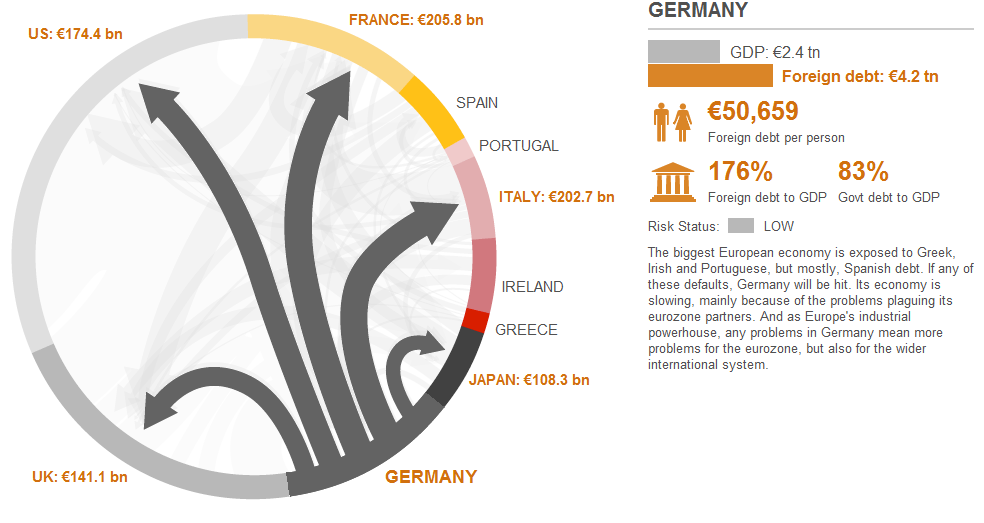
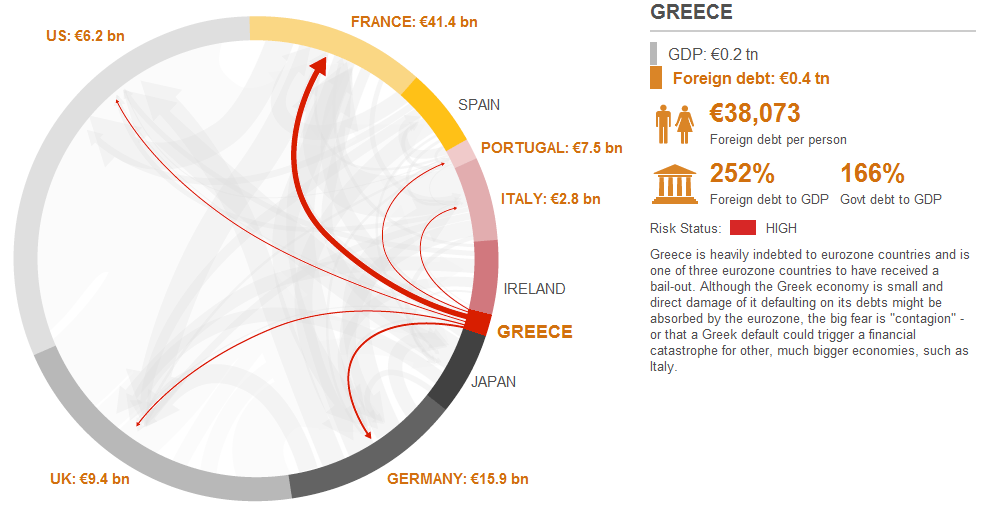
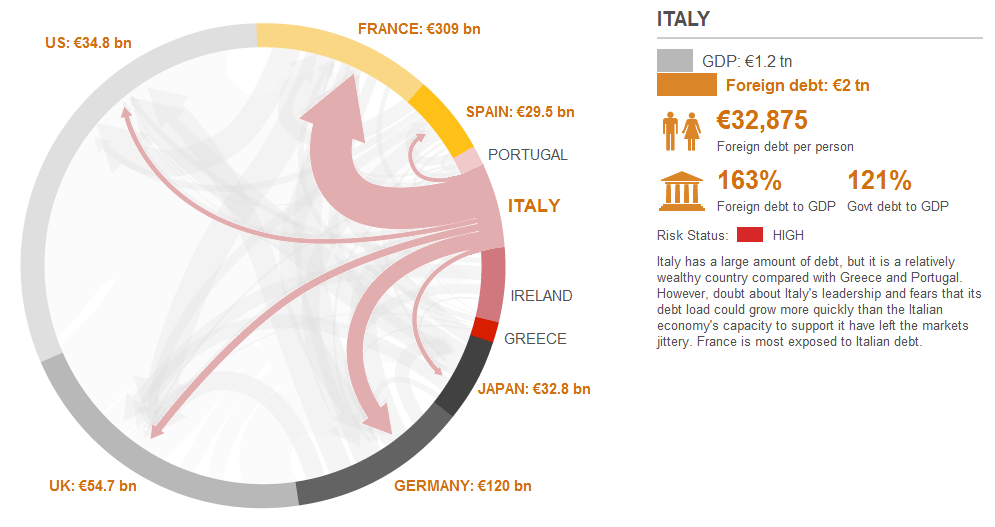
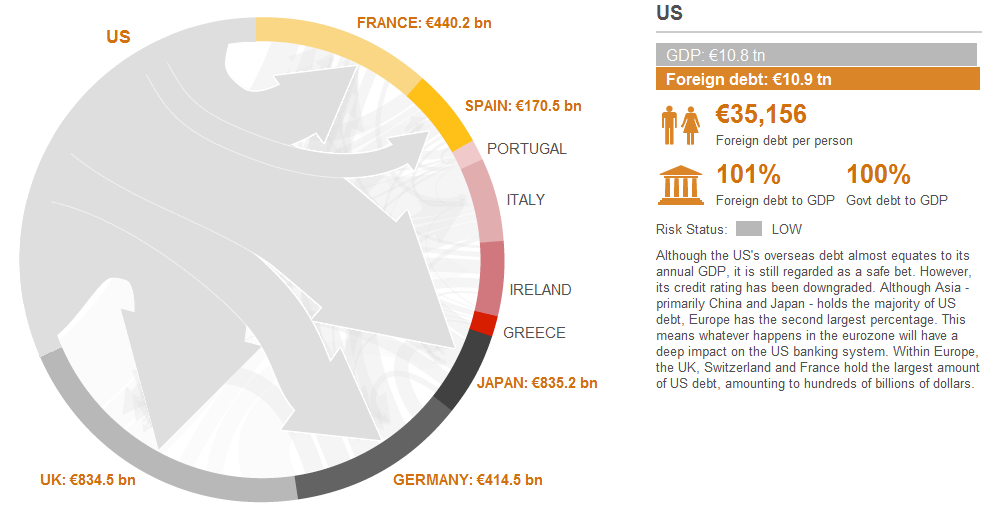
| Eurozone Debt Web: Who Owes What To Whom? Posted: 18 Nov 2011 11:00 AM PST Chlick to enlarge: ˜˜˜ ˜˜˜ ˜˜˜ Source: Eurozone Debt Web: Who Owes What To Whom?
Hat tip Invictus |
| Bad Lip Reading; Hilarity Ensues Posted: 18 Nov 2011 09:40 AM PST Brace yourself for absurdist hilarity > Herman Cain: ~~~ Rick Perry ~~~ “Trick The Bridesmaid” — a Bad Lip Reading of Barack Obama ~~~ Michele Bachmann ~~~ There’s more at Bad Lip Reading You Tube Channel |
| Posted: 18 Nov 2011 09:00 AM PST
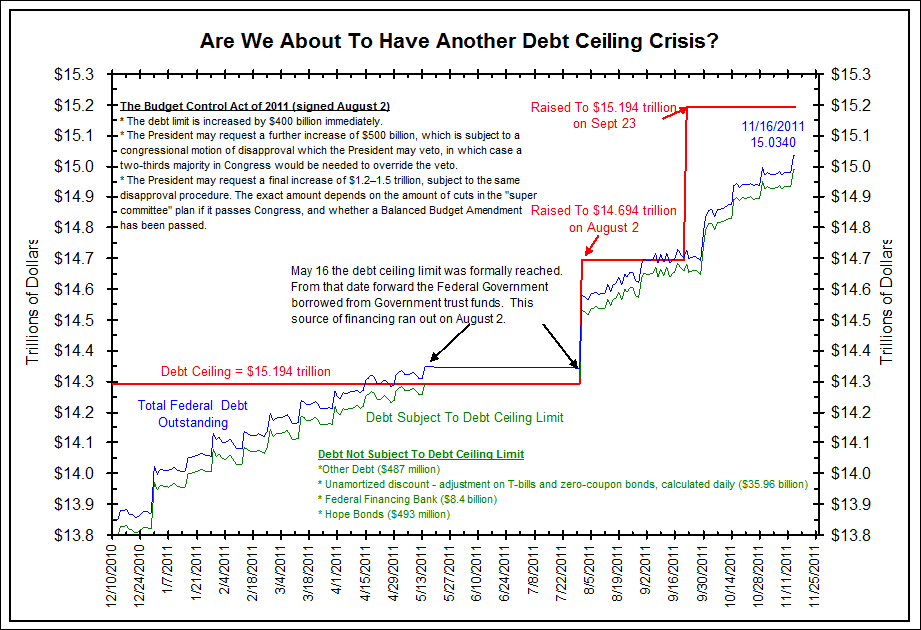
> Earlier this week, the total debt in the U.S. topped $15 trillion ($14.98 trillion of which counts against the debt ceiling). This makes the U.S. just a few ticks away — $200 billion,practically a rounding error in DC terms — away from the current ceiling. Estimates for based on current pace of debt accumulation are that the ceiling should be reached around New Year’s Eve, plus or minus a day. To raise this ceiling, the Super Committee must agree to $1.2 trillion in debt reduction over the next 10 years. No one is particualrly optimistic about the prospects for this occurring. Will early August's default talk return once again? See also Wall Street Journal: Deficit Stalemate Signs Rise; |
| Your Daily Update On European Bonds Posted: 18 Nov 2011 08:00 AM PST
> Wall Street Journal – European Bonds Under Pressure
The Wall Street Journal – The Culture War Over Europe's Money
Comment The chart below is the metric that the London Clearinghouse now uses to determine when to hike margin rates. Should Spanish yields exceed 4.50%, history says LCH will hike rates. This was the case last week with Italy. Considering that Spain is only 44 basis points from this level and Spanish yields are 50 basis points higher just this week, this might only be a few days away.
Source: |


| You are subscribed to email updates from The Big Picture To stop receiving these emails, you may unsubscribe now. | Email delivery powered by Google |
| Google Inc., 20 West Kinzie, Chicago IL USA 60610 | |



0 comments:
Post a Comment