


The Big Picture |

- America’s Next TARP Model
- One Big Greek Post
- The Smaller Lies
- 10 Thursday PM Reads
- Cool Cars From The Tokyo Motor Show
- Recessions And Unemployment Rates 1929-2011
- Stand with Science Today
- Withholding-Tax Collections Look Solid
- QOTD: System Crash
- Bono on Aids: Getting to Zero
| Posted: 02 Dec 2011 02:18 AM PST A Bloomberg report reveals that the U.S. government loaned banks $7.7 trillion in secret bailout funds at no interest and then borrowed the money back at interest. TDS, 07:53 Thursday December 1, 2011 |
| Posted: 02 Dec 2011 01:00 AM PST
˜˜˜ ˜˜˜ ˜˜˜ ˜˜˜ ˜˜˜ ˜˜˜ ˜˜˜ |
| Posted: 01 Dec 2011 04:30 PM PST Barry did a masterful, comprehensive job of exposing The Big Lie for what it is. And although these zombie lies, regrettably, never really die, it is imperative that the facts be made known. There are many other lies of varying sizes still out there, both large and small. That unsubstantiated talking points become conventional wisdom via the echo chamber in which they’re repeated is very troubling, though it has become the reality in which we live. Personally, I find it repugnant no matter who is doing it. What follows is but the latest chapter in a saga I’ve been following for some time — how some folks view Americans who have fallen on hard times. I wrote here, in March 2010 (and not for the first time*), about what I thought were absurd claims about how extending unemployment benefits were nothing more than a disincentive to the unemployed to find work and that folks found new work toward the tail end of their benefits or just after they expired. At the time, Senator Jon Kyl had said that unemployment relief "doesn't create new jobs. In fact, if anything, continuing to pay people unemployment compensation is a disincentive for them to seek new work." Tom DeLay agreed with the notion that people were unemployed because they want to be. I followed that piece up here shortly thereafter when the San Fran Fed release a study showing that an “analysis of unemployment data suggests that extended unemployment insurance benefits have not been important factors in the increase in the duration of unemployment or in the elevated unemployment rate.” Finally, a few months ago, I posted about a WSJ story that cited yet another report: “There's a chance extended benefits actually increase the number of Americans who find new jobs, according to the study.” Well, now we have the states of Washington [pdf] and Connecticut [pdf] publishing separate reports that have tracked their respective unemployment insurance exhaustees. The news is not good, but it does starkly repudiate the claim that folks are unemployed because they want to be or that extending benefits is a disincentive to find work. First, from the Washington report (emphasis mine):
Let’s recap: Of UI exhaustees, only 1 in 4 had found work, and 80 percent of those did so at about 70 percent of their pre-unemployment wages. From the Connecticut study (pdf, emphasis mine):
Worth noting is that both studies found the same percentage — 25 percent — of exhaustees had found new work. Looked at the other way, it implies that 75 percent of those who exhausted their benefits remained unemployed, some perhaps voluntarily (i.e. retirement), most probably involuntarily. Connecticut also found the majority of the exhaustees who found work doing so at lower wages:
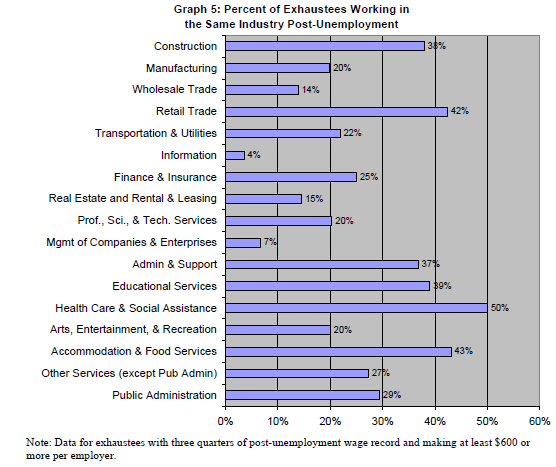
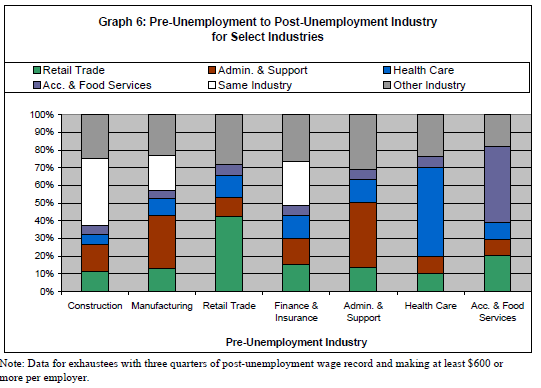
The Connecticut study also found an apparent willingness — dare I say necessity — by individuals to cross industry lines to take work, as few tend to find employment in the same industry they left (e.g. 75 percent of those in Finance and Insurance — a big industry in Connecticut — did not resurface in that sector):
Here is a graph showing the cross-industry movement:
Conclusion of the Connecticut report:
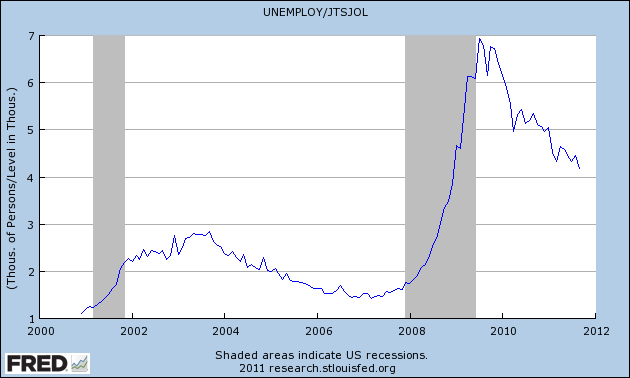
Also, we can easily see that as the recession unfolded, the sheer number of unemployed simply swamped the number of job openings, which should have been fairly self-evident to anyone who was paying attention. Below is the number of unemployed per job opening over the past decade:
So, what planet do you have to live on to believe the canard that for most of the unemployed it’s a matter of choice? That people milk the system for what they can and then find a new job in the waning weeks of benefits or just after they expire? That it’s a choice to be unemployed and then go back to work for 75 percent or less of what you were previously making? Can we get serious here? Americans are not lazy and want to work — just give them a chance. Of course there are going to be people who game the system — there always have been and always will be (and is it really controversial any more to assert that the system is being gamed far more — and for much, much bigger dollars — at the top of our capitalist structure than at the bottom?). But it is simply offensive to claim that the majority of Americans who have fallen on hard times and had to rely on our social safety nets are doing so as a matter of choice and because they want to, because they’re happy to suckle at the public teat. And it’s particularly hypocritical coming from a group that tends to hurl the pejorative “unpatriotic” at the drop of a hat. (*All of my prior work at another venue — Blah3.com, where I cut my teeth starting in the mid-aughts — appears to have been lost in some sort of web-hosting disaster. It is my hope that Don will somehow be able to recover what’s been lost. If not, I will be bummed beyond words.) |
| Posted: 01 Dec 2011 02:00 PM PST Afternoon train reading:
What’s on your iPad? |
| Cool Cars From The Tokyo Motor Show Posted: 01 Dec 2011 01:45 PM PST |
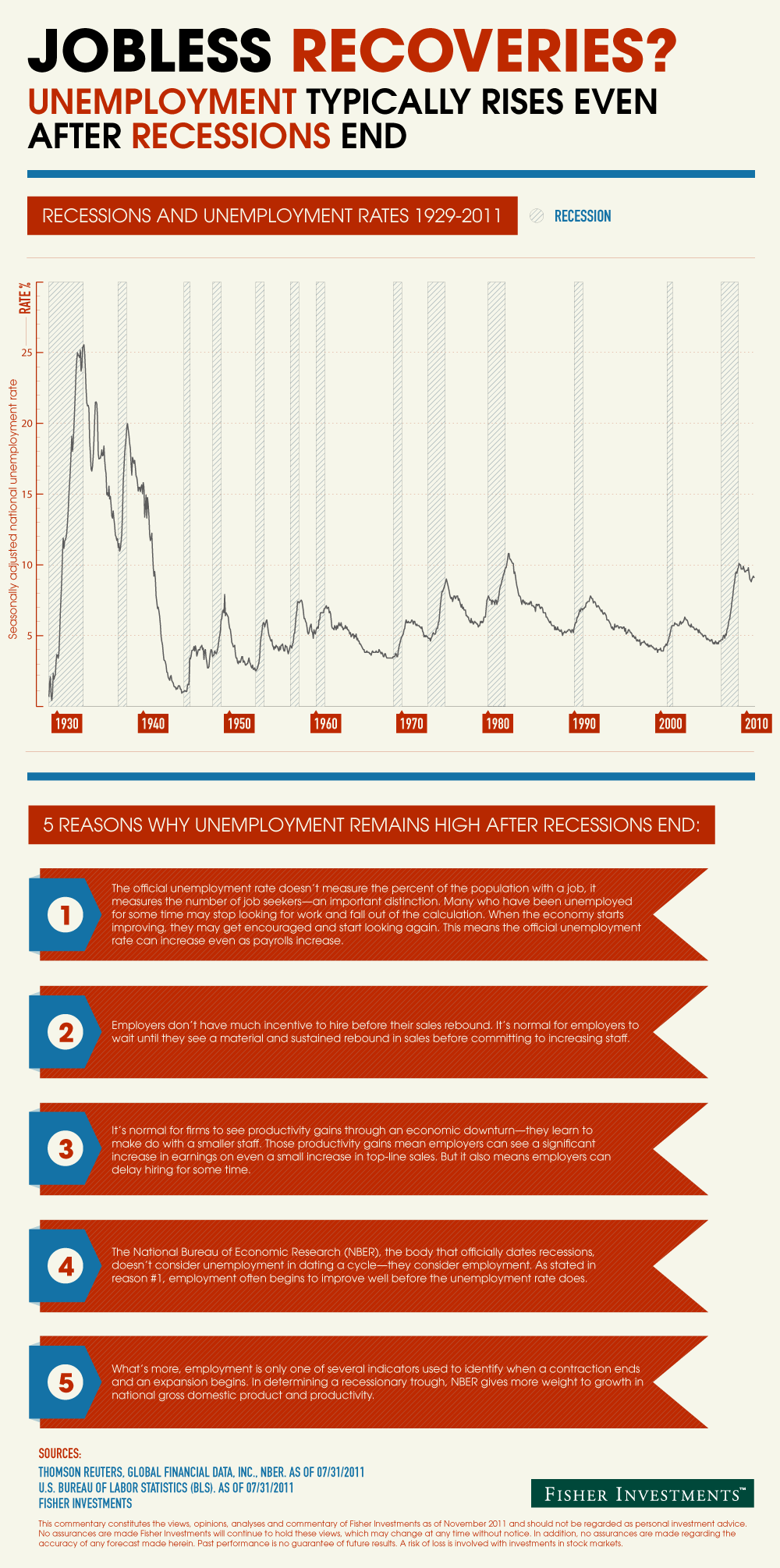
| Recessions And Unemployment Rates 1929-2011 Posted: 01 Dec 2011 11:30 AM PST Click to enlarge: |
| Posted: 01 Dec 2011 10:00 AM PST Visit http://www.standwithscience.org/ We encourage everyone–grad students, former grad students, and all other supporters of science–to sign the letter. Tell Congress how important it is to choose cuts carefully and avoid ruining our future while attempting to save it. |
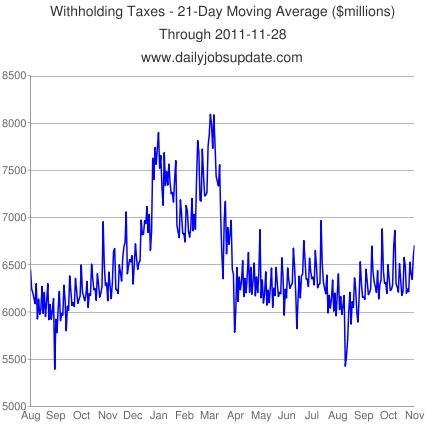
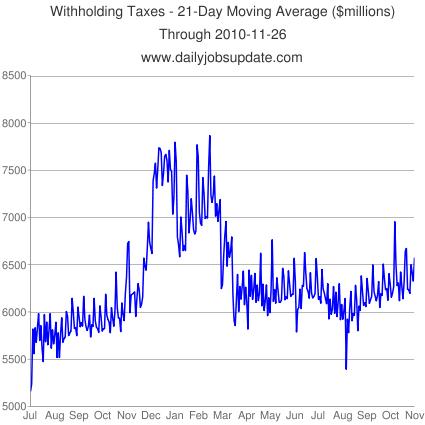
| Withholding-Tax Collections Look Solid Posted: 01 Dec 2011 08:30 AM PST Matt Trivisonno is an astute observer of tax withholding data. In advance of tomorrow’s NFP, he shares the following charts with us: In the first chart attached, you can see the 21-day moving average of federal withholding-tax collections is on an upswing since the summer. But that happens every year, so let’s see how this year’s holiday upswing in payrolls looks compared to last year’s.
If you line up the second chart beneath, you will see that employment seasonality is almost identical to last year’s. Of course, we had a large payroll-tax cut this year, so it’s safe to assume that the first chart would be much stronger if not for that.
Now, if you look closely at the last two months worth of data on the charts, you will see that the moving average was slightly more perky in October and November this year. And that makes sense because we have 1.5 million more workers on payrolls than we did at this time last year. And those people have more money to spend this year. While markets have been roiled by events in Europe, there does not yet appear to be any impact at all on the US economy using the withholding-tax collections as our yardstick. And there doesn’t seem to be much risk of a nasty surprise in Friday’s job’s report, though anything is possible of course. Source: |
| Posted: 01 Dec 2011 08:00 AM PST Hey! I am my own quote of the day:
heh heh |
| Posted: 01 Dec 2011 07:30 AM PST Bono on the Daily Show ~~~ getting AIDS to Zero Getting to Zero – AIDS Out Life In @abhishek shah View more presentations from Abhishek Shah |








| You are subscribed to email updates from The Big Picture To stop receiving these emails, you may unsubscribe now. | Email delivery powered by Google |
| Google Inc., 20 West Kinzie, Chicago IL USA 60610 | |



0 comments:
Post a Comment