


The Big Picture |

- Inside the 1% (Big PIcture Conference)
- Louie C.K.
- Succinct Summation of Week’s Events (12/16/2011)
- Media Consolidation: The Illusion of Choice
- Year-end Holiday Season Rallies + Some Bullish Indicators
- Interest Rates: 1831-2011
- BlueCrest’s Platt: European banks are ‘insolvent’
- Friday Reads
- Fannie, Freddie Execs Charged with Securities Fraud
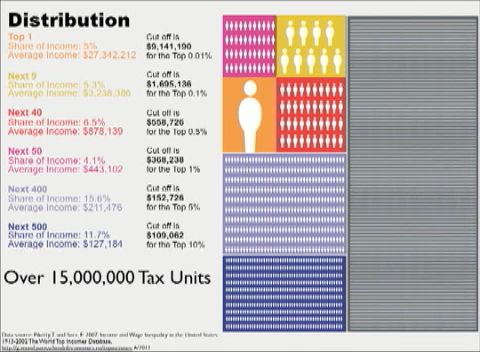
| Inside the 1% (Big PIcture Conference) Posted: 16 Dec 2011 03:30 PM PST All of the Big Picture conference videos are now available. Here is the latest video posted: The One Percent: Breaking Down US Wealth Distribution.
~~~ Watch all of the Big Picture Conference for $39.95 or choose just the speakers you want to see on FORA.tv | |
| Posted: 16 Dec 2011 01:00 PM PST He brushed aside college and went straight to the clubs. He went all in, like a gambler in Vegas. And his career was riddled with one failure after another, can you say “Pootie Tang”? But he kept on keepin’ on and now he’s the number one Internet sensation, I’ve gotten more e-mail about the distribution of his Beacon show on the Net than any other subject in months. What have we learned? 1. It’s a long way to the top if you wanna rock ‘n roll. You can go on a TV show, your name can be known by millions, but that doesn’t mean you’ve got any staying power. If you want a notch in your belt, a line in your resume, go for instant fame… But I’ve got to tell you, so many of the flashes in the pan, especially the reality TV stars, are ashamed of their notoriety and would give anything to have it fade away and never radiate. Sure, there are those still trumpeting their moment in the sun, but they’re such creepy losers we want nothing to do with them. To be great, you’ve got to make mistakes. Louie’s FX show may have been nominated for an Emmy, but “Lucky Louie” on HBO was canceled and forgotten. It’s kind of like signing a major label deal and failing to connect and going out and making it anyway. But today people want the label to do all the work and are sour grapes when they don’t make it. No one arrives instantly formed. I’ve known of Louie for years, but only now has he connected, only now, having matured in years, has he refined his comedy to the point where the masses can relate. He hasn’t forgone his edge, but now he can show his heart. Someone sent me a Kickstarter campaign for an 11 year old who wants to make a CD. That’s what I want to hear, the wit and wisdom of middle school. Why do we keep on listening to the prognostications and idiocies of the young and stupid when anybody with a brain knows that wisdom comes with age? What is Kim Kardashian gonna do in ten years? The same thing Paris Hilton is doing. Drugs. And trying to find a spot in a society that has no place for her. 2. It’s all about your tribe. Without a fan base, without an audience, Louis C.K.’s Beacon video would have fallen on deaf ears. You can pay a publicist to get you on “Entertainment Tonight”, just don’t expect anybody to care. People still believe if you can just cross that threshold, you’re in the club. And the way to get there is by signing a deal with a major or working the publicity angle so damn hard that everybody knows you and you’re made. But you’re not. Linda Chorney may have gamed the Grammy system, may have even gotten a bit of mainstream publicity, but is anybody listening to her music, has she gained any real fans? No. So she can post her nomination certificate on her wall, has a story to It’s easy to be famous. It’s hard to have fans. The Internet video sale only worked because Louie had fans. First and 3. Publicity is a byproduct, it comes after the fact. I guarantee you Louie had no idea this story would become an Internet This is the story of the 99%. We want to embrace our own, put them on 4. This is proof of concept. That you can do it without the machine. But don’t expect the 5. Trust is key. Louie didn’t try to screw his customers with DRM and regional locks. 6. The future. This is a milestone. Radiohead’s pay what you want model wasn’t One of the reasons artists have lost power is they no longer lead. People are excited by the possibilities Louie C.K.’s move has But no one’s gonna care if you don’t have the goods. A great marketing And a great artist doesn’t repeat what someone else has already done The dam has been opened. But really, only a trickle has seeped out. But our entire nation, the whole world is sick and tired of being Buy The Thing: https://buy.louisck.net/ The Reddit Q&A: http://bit.ly/s9ZGMB A synopsis of the story (so you don’t have to read the entire Reddit AND MOST IMPORTANTLY, LOUIE’S STATEMENT: https://buy.louisck.net/statement – http://www.twitter.com/lefsetz – http://www.lefsetz.com/lists/?p=subscribe&id=1 I | |
| Succinct Summation of Week’s Events (12/16/2011) Posted: 16 Dec 2011 12:30 PM PST Succinct summation of week’s events: Positives:
Negatives:
| |
| Media Consolidation: The Illusion of Choice Posted: 16 Dec 2011 11:15 AM PST | |
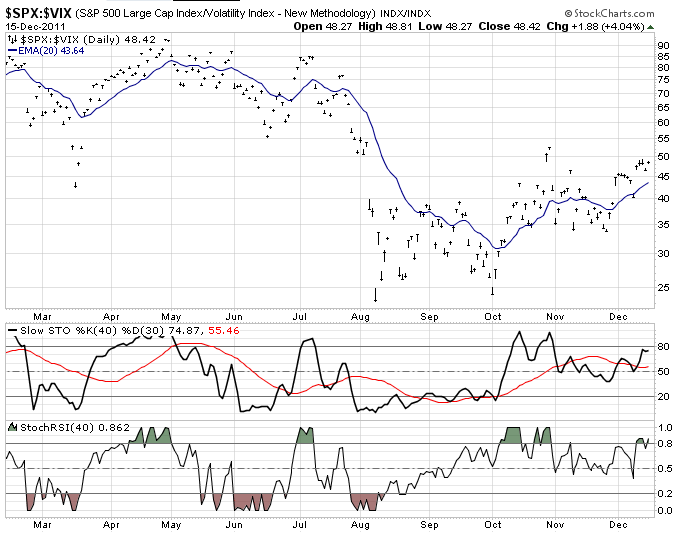
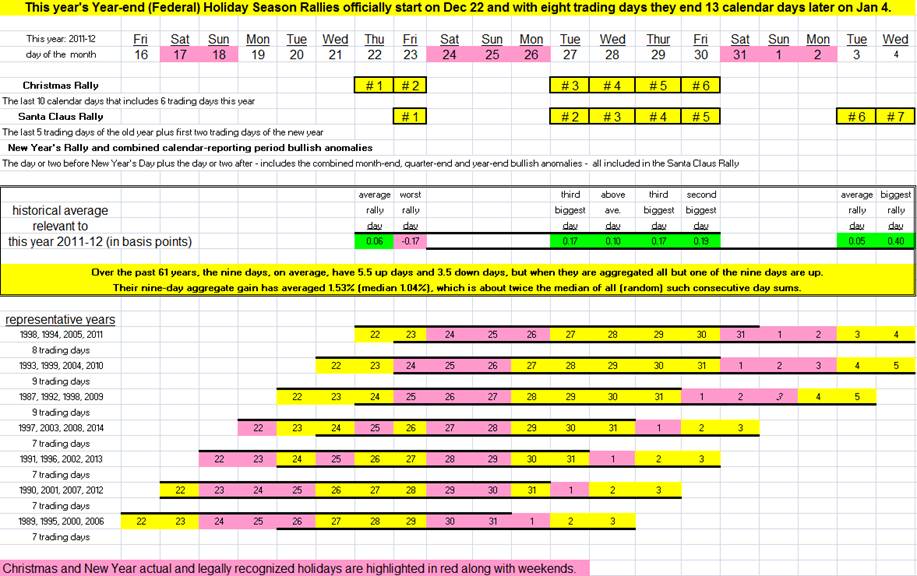
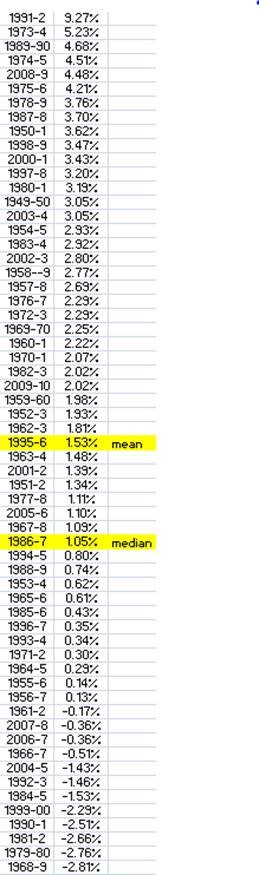
| Year-end Holiday Season Rallies + Some Bullish Indicators Posted: 16 Dec 2011 10:30 AM PST In addition to other bullish coincident economic data reported yesterday, initial unemployment claims, which are a leading economic indicator, are especially noteworthy. They are a good precusor to the popularly-followed payroll, or jobs, report, a coincident economic indicator. The December data will be reported in 14 trading days on Jan 6, just two days after the usually strongest two-day ending of the Year-end Holiday Season Rallies, which appears to have started yesterday, or two days earlier than usual. Both are detailed in the table below. Click to enlarge: Here's an important technical indicator that is making new three-week highs, also suggesting the same is coming for the stock market. Typically astute put-and-call option writers, who determine the stock market's implied volatility as reflected by the VIX, are fading the stock market's past five-to-eight days decline. This is an unusual divergence that is bullish for the stock market over the days and weeks ahead.
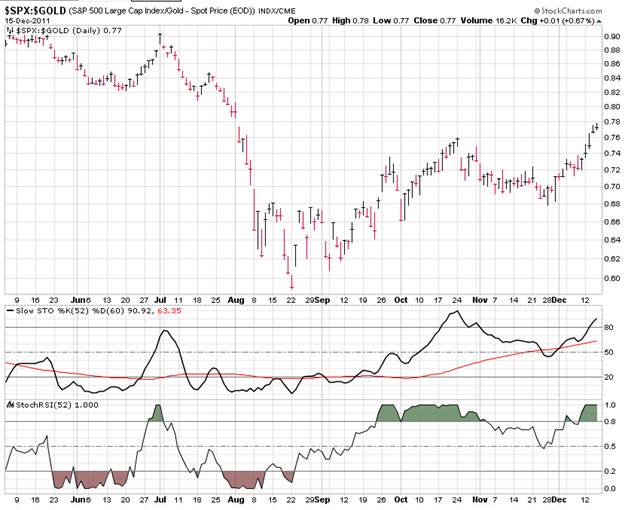
Another indicator that is short term bullish for the stock market is the relative strength (ratio) of the stock market compared to gold bullion. Even more bullish for the stock market that the SPX/VIX ratio above, it has just made a higher high that the stock market's Oct high. Not-withstanding that gold is probably starting to make a bottom in its very short term (days) and short term (weeks) declines to $1,562.50 – see our working model in the second chart below- this indicator also suggests that the stock market rally since its Aug 9 and Oct 4 intraday lows will extend through the Year-end Holiday Season Rallies.
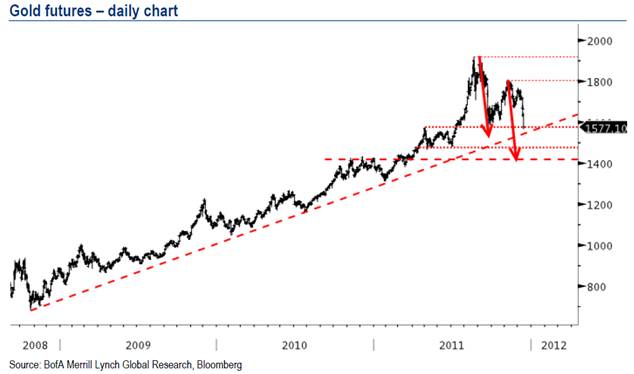
Gold still likely to make a high-$1,800s test of the Aug-Sep $1,900 highs where we recommending selling, following our early-Dec last year recommendation to sell the equity precious metal index, XAU. Notice how the chart pattern of an unfinished uptrend #5 (left-most open arrow) in an up-down-up-down-up 12345 has probably morphed into a coming C uptrend in an up-down-up ABC pattern (right-most open arrow with embedded matching solid line arrow), which will probably finish a slightly higher high six-to-seven weeks later.
Here's a more reliable contrary opinion buy signal for gold: The gold bugs are throwing in the towel Again, our work disagrees with Merrill Lynch's technical analysis, in this case gold, as they keep trend following and expecting too-popular classical chart patterns, with which our multi-indicator work currently disagrees:
| |
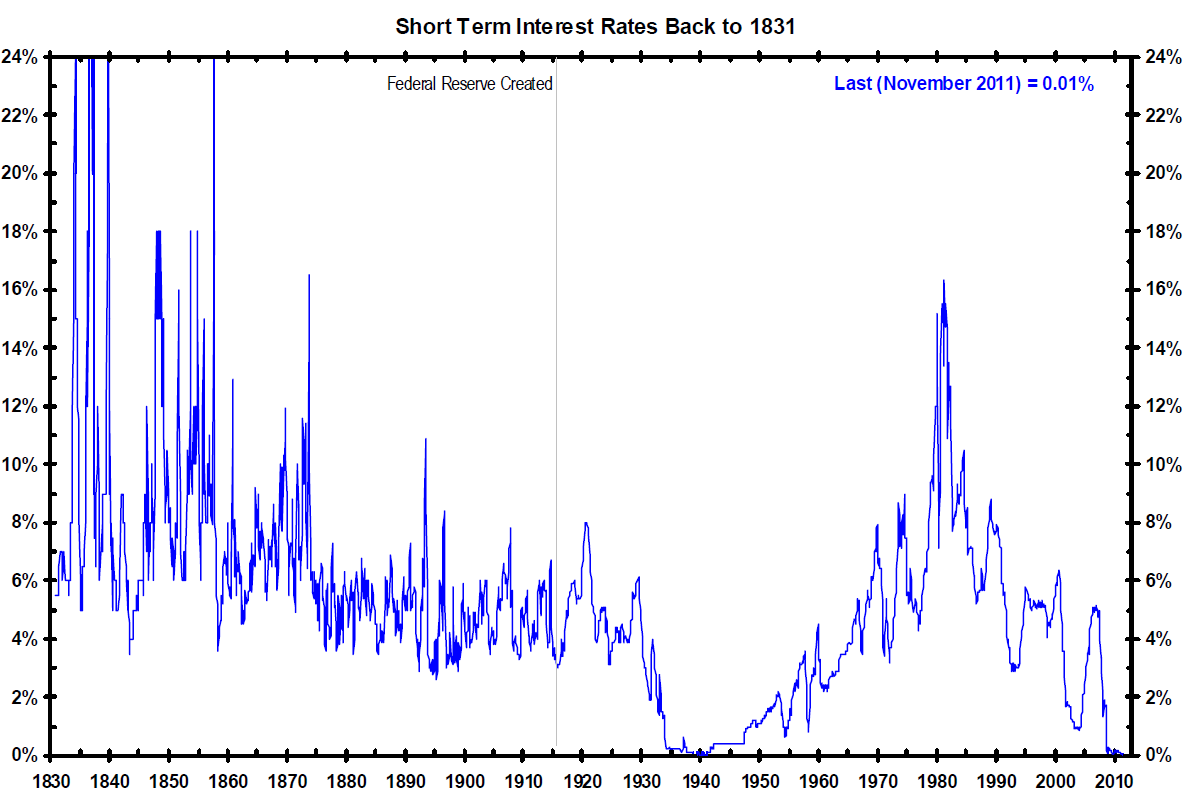
| Posted: 16 Dec 2011 09:30 AM PST Click to enlarge chart Fascinating chart from Jim Bianco, looking at interest rates back nearly 2 centuries. | |
| BlueCrest’s Platt: European banks are ‘insolvent’ Posted: 16 Dec 2011 08:04 AM PST Michael Platt, founder of the $30 billion hedge fund BlueCrest Capital, spoke to Bloomberg Television’s Erik Schatzker and Stephanie Ruhle in his first-ever live TV interview. Platt said that most of the banks in Europe are insolvent and the situation in the region is “completely unstable.” On investing in illiquid assets, Platt said he “would not touch them with a barge pole” and that “the major opportunities will come post-blowout.” Source: Bloomberg > Transcript after the jump > Platt on Europe’s sovereign debt crisis: “The level of concern of what we have about what is going on in Europe is absolutely huge. When you evidence all over the markets that they are pricing for the potential of the eurozone break up, it is contrary to what everything is set by policy makers and by central bankers. We distill it down essential fact that we continue to focus on at BlueCrest Capital Management – if you look at the debt of Italy at 120% of GDP, which is increasing at a real rate of 5%, and if you look at the GDP, which now is forecast next year to be declining, arithmetically their debt is going to blow up. And we don’t see anything happening at the policy level that gives us any indication that there’s anything that’s going to convert this situation from where it is now to a much more substantial and real crisis in the future.” On whether a blow up of Italy will force a breakup of the Eurozone: “We need much more radical measures to prevent this from happening. If Italy and Spain are forced to roll their debt over, if they have to pay rates between 5 and 7% for this, then the situation in Europe is unsustainable. We’re not going to have any euro bonds, we’re not going to have a full political and fiscal union where the transfers will take place. It seems what we’re going to have is an attempt to control the European situation through continued austerity, which is pro-cyclical. As the economy slows down, we end up with more austerity which creates more slowdown. We also have a requirement for banks to increase capital, therefore we’re looking at a 3 trillion euro takedown in European balance sheets. There’s basically nowhere I can see where we can get any growth from.” On whether cultural and political divides between nations in Europe have played a role in the crisis: “Absolutely, it’s about the cultural and political divide. The reality is that there is no willingness within the Eurozone to share wealth. In the United States, if California is having a really difficult time, the rest of the United States will send money to California. This is not the case in Europe. There is no willingness to transfer money across boundaries in a long-term and sustainable way.” “The market prices the probability of a euro breakup to be distinctly non-zero, despite what the politicians say. I believe that the eventuality of a European breakup is so awful, that more and more drastic measures will take place as time goes by. The ECB is probably the only institution that can tackle this problem, but it doesn’t have a mandate to do so…As time goes by, my view of what’s required is a radical change of policy from the ECB to tackle this problem.” More on Europe’s problems: “The probability that the market is putting on a Eurozone breakup, in my opinion from evidence I’m seeing from option pricing across the different markets, is steadily rising…We’re going into 2012, and in our opinion, it’s only going to get worse.” “There is a sensible argument you should not price and the whole loan in response to where the government trades because the government has the ability to remove assets and put them on their own balance sheets.” “The problem with Europe is that almost every part of it has gone wrong now. The banks are undercapitalized…If banks were hedge funds, and you mark them to market properly, I would say that probably most of them are insolvent. [Most of the banks in Europe are insolvent right now] if they were marked like I am at a hedge fund, yes.” On whether BlueCrest’s relationship with banks has changed: “I do not take any exposure to banks at all if I can avoid it. All the money at BlueCrest Capital Management is in Two-Year U.S. government debt, Two-Year German debt, we have segregated accounts with all of our counterparties. We are absolutely concerned about the credit quality of the counterparties.” On whether he’s afraid of taking risk right now: “Absolutely. The main thing that’s driving our decision about where to lend money or where to place our funds under management, the vast majority is dollars which we keep in two-year notes. We have a chunk of euros, which we keep in German two-year paper. We’re not interested in taking any peripheral debt risk at all and we’re not interested in taking any bank credit risk right now.” On the United States and Germany: “I think they’re the best of the bunch. I feel pretty good about the United States. I don’t really have an issue because I think the complete control that the authorities have, particularly the Fed and its bond buying program, we do not have issues about having money in Two-Year securities in the United States. In Europe, you’ve got to put your euros somewhere. It is a much more difficult place to make a decision. Two-year German notes seem like a reasonably safe bet right now, certainly compared to anything else.” On making money in a crisis: “The most important thing to remember about crises is you do not make your money going into the crisis. When you go into a crisis such as 2008, markets trade against positions. People have positions on and people need to get risk off. All the things that people thought were a good idea start going into reverse. The big money you make in trading is more in the aftermath of the crisis. In 2009 we made 60% with no down months on our master fund.” On whether BlueCrest is looking at illiquid investments: “I would not touch an illiquid product with a barge pole, to be honest. We’re going into an environment where banks need to delever. Illiquid assets will be coming on to the streets everywhere. The price of liquidity in my opinion will go up. I don’t want to own any illiquid assets whatsoever. The strategy at BlueCrest is to be in super liquid products, things that can be turned around in a day.” “It would have been the end of my business in 2008 had I done such a thing. Anyone who had an illiquid position within their hedge funds, there were runs on those hedge funds because people wanted to get the cash out and not be side pocketed with the illiquids. In 2008 I paid out $9.5 billion to the street because I was the only hedge fund that was up a lot and completely liquid. On whether we’ll see a repeat of the 2008 credit crunch and whether those that hold illiquid assets will get crushed: “That’s what I think, yes. I think so. In my opinion, what’s going on now is significantly worse than 2008…The European debt situation is fundamentally completely unstable. The process of refinancing your debt with a real rate of 5 when you have negative GDP growth, and we are heading into a recession in Europe, arithmetically can turn all of the countries in Europe, given enough time, into Greece.” On how closely tied America’s futures and the potential for investment are to Europe’s debt crisis: “Clearly it would be a huge drag on the U.S. economy. We’re talking about in Europe is a situation of instability driven by pro cyclical policy, removing the ability of banks to invest in sovereign debt. We’re talking about pro-cyclical policy of governments not being able to deficit spend by law. We’re talking about existing deficits that need to be closed. We’re talking about an increase in the amounts that governments will have to find when they’re Forced to refinance their rolling over paper this year at real rates of interest, which are way beyond anything they will ever be able to achieve in terms of growth.” On how BlueCrest continues to make money through the slowdown: “Because we are traders and do not take any credit risk and we’re super liquid. In the time that BlueCrest has been around, we have made $17 billion of trading profits for our investors…so in an environment like this where we are a very secure trading strategy, taking no credit risk, not buying anything illiquid, that is the kind of thing investors frankly really want to hear from someone like me.” On where he’s seeing investment opportunities: “I think the major opportunities will come post the blow up. I think for the time being you want to keep it quite simple. You do not want to take any credit risk. I think volatility in certain markets is very underpriced compared to what’s potentially about to happen. I think if we go into a crisis scenario, things like German bunds could be more expensive than they are right now. And I think as the crisis intensifies through the process of governments refinancing and deficits becoming more unstable and growth deteriorating in particular, I think those kinds of trades will play out in the market and be profitable.” On moving BlueCrest from London to Geneva: “I did not really want to be exposed to the Eurozone. I don't want to be exposed to regulation coming out of the Eurozone. Most of my clients come from the United States. I am not really marketing to the Eurozone anyway. So it didn’t make much sense for me to be in the Eurozone as a business.” | |
| Posted: 16 Dec 2011 08:00 AM PST My end of week reading:
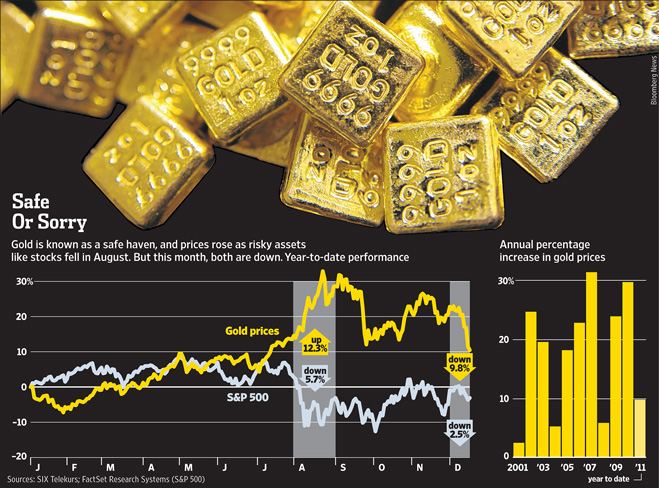
What are you reading? > Gold: Safe or Sorry? | |
| Fannie, Freddie Execs Charged with Securities Fraud Posted: 16 Dec 2011 07:31 AM PST Hey, lookie here, someone finally got indicted charged with civil fraud Phoney & Fraudie had a long history of fraud, bad execs, fake accounting. Next up: AIG. They are the no brainer, with zero reserves against $3 trillion in potential liability. There are cases to be made against Countrywide, Citigroup, Bank of America, Lehman Brothers, Bear Stearns, etc., but you take the low hanging fruit first. ~~~ SEC release below
SEC CHARGES FORMER FANNIE MAE AND FREDDIE MAC EXECUTIVES WITH SECURITIES FRAUDCompanies Agree to Cooperate in SEC Actions Washington, D.C., Dec. 16, 2011 — The Securities and Exchange Commission today charged six former top executives of the Federal National Mortgage Association (Fannie Mae) and the Federal Home Loan Mortgage Corporation (Freddie Mac) with securities fraud, alleging they knew and approved of misleading statements claiming the companies had minimal holdings of higher-risk mortgage loans, including subprime loans. Additional Materials
Fannie Mae and Freddie Mac each entered into a Non-Prosecution Agreement with the Commission in which each company agreed to accept responsibility for its conduct and not dispute, contest, or contradict the contents of an agreed-upon Statement of Facts without admitting nor denying liability. Each also agreed to cooperate with the Commission’s litigation against the former executives. In entering into these Agreements, the Commission considered the unique circumstances presented by the companies’ current status, including the financial support provided to the companies by the U.S. Treasury, the role of the Federal Housing Finance Agency as conservator of each company, and the costs that may be imposed on U.S. taxpayers. Three former Fannie Mae executives – former Chief Executive Officer Daniel H. Mudd, former Chief Risk Officer Enrico Dallavecchia, and former Executive Vice President of Fannie Mae’s Single Family Mortgage business, Thomas A. Lund – were named in the SEC’s complaint filed in U.S. District Court for the Southern District of New York. The SEC also charged three former Freddie Mac executives — former Chairman of the Board and CEO Richard F. Syron, former Executive Vice President and Chief Business Officer Patricia L. Cook, and former Executive Vice President for the Single Family Guarantee business Donald J. Bisenius — in a separate complaint filed in the same court. “Fannie Mae and Freddie Mac executives told the world that their subprime exposure was substantially smaller than it really was,” said Robert Khuzami, Director of the SEC’s Enforcement Division. “These material misstatements occurred during a time of acute investor interest in financial institutions’ exposure to subprime loans, and misled the market about the amount of risk on the company’s books. All individuals, regardless of their rank or position, will be held accountable for perpetuating half-truths or misrepresentations about matters materially important to the interest of our country’s investors.” The SEC is seeking financial penalties, disgorgement of ill-gotten gains with interest, permanent injunctive relief and officer and director bars against Mudd, Dallavecchia, Lund, Syron, Cook, and Bisenius. Both lawsuits allege that the former executives caused the federal mortgage firms to materially misstate their holdings of subprime mortgage loans in periodic and other filings with the Commission, public statements, investor calls, and media interviews. The suit involving the Fannie Mae executives also includes similar allegations regarding Alt-A mortgage loans. The suit against the former Fannie Mae executives alleges they made misleading statements — or aided and abetted others — between December 2006 and August 2008. The former Freddie Mac executives are alleged to have made misleading statements — or aided and abetted others – between March 2007 and August 2008. The SEC’s complaint against the former Fannie Mae executives alleges that, when Fannie Mae began reporting its exposure to subprime loans in 2007, it broadly described the loans as those “made to borrowers with weaker credit histories,” and then reported — with the knowledge, support, and approval of Mudd, Dallavecchia, and Lund — less than one-tenth of its loans that met that description. Fannie Mae reported that its 2006 year-end Single Family exposure to subprime loans was just 0.2 percent, or approximately $4.8 billion, of its Single Family loan portfolio. Investors were not told that in calculating the Company’s reported exposure to subprime loans, Fannie Mae did not include loan products specifically targeted by Fannie Mae towards borrowers with weaker credit histories, including more than $43 billion of Expanded Approval, or “EA” loans. Fannie Mae’s executives also knew and approved of the decision to underreport Fannie Mae’s Alt-A loan exposure, the SEC alleged. Fannie Mae disclosed that its March 31, 2007 exposure to Alt-A loans was 11 percent of its portfolio of Single Family loans. In reality, Fannie Mae’s Alt-A exposure at that time was approximately 18 percent of its Single Family loan holdings. The misleading disclosures were made as Fannie Mae’s executives were seeking to increase the Company’s market share through increased purchases of subprime and Alt-A loans, and gave false comfort to investors about the extent of Fannie Mae’s exposure to high-risk loans, the SEC alleged. In the complaint against the former Freddie Mac executives, the SEC alleged that they and Freddie Mac led investors to believe that the firm used a broad definition of subprime loans and was disclosing all of its Single-Family subprime loan exposure. Syron and Cook reinforced the misleading perception when they each publicly proclaimed that the Single Family business had “basically no subprime exposure.” Unbeknown to investors, as of December 31, 2006, Freddie Mac’s Single Family business was exposed to approximately $141 billion of loans internally referred to as “subprime” or “subprime like,” accounting for 10 percent of the portfolio, and grew to approximately $244 billion, or 14 percent of the portfolio, as of June 30, 2008. The SEC’s complaint alleges that Mudd violated Section 10(b) of the Securities Exchange Act of 1934 (the “Exchange Act”) and Rules 10b-5(b) and 13(a)14(a) thereunder, and Section 17(a)(2) of the Securities Act of 1933 (the “Securities Act”); and that Mudd aided and abetted Fannie Mae’s violations of Sections 10(b) and 13(a) of the Exchange Act and Exchange Act Rules 10b-5(b), 12b-20, 13a-1, and 13a-13 thereunder. The SEC complaint also alleges that Dallavecchia violated Section 17(a)(2) of the Securities Act and aided and abetted Fannie Mae’s violations of Sections 10(b) and 13(a) of the Exchange Act and Exchange Act Rules 10b-5(b), 12b-20, 13a-1, and 13a-13 thereunder. Finally, the SEC complaint alleges that Lund aided and abetted Fannie Mae’s violations of Sections 10(b) and 13(a) of the Exchange Act and Exchange Act Rules 10b-5(b), 12b-20, 13a-1, and 13a-13 thereunder. The SEC’s complaint alleges that Syron and Cook violated Exchange Act Section 10(b) and Rule 10b-5(b) thereunder and Securities Act Section 17(a)(2); that Syron violated Exchange Act Rule 13a-14; and that Syron, Cook and Bisenius aided and abetted violations of Sections 10(b) and 13(a) of the Exchange Act and Rules 10b-5(b), 12b-20 and 13a-13 thereunder. The SEC’s investigation of Fannie Mae was conducted by Senior Attorneys Natasha S. Guinan, Christina M. Marshall, Liban Jama, Mona L. Benach, and Associate Chief Accountant, Peter Rosario, under the supervision of Assistant Director Charles E. Cain, and Associate Director Stephen L. Cohen. Sarah Levine and James Kidney will lead the SEC’s litigation efforts. The SEC’s investigation of Freddie Mac was conducted by Senior Attorneys Giles T. Cohen and David S. Karp and Assistant Chief Accountant Avron Elbaum of the SEC’s Division of Enforcement under the supervision of Assistant Director Charles E. Cain and Associate Director Stephen L. Cohen. Kevin O’Rourke and Suzanne Romajas will lead the SEC’s litigation efforts. # # # For more information about these enforcement actions, contact: Robert S. Khuzami, Director Lorin L. Reisner, Deputy Director Stephen L. Cohen, Associate Director Charles E. Cain, Assistant Director http://www.sec.gov/news/press/2011/2011-267.htm
|





| You are subscribed to email updates from The Big Picture To stop receiving these emails, you may unsubscribe now. | Email delivery powered by Google |
| Google Inc., 20 West Kinzie, Chicago IL USA 60610 | |



0 comments:
Post a Comment