


The Big Picture |

- The Dismal Outlook for 2012
- Vampire Squid Watch: 4 Scary Economic Trends for 2012
- 2011: Year of the Currency Intervention
- 10 Monday AM Readers
- Europe at the Brink – A WSJ Documentary
- Origami-Inspired Holiday Card to Friends
- What if the SEC investigated Banks the way it is investigating Mutual Funds?
- Killer Whale vs Great White Shark
| Posted: 02 Jan 2012 01:00 PM PST The Dismal Outlook for 2012 ~~~ "Dismal" is the only word I can think of to describe the economic and political outlook for the coming year. Deep recession seems almost unavoidable for Europe. Governments in all the so-called advanced countries face mounting debt and long term unfunded entitlement liabilities, huge banking problems and negative long term demographic trends. Governments' response will be to pillory the so-called "rich" as much as possible, levy higher taxes in a variety of ways, enact various measures of financial repression, pile on more and more regulations, print more money and ultimately continue the default process that began with Iceland and Greece. The only "good" that comes out of this will be an increased reluctance to engage in ill-advised wars (I'll let the reader decide which recent wars were ill-advised) simply because governments can't afford them. • The Euro – I've been a big fan of the euro. The world needs the euro as a second reserve currency after the dollar. The renminbi just isn't yet ready for prime time. And the euro makes so much sense for an ever more economically and financially integrated Europe. But the Europeans have managed to do everything wrong in response to the crisis. The list goes on and on. My recommendation was to let each nation be responsible for its own fiscal integrity. National defaults should be accepted as defaults by states and provinces were accepted for the US and Canada. That's not what the Europeans have done. German Chancellor Merkel's attempt to force fiscal responsibility on member states is a political nonstarter. The European Central Bank (ECB), regardless of what it says, is printing money to tidy over the Italian and Spanish huge 2012 borrowing needs. Talk German, act Italian, is the ECB mantra. The plan to do three year repos with the banks so that they can buy their home country's bonds is a cynical repudiation of bank risk management principles, a debauching of the euro itself and to some extent a protectionist scheme that will encourage a sort of "beggar thy neighbor" approach to banking where banks only loan to their own governments. The banks need capital, not high risk lending schemes. Credit is going to be scarce in Europe in 2012. The tax-oriented austerity schemes being adopted in Italy, Spain, Greece and elsewhere ensure that Europe will be in deep recession in 2012 and that Europe's growth prospects longer term will be dim. There is talk of privatizations and pushing up state employee retirement ages. We'll see. What is more likely is that the austerity packages just push Europe further down the road of more socialism and more state dominance of the economy. That is not a bright investment scenario. A further decline of the euro against the dollar would not be a surprise. • Gold – I've been positive on gold and long term still am. Gold was up 10 % in 2011 and outperformed all major assets except US Treasuries. But there can be no gainsaying that since reaching a high in August gold has been tanking. Near term this downward drift may continue. My view has been that gold is an alternative to owning continuously depreciating fiat currencies. The recent quantitative easing programs suggest further future fiat currency depreciations. But of late the market has viewed US dollar assets– and not gold– as the preferred alternative to other currencies. It doesn't make sense to me but the market makes its own decisions. Moreover, with the massive liquidity squeeze centered in Europe, people no doubt are taking profits and raising cash by selling the one liquid asset they have profits in – gold. Emerging market central banks have been buyers of gold but the recent decline of the Indian rupee has reportedly reduced Indian retail demand. • US Treasury Securities – Just behind gold, longer term US Treasury securities rose 9.6% and were star performers in 2011. US government securities were perceived as a place of refuge. Amazing. Nobody could have been buying for yield or because of the outstanding US fiscal situation. Let's start with the yield. According to Irving Fisher and just about every economist who followed him, the long run the interest rate on a bond should equal the expected real rate plus the expected rate of inflation. The official rate of inflation, the CPI-U was up 3.4% year over year as of November. Ten year Treasuries yields averaged below that which means their real yield was significantly negative. Not only that, there are a number of people – I am one – who don't trust the government numbers. Governments which publish the inflation numbers have every incentive to understate those numbers. In Argentina it's now against the law to publish an inflation estimate which differs from the flagrantly understated government number. In the US the calculation of the CPI was changed in 1980 and again in 1990. An advisory service called ShadowStatistics, using the earlier methodologies, comes up with much higher estimates for US inflation in 2011. Calculating the CPI isn't as simple as it sounds and there are a number of choices that can be made. The government has every incentive to make choices that make the inflation number lower. The point is that, unlike Japan where low nominal government bond yields have been positive in real terms because Japan has experienced mild but actual deflation, US government bonds have offered negative real yields. The US is not in deflation the housing bust notwithstanding. US government securities are a bad buy on a yield basis. Irving Fisher would never own one. The US government's fiscal situation on the face of it doesn't seem any better than half the countries in Europe. (And neither does that of the British, as the French central bank has so ungraciously pointed out. But so far the British bonds get the Royal treatment as well.) Most people are familiar with the dreary US numbers so I won't belabor them here. The size of the US deficit, the staggering total of unfunded entitlement liabilities, the growing debt load, the debts of the states, the endless gimmickry used to understate the US budget deficit – pick your statistic. And of course the Congress and the President are unable to agree on anything. Who knows? Perhaps national muscles count in determining investor comfort levels. The US has ten nuclear powered Nimitz class aircraft carrier behemoths that can operate for twenty years without refueling and bases just about everywhere in the world. A psychic compensation for the skimpy yield on US government issues? Maybe Irving Fisher should put that in his model. There is a good chance the US will be viewed as the ultimate refuge right up until the November 2012 elections. Those elections might be the most important in US history. Treasury securities may continue to lead a charmed life until then. If the fiscal conservatives (whoever they are) don't sweep, then après la election, le deluge. • US Stocks – US stocks, perhaps basking in the same refuge aura as US Treasuries, have been global relative outperformers. The Dow Jones Industrial Average, which consists of 30 generally stodgy blue chips, was up 5.5% in 2011. The broader S&P 500 was unchanged and NASDAQ was down "only" -1.8%. That doesn't sound great especially considering the year's volatility. Who needs a heart attack and no return? But the US was the world's star performer. Hong Kong for example was down -19%. The trendy BRICs of Brazil, Russia, India and China were down -25%, -21%, -35% and -19% respectively (all in US$ as of 12/27, taken from The Economist). Near term in 2012, if US Treasuries are the place money is hiding and the US economy outperforms Europe, the big US stock names may continue to receive similar favorable treatment. Still, I don't buy the hypothesis that the US economy is making a significant recovery. The consumer remains overindebted, income growth in real terms is negligible, the states are cutting back and raising taxes and Europe is entering deep recession and Asia a slowdown. People are getting excited over the recent decline in employment claims but there could be some distortions produced by the holidays. And again – no income growth, no big recovery. • Financial Repression The term financial repression is an old one in monetary theory, having first been used by economists John Gurley and Edward Shaw in the 1960s. More recently, Carmen Reinhart and Kenneth Rogoff, in their now seminal work This Time It's Different as well as in follow up papers, have warned that financial repression was a likely weapon governments would use to deal with their overwhelming debt burdens. Financial repression simply denotes government measures undertaken to divert funds to themselves that otherwise in a free market would have flowed elsewhere. In plain English, that means the things governments do to screw investors in order to sell their debt obligations. Quantitative easing arguably is a form of financial repression whereby yields on government debt are pushed down to below market levels at the expense of savers. Attempts to nationalize pension plans and force them to invest in government bonds at below market rates are another example of financial repression and such nationalizations have already been carried out in Europe. Expect to see more of this. So far the government has not touched IRA and 401K Plans in the US but don't be surprised if an attempt is made. Investors of the world, unite! Your savings are at risk of confiscation. • China – Hard landing, soft landing which will it be? That's the question the world is asking. The Chinese people are hardworking, relatively well educated, the majority relatively undivided by religious and ethnic issues and totally materialistic. Characteristics thus far largely responsible for the Chinese economic success story. Nevertheless, I believe there may be no escaping from the fact that the Chinese economic system is in need of a substantial overhaul. The Chinese economic system is characterized by a government owned and dominated financial system that misallocates resources towards real estate, capital goods and industrial commodity inputs on a massive scale. It is driven by a mercantilist policy that has undervalued the exchange rate and stifled foreign competition. It has brought significant damage to the environment. And it is characterized by crippling restraints on the flow of information, financial and otherwise. A modern economy cannot function without the free flow of information. I tend to the view that a hard landing lays ahead, one hard enough at least to force some major reforms. That would be good. The Chinese stock market today looks cheap on a PE basis. There may be some rallies in response to government easing in the months ahead. But for China to be a good long term investment the reforms have to be made. Unlike Europe the long term future of China looks bright provided reforms are made. When the time comes to buy, stay away from state owned firms and buy real private Chinese firms that trade in New York, Hong Kong and Singapore. • India – Three years ago the prospects for India looked bright. The ruling Congress Party had just been reelected with a larger margin and the Prime Minister was an Oxford PhD in economics who was viewed as the architect of India's market oriented reforms of the 1990s. Indian companies and their managements are among the best in the world and, unlike China, information flows freely and in a language (English) most of the world can understand. India looked like it was fulfilling its potential at last and that it would offer great opportunities for investors. But since the election in 2009 it's been all disappointment and the Indian stock market's poor performance has reflected this. One reform proposal after the other has gone down in flames including proposals to allow larger foreign participation in the retail and education sectors. The one "reform" that was actually passed was an education bill that if enforced will effectively close down a substantial number of successful private schools. The Indian budgetary situation can be charitably described as precarious and inflation has remained stubbornly high. Worst of all, the Congress Party, presumably to please voters, is pushing through massive subsidy and employment programs which are bound to grow in size and present enormous budgetary challenges. The prior government, led by the Bharatiya Janata Party or BJP, had a slogan in 2004 called India Shining. The Congress Party's slogan at the rate things are going might be India Bankrupt. Indian equities are not interesting right now. • A Note on Race, Caste and Fiscal Prudence It is a core view that I have elaborated on in prior letters that democracies with universal suffrage have a long run tendency to spend their way into fiscal bankruptcy and degrade their currencies along the way. Investors have to recognize this phenomenon. The so called advanced West has reached that point of bankruptcy now. Politicians pass measures to please the majority that elected them, regardless of whether the country can afford it or not. This phenomenon becomes more politically complicated if there is some difference – be it race, religion or caste – that differentiates the recipients of the government largess from those who produce the wealth, pay most of the taxes and dominate the professional and entrepreneurial classes. Normally in these situations the recipients, who are of a different race, religion or caste, believe they cannot compete with the professional/entrepreneurial groups and regard the government largess as an equalizer and redress for current and past wrongs. Indian democracy provides an interesting case study regarding this point. The so-called Indian masses tend to be from "lower" castes (India has a complicated definitional scheme to formally identify these groups) than the professional and entrepreneurial groups running the businesses and generating the wealth. The democratic process in India has become a mechanism whereby the lower castes, who constitute significant "votebanks" and regard themselves as having been oppressed for centuries, appropriate wealth to themselves through the (unfortunately corrupt) political system. This may be why Indian politicians, who presumably really do know better, cannot say "no" to fiscally irresponsible welfare schemes. The same phenomenon is observable in other countries, including South Africa and Brazil and even in the US where the word "race" can be substituted for caste and to some extent welfare and subsidy schemes carry racial overtones. In the US, when the real brawling over cutting back government spending starts after the 2012 elections, the subject of race will come up. Things could get ugly. Economists and Wall Street analysts don't like to talk about these things for fear of being labeled politically incorrect. But they have investment significance. China on the other hand does not have this problem, partly of course because it is not a democracy in which politicians have to appeal to voters but also because ninety percent of its people define themselves as Han and its minority groups are on the geographic and political periphery of the country. The lower income Han do not perceive themselves as different from the professional and entrepreneurial groups which are also Han. In this case China's relative homogeneity – which is sometimes criticized as an impediment to creativity –can be viewed as an investment plus. ~~~ Dr. Peter T Treadway is principal of Historical Analytics LLC. Historical Analytics is a consulting/investment management firm dedicated to global portfolio management. Its investment approach is based on Dr. Treadway's combined top-down and bottom-up Wall Street experience as economist, strategist and securities analyst.
Dr. Treadway also serves as Chief Economist, CTRISKS Rating, LTD, Hong Kong. http://www.thedismaloptimist.com |
| Vampire Squid Watch: 4 Scary Economic Trends for 2012 Posted: 02 Jan 2012 09:00 AM PST Vampire Squid Watch: 4 Scary Economic Trends for 2012 ~~~
Top economic thinkers explain why 2012 will be a year of continued – and escalating – predation by financiers. Vampire Squid Watch: 4 Scary Economic Trends for 2012Nearby photo: Delmar catches a medium-sized Humboldt Squid, also known as the Red Devil or Diablo Rojo. Having been seen to twitch – ever so slightly – in 2011 as global protests erupted, the vampire squid is stirring in its evil lair. Reports of sucking noises and new tentacles sprouting in every direction tell us that the global financial monster is poised to steal yet more wealth and resources from the public in the coming year. Top economic thinkers have shared their forecasts with AlterNet, and the focus is clear: 2012 will be a year of continued – and escalating – predation by financiers. Their influence over political, financial, and economic activity is likely to grow – along with potential for harm. 1. Back-door Bailout of the Eurozone Would you like more of your hard-earned money to flow to fatcats? Wish granted! Attorney Walker Todd, who spent two decades in the legal departments of the Federal Reserve Banks of New York and Cleveland, names the back-door bailout of the eurozone banking system by our very own Federal Reserve as the top economic story of the upcoming year – or, at least one of the most outrageous. In a nutshell, the Fed is helping European banks by opening up the short-term 'emergency' lending pipeline, which means that U.S. taxpayers are indirectly bailing out private European capitalists. This is being done through a bit of financial hocus pocus called "swaps" – essentially the trading of dollars for euros. Such a maneuver allows the Fed to prop up European banks while claiming that it is not ‘technically’ directly lending. In other words, swaps are an attempt to hide the truth from the public. As Gerald O'Driscoll put it in the Wall Street Journal: "This Byzantine financial arrangement could hardly be better designed to confuse observers, and it has largely succeeded on this side of the Atlantic, where press coverage has been light." O’Driscoll observes that the Fed has no authority to bail out European banks and warns of what economists call "moral hazard" – the nasty habit of banks to engage in even riskier behavior when they get bailed out. Why is this happening? Well, because the squid is strangling morality, democracy, and the rule of law. We pay, they play. "This is an attempt by our own governing elites to maintain a false vision of how the world works, or how 'we' think it should work," Todd told AlterNet. "This comes at the expense of many people who never will go to Europe, who know no European bankers, and who have no European bank accounts." You may not know a European banker, but you can be sure that one is just now raising a glass of bubbly in your honor. After all, you paid for it. 2. Record-breaking Political Finance What does corporate dough buy? Newspapers and elections and presidents, oh my! Thomas Ferguson of the University of Massachusetts, Boston and the Institute for New Economic Thinking suggested that next year's very biggest stories could well be about corporate money influencing politics. He told AlterNet he saw a real possibility that a serious third party candidate for president might emerge; if one does, it will be bankrolled from the right while promoted in public as representing the political "center." And it will also be designed to give corporate America many of the policies it has long sought, such a trimming Social Security and eviscerating the social safety net. “People are going to be astonished at how lethal the combination of secret money and corporate mass media will be to the public's interest,” said Ferguson. Ferguson was confident that the 2012 elections would break all records for political finance, but he did add a sobering qualification. He thought there was an outside chance that the world economic slowdown would provoke really serious unrest in China or Europe on a scale that would put American developments in the shade. 3. Executive Pay Explosion Since the Great Recession of 2008-2009, the prime beneficiaries of the sluggish recovery have been…you guessed it!….top corporate executives. And it looks like the good times will keep rolling – for them. William Lazonick, professor of economics at the University of Massachusetts, Lowell, predicts an escalation of the harmful practice of corporate stock buybacks, which produces the explosion in executive pay. As Lazonick explained to AlterNet, corporate honchos have enjoyed a windfall as they have cashed in their stock options in a generally rising stock market. This kind of thing does absolutely zilch for the economy. But here's what it does do: spending on buybacks makes executives rich and results in manipulative boosts to stock prices in the short-term at the cost of investments in innovation and job creation. "Look for buybacks to continue to increase in 2012, perhaps surpassing the record $600 billion done by S&P 500 companies in 2007," predicted Lazonick. What to do? Maybe it's time for Congress to confront the reality of that predatory monster, the financialized business corporation. Lazonick suggests that a ban on buybacks (which is already in the purview of the Securities Exchange Act) would be a good start. Unfortunately this idea is at odds with prediction #2. 4. Pathological Corporate Leadership Jamie Dimon never seems to seize an opportunity to keep his mouth shut. JP Morgan’s CEO, who happens to be the highest-paid chief executive officer among the six biggest U.S. banks, has consequently regaled us with his worldview, in which bank regulations are "anti-American" and ordinary folks have no right to be mad at rich people. He has become the poster-boy for Wall Street greed and has earned the especial ire of the Occupy movement, which recently marched to his digs on Park Avenue to offer to help him pack his bags and go wreak havoc somewhere else. In his universe, defrauding investors, spreading lies to manipulate markets, and foreclosing on military families are all part of a good day's work. Dimon is a particularly nasty customer, but he is part of a new breed of sociopathic financiers. And his kind of distorted 'vision' has harmed the country's prospects and created a gap in America between the richest and the poorest that puts us in close range of Rwanda and Serbia. When those at the top of the corporate pyramid are this tone-deaf and lacking in any sense of public responsibility, we are in treacherous waters. "The biggest danger to America is that the people in the financial sector and corporate leadership convey no awareness of what is needed to create a coherent and prosperous society," economist Rob Johnson, head of the Institute for New Economic Thinking, told AlterNet. "Leadership is not simply about how much money one makes." Many dollars. Very little sense. Ultimately, hoarding everything at the top is not sustainable, and bankers like Dimon will end up destroying the very society that makes their enormous wealth possible. If we let them. And that, Reader, is what’s on the horizon. As a friend of mine is fond of saying, if you want a happy ending, see a Disney movie. ~~~ Photo Credit: EMMANUEL RUIZ LIKE THIS ARTICLE ? Join our mailing list: Sign up to stay up to date on the latest headlines via email.~~~ Lynn Parramore is an AlterNet contributing editor. |
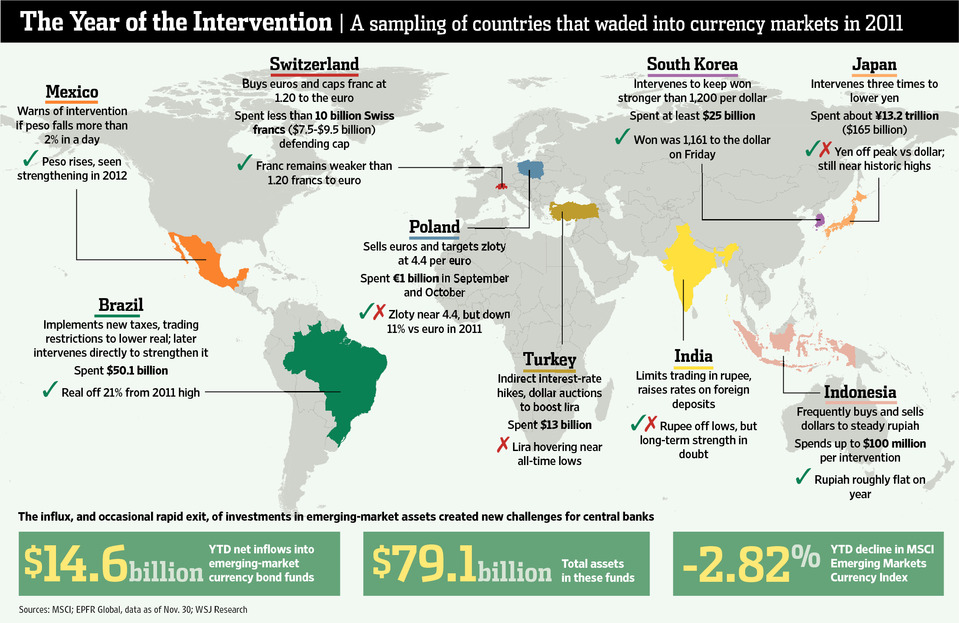
| 2011: Year of the Currency Intervention Posted: 02 Jan 2012 08:00 AM PST European sovereign debt crisis and fears of a worldwide economic slowdown have led to Central banks around the world to try to “rescue their beleaguered currencies” in 2011. Selling dollar reserves, lowering interest rates, and enacted new regulations are all part of an unprecedented series of protectionist currency interventions in emerging markets. > Currency Intervention Anyone? > Source: |
| Posted: 02 Jan 2012 05:30 AM PST Some reads to start your day:
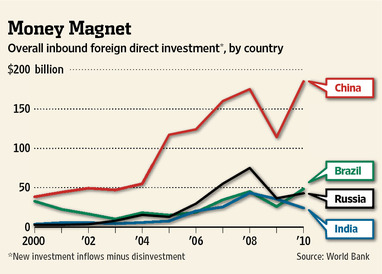
What are you reading? > Foreign (inbound) Investment by Nation Source: WSJ |
| Europe at the Brink – A WSJ Documentary Posted: 02 Jan 2012 05:00 AM PST In this 23 minute documentary, Wall Street Journal editors and reporters examine the origins of Europe’s debt crisis and why it spread with such ferocity to engulf much of the continent and threaten the entire world.
|
| Origami-Inspired Holiday Card to Friends Posted: 02 Jan 2012 04:30 AM PST
Christmas Card to Friends from Stephen Fitzgerald on Vimeo. Grant Harold used this song he wrote for Chrismas this year. Stephen Fitzgerald and his friend Nathan Deceasar decided to turn it into a card for friends. Grant and Nathan and I call our little trio “Group Hug” I hope these holidays have been a time that you’ve gotten to share with people you love. ———————- inspired by designs found on flickr and created by Robert Lang, Stephen Weiss, Yusuke Muroya, Petr Stuchly, and Beth Johnson, among others. |
| What if the SEC investigated Banks the way it is investigating Mutual Funds? Posted: 02 Jan 2012 03:00 AM PST What if the SEC investigated Banks the way it is investigating Mutual Funds? ~~~ The Wall Street Journal ran a story today (12/27/11) entitled "SEC Ups Its Game to Identify Rogue Firms." "Rogue" is an interesting word with a range of definitions. When it is used as an adjective its meaning is: "a playfully mischievous person; scamp." The trivialization of the most destructive elite frauds is one of the most common forms of what criminologists call "neutralization" of the moral content of wrong doing. Neutralization increases crime. The actual story makes it clear that the criminals that the SEC was identifying were not "rogues." They were the CEOs of seemingly legitimate firms. The SEC is identifying "accounting control frauds" – the frauds that cause greater financial losses than all other forms of property crime combined. The SEC is not identifying a few rotten apples, but roughly 100 hedge funds likely to have engaged in accounting fraud. The WSJ describes the SEC's identification system:
The SEC has, inevitably, discovered that accounting fraud is common among hedge funds. It is unlikely that the SEC system is really "high-tech" in information science terms. Low-tech information systems have been capable of identifying "aberrational performance" for at least thirty years. We did not have to create any pioneering software in 1984 in order to identify aberrational performance. The cost and time to create our "red flags" was trivial (a few hours of programming time by an agency staffer). (We were collecting the data and computing the necessary ratios anyway. One simply decides the level of a few key variables worthy of being flagged. There's nothing magic about a "flag." All it means is that suspicious levels are highlighted on the computer screen and on physical copies of the periodic reports so that they capture the reader's attention.) The SEC took two years to create its "aberrational performance" system and is embarrassed enough about the cost that it wants to keep it secret. The two year development process allowed the SEC to make a major advance relative to our system – they invented a title consisting of two words and eight syllables. Devising a title that recondite doubtless accounts for six months of the time it took the SEC to develop its flags. The most interesting aspects of the WSJ story, however, are two unexamined topics that should have been central to the story. First, there is not a word in the article about criminal prosecutions for the frauds the SEC has identified. The frauds, as described in the article, are so blatant that they would make relatively simple to prosecute. There is no indication that the SEC wanted the WSJ to know that they had made well over a hundred criminal referrals against hedge fund CEOs and senior officers. There is no indication that the WSJ reporters were interested in whether the SEC had made criminal referrals against these moderately elite felons. As a result, we have no information on whether the SEC has in fact made hundreds of criminal referrals against the senior officers at the hedge funds that they have identified as having engaged in likely fraud. Indeed, we have no evidence that they have made any criminal referrals. Neither the SEC nor the WSJ reporters indicated that any prosecutions, or even Department of Justice investigations, resulted from the SEC hedge fund investigations. Second, why isn't the SEC's top priority the systemically dangerous institutions (SDIs)? The SDIs are the financial institutions that are so large that the administration fears that their failure will cause a new global crisis. The SDIs pose by far the greatest risk to the economy and investors of any entity. Their frauds reached "epidemic" proportions and drove our ongoing crisis and the Great Recession. The SEC, however, applied its "aberrational performance" system to its smallest entities and is now expanding it to mutual funds. There is no indication that the SEC intends to use the system to spot fraudulent SDIs. There is no indication that the SEC has even contemplated using the system to spot fraudulent SDIs. There is no indication that the WSJ reporters asked why the SEC was failing to use its system where it was most needed. Applying the SEC system to the SDIs would have led the SEC to develop a more sophisticated analytical approach to identifying fraud. There is no indication that the SEC has any familiarity with the criminology, economics, and regulatory literature about how to identify accounting fraud. Admittedly, the SEC (finally) has taken seriously the warning that generations of parents have impressed upon their children – "if it's too good to be true; it probably isn't true." The Achilles' heel of the SEC analytics is that it assumes fraud must be aberrational and its flags are (at least as described in the story) all tied to identifying aberrations premised on the implicit assumption that fraud cannot be endemic. The SEC official told the WSJ reporter that they looked for "outliers." Accounting control fraud, however, can become endemic, particularly in a product line, because it produces a "Gresham's dynamic" in which bad ethics drives good ethics out of the market. Accounting control frauds report results that are too good to be true, but they all report extraordinary results because accounting fraud is a "sure thing" (George Akerlof and Paul Romer, "Looting: the Economic Underworld of Bankruptcy for Profit, 1993). Accounting control fraud was far more common among the SDIs than the SEC system has identified among hedge funds. |
| Killer Whale vs Great White Shark Posted: 02 Jan 2012 02:00 AM PST In 1997, just off the Farallon Islands, a group of whale watchers watch an Orca prey upon a great white shark. Wild: The Whale That Ate Jaws : http://channel.nationalgeographic.com/series/wild/4669/Overview |

| You are subscribed to email updates from The Big Picture To stop receiving these emails, you may unsubscribe now. | Email delivery powered by Google |
| Google Inc., 20 West Kinzie, Chicago IL USA 60610 | |



0 comments:
Post a Comment