


The Big Picture |

- Two-for-Tuesday PM Reads
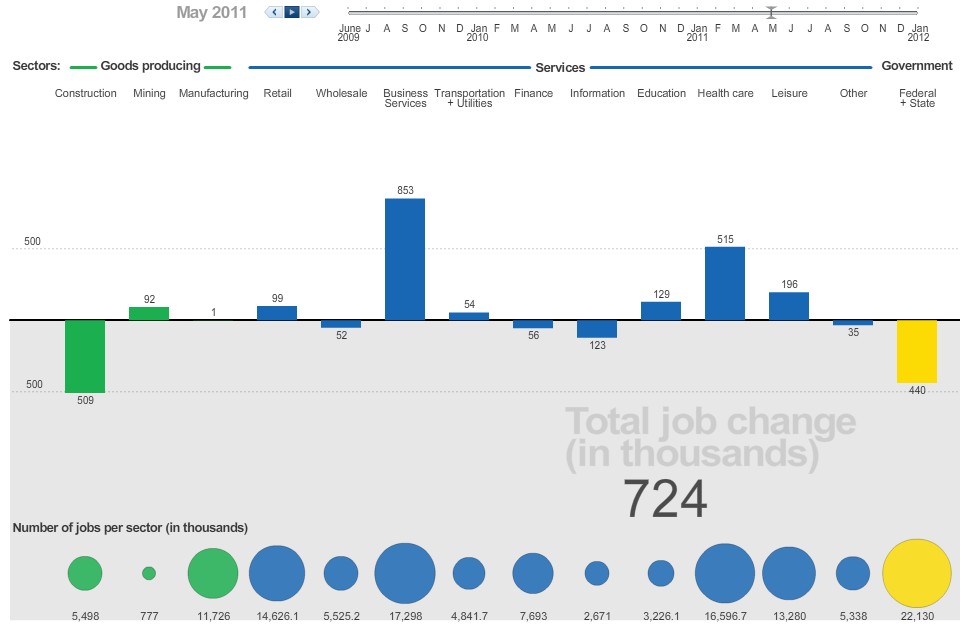
- Uneven Recovery – Jobs Power Market Rebound
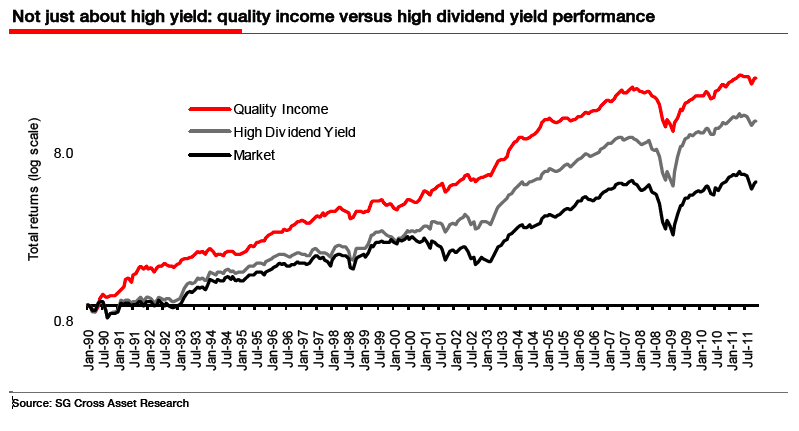
- Dividends Are All The Rage – The Clamour For Equity Yield
- BLS Warned About Census Adjustment in December 2011
- The Greedy Bastards Antidote to Rigged Energy
- 10 Tuesday AM Reads
- Carry or not to carry trade?/China view/Ben
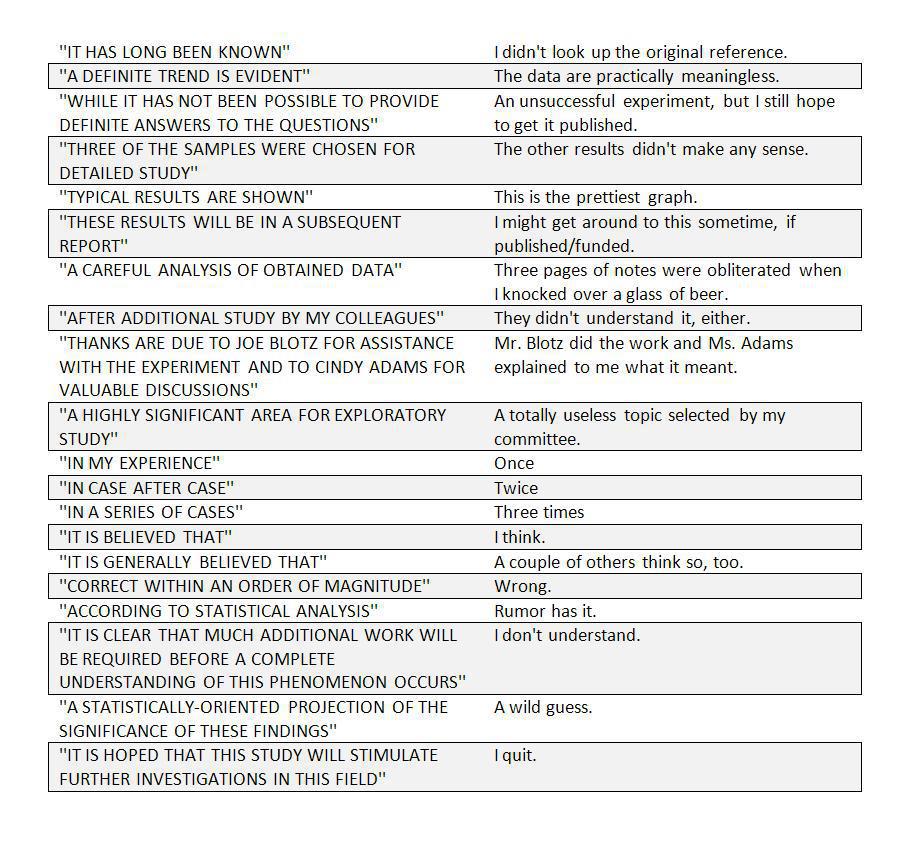
- Academia Translation Guide
- Last word: BLS Decennial Census Adjustment
- Chinese debt has risen by 200% in the last 5 years
| Posted: 07 Feb 2012 01:30 PM PST My afternoon train reading:
What are you reading? > Dollar’s China Conundrum |
| Uneven Recovery – Jobs Power Market Rebound Posted: 07 Feb 2012 11:30 AM PST Click interactive chart to see which sectors have lost or gained the most jobs cumulatively since the recovery started:
Source: WSJ, January 4, 2012 |
| Dividends Are All The Rage – The Clamour For Equity Yield Posted: 07 Feb 2012 09:30 AM PST Nice SocGen expression of how the search for yield has manifested itself in different asset classes: > Source: |
| BLS Warned About Census Adjustment in December 2011 Posted: 07 Feb 2012 07:40 AM PST Barry has been crushing the BLS flat-earthers the past few days. Resistance, however, is futile. Try as I might not to opine on the 1.2-million-one-month-drop-in-the-labor-force, I cannot help but spill a few pixels of my own. So here goes. Let’s start with last month’s BLS Employment Situation release. It contained a box, on Page 4 (of the PDF), that included the following heading and text (emphasis mine):
So right there, in black and white, BLS explicitly told its users that January 2012 and December 2011 (and earlier) simply would not be comparable — and that would obviously be the case notwithstanding how the various numbers broke. Overlooking that caveat is one thing, I guess. Being corrected all over the web and then not correcting and/or retracting is something else altogether. ADDING: For what little I’m sure it’s worth, whenever I have had a question about an economic release — and that’s dozens (hundreds?) of times — I have picked up the phone and inquired directly of the issuing agency. Guess what? They’ve always been happy to help. Point being, there’s no need to go out with bad information or run your mouth when you have doubts. Of course, this will be of no comfort to the tin-hatters who claim the agencies are in the bag. Source: |
| The Greedy Bastards Antidote to Rigged Energy Posted: 07 Feb 2012 07:38 AM PST
This post originally appeared at Treehugger.com on February 7, 2012. For decades now, fossil fuel company executives and D.C. politicians have worked together to ensure that coal and oil prices stay low enough to keep the American people hooked. In his new book Greedy Bastards, Dylan Ratigan explains how "vampire industries" like oil and coal have forged "an unholy alliance with government based not just on the money that they contribute to political campaigns and spend on lobbying, but on their ability to hypnotize us with false prices." Industry gets tax breaks, subsidies, military support in volatile regions, the right to use our air and water like a sewer, and assurance that the government will clean up its environmental messes. Politicians get campaign contributions, a steady flow of dirty energy, and a talking point to brandish about how they kept gas affordable. But the American public just gets screwed. We get stuck with a dirty, polluting energy regime; one that enriches a few one percenters while making the public sick and hobbling American innovation. As Ratigan puts it in his book, a handful of greedy bastards are fleecing Americans with a "Very Bad Deal". Fossil fuels seem cheap and convenient now, but when we get hit with the true costs—of a spoiled environment, of missing out on vital future industries like clean energy, of a mounting public health burden, of possible war—we'll see we were had. The Rigged Market for Fossil FuelsJust how rigged is the fossil fuels market? In a word, overwhelmingly. Experts believe that oil companies alone receive $10-40 billion in handouts yearly. A conservative study from the Environmental Law Institute found that from 2002-2008, oil companies received $72 billion of taxpayer's hard-earned cash. Another report from Management Information Systems, Inc found that between 1950 and 2010, $594 billion was spent directly subsidizing fossil fuels—and the lion's share of that, almost two thirds, went to the oil industry. Coal, too, receives billions of dollars in annual federal handouts. Clearly, government assistance distorts the price of fossil fuels, making them artificially cheaper. But those direct subsidies are nothing compared to the enormous costs the public indirectly pays for fossil fuels. For one, our taxpayer dollars fund the cleanup of the industry's accidents and disasters. In an interview, Dylan Ratigan told me that greedy bastards in the energy world are "masters" of transferring the long tail risk in their businesses to the public:
Mining, transporting, and burning oil, gas, and coal also inflicts major damage to the environment and public health—and we pick up the tab. A 2009 report from the National Research Council showed that fossil fuels impose $120 billion of annual costs on the public every year. Air pollution takes a massive toll on public health—it causes respiratory problems, widespread illness and death, and leads to a huge number of missed work days. The prognosis from a Harvard study, the first to analyze the full life-cycle impact of coal, is even bleaker. That report's lead author, the late Dr. Paul Epstein, told me in an interview that "Between the land disturbance, the mountaintop removal, the processing … and the combustion, we estimate that this is costing the American public somewhere between a third to half a trillion dollars in health costs and deaths." Yes, that's 'trillion' with a 'T'. Every year. In fact, coal is so economically disastrous that the mainstream journal American Economics Review found that the electricity generated from coal actually does more damage to the economy than the electricity is worth. Grist's David Roberts notes that "Coal-fired power is a net value-subtracting industry. A parasite, you might say. A gigantic, blood-sucking parasite that's enriching a few executives and shareholders at the public's expense." Finally, taxpayer-funded military expeditions have played a crucial role in securing fossil fuel supplies and transport routes—a cost to the public registered not just in billions of dollars but in American lives. According to Ratigan's calculations, the price of gasoline is around $10 too cheap per gallon when all unaccounted-for costs are included. Other projections put the figure even larger. And there are a wide range of estimates of the "true" cost of coal: Depending on how you factor in the costs of climate change, it could be between a few additional cents per kWh to a whopping ¢26.89 extra per kilowatt hour—the high-end estimate from the Harvard study. By way of comparison, the average American paid ¢11.54 per kWh on their residential electric bills last year. In other words, if prices accurately reflected all of the actual costs of burning coal, coal-fired power plants would be dead in the water. Using the example of oil, Ratigan writes that such distortion results in a situation where "the free market can't help [us] decide if it's worth switching from gas to another fuel, because the market isn't free, it's rigged." Similarly, investors, homeowners, and utilities can't decide whether it will pay off to invest in clean energy and efficiency when the price of burning coal, which still supplies nearly half the nation with electricity, is so cheap. Which is why we've got to restore price integrity to commodities like oil and coal—we've got to prevent fossil fuel companies from dumping their costs on us, level the playing field for clean energy technologies, and give Americans the choice they deserve over what powers their lives. Which means we've got to increase the price of gasoline and coal-fired electricity. Restoring Price Integrity: Fee and DividendLower your pitchforks for a second, hold back with the tar and feathers. What if there was a way to make fossil fuels companies pay their fair share—while putting extra cash in American pockets? It's called 'Fee and Dividend'. The plan is simple: charge oil, gas and coal companies a small, annually increasing fee on fossil fuels sales—then collect the fees and evenly distribute them amongst the American people. The idea has the support of not just environmentalists, but scientists, politicians, and free-market conservatives. Jim DiPeso, the Republicans for Environmental Protection's Vice President for Policy and Communications, sings its praises: "Transparent. Market-based. Does not enlarge government. Leaves energy decisions to individual choices … Sounds like a conservative climate plan."  Dr. James Hansen Dr. James Hansen NASA's Dr. James Hansen, one of the world's top climate scientists, also advocates this approach. Hansen describes it as a "flat, across-the-board rising fee on carbon emissions" that would be levied on fossil fuels at a domestic mine or port of entry. Hansen wrote to me to explain the impact fee and dividend would have: "The price of fossil fuel energy will rise, but with today's fossil fuel uses, over 60 percent of the people will get more in their dividend than they pay in increased energy prices. People who have several houses or fly around the world all the time will have costs that increase more than their dividend. People will tend to make consumer and lifestyle choices that minimize their carbon emissions—this will happen naturally via the prices that they see." That way, when fuel prices rise to reflect their true costs, the public will have a buffer—in fact, the majority of Americans will earn money from the policy. And they'll earn even more if they use less fossil fuels. A public website could be created to track the fees collected on fossil fuels, and Americans could see exactly how much they stand to earn. As DiPeso explains, "Those who wish to use carbon-based energy with abandon would be free to do so – knowing up front that they would pay the environmental and other costs of using lots of carbon-based energy rather than shift those costs onto their fellow citizens." It's a win-win. Not just for individual Americans, but our economy at large: Nonpolluting industries will benefit from a leveled playing field, American innovation will be unleashed, and jobs will grow in the clean energy sector. "The carbon fee should rise over time to a level that covers the full cost of fossil fuels to society—by the time it gets there we will have generated better energy technologies and improved energy efficiency," Hansen says. Now, it's not a perfect solution—farmers and folks who live in rural areas would be hit harder than those in urban areas, who already rely less on fossil fuels. A fair way to help cover those costs—perhaps tax breaks for energy efficient machinery upgrades—must be worked out with citizens in fossil fuel-dependent regions and occupations. From Securing Oil to Securing Our FutureWe also need to eliminate the massive fossil fuel subsides for coal, oil, and gas companies. This too has widespread bipartisan support. Obama calls to repeal oil subsidies just about every year, and Republicans, Independents, and Democrats alike support ending the handouts—but the unholy alliance between industry execs and the politicians they finance keeps them in place. And, of course, we'd have to tackle what's perhaps the biggest oil subsidy of all: U.S. military assistance to fossil fuel companies. This is a deeply entrenched system, and no single piece of legislation could likely disrupt the long-standing symbiosis between Big Oil and the military. But we could start by launching a jobs program designed to help vets get work in the energy efficiency and clean energy sector. A group called Operation Free is already fighting a battle along those lines: Founded by veterans, it helps other vets organize to fight for clean energy policies that will lead to true energy independence, to ensure that their children won't have to fight the same oil-tinged wars that they did. In many European nations, where the oil industry doesn't have as powerful a grip on politics, gasoline routinely costs two or three times as much. Governments levy gas taxes that better reflect the true cost of oil, which then spurs industry to develop cleaner, more efficient cars. This leads to less pollution, healthier communities, job transference to more productive industries, and a more competitive economy. We could do the same in the United States—in fact, we've got to. Now, plenty of skeptics will insist that these ideas aren't "politically feasible". The plan is too ambitious, it will never pass the dysfunctional Congress, it's too … yawn. Over the last year, we've watched as brand new spaces for novel approaches to politics have been blown wide open—Occupy Wall Street suddenly brought the nation face to face with its own income inequality and the safe-housing of corporate greed. The same could happen for energy and pollution. In a recent discussion, former US Energy Secretary Bill Richardson told me we need an "Arab Spring for the environment". Indeed, across the nation, concerned citizens are beginning to rally against the cushy alliance between D.C. and the fossil fuels industry. Who can blame them? Americans are paying through the nose on their tax returns and health bills to help Big Oil and the political elite maintain the illusion that cheap, dirty energy is a bargain. But enough is enough, and time is of the essence. We're paying for wars, pollution and handouts to massive multinationals—instead of allowing the free market to reward the innovators and industries that will lead us to energy security. To stop the vicious cycle, we must unravel and reset the rigged market for oil and coal, revealing their true costs once and for all. We must loose the nation from the stranglehold of its aging, fossil-fueled energy regime. As Ratigan says, "There's no greater path to freedom than energy independence." Related Articles Auction 2012: The Hidden Costs of Energy (1/31/12) Auction 2012: Energy Fear Factor with Dan Froomkin (2/1/12) |
| Posted: 07 Feb 2012 06:30 AM PST My morning reads:
What are you reading? > Bulls on Asia See Room to Roam |
| Carry or not to carry trade?/China view/Ben Posted: 07 Feb 2012 05:25 AM PST The key result of the ECB’s LTRO was a dramatic decline in the bond yields of Europe, especially Italy and Spain. Speculation of course was that the borrowing banks were playing the carry trade with the 1% financing but with 500b euros still being deposited overnight with the ECB we’re not exactly sure. The CEO of the Italian bank Intesa did say today though “We will use part of ECB funds to buy Italian government bonds, considering that there are significant amounts expiring this year.” Since banks got slammed in Q4 because of their sovereign holdings, the size I believe has and will be modest and banks will instead solidify their 2012 funding needs. German IP in Dec fell almost 3% vs expectations of flat with Nov. In China, the Ministry of Industry and IT gave its view of the world, “the global economy is slowing down, Europe’s sovereign debt crisis is deepening and the downside risks to the world economy are rising with international demand still slack and global commodities and financial markets continuing to be volatile.” The Shanghai index did close down 1.7%. The Reserve Bank of Australia unexpectedly left interest rates unchanged and the Aussie$ is rising to a 6 month high vs the US$ in response. Lastly, Bernanke repeats his testimony in front of the Senate and we’ll see if Friday’s Payroll report changes his thoughts on the economic outlook and monetary policy. |
| Posted: 07 Feb 2012 05:00 AM PST |
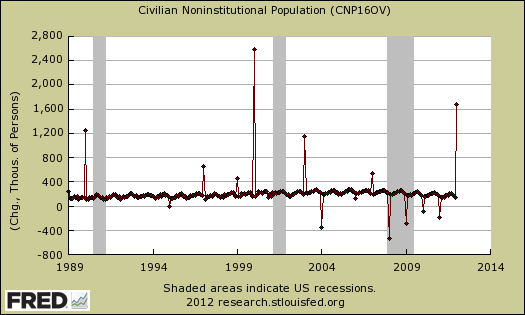
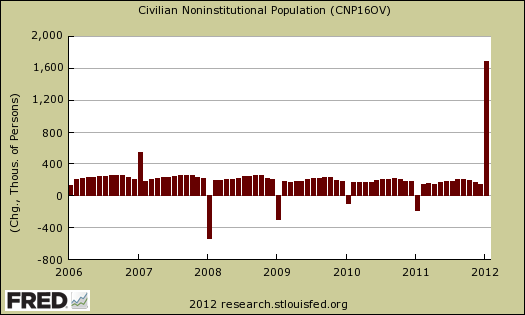
| Last word: BLS Decennial Census Adjustment Posted: 07 Feb 2012 03:45 AM PST Yesterday, I went into some detail as to why a few people got the NFP data so (disingenuously) wrong. Then Invictus pointed me to this Economic Populist post, titled, Getting It Wrong on the BLS Employment Report. It came out late on Friday, hence why it may have been overlooked. The long term chart via FRED shows the impact the Census has every 10 years on the civilian population. As you can see in the first chart below, this baseline adjustment to population is about 25% larger than 1989′s, but 35% smaller than 1999′s: > > The next chart shows the BLS annual population benchmark to make sure their models reflect the latest estimates of population size, growth and characteristics. Note the monthly change between December and January every year — that is the yearly population adjustments. These are not month-over-month changes, they reflect the adjustments made for the prior year showing up all at once in the month of January. Hence, to quote the Economic Populist, “it is statistically invalid to compare December to January monthly changes. You simply cannot compare a change of a month, when one of those month’s includes a year of population adjustments.” Annual Change in BLS Population Measures > Anyone who thinks that 1.2 million people suddenly dropped out of the labor force needs to take a basic statistics course. I wont hold my breath waiting for the usual suspects to admit their errors. > Source: |
| Chinese debt has risen by 200% in the last 5 years Posted: 07 Feb 2012 03:20 AM PST The RBA, unexpectedly, kept interest rates on hold at 4.25%. The decision was even more surprising, given the accompanying statement – namely a weaker Europe, slowing China etc, etc, though (in defence of their decision) they highlighted the better US economic data and high commodity prices. Personally, I believe this is merely a pause before further easing, quite possibly as early as next month. The surprise decision resulted in Australian equity markets declining, though the A$ rose above US$1.08. Still believe its crazy. Fortunately, I did not act on my view to short the A$, but it’s getting to be one of my top prospective plays in the near future – hopefully the A$ will rise to closer to US$1.10; Japan’s Coincident Composite Index (which reflects current conditions) rose by +2.9 points to 93.2 in December (forecast was for a rise of +2.4 points). The CCI dropped by -1.1 points in November. The leading Composite Index (reflecting expectations 3 months ahead) rose by +0.6 points to 94.3 MoM. Better numbers and Japanese authorities are talking of a turnaround. Hmmmm; The Chinese Ministry of Industry reports that industrial output is expected to decline this Q. Output is expected to rise by +11.0% this year, below last years +13.9%. Whilst analysts still write about China’s financial strength, the IMF warns that China has already pushed debt levels (which have increased by 200% in 5 years – a larger rise than in the US during the sub prime crisis) above safe levels. The IMF is proposing that the Chinese authorities introduce stimulus measures. Just 1 piece of anecdotal evidence – some 3 years ago, when I first started to question the validity of the Chinese “economic miracle”, I received numerous comments from Chinese “experts” telling me that I was NUTS. At present, I get few, if any, such comments. Just saying; The Indian Government has reduced its forecast for the year to March this year to +6.9%, sharply down from the +8.4% recorded last year – the lowest growth since 2009. The RBI is expected to reduce interest rates further, though inflation at +7.47% in December remains high; Russian inflation declined to +4.2% last month, well below December’s +6.1%, reports the Federal Statistical Service (“FSS”) – by the way, the FSS is controlled by the Russian Ministry of Economy. Presidential elections are due in a few months. A very clued up friend of mine, based in Moscow, advises me that I should treat comments by Mr Gideon Rachman’s of the FT re Russia with a pinch of salt – apparently Mr Rachman’s views does not reflect the actual situation in Russia. Let me say, my friend is particularly well plugged in and, as a result, I take his views seriously; The British retail consortium reported that UK January retail sales (for shops open for at least 1 year) declined by -0.3%. Times are tough, but other recent economic data has been positive; EPFR reports that inflows into EM has risen significantly since the start of the year – by +US$3.5bn for the week ended 1st February and a total of US$11.5bn since the beginning of the year. Fund flows into EM bonds rose by US$1.2bn last week, the highest since March last year. EM’s have been the star performers in 2012 – too much, too soon in my humble opinion – still believe they may well be a shorting opportunity shortly; Euro seems to have picked up on hopes of a resolution re Greece – currently US$1.3145. Well, I suppose the Euro will recover if the Greek’s agree to the Euro Zone demands, but I for one, am not buying into it – indeed, look to raise my short (against the US$). Glencore is paying a 15% premium to buy out the rest of Xstrata – does not seem to be too generous. Call me a cynic, but I’ve always believed you invest in the company where the main guy(s) own shares – wow, that’s Glencore – up nearly 2.0%, though Xstrata is down over 2.0%. I would guess that Xstrata shareholders are likely to object to the proposed terms. European markets flat – I must admit, I’d thought that they would be higher. US futures indicate a flat open, but way, way too early. Brent still around US$115.50. Was preparing this for tomorrow, but too much alredy so I thought I’d send it out. |



| You are subscribed to email updates from The Big Picture To stop receiving these emails, you may unsubscribe now. | Email delivery powered by Google |
| Google Inc., 20 West Kinzie, Chicago IL USA 60610 | |



0 comments:
Post a Comment