


The Big Picture |

- Washington vs The Middle Class
- 10 Thursday PM Reads
- Greg Ip on the Fiscal Cliff
- Euro Zone, part 1,000,000,000…
- American Corporate Buzzwords By Decades
- Fusion Research – Major Index Review for June 12th 2012
- Emerging Markets, Not Inflation Drives Gold
- 10 Thursday AM Reads
- The Eurozone, Swiss National Bank, Market Strategy
- Who Else Is Buying U.S. Treasuries?
| Washington vs The Middle Class Posted: 14 Jun 2012 04:30 PM PDT A list of middle-class miseries by economist David Rosenberg (as told by Anthony Mirhaydari)
Source: |
| Posted: 14 Jun 2012 02:15 PM PDT My afternoon
What are you reading? > |
| Posted: 14 Jun 2012 01:00 PM PDT |
| Euro Zone, part 1,000,000,000… Posted: 14 Jun 2012 12:00 PM PDT The only issue of interest remains the EZ,so here goes. However, I will point out that analysts continue to downgrade China’s GDP forecasts – still way too high, which suggests to me that China will have to take additional measures to stimulate their economy. At present, Spanish 10 year bonds are trading at 6.96% (having briefly traded around 7.0%), up 21bps on the day – Moody’s downgraded Spain to Baa3, from A3 today, with a warning that it could be downgraded further in 3 months. Historically, EZ countries have had to seek a bail out at yields around 7.0% – no real reason for this number/level, but it is important, as its in the mind of market participants. As you know, I believe it is inevitable that Spain seeks a bail out – its being (indeed has been) priced out of international capital markets. The E100bn (will need to be increased) bank bail out is also insufficient. With Spain requiring at least E400bn by 2014, and with the ESM (which requires funding from a number of EZ countries) with funds (assuming full contributions from EZ countries including, at present, from Spain !!!!), of just E500bn, the current situation is untenable. Yes the EFSF boosts that’s number, but the funding available remains insufficient for the task required. As a result, there are really only a few options, namely (a) that the ECB buys peripheral country bonds or (b) the ESM is expanded, with EZ countries increasing their capital contributions – unlikely given that most contributing countries are unable/unwilling to increase their contribution especially as Spain, a major contributor, will not be able to cough up, or (c) the ESM is granted a banking licence or (d) Euro Bonds. The ECB does not want to reenter the markets and buy peripheral debt – it believes (rightly in my opinion) that this is now a crisis which requires political/policy action. To date the politicians have relied on the ECB (an excuse to do nothing), but this is untenable and, as Draghi quite rightly points out, is not the ECB’s task. Having said that, I do believe that the ECB will have to act if the situation spins out of control (quite possible) – there is no alternative. However, ECB action is not a long term or even a medium term solution, for that matter – the EZ still needs policy action. In addition, the fear of private sector subordination (to bonds bought by the ECB) will result in Spanish bond yields not declining by as much as would otherwise be the case, in my humble view, making ECB buying somewhat futile. Various analysts/newspapers have suggested that Germany will cave in and agree to issue Euro Bonds imminently – personally, I believe that this is misguided, indeed completely wrong/pie in the sky stuff. Neither will Germany, in my humble view, agree to an EZ wide bank deposit guarantee scheme, though they may make offer some generic remarks/ gestures towards a banking union in due course (probably at the 28/29th June EU Heads of State meeting). They may even, in generic terms, talk about the issue of Euro Bonds, but only when conditions are right ie after sufficient fiscal measures are enacted. The idea of a bond redemption fund seems to be off the agenda, as well. An EZ wide bank deposit guarantee scheme increases German exposure materially and, in addition, is being resisted by the politically powerful German banking lobby. As a result, the only available alternative (other than a bust up of the EZ) is for the ESM to be granted a banking licence, in my humble view. Yes the ECB (in the past, though seems to be less opposed, at present) and Germany are allegedly opposed, but what alternative is there – pray tell me. Today Mrs Merkel stated that there would be “no miracle solutions”. Remember those words – she means it. Yesterday, in a speech to the German Parliament, she dismissed the idea of Euro Bonds and/or an EZ wide bank deposit guarantee scheme. Everyone expects Germany to bail out the EZ says Mrs Merkel. However, the bottom line is that even if it wished to, Germany cannot – it does not have sufficient firepower. Mrs Merkel added “Germany’s resources are not unlimited” – too true, Mrs M. The ECB has held off reducing interest rates till after the outcome of the Greek elections is known. However, I have no doubt that the ECB will reduce interest rates (by at least 25bps) imminently, especially as inflation continues to decline in the EZ. Whilst helpful, it will not be enough – the situation has moved far too far for such measures to have any meaningful impact. As for Greece, I remain of the view that the New Democracy Party will gain the highest % of votes in this Sunday’s elections, with Syriza coming in 2nd. A week or so ago, I was convinced that New Democracy would win, but with the EZ making noises that they would renegotiate the previous deal with the Greeks (sort of changing its mind today), voters may move to Syriza, on the view that Mr Tsipras will get Greece a better deal. However, I remain of the view that New Democracy will return as the largest party – 65%+ chance, though down from 80%+ a week or so ago. The reality is that Mr Tsipras wont be able to negotiate a better deal (he is delusional) and if he is in power and maintains his current position, Greece will be out of the EZ pretty soon thereafter. If New Democracy wins and can form a coalition, there will be some give from the rest of the EZ, but the Greeks will never deliver, which suggests to me that they will be forced to exit, but a little bit later. The key issue remains, namely avoiding contagion spreading and I can only see that being put in place with a much larger ESM ie granting the ESM a banking licence. OK, the Germans will not want to monetise debt – they will demand strict adherence to a (revised) fiscal compact, and in addition, they have issues re their Constitutional Court. However, the current budget targets are impossible for virtually every country to meet. If access to ESM funds is contingent on EZ countries meeting their (revised) fiscal targets, the result will provide Germany with its desired outcome – cutting expenditure and imposing fiscal discipline, which, of course, will require structural (including labour) reforms and, ultimately, tax harmonisation – sorry Ireland, though the concept of fiscal transfers to less well off countries will also have to be put in place. The EZ is heading towards a fiscal union, which means a political and transfer union – very much similar to the US. Sure it could bust up before that, but I believe that, kicking and screaming, it is heading that way. This are the key German requirements. Yes, there will be some growth measures introduced, but the thought that an expanded EIB can finance infrastructure projects (most countries do not need more infrastructure and it will take time) which will make a difference, is a clear nonsense. The cost of an Euro break op is way in excess of keeping it together, flawed though it is. I have been a committed Euro sceptic forever – however, I believe there is no choice but to retain the Euro, for the vast majority of EZ countries – the UK, well lets remain well out of it for quite some time. The alternative, well I’ll be bagging the first decent cave. I gave a lecture to a number of US business school students who are in London. By a margin of 4 to 1, they believed that the Euro would survive, though not necessarily with the current 17 members. Interesting and, indeed, surprised me, I would have thought that they would have been far more Euro sceptic.. Germany will have to concede on the tough austerity measures it is proposing – indeed, some growth measures will have to introduced. However, the EZ will have to agree to (strictly) stick to revised budget deficits and to structural (including labour) reforms. I don’t believe that Germany will agree to Euro Bonds, a deposit guarantee scheme and/or a bond redemption fund at present. As a result, the ESM will have to be expanded in terms of available firepower, which in my view is granting it a banking licence. There are issues re Germany’s constitution, but I believe that German politicians have breached constitutional issues (and know it) before and will be prepared to do it again. The good news is that we are fast coming to crunch time. The EZ only moves in a crisis and boy do we have one at present. Mr Soros believes that the EZ has 3 months, I believe closer to 1 month. Yes, everything could go pear shaped – however, it is my view that it will not and, indeed, the current (fast worsening situation) will force EZ politicians to act. Greece has an amazing ability to disappoint, so caution is certainly warranted. However, I believe that the good news is that some kind of fix is necessary (and will be implemented) in the very near future – delayed if New Democracy wins. I realise that most are highly sceptical/bearish, but personally I’m not. Sure volatility is going to rise, but with institutional liquidity levels high and investors uber cautious (short or at least cashed up to exceedingly high levels), the possibility of a major rebound (65% to 70%+ chance), as opposed to a collapse, remains. European markets are off today, but by only around -0.3% to -0.6% – the German DAX is the worst performer of the European majors, though both Spain and Greece are higher – interesting, don’t you think. In addition, financials are not performing too badly. US markets have opened higher. The Euro is close to its highs for the day – currently around US$1.26. Does not seem like panic out there. The markets have been subject to bad and yet more bad news from the EZ. Any good news (Syriza losing) should be pretty positive, though I accept will fade rapidly if not followed up with the necessary policy measures. Finally, the likelihood of coordinated Central Bank action (in the event of a crisis), or at the very least, policy action by the FED, ECB, BoE, (and others) must be a distinct possibility, if there is really bad news. Kiron Sarkar 14th June 2012 |
| American Corporate Buzzwords By Decades Posted: 14 Jun 2012 11:30 AM PDT
http://www.ritholtz.com/blog/wp-admin/post.php?post=80541&action=edit |
| Fusion Research – Major Index Review for June 12th 2012 Posted: 14 Jun 2012 09:30 AM PDT Source: Fusion Invest |
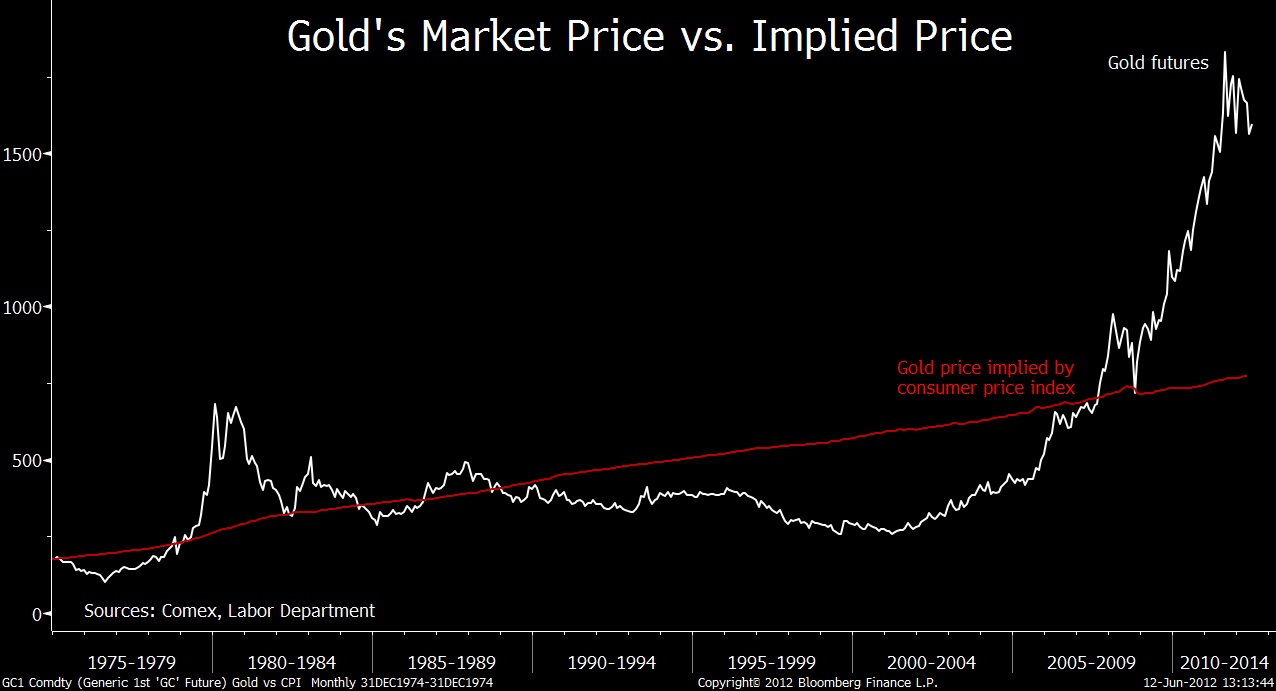
| Emerging Markets, Not Inflation Drives Gold Posted: 14 Jun 2012 09:00 AM PDT Click to enlarge:
Kudos to Bloomberg’s Dave Wilson for spotting this study last week by Duke University Professor Campbell R. Harvey and his collaborator, Claude B. Erb. They discovered that “Gold's prospects are less dependent on inflation than on demand from emerging markets.” As the chart above shows,
The good news for the Gold ug community is that “Emerging markets are in a position to sustain the surge” because gold is such a relatively small portion of EM central-bank reserves versus the U.S. and other developed countries. To match US holdings relative to GDP, Brazil, Russia, India and China need to raise their gold reserves by 153%.
Source: |
| Posted: 14 Jun 2012 07:53 AM PDT Ack! Word Press disaster delays reads interminably:
What are you reading? |
| The Eurozone, Swiss National Bank, Market Strategy Posted: 14 Jun 2012 06:00 AM PDT The Eurozone, Swiss National Bank, Market Strategy, Erwan Mahe
This morning, Barclays called 7% "crucial." Bullets. 1. Earlier today Spain was 6.99%. Italy was 6.30%. Portugal was in double digits. Greece yields are so high we no longer pay attention to the numbers. 2. Risk management is necessary. Cumberland's US ETF accounts are in the highest cash-reserve position they have seen since the October stock market bottom. Cumberland's International ETF, Emerging Market ETF and Global Multi-Asset Class accounts have cash reserves. That trading was completed into the rally. 3. Those cash reserves may be redeployed at any time, or they may be held for a while as a reserve for a future buying opportunities. At this moment, we do not know when we will redeploy or at what target level. Politicians in Europe have failed their constituents. Election results and policy changes loom with growing uncertainty. This calls for some cash reserve. 4. The economic weight of Germany in the eurozone is about one-third. The German 10-yr benchmark bond is yielding 1.5%. The economic weight of the highest-yielding countries in the eurozone is now larger than Germany's. Their weighted average 10-yr benchmark yield is above 7%. Their economies are shrinking. Their debt-GDP ratios are rising. Think about this barbell and try to picture what the business climate in the US would look like if New York had a 7% borrowing cost and Pennsylvania had 1.5%. Then add Rhode Island at 12% and you start to get the impact of this metaphor. 5. Banks in Europe are staying afloat because of the Emergency Liquidity Assistance (ELA) vehicle, which provides cash so that bankers can pay depositors who wish to withdraw their money. Europeans know that any visible bank failures will bring down the entire system. ELA and other mechanisms are the de facto ways Europeans are preventing bank failures. They lack a credible, de jure, FDIC-type deposit insurance system. 6. So why isn't the euro weaker? One part of the answer lies in Switzerland. The Swiss National Bank (SNB) is maintaining a currency peg to the euro, regardless of the short-term cost. "The SNB kept rates unchanged and 'will maintain the minimum exchange rate of CHF 1.20.' But the SNB also 'stands ready to take further measures at any time.'" Sources: Goldman Sachs comment, SNB, Bill Witherell 7. Erwan Mahé is a Paris-based analyst who has written about the SNB intervention. He has given us permission to post his essay on our website, www.cumber.com. Here is the link: http://www.cumber.com/content/special/GB%20Thaler.pdf . Note that the interest rates on short-term Swiss debt are negative. Note that the yield differential between the Swiss benchmark 10-yr bond and its German counterpart is about 100 basis points. Also note that Erwan is committed to participate in the GIC, Rocky Mountain Summit in Jackson Hole on July 27. Details @ www.interdependence.org . 8. We conclude that the massive expansion of the SNB balance sheet and the commitment to the peg now combine to make the Swiss 10-yr bond the European benchmark. Switzerland is considered the highest-quality, most truly AAA-rated credit in Europe. Switzerland is supposed to be a neutral country, but it clearly has linked its monetary path with that of the eurozone. Cumberland has no investment positions in Switzerland in its international ETF accounts. For the US, we still hold our outlook to be one of slow growth and no recession. We expect there to be lots of volatility. We expect the US stock market to provide entry opportunities so we may resume a fully invested position. Our longer-term targets for the US market are S&P index levels of 1550-1600 within two years and S&P 2000 by the end of the decade. We expect the nominal US GDP to approach $20 trillion by the end of the decade. We continue to assume interest rates in the US will remain quite low and that the US inflation rate will be low for several more years. We expect the US economy to feature ongoing recovery in the manufacturing sector and growth in the energy sector due to shale gas expansion. We see the US housing market as bottoming and then embarking on a slowly accelerating growth path. These three sectors will generate higher-paying jobs. We are bullish on the American outlook, in spite of our awful politicians, who cannot coalesce on any important decision. Both parties are guilty of failing their constituencies and our country. If we had a parliamentary system in America, our political landscape would be different, maybe better, maybe worse, but certainly different. We would have thrown out many of the Democrats and Republicans presently in office. However, we don't have a parliamentary system and we won't change to one. We will continue to live with the two-year and four-year fixed election calendar. So be it. It is our system for better or for worse. The power and durability of America is in its constitutionally protected institutions and freedoms. We succeed, not because of the scoundrels we call our politicians, but in spite of them. Cash reserves today. Buying opportunity soon. We believe that investors with strategic timeframes (measured in months and years, not minutes and days) will be amply rewarded. ~~~ David R. Kotok, Chairman and Chief Investment Officer |
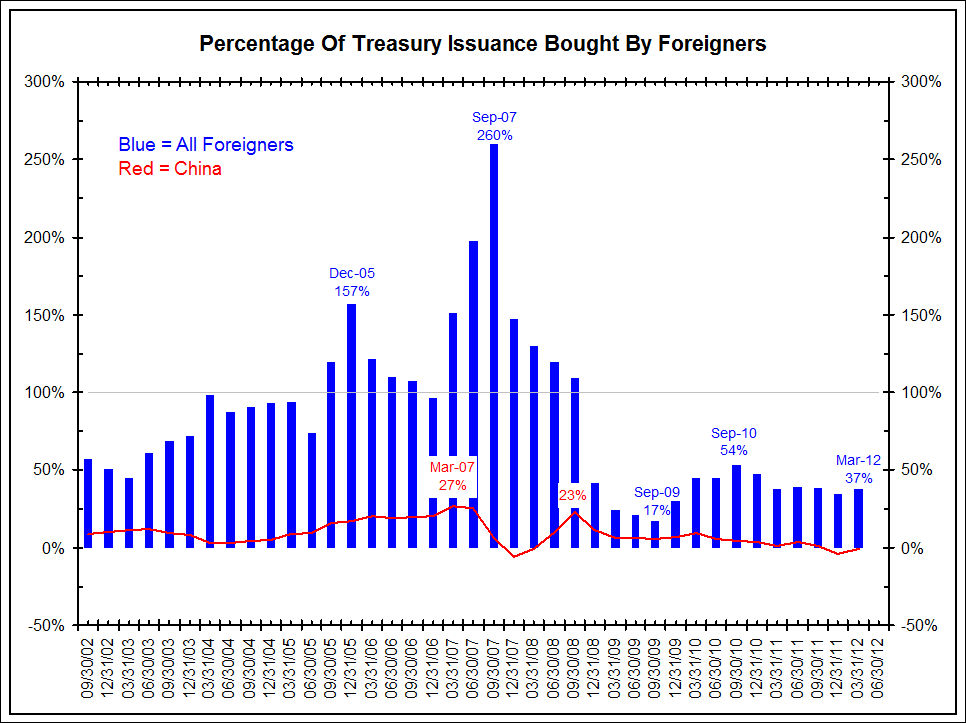
| Who Else Is Buying U.S. Treasuries? Posted: 14 Jun 2012 05:30 AM PDT CNBC – Guess Who's Buying All the Bonds? (It's Not the Fed) Comment Yesterday we focused on household purchases of U.S. Treasuries, making note of the fact that the category is not "mom and pop" as many may believe. Instead, it is the residual category the Federal Reserve uses for all Treasury purchases which cannot be categorized. While mom and pop are part of this category, it is difficult to say how large a part of this category they actually are. Mutual fund flows, which are driving by mom and pop flows, suggest it is not very large. Households recorded $193.03 billion in net Treasury purchases in Q1 2012, their third largest quarterly sum ever. This begs the question, "Who else is buying U.S. Treasuries?" Below we will delve into many of the other parties responsible for soaking up the ever-expanding offering of Treasury issuance. Foreign Buyers When asked who is buying Treasury debt, people usually instinctively think of foreigners. At face value, the next two charts look impressive. The first shows all foreign buyers of Treasury notes and bonds on both on a monthly (top panel) and a rolling 12-month sum basis (bottom panel). This data comes from the Treasury International Capital(TIC) Report. As the bottom panel shows, foreign net purchases of Treasuries totaled just under $400 billion in the past year. When viewed in the light of surging issuance, foreign purchases are actually falling as a percentage of bonds auctioned. The next chart compares foreign net purchases of Treasuries to the amount of bonds issued every quarter in blue. The red line compares Chinese net purchases of Treasuries to the amount of bonds issued every quarter. From 2004 to 2008 all foreigners regularly bought more Treasury securities than were issued. This is shown as a ratio above 100%. To be clear, the ratio below shows all Treasury securities bought by foreigners (whether at auction or in the secondary market) relative to all securities issued by the Treasury department for the quarter. Since mid-2008 foreign purchases of Treasury securities have been under 50% of securities auctioned, and the Chinese have bought less than 10% of the amount auctioned. Even though foreigners have almost doubled their buying of Treasuries in the last few years, they have not kept pace with growing Treasury issuance over the same period. As a result, foreign purchases now account for less than half of what has been issued since mid-2008. Domestic purchasers of Treasuries are now buying more than half of the amount auctioned. Who are these domestic purchasers of Treasuries?
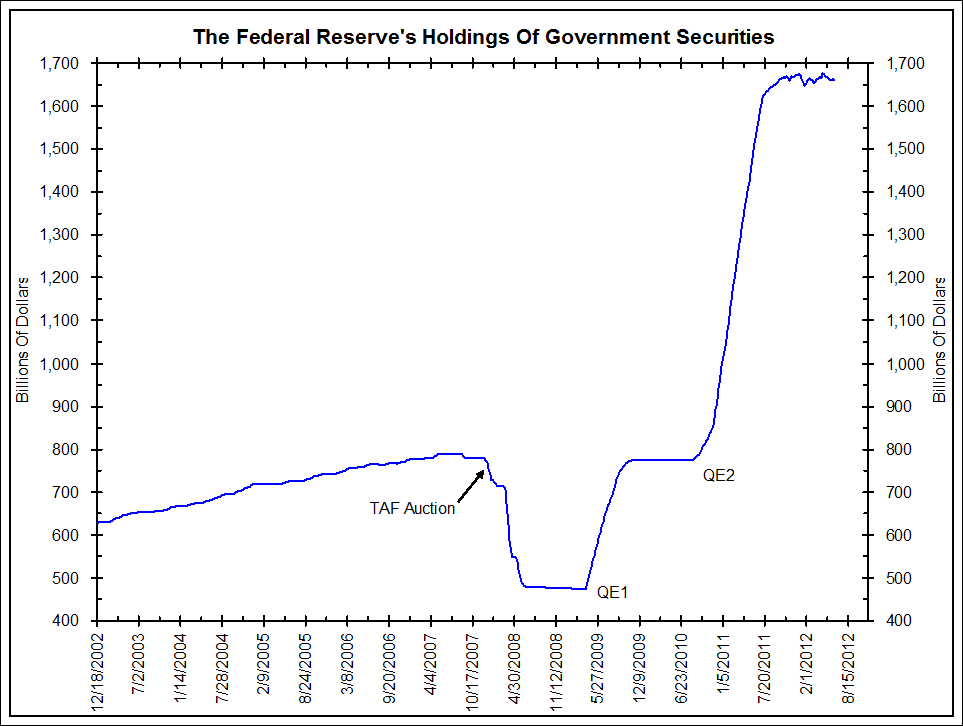
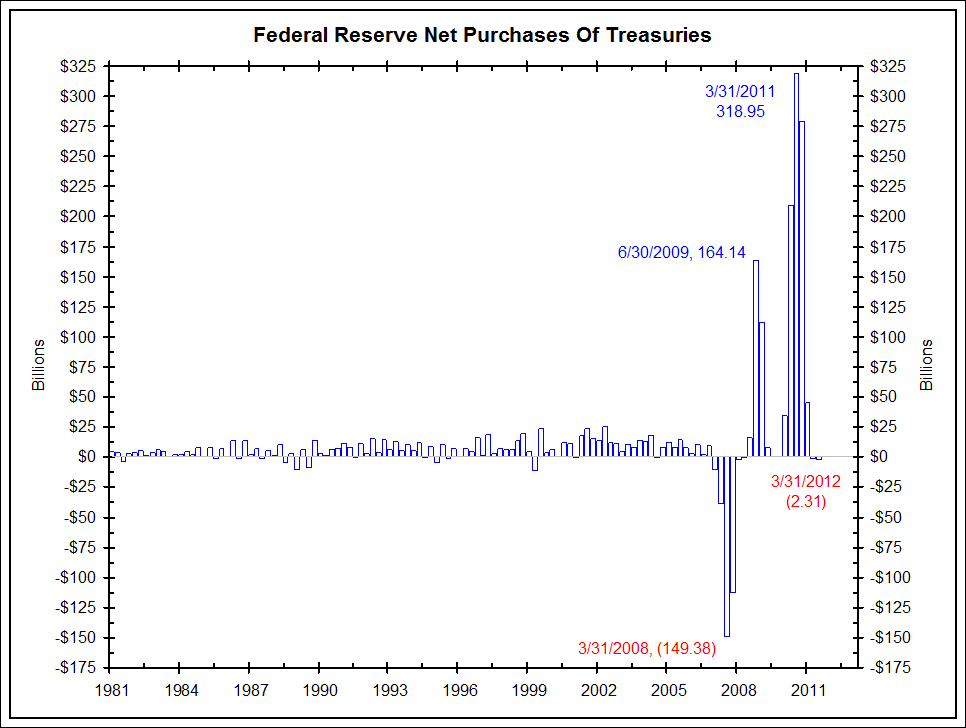
Domestic Investors – The Federal Reserve When thinking about potential domestic purchasers of Treasury securities, the Federal Reserve quickly comes to mind. The two charts below show the Federal Reserve's holdings of Treasuries and their quarterly net purchases. This data comes from the flow-of-funds report. When the Federal Reserve first created the Term Auction Facility, or TAF, in late 2007, they initially "sterilized" any loans by selling Treasuries in an amount equal to those loans. This is evident in the large quarterly net sales in early 2008 in the second chart below. Since foreigners were buying more Treasuries than were being issued during this period (greater than 100% in the chart above), these sales were not a problem. The Federal Reserve's holdings of government securities quickly rose in light of QE1 and QE2. Even though foreign demand for Treasuries was still present during this time, the Federal Reserve's purchases far outpaced foreign purchases.
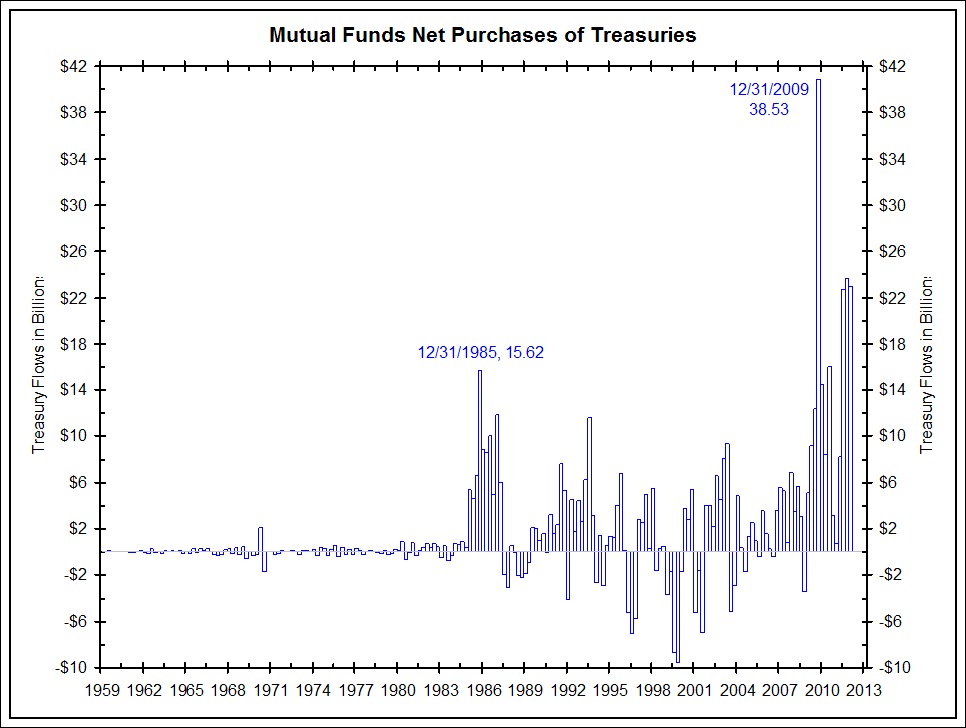
Domestic Investors – Mutual Funds The next big domestic buyer that comes to mind is the mutual fund community with more than $12.4 trillion in assets ($9.9 trillion in long-term funds — stocks, bonds and hybrid funds — and $2.5 trillion in money market mutual funds). The two charts below show the net purchases of Treasuries for money market mutual funds and long-term mutual funds. This data also comes from the Federal Reserve's flow-of-funds report. As the first chart shows, money market mutual funds were net sellers of Treasuries seven quarters in a row before returning with net purchases. The second chart shows long-term mutual funds are net buyers of Treasuries. While these purchases have rebounded in recent quarters, neither the long-term mutual funds nor the money market funds are large players in the Treasury market when compared to foreigners or the Federal Reserve.
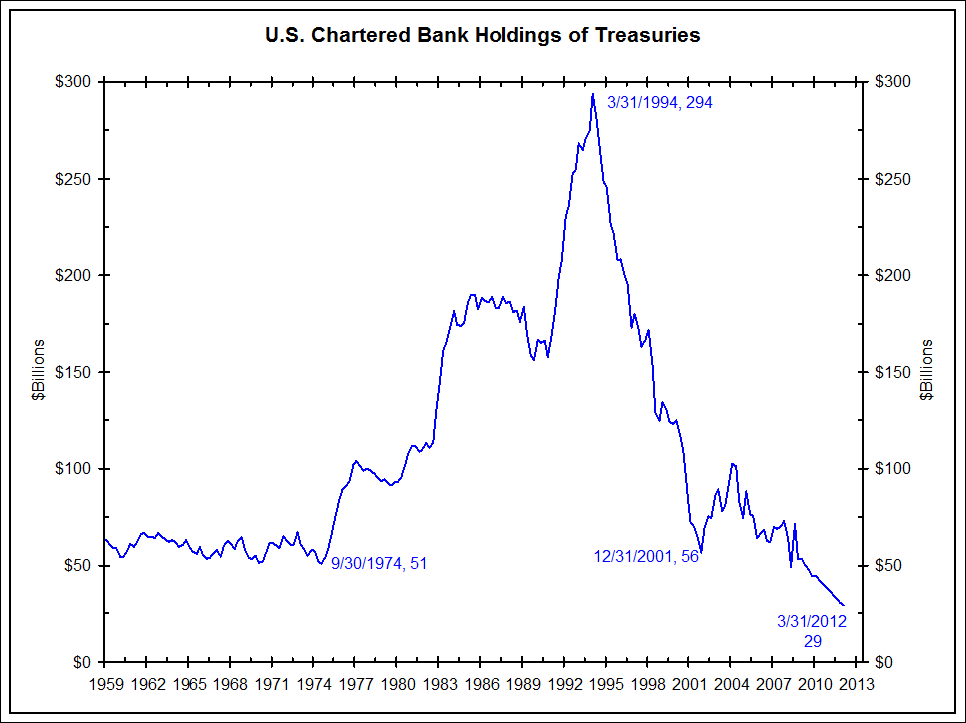
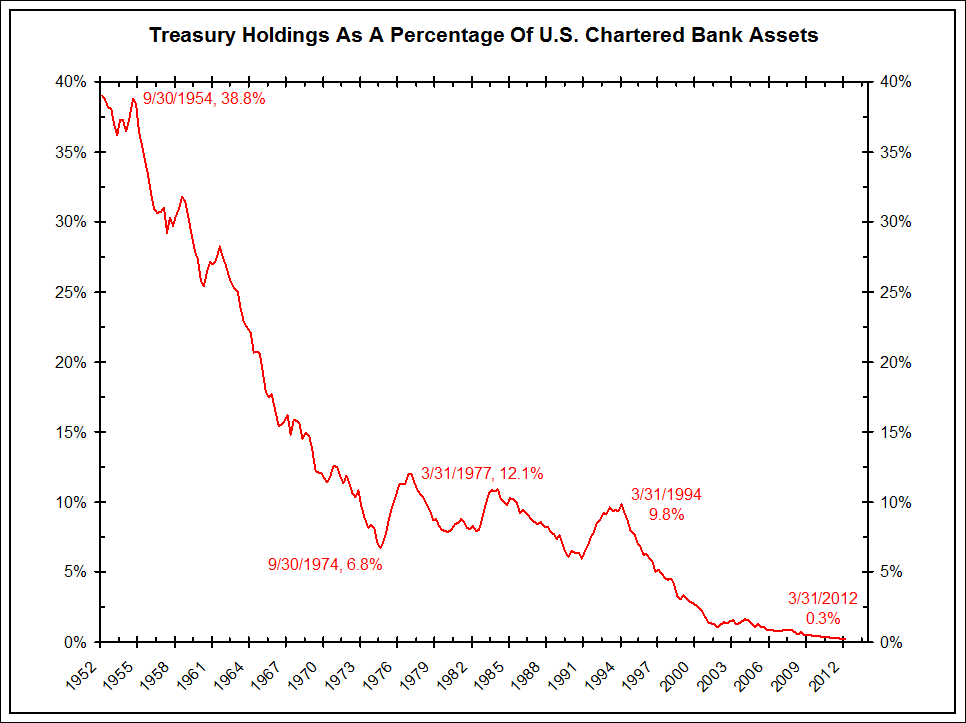
Domestic Investors – Banks Are banks' holdings of Treasuries closer in scale to those of the Federal Reserve or foreigners? The first chart below shows U.S. chartered bank holdings of Treasuries have declined from $294 billion in Q1 1994 to just $29 billion in Q1 2012. The second chart shows a long-term look at the percentage of banks' assets invested in Treasuries. Back in the 1950s it was near 40%. Today it is less than 0.3%. Simply put, banks do not buy Treasuries.
Conclusion We have shown that the deficit has exploded higher to the point that issuance is outrunning foreign purchases. Clearly a large portion of this issuance has been bought by the Federal Reserve in the form of QE1 and QE2. As we showed yesterday, the default category of "households" chipped in with almost $200 billion of Treasury purchases during Q1 2012. With QE2 now a relic of the past, the Federal Reserve would have to initiate a new round of QE to continue soaking up Treasury issuance. Sterilized programs such as Operation Twist will alter the Federal Reserve's holdings, but will not contribute to soaking up overall Treasury issuance. Rates have managed to stay at historic lows for the now, but the categories of Treasury debt highlighted above will bear watching. Should any of the private sector purchasers walk away, the Federal Reserve will have some difficult decisions to make regarding its ability/desire to further prop up this market. Source: Bianco Research |




| You are subscribed to email updates from The Big Picture To stop receiving these emails, you may unsubscribe now. | Email delivery powered by Google |
| Google Inc., 20 West Kinzie, Chicago IL USA 60610 | |



0 comments:
Post a Comment