


The Big Picture |

- Weekly Eurozone Watch – Greece Bond Yields Plunge
- GMO Labeling
- Succinct Summation of Week’s Events (12/14/12)
- Japanese Tankan survey suggests material weakness
- American People Are Against Reducing the Deficit
- The Fed on Food Stamps
- 10 Friday AM Reads
- The Newest Foreclosure Scandal: Robo-Witness
- It’s Time
- Chasing Ice
- Deposition of Angelo Mozilo in MBIA vs Countrywide
| Weekly Eurozone Watch – Greece Bond Yields Plunge Posted: 14 Dec 2012 03:00 PM PST Key Data Points
Comments Source: Guardian and Telegraph
France does not determine its economic policy according to credit rating agencies, it does it according to what is right for France. - Francois Hollande
(click here if charts are not observable) |
| Posted: 14 Dec 2012 01:30 PM PST From WTF Graphics: |
| Succinct Summation of Week’s Events (12/14/12) Posted: 14 Dec 2012 12:45 PM PST Succinct summation of week’s events: Positives:
Negatives:
|
| Japanese Tankan survey suggests material weakness Posted: 14 Dec 2012 10:00 AM PST The RBA needs to cut interest rates further as current policy is limiting economic growth, suggests the OECD. They forecast that the Australian economy will grow by +3.0% next year, down from +3.7% this year. The A$ continues to defy gravity and is currently trading at US$1.0536, slightly off its high of the day. I continue to believe its excessively overvalued, though the A$, I must admit, is the 1 currency I have got wrong this year. The RBA is expected to cut interest rates by at least 50 bps, though probably 100 bps next year; The Japanese Tankan survey reveals that the large manufacturers are the most pessimistic in almost 3 years. The economy is in recession and is expected to shrink by -0.4% Q/Q this Q. The Tankan index declined to -12 in December, from -3 in September, worse than the reading of -10 expected. Tensions with China over disputed territory in the South China seas is not helping. The general elections will be held this weekend (16th December) and the coalition headed up by the LDP is expected to be the outright winner. The LDP coalition may need the support of the the Upper House, which has its elections in July 2013. The BoJ will announce its decision on the 20th December – they are expected to ease further. The Yen continues to weaken and is currently trading around Yen 83.44. I remain short the Yen; HSBC December preliminary PMI for China came in at 50.9, in line with estimates of 50.8 and a final reading of 50.5 for November. The reading was a 14 month high and the 5th straight monthly gain. Electricity consumption, a key economic indicator, rose by +7.6% in November Y/Y, the largest increase since February. Chinese markets rose by +4.3% today on expectations that the economy is recovering, mainly due to domestic considerations. The local property market, in particular, has been picking up, with both demand and prices rising – a material factor for the Chinese economy. In the short term, I remain bullish on Chinese markets and added an ETF to my Chinese related investments, together with being long the mining sector. In the medium to longer term, China faces major economic problems – of that I have very little doubt. However, with the new regime in place, I continue to believe that Chinese markets will outperform in the short term; Indian November inflation (wholesale price index) came in lower than expected at +7.24%, lower than the forecast of +7.60%. However, the Central Bank, the RBI is expected to remain on hold next week, though cut rates in the new year. The Indian government approved a land acquisition bill yesterday, yet another sign that they are pushing ahead with their recently announced reform agenda. The government has also set up an infrastructure panel to speed up approvals of infrastructure projects; It looks as if Spanish PM, Mr (ditherer) Rajoy believes that Spain will not need ECB/EZ assistance for the present. The ECB’s OMT programme has been of material assistance, without the ECB having to act. However, I continue to believe that Spain will need support next year – it cannot keep borrowing at current levels. It is true that Germany would prefer that Spain not request a bail out ahead of its general elections in September next year; The EZ December composite index rose to 47.3 (remains in contraction territory), though higher than the 46.9 forecast and 46.5 in November. The services sector gained the most – it was up to 47.8, from 46.7. Manufacturing remained in the dumps, with the gauge virtually flat at 46.3, from 46.2 in November. French PMI data was roughly in line with expectations, though German services PMI came in higher than forecasts at 52.1, higher than the 50.0 expected and 49.7 in November; EZ November inflation declined to +2.2% Y/Y, in line with the initial estimate and down from +2.5% in October. Core CPI came in at +1.4% Y/Y, slightly lower than the +1.5% expected and +1.5% in October. Inflation should decline further and I expect the ECB to cut interest rates by 25 bps early in Q1 next year; EZ employment declined by -0.2% in Q3, Q/Q. Y/Y, employment declined by -0.7%; In a dig against Mrs Merkel, President Hollande stated today that France would not be bound by reluctant EU members. Well great, but France’s options are limited and I’m being polite. There was clear friction between Mrs Merkel and Hollande at the EU summit; S&P revised the UK’s credit outlook to negative, down from stable previously, though reaffirmed the AAA rating. There is a very high chance that the UK will be downgraded next year; US November CPI came in at -0.3% M/M, better than the -0.2% expected and +0.1% in October. Y/Y, CPI came in at +1.8% in November, lower than the +1.9% expected and +2.2% in October. Core CPI came in at +1.9% Y/Y, slightly lower than the +2.0% expected; US December manufacturing PMI came in at 54.2 (the highest since April), much better than the 51.8 expected and 52.4 in November, the highest since April. The output, new orders and employment sub-components all came in higher than expected and the highest since April; Outlook Asian markets closed mixed, with Shanghai the star performer – it was up +4.3% and has further to go in my humble view. The European markets are higher, with US markets flat. The Euro is well above US$1.31 – currently US$1.3138 (had to cover my short), with the Yen weak – currently Yen 83.49. A resounding win by Abe’s LDP party is expected this weekend, which should be further Yen negative. Spot gold is trading lower at US$1696 – cant see the interest with inflation lower, January Brent is trading at US$107.56. With the FED on QE4 and the ECB with its OMT programme at the ready and likely to reduce interest rates in Q1 next year, combined with declining inflation and a more positive China, I continue to be positive/bullish. Yes, there is the fiscal cliff, but analysts (including myself) expect a resolution. I continue to add to my holdings on weakness. Have a great weekend. Kiron Sarkar 14th December 2012 |
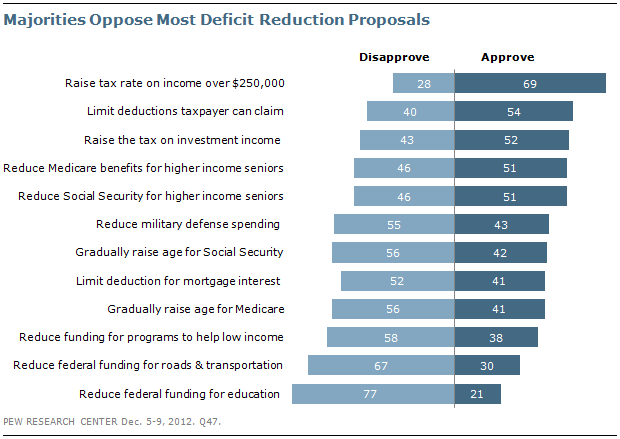
| American People Are Against Reducing the Deficit Posted: 14 Dec 2012 09:36 AM PST Little Support for Most Specific Deficit Options
Lots of people like to talk about deficit reductions. No one really wants to do anything about it. That is not an exaggeration. Despite all of the back and forth over the fiscal cliff and the deficits, when you get specific about deficit reduction, the majority of Americans are not supportive.
Source: |
| Posted: 14 Dec 2012 09:30 AM PST Wow! The food stamp program is now equivalent to 14 percent of all U.S. grocery store sales. Though the Fed indirectly finances the food stamp program with its purchase of treasury securities — $45 billion per month starting in January — we wouldn't be surprised someday that the central bank actually begins to print food stamps. This wouldn't pack the potential punch of creating "high powered" bank reserves, which can be multiplied in a healthy financial system through credit creation, however. But at least the "printed Seriously. Monetary policy has What if the Fed's policies actually contribute to unemployment? Such as repressing and changing the relative cost of capital. This makes it easier for companies to finance machinery which either enhances labor productivity, reducing the need for more workers, or less costly to replace workers with robots. Clearly, some of this is currently taking place. The Fed's policy of repressing government borrowing costs and indirect deficit financing reduces the government's incentive to implement the necessary structural reforms to put the budget on a sustainable path. This would reduce uncertainty and maybe give the business sector more confidence to hire and spend their cash hoard. We're starting to think that the business sector behaves according to the Ricardian equivalence model. Consumers? We are not so sure. Great thesis for a Ph.D. dissertation, by the way. In other words, the probability the Fed has the wrong, or, at the very least, flawed model of the economy (think Apple maps instead of Google maps) is much larger than is priced, in our opinion. This wouldn't be the first time. No problem now, but if the Fed loses cred with such a ballooned balance sheet, the demand for money could become more unstable or collapse. It would, at first, feel nice as equities would shoot to the moon. Beyond the short-term, however, we would be in a heap of trouble, with a capital T, right here in River City! Big trouble. Just got back from the grocery store. Inflation cometh! P.S. Negative real interest rates are immoral.
(click here if chart is not observable) |
| Posted: 14 Dec 2012 07:00 AM PST My morning reads:
What are you doing this weekend?
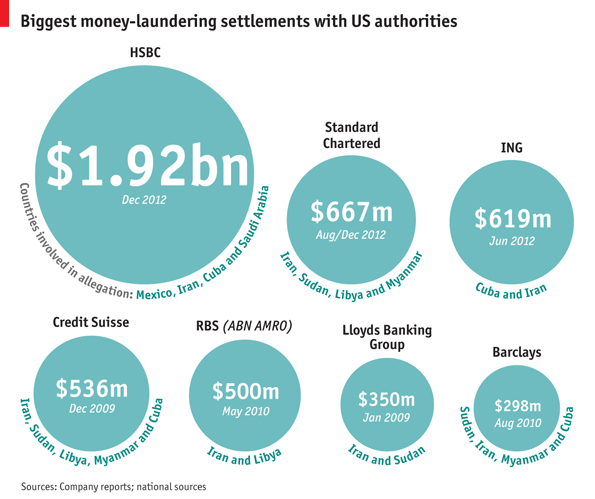
Big Bank Money-laundering Settlements |
| The Newest Foreclosure Scandal: Robo-Witness Posted: 14 Dec 2012 05:44 AM PST Pay attention to this, its quite fascinating and has potentially awesome and amusing consequences. There is a former bank defense attorney named Thomas Cox. You may not recognize his name, but after he retired, he decided to switch sides, defending people on the receiving end of bank litigation, typically foreclosures. You should know him as the lawyer from Maine who exposed the entire robo-signing sscandal. The cost to banks were a few billion dollars (far less than the damage they wrought and the profits they earned on this unlawfulness) Oh, and it also resulted in exactly one arrest. Robo-signing was conceived to deal with a quantity of scale issue — there were simply too many foreclosure files that required to much costly review for banks to pay attorneys $300 hour to pursue them. Hence, a 90 minute, legal review might cost over $200-500 was covered instead by an $8 an hour person doing 100-200 files per hour. The math is compelling: 36 seconds of time from someone making $8 per hour = 8 cents a file. That’s more attractive than the $100s they pay for an actual legal review. The Robo-signing scandal revealed exactly how corrupt the US banking system was, but also show the corruption of the US Treasury department, too many state Attorneys General, and a frightening swath of court rooms and judges. If I had anything good to say about the Robosignin, it was the epiphany it was for so many people perhaps the exact moment they discovered we are in fact a banana republic. Perhaps emboldened by the costless (at least to them) destruction of centuries of US Property law and legal precedent, the bankers are pursuing a new form of legalfuckery, as revealed once again by our intrepid counsel from Maine, Thomas Cox: Behold the litigation department “Robowitness.” A very similar person to the robosigner, only instead of doing the robosigning behind close doors, they do their dirty deeds by testifying live in person in court. This new approach to robosigning is very different — you are not paying $8 an hour burger flippers to falsify documents — you have specifically trained witnesses testifying in open court to some very dubious data. Judges do not like when someone under oath lies to them in their court. This is, to my eyes an extremely risky behavior. After the testimony of the Robowitness, I believe it would take less than 20 questions of cross examination to get them to repeatedly perjure themselves. That would be part 1 of my strategy as a defense counsel. Part 2 would be working closely with judges and local prosecutors — the goal is to have the RoboWitness arrested for perjury immediately as they get off the stand. This is a very interesting development, and warrants further observation.
The Big Lie on Fraudclosure (October 29th, 2010) Crystal Moore RoboSigning Deposition (November 14th, 2010)
|
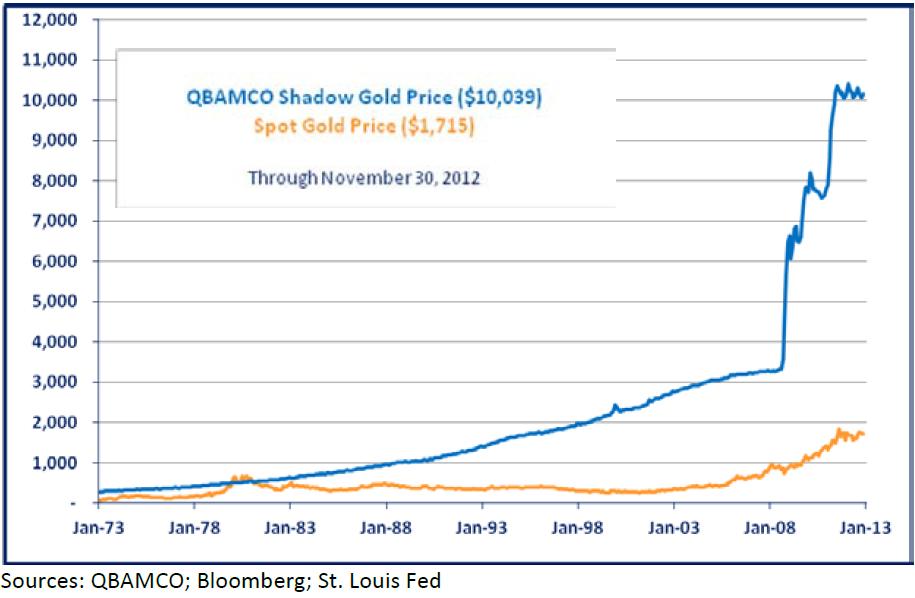
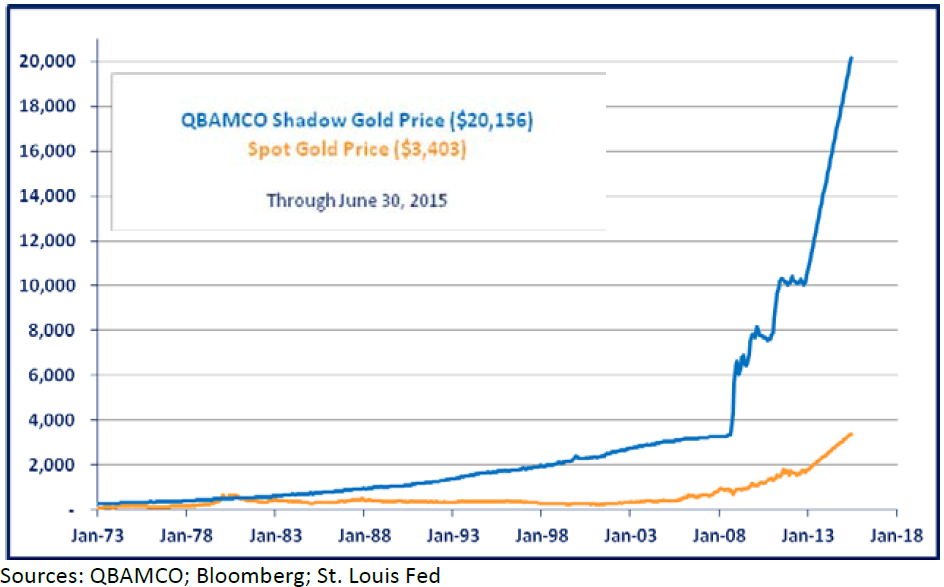
| Posted: 14 Dec 2012 05:30 AM PST It's Time Gold bugs can't understand how the public can be so unaware, how highly intelligent policy makers can be so immoral, and how the mainstream media can be so incurious. We can't understand why more men and women in the investment business haven't joined some of the more successful ones that have come around to precious metals and have taken substantial positions in them for their funds and personal accounts. The list of high profile independent-minded investors that have come out of the proverbial closet is impressive and growing: Kyle Bass, John Paulson, David Einhorn, George Soros, Bill Gross and Paul Singer, to name only a few. Conventional financial asset selection guidelines for professional investors are becoming increasingly uneconomic and problematic. Current macroeconomic conditions leave little doubt as to why. A zero-bound rate structure across developed economies, heavy monetary policy intervention, guaranteed negative real returns of benchmark financial assets and cash, impossible discount cash flow models, cacophonous (and economically meaningless) fiscal political wrangling diverting attention from legitimate budget arithmetic ($800 billion over ten years when we're running $1 trillion-plus annual deficits?), dubious short and intermediate-term prospects in already-emerged emerging economies, and non-trending financial markets, all suggest something has changed. Regardless of whether one is investing personally or as a fiduciary, conventional financial asset allocation models and procedures are obviously failing and the reason is simple: the currencies in which financial assets are denominated are gravely flawed – levered beyond reconciliation and incapable of generating positive real returns for assets denominated in them, or ongoing consumer and business confidence while the leverage is being transferred from banks to central banks, and from central banks to government balance sheets. The political/policy dimension is boxed. We think prudence demands stepping away from conventional financial asset allocation models. Our Experience Exposure to a contrary investment theme is justified by sound reasoning, which helps cure investors of toxic doubts raised by opposing (less informed?) opinions. Whether or not we will be proven right in our analysis and expected outcome, our investors have been well-aware of their exposures and have allocated accordingly. (As of November 30, the Fund had about 1.4 turns of leverage and was 83% long / 17% short, with long exposure comprised of 90 % precious metal plays and 10% natural resources.) Our exposure to precious metals has never been higher or more concentrated, and is based on our sense of relative asset valuation and current events. We are excited to have more than 100% of fund equity invested in what we perceive to be very cheap assets at a time when their fundamental outlooks could not be brighter. The fundamentals are staggering, in our view. Multiples more high powered money has already been layered over more or less the same global supply/demand equilibrium, suggesting significantly higher forward prices for goods and services. Meanwhile, the ratio of bank assets to base money remains incredibly stretched, implying far more money dilution will be necessary. This is the closest thing to physical science economics has to offer: more money (or credit) chasing relatively constant supply demands higher prices because producers of resources, goods and services are also of this world and want fair value. (Call it "cost-push inflation" if you like.) Desire is infinite. Demand requires means. Supply (at current pricing) is relatively scarce. Value is constant. Price follows the quantity of money. We are following the money. Boundless inflation will become apparent to the public either when: 1) banks begin using their new reserves to try to issue more credit; 2) mysterious "animal spirits" (i.e., when leveragable balance sheets meet common greed) spontaneously combust, or; 3) next Tuesday for no apparent reason. Why all the fuss about what the catalyst will be or when it might occur (especially when risk-free real rates are negative)? Most bonds with any sort of duration and stocks held mostly by levered entities or representing businesses that sell goods or services to leveraged consumers are likely to be losers in real terms. Alternatively, precious metals (physical held above and below ground) and natural resources with inelastic demand properties are significantly under-owned. We see very little cogent analysis that argues against our view. Inflation indicators are like yesterday's closing share prices – contemporaneous at best. Good Company There is a difference separating investors from financiers. Leverage is the element that defines "Wall Street" and Pimco is not Wall Street. When a bank or a leveraged fund using a bank's balance sheet buys a stock, bond or a piece of real estate it is ultimately done with central bank credit, and so the purchase is almost completely unreserved (even if there is investor equity in the fund). Pimco and other mostly unlevered funds are vehicles in which pensioners deposit unlevered money, which is then invested without leverage. When Pimco buys a stock or bond it is fully funded. Our definition of "conspiracy theory" is a reasonable idea supported by historical precedent that is not yet officially endorsed and therefore not yet printed in the New York Times. One thing that should not be considered conspiratorial is private sector incentives (or, if you will, common greed accompanied by motive and means). According to most died-in-the-wool hard money advocates there is a "Gold Cartel" that suppresses the gold price. They tend to argue that US banks continually short gold (and silver) futures nakedly, clipping significant yield each quarter without sufficient metal in stock to deliver to futures buyers if exercised. They further argue that these banks do not fear regulatory reprisal, and in fact that their actions are blessed by the powers that be because runaway gold prices would signal to the world that there is something wrong with the currencies gold competes with, notably US dollars. Thus, as the argument goes, banks have the means, motive and implicit sovereign go-ahead to suppress the gold price. Mmmm, maybe. We certainly agree that gold should fundamentally be priced much higher than where it is presently and that the way gold futures seem to be reliably stepped-on before Treasury auctions and Fed meetings is a bit snarky, but as for the progenitors of the crime? It might be better to look east. Conspiracy theorists should consider foreign dollar reserve holders that would like to take delivery of as much physical gold (and silver?) as possible in a very short time, and do so at cheap prices. It would be simple to do: fund offshore hedge funds that continually short gold futures through US bank accounts, thereby keeping the spot price and London fixings down. Physical gold could then be delivered to sovereign accounts directly from mines and through exports at the suppressed prices. Why would sovereigns like China, Russia, even Japan and South Korea want to take physical possession of bullion at current prices and so quickly? The short answers are that they could not buy size required on exchanges without driving prices multiples higher and because there is likely to be a reset of the global currency system, soon. Again, we have discussed this before and are talking our book so take it with a grain of salt, but the logic supporting a coordinated move is too clear to ignore. First, we think all currencies are in the process of being devalued against global resources. Ask yourself what $3 trillion in Chinese dollar-denominated reserves is worth when it takes an act of parliament to spend CAD $15 billion on an energy acquisition? Clearly, the future purchasing power of surplus dollar reserves is not equal to its current notional amount in natural resource terms. What is the motivation of Chinese businesses to continue trading cheap human resources for US dollars so that they may use those dollars to buy global natural resources (at any price)? Our speculation goes beyond natural market incentives and how economic participants have already reacted. We presume Western policy makers have also been quite aware of currency-based incentives, which would explain why ongoing meetings between representative treasury officials have also included State Department officials (check). And diplomatically, we would speculate that creditor nations would also continue purchasing US Treasuries at negative real rates until they amass enough of whatever it may be that US dollars would be devalued against (check, check). 1) the redistribution of public/official bullion holdings, from public entities overweight them to those underweight them, to create balance for the launch of a modified (bullion-backed) SDR, which would be the new global reserve currency (and which would allow banks to continue their fractionally reserved business models after draconian nominal deleveraging via coordinated base money inflation) 2) the redistribution of public/official bullion holdings at current pricing, from public hands to smart-money private hands, which would provide substantial gains to targeted global parties following the implementation of the fiat devaluation/monetary reset, noted above. The only necessary "conspiratorial" leap of faith required to accept such a scenario would be accepting the following logic: a) currencies are naturally being devalued versus resources in the marketplace already b) they could easily be devalued formally by policy administration c) behavior among official parties already implies knowledge of such an outcome (e.g., intense bullion importation and hoarding of bullion production by large dollar reserve holders) d) the Fed is increasing and extending its QE bond buying program amid substantial evidence it has no material impact on the US economy, (other than a counterfactual were it to stop), which sets the table for the withdrawal of foreign lenders e) currency devaluation (i.e., monetary inflation) has a long history of usurping the severe contractionary impact of credit/debt destruction, and f) those that figure it out, now or later, will express their greed and push policy makers to act. Whether or not our speculations prove correct, it seems that the vast majority of investment allocations have virtually ignored the obvious beneficiary of the scenario above. Is its probability zero? Or, have the vast majority of allocators chosen not to educate their constituents about the impacts of monetary inflation when none is visible because it is not good business? (At the end of the day, smart portfolio managers with dumb investment constraints are dumb money.) Is it worthwhile to make such a speculation? We published two graphs on the following page. The first is a time series of spot gold and our Shadow Gold Price (SGP) from 1973 to November 30, 2012. (The SGP uses the Bretton Woods monetary calculation for valuing the fixed exchange rate linking gold to the US dollar – Base Money divided by US official gold holdings.) As the top graph shows, since the US dollar has been baseless with a floating exchange rate, there has been significant base money creation, with the vast majority of it coming following the 2008 credit event. The SGP implies the level where spot gold would trade if the purchasing power of base money were held constant. The gap separating the SGP from spot gold indicates the implicit arbitrage representing already reduced implicit purchasing power from holding US dollars vis-à-vis the potential gain of purchasing power from holding spot gold now.
Purchasing power parity is the basis of this currency arbitrage, and it seems very worthwhile to us. So we think it's time for professional investors and fiduciaries take their spines out of the closet, strap them on, explain to investors where risk-on and risk-off really is, lengthen their investment horizons, and take possession of stores of purchasing power on behalf of their constituents. Then, sit back and watch policy makers and media talk back and forth to each other about fiscal theory while real economies atrophy and real returns in levered financial asset markets sink deeper into negative territory, ultimately demanding a coordinated currency reset. We think it's a rare chance to do well by doing good. It's time for reasonable investors to objectively consider the risks and merits of precious metals. We are confident intense scrutiny would further lead to confidence, conviction and long market expressions in PM plays holding significant relative real value. Source: |
| Posted: 14 Dec 2012 05:00 AM PST Acclaimed photographer James Balog was once a skeptic about climate change. But through his Extreme Ice Survey, he discovers undeniable evidence of our changing planet. In Chasing Ice, Balog deploys revolutionary time-lapse cameras to capture a multi-year record of the world’s changing glaciers. His hauntingly beautiful videos compress years into seconds and capture ancient mountains of ice in motion as they disappear at a breathtaking rate. Traveling with a team of young adventurers across the brutal Arctic, Balog risks his career and his well-being in pursuit of the biggest story facing humanity. As the debate polarizes America, and the intensity of natural disasters ramps up globally, Chasing Ice depicts a heroic photojournalist on a mission to deliver fragile hope to our carbon-powered planet Like on Facebook https://www.facebook.com/ChasingIceUK
|
| Deposition of Angelo Mozilo in MBIA vs Countrywide Posted: 14 Dec 2012 03:00 AM PST |



| You are subscribed to email updates from The Big Picture To stop receiving these emails, you may unsubscribe now. | Email delivery powered by Google |
| Google Inc., 20 West Kinzie, Chicago IL USA 60610 | |



0 comments:
Post a Comment