


The Big Picture |

- Look Out Below, Republican Revolt edition
- 10 Thursday PM Reads
- Your Tax Rates Since 1913
- Frank to AG Holder: Prosecute Banks Criminally
- Broadening the Debate on HFT & Market Structure
- Jerry Seinfeld: How to Write a Joke
- Why are Equities Surging in Europe?
- Jobless Claims / Philly Mfr’g / Existing Home Sales
- Holiday Gift Ideas
- BoJ increases size of asset purchase programme
- 10 Thursday AM Reads
- Buy-and-Forget Portfolio: 10 Stocks To Last The Decade
| Look Out Below, Republican Revolt edition Posted: 20 Dec 2012 06:03 PM PST
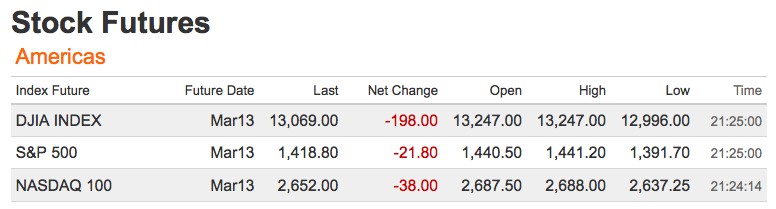
The GOP is bolting, not from the President’s proposal, but from House Speaker Boehner’s. Can you say Speaker Cantor?
See also: Asian Stocks Gain as U.S. Economic Data Lifts Confidence (Bloomberg) House GOP Cancels ‘Fiscal Cliff’ Vote (WSJ) G.O.P. Leaders in House Pull Tax Bill, Citing Lack of Votes (NYT) Boehner abandons plan to avoid 'fiscal cliff' (Washington Post) |
| Posted: 20 Dec 2012 01:30 PM PST My afternoon train reads:
What are you reading?
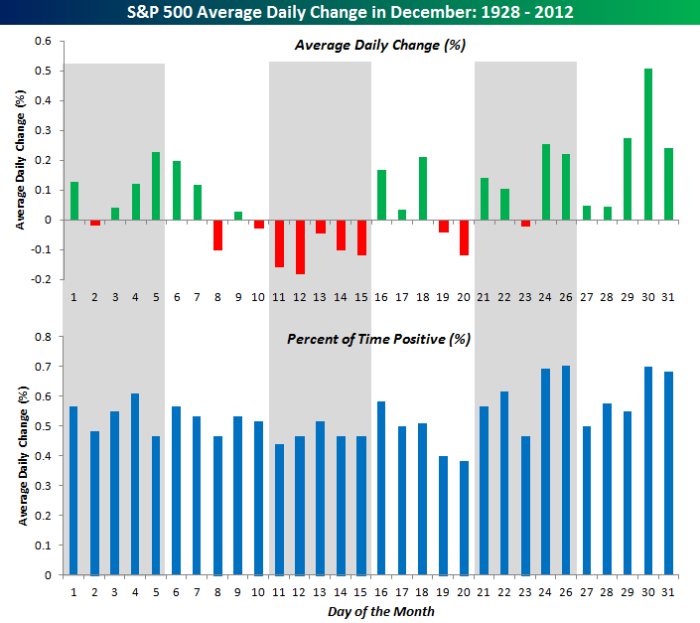
Average December Change By Day: Santa on His Way? |
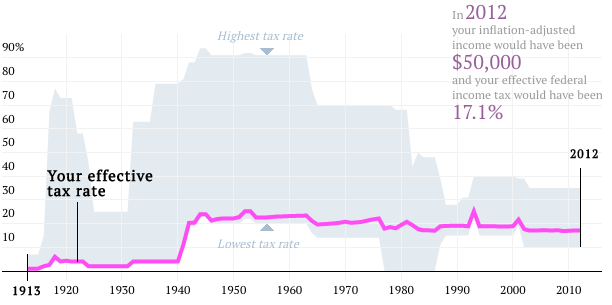
| Posted: 20 Dec 2012 11:30 AM PST Your tax rate in 2012, and past rates since 1913
Very nice interactive chart from Ritchie King showing our effective tax rates of 2012 versus past years. Note that the top bracket used to be 2X what it is today. If you your taxable income and filing status, you can see how much your total tax rate would’ve been in different eras (The NYT did something similar)
hat tip Flowing Data
|
| Frank to AG Holder: Prosecute Banks Criminally Posted: 20 Dec 2012 10:53 AM PST Hat tip Mana
Dear Mr. Attorney General: I note several instances recently in which Administration officials have proceeded civilly against blatant violations of our important financial laws, in part because of the difficulty of proving cases beyond a reasonable doubt, especially where the law may have been somewhat uncertain, but also because of a concern that the criminal conviction—and even indictment—of a major financial institution could have a destabilizing effect. This latter consideration does not apply, similarly, to individuals. It is, of course, the case that no corporation can have engaged in wrongdoing without the active decision of individual officers of that entity. I believe it is also the case that prosecuting individuals has more of a deterrent effect than prosecuting corporations. I am writing to you as well as to financial regulators, understanding that the decision to pursue criminal proceedings rests with the Justice Department, so I ask that there be a series of consultations involving law enforcement officials and regulators with the goal of increasing prosecution of culpable individuals as an important step in seeing that the laws that protect the stability and integrity of our financial system are better observed. BARNEY FRANK |
| Broadening the Debate on HFT & Market Structure Posted: 20 Dec 2012 09:53 AM PST
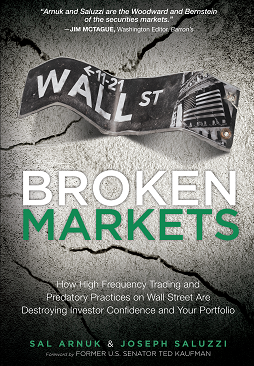
As anybody who has written a book will tell you, it is not easy, particularly if it's the first. We were anxious every step of the way. What approach should we take? How should we organize it? Have we thoroughly documented our theories and facts? What if we get something wrong? We are happy to report that it all turned out OK. The HFT crowd wasn't too pleased, but they didn't come up with anything new to refute what we wrote. All they could say was more of the same: "Technology is good…Speed is even better…Joe and Sal are wrong…" The vast majority of reviewers, readers, Wall Street executives, regulators and legislators got it. As of December 18th, the book was in Amazon's Top 100 Best Sellers in the "economics" category.
Major Reviews & Comments In his review, Jim McTague, Washington Editor of Barron's, wrote, "Every time you buy or sell a stock, your pocket is being picked by the most sophisticated group of scoundrels ever to frequent that notorious clip joint known as Wall Street. If it were not for the two astute traders who wrote this breezy, instructive, and, ultimately, infuriating book, few of us would be any wiser." Click here for more. Nathaniel Popper, in a lead New York Times Sunday Business Section feature on us, wrote how our point of view was "gaining more traction with industry insiders. The head of the New York Stock Exchange said this summer that the pursuit of speed had gone too far. In debates with Mr. Saluzzi, some H.F.T. executives have agreed that the fragmentation of the markets is now doing more harm than good for investors." Click here for more. Within our industry, Tom Steinert-Threlkeld, editor-in-chief of Securities Technology Monitor, named Broken Markets one of the "12 Great Trading Books for the Holidays." He wrote, "Arnuk and Saluzzi go to great length to show how smart, sophisticated and automated traders are taking money out of the pockets of trusting or unsuspecting individual and institutional investors." Click here for more. Martin Fridson, who the New York Times once called "one of Wall Street's most thoughtful and perceptive analysts," reviewed Broken Markets for the CFA Institute. "The authors have already helped bring about limited reform by casting light on questionable practices," he opined. "Wider dissemination of their message could build upon that progress." Click here for more. Jim Kim, editor-in-chief of FierceFinance, noted, "It may not be long before retail investors hail Saluzzi and Arnuk as heroes, champions of the little guys. They will not likely be comfortable in the spotlight, but you have to admire their willingness to take on the powers, even if you do not agree with them." Click here for more. Joshua M. Brown, writing for Huffington Post, named us one of "The 25 Most Dangerous People in Financial Media." He explained, "Joe Saluzzi and Sal Arnuk are… far and away the foremost critics of HFT. Their new book Broken Markets will surprise you with the picture of modern trading that it paints." Click here for more. Continued "Bimbo Eruptions" on Wall Street Much of the favorable reaction was fueled by continued HFT "bimbo eruptions" on Wall Street. In March, there was the failed BATS IPO, and in May, there was the Facebook IPO, which gave new meaning to the term SNAFU. Later in May, JP Morgan lost $2 billion in the "London Whale" trading scandal, and in August, Knight lost $440 million when it was "algo trading gone wild". This fall we had "The Equity Order Type Controversy," when it was revealed that all kinds of high-tech order routing processes provided by stock exchanges help manipulate orders so it is easier for HFT firms to scalp them. Now, instead of just being concerned about market structure, you had to be concerned about market microstructure. First Authors, Now Speakers As a result of all this, a variety of organizations began to seek us out. They wanted us to explain HFT, how it works, and how it is "hollowing out" our equity markets, similar to the way Chinese companies have hollowed out American manufacturing. The Commodity Futures Trading Commission invited Joe to join a subcommittee to help the agency grapple with HFT. We spoke at conferences, such as Finance Watch in Brussels, United Nations Principles for Responsible Investment Webinar, National Investor Relations Institute Southwest Regional Conference, SAP Financial Services Forum, Securities Traders Association of Dallas, and CFA Society of Austin. By December, it was clear we had accomplished one of our primary goals in writing the book. That was broadening the debate. As we wrote on page 4: "The discussion and debate around the workings of our capital raising superhighway needs to be had by the much larger and more mainstream stakeholders: investors. "For too long, the HFT and market structure debates have been monopolized by a small group of industry insiders, regulators, and group thinkers. In the process, our markets have morphed into an insanely complex web of conflicted stock exchanges, dark pools, alternative trading systems (ATSs), and liquidity providers. "We want to call attention to these conflicts and issues more broadly. We want you to understand how our markets actually work and why they morphed the way they have. "It was no accident." Thank you again, everyone. Here's to 2013 — hopefully a year when reason will return to our markets. |
| Jerry Seinfeld: How to Write a Joke Posted: 20 Dec 2012 09:23 AM PST The comedian describes the anatomy of his Pop-Tart joke, still a work in progress, and shows his longhand writing process.
Hat tip Joe Fitz |
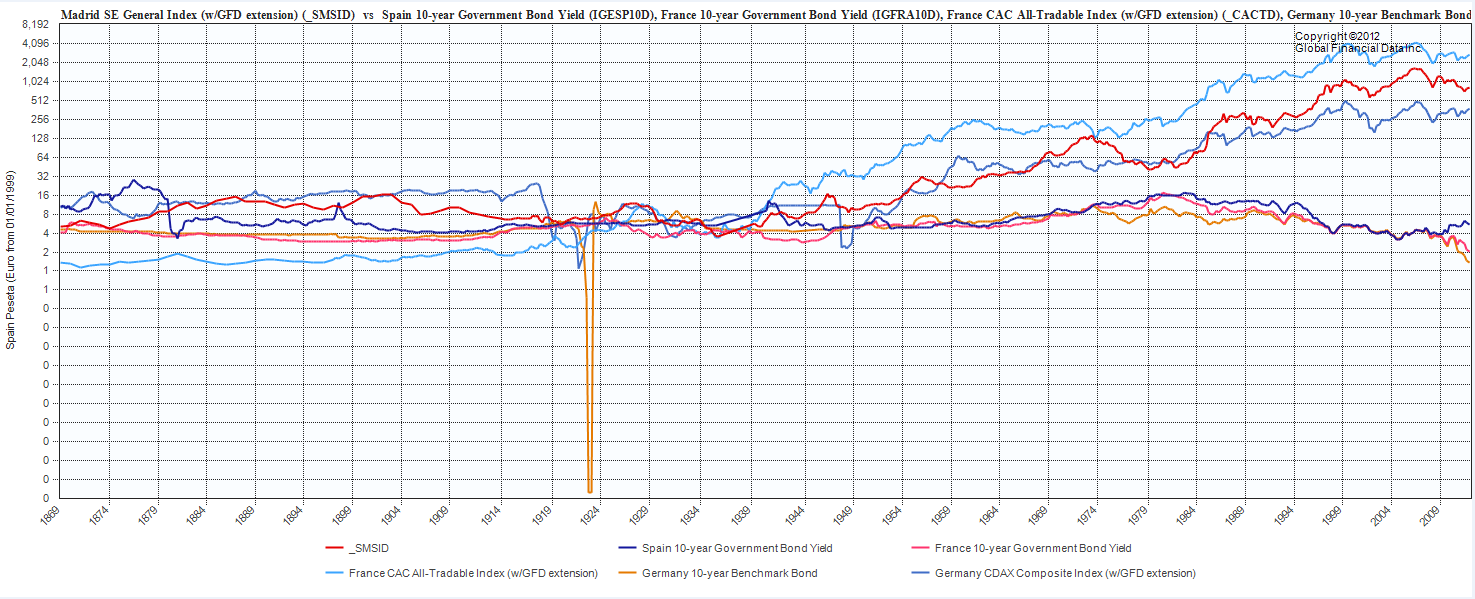
| Why are Equities Surging in Europe? Posted: 20 Dec 2012 09:00 AM PST Take a look at this chart of the 10yr vs Equities to 1869 After years of negative news on well, just about everything equities have been rallying while yields are dropping. The chart below shows France, Germany and Spain, along with each’s 10 Bonds vs Equity Index back to 1869. All three equity indices are spiking and all three yields are diving. Are we getting ready for another EU bailout?
10 Year Bonds vs Equities to 1869
Hat tip Ralph M Dillon |
| Jobless Claims / Philly Mfr’g / Existing Home Sales Posted: 20 Dec 2012 08:36 AM PST Initial Jobless Claims totaled 361k, about in line with expectations and up from 344k last week. Unlike data seen post hurricane and seasonal issues with holiday shutdowns, the Labor Dept is saying today’s data point is clean. In order to smooth out the number from the issues stated, the 4 week average was 368k which is basically where it was in mid to late October before the storm. Continuing Claims were higher by 12k but Extended Benefits fell by 95k. Extended Benefits fully expire at yr end and to extend or not extend is part of the fiscal discussion going on. Bottom line, the 4 week average of initial claims is back near the lowest since the Spring of ’08 and points to a labor market that continues to improve but at a still lackluster pace. Certainly the fiscal negotiations in DC and the cloudy visibility that comes with it has impacted business decision making. Historically, initial claims hover closer to 300k during more robust economic expansions. ~~~ After the weaker than expected NY mfr’g survey that was negative for a 5th straight month, the Philly region in Dec saw its mfr’g index unexpectedly go from -10.7 to +8.1 and vs +5.7 in Oct. New Orders jumped to +10.6 from -4.6 and Backlogs were up at +2.3 from -4.6. Shipments, which follow orders, rose 25 pts. Inventories were little changed at -11.5. Employment went positive for the 1st time since June at +3.6 from -6.8 and the Avg Workweek rose to +4.2 from -6.2. Prices Paid were little changed but Prices Received jumped to +15.4 from +6.3, the highest since April ’11. The 6 month outlook rose to 30.9 from 20. Bottom line, following the Nov declines post hurricane, and in contrast to the NY region, things bounced back in Dec. Because the survey though is a diffusion index, the improvement in the numbers show only the direction of the bounce rather than the degree. Because of the discrepancy between the two data points where both regions dealt with the storm, we’ll wait to see the other areas of the country in mfr’g culminating with the national ISM on Jan 2nd before we can draw any good conclusions on the state of mfr’g. ~~~ |
| Posted: 20 Dec 2012 08:01 AM PST So far this year, I’ve thrown out a few Shopmas gift guides. If you missed any of them, just click below:
These end up being more time consuming and involving to produce than I ever expect, and I really appreciate the kind words and emails y’all sent. Its a fun exercise that generates some great data as to your buying habits (and a little coin for TBP staff).
|
| BoJ increases size of asset purchase programme Posted: 20 Dec 2012 07:00 AM PST Not surprisingly, the Australian Treasurer, Wayne Swan, has admitted that Australia is unlikely to generate a budget surplus this year, which is a u-turn on previous statements and promises made by the Gillard government. They had previously promised a budget surplus of over A$1.0bn this year. Swan cited lower commodity prices, weaker than expected growth (due to a high A$ which has adversely affected tourism and non-commodity sectors of the economy) and that tax receipts were A$3.9bn (US$4.1bn) lower than expected. Swan stated that "In just four months we have seen the revenue hit that we were expecting for the full year". However Swan also said that making spending cuts in order to make good their governments election promises would be "self-defeating" and that the policy of the government remained growth and jobs. The chief economist of the Bank of Australia stated that the likely deficit will now be A$1.6bn for 2012-13. The most recent polls report that Gillard's government popularity dropped 4 percentage points to 32%, whereas the opposition Liberal-National Party gained three points to 46%. Gillard faces an election in the second half of next year and is being heavily criticised by the opposition on their management of the economy. The A$ has come off its recent highs of over US$1.0550, currently US$1.0487 – still believe its way overvalued. S&P has asserted Australia’s AAA rating as stable. (Source Bloomberg); The BoJ, as expected, increased its asset purchase programme (the 3rd increase in 4 months) by Yen 10tr (US$117 bn) to Yen 101tr and, in addition, stated that they will review their inflation target. The BoJ left its lending programme at Yen 25tr. The BoJ will discuss its inflation target (currently 1.0%, lower than the 2.0% proposed by Mr Abe) at its next meeting on 21/22nd January. The market, unrealistically in my opinion, was expecting more. Personally, I believe that the BoJ has responded to the governments urging to ease monetary policy and I continue to believe that the Yen will weaken further, in spite of it rebounding today – currently Yen 83.97 against the US$. The Nikkei closed lower -1.2% on the day, but is up around 15%, since the previous government announced its decision to call a general election. Foreign investors were net buyers for the 5th consecutive week, buying a net US$5.5bn of shares, the most since March 2011 (Source Bloomberg) A senior LDP official stated that the government will decide on a significant supplementary budget spending programme on 15th Jan next year; Chinese regulators are considering how to respond to the recent failure of a "wealth" management product sold by a Chinese bank. Chinese investors have bought some US$1tr of such products, which offer higher yields than bank deposits, though clearly with much higher risk. I have reported on this issue before and continue to believe that more failures of "wealth" management products should be expected. Chinese regulators have the traditional moral hazard problem, though realistically can they afford to support failures of such schemes. This is an issue which, together with the territorial disputes with its neighbours, are at least 2 of my major issues of concern I have in respect of China; Greek 10 year bond yields decline further – currently around 11.5%. Yes, the EZ has provided an aid package and the ECB announced yesterday that Greek debt can be used as collateral. However, whilst I will not short, it is clear that Greek debt will need to be restructured and implementation risk next year remains a serious concern. I will stay well away; Italian seasonally adjusted October retail sales declined by -1.0% (-3.8% Y/Y), much weaker than the flat reading expected and the -0.1% in September and the largest decline since April. Recently, Italian economic data has been weaker than expected; The Italian government won a confidence vote in the Senate on the 2013 budget, as expected. The bill now goes to the Chamber of Deputies for a final vote. Mr Monti has announced that he will resign, following the passage of the 2013 budget. It remains unclear as to whether Mr Monti will stand for the role of PM. Mr Berlusconi's plan to delay the budget vote and the general elections have failed; Nationalist parties who won the regional elections in Catalonia have agreed to form a coalition and, in addition, to hold a referendum on independence from Spain in 2014. Personally, I don’t believe that Catalans will vote for independence when they realise that they will not be able to retain the Euro. In addition, the coalition looks fragile. However, it will create a further headache for the Spanish PM, Mr Rajoy, as the central government may well have to concede on more fiscal transfers to Catalonia; UK November retail sales were flat, weaker than the +0.4% expected, though higher than the -0.8% in October; The Brazilian government are introducing an extension of existing stimulus plans to the retail sector. However the Brazilian government has affirmed that it will increase oil prices in 2013 to help profits at state-owned oil producer, Petrobras, as the company has been hampered by the lack of investment capital as oil prices in the country are kept significantly lower than the world average. It is thought that increases in the oil price will significantly impact Brazil’s inflation next year, which the Brazilian Central Bank has targeted at 4.9% – unrealistic. Many analysts expect inflation to be north of +5.5%. Economists expect growth to be 3% in Brazil in 2013 as opposed to 4% by the Brazilian Government. Q3 growth this year of 0.6% was well below analyst expectations. The Real has declined around 10% this year and the Central Bank is intervening to ease the fall and to encourage foreign investment in the country; Yet more politicking in the US, with President Obama threatening to veto a bill which Republicans intend to pass through the House, which includes tax increases on incomes over US$1mn. President Obama has proposed to increase taxes on those earning over US$400k. Negotiations clearly are becoming difficult (Mr Boehner's press conference was particularly brief yesterday), though I continue to believe that a deal will be done, most probably just after the New Year; US Q3 GDP was revised higher to +3.1% Q/Q, better than the +2.8% expected and higher than the +2.7% previous estimate. In particular corporate earnings component came in better, which is a good sign. US Q3 personal consumption came in at +1.6% Q/Q, also better than the +1.4% expected and +1.4% previously. Core Q3 PCE came in at +1.1% Q/Q, in line with expectations and +1.1% previously. The US$ rose on the better GDP number; Initial Jobless claims came in at 361k, in line with expectations of 360k (prev. 344k) and a small increase in jobless claims of 16k. Continuing jobless claims came in lower than expected at 3125k (exp 3200k) and lower than the previous 3213k. Outlook Asian markets (ex Japan) closed mainly higher today, whilst European markets are flat. US markets sold off into the close yesterday, due to fears over a lack of an agreement on the fiscal cliff. Mr Boehner's Plan B is going nowhere. Lets hope we don’t have plan C, plan D………. The Republicans and the Democrats are pretty close and I continue to expect a deal. US futures suggest a flat to lower opening – I would have thought that futures would have been higher. Spot gold is trading around US$1653 (still remain bearish), lower following the better US Q3 GDP number, with February Brent at US$110.01. The Euro is recovering against the US$, currently US$1.3269. The Yen strengthened in early morning trading on "disappointment" (totally unrealistic, in my humble view) that the BoJ did not endorse the 2.0% inflation target. However, the BoJ is studying the issue and looks as if it is ready to become more accommodative. The Yen has subsequently weakened, especially following the upwardly revised Q3 GDP data and is currently trading at Yen 84.29. I remain short the Yen. I remain positive on equity markets and continue to buy on weakness. Kiron Sarkar 20th December 2012
|
| Posted: 20 Dec 2012 06:45 AM PST My morning reads:
What are you reading?
Stocks Love Inflation |
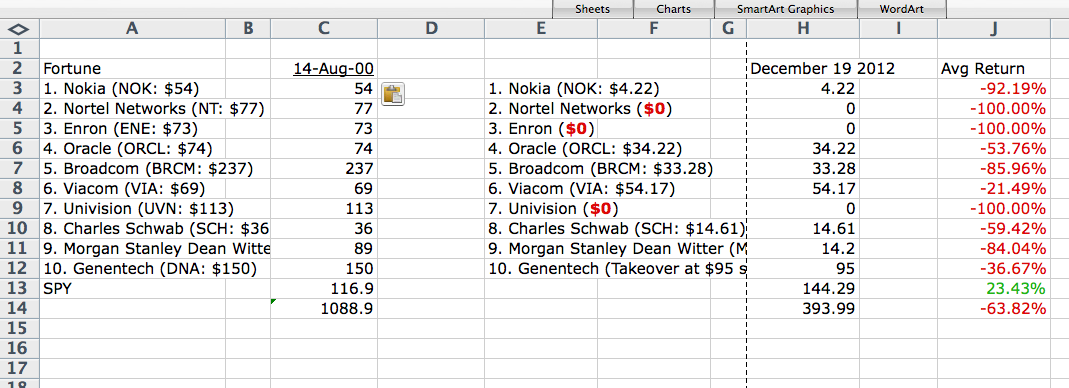
| Buy-and-Forget Portfolio: 10 Stocks To Last The Decade Posted: 20 Dec 2012 04:15 AM PST This time of year, newspapers and magazines are filled with predictions and stock recommendations and trading ideas. I have repeatedly explained why these are terrible ideas and you should ignore them. Sometimes, you just have to let the performance speak for itself. And for that, I present Fortune: 10 Stocks To Last The Decade A few major trends will likely shape the next ten years. Here’s a buy-and-forget portfolio to capitalize on them. August 14, 2000 1. Nokia (NOK: $54) Closing prices December 19, 2012: 1. Nokia (NOK: $4.22) The portfolio managed to lose 74.31%, with 3 bankruptcies, one bailout, and not a single winner in the bunch. Even the Roche Holdings takeover of Genentech was for 37% below the suggested purchase price. The lesson is that valuation matters. (Update: Forgot about Univision takeover — I’ll pull the TO price and recalculate when I get into the office) (Update 2: Yeah, I forgot about Oracle 2 for 1 split — I’ll adjust that as well Broadcom 3 to 2 split) Had you merely bought the S&P500 index via the Spyders, you would have seen a gain of 23.43%. Have fun forecasting!
Previously: 2008 Investment Guides Are HILARIOUS (December 31st, 2008) UPDATED: Worst Predictions for 2008 (December 31st, 2008) Investing in 2012: Get ahead of forecaster folly (WaPo, December 30 2011)
Source:
|

| You are subscribed to email updates from The Big Picture To stop receiving these emails, you may unsubscribe now. | Email delivery powered by Google |
| Google Inc., 20 West Kinzie, Chicago IL USA 60610 | |



0 comments:
Post a Comment