


The Big Picture |

- Every Rolling Stone Tour Mapped
- Open Thread: Why Is US HealthCare So Expensive
- EVERYBODY KNOWS . . .
- 10 Tuesday PM Reads
- Those Idiotic ‘Fiscal Cliff’ Countdown Clocks? All Wrong.
- US Labor Force Participation Rate
- 10 Tuesday AM Reads
- Fiscal negotiations/RBA/other
- Tensions rise in South China seas
- The War on Christmas: Friendly Fire Edition
- The Austerity Dictionary
- Taxation and Leverage in International Banking
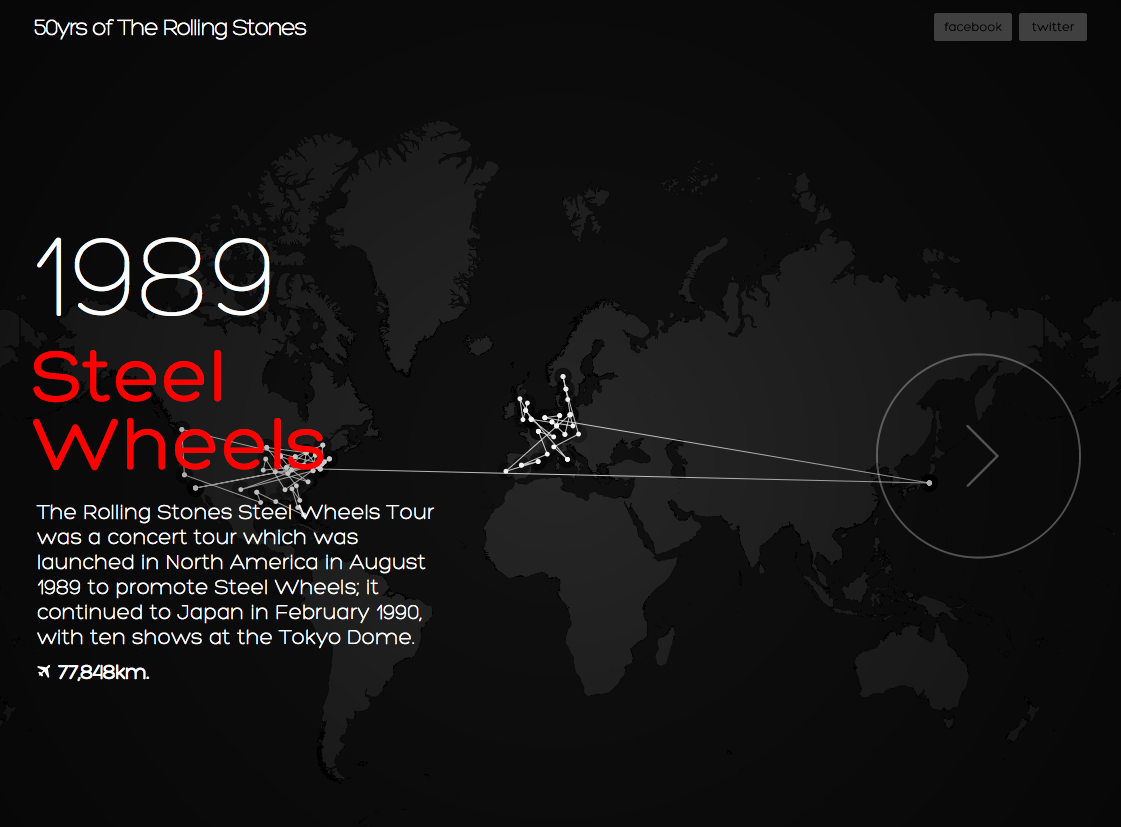
| Every Rolling Stone Tour Mapped Posted: 04 Dec 2012 06:00 PM PST
Vizzuality has a digital mashup of every single Rolling Stones tour — ever. 50 Years of touring, overlaid onto global maps. Now if only someone will animate it . . .
|
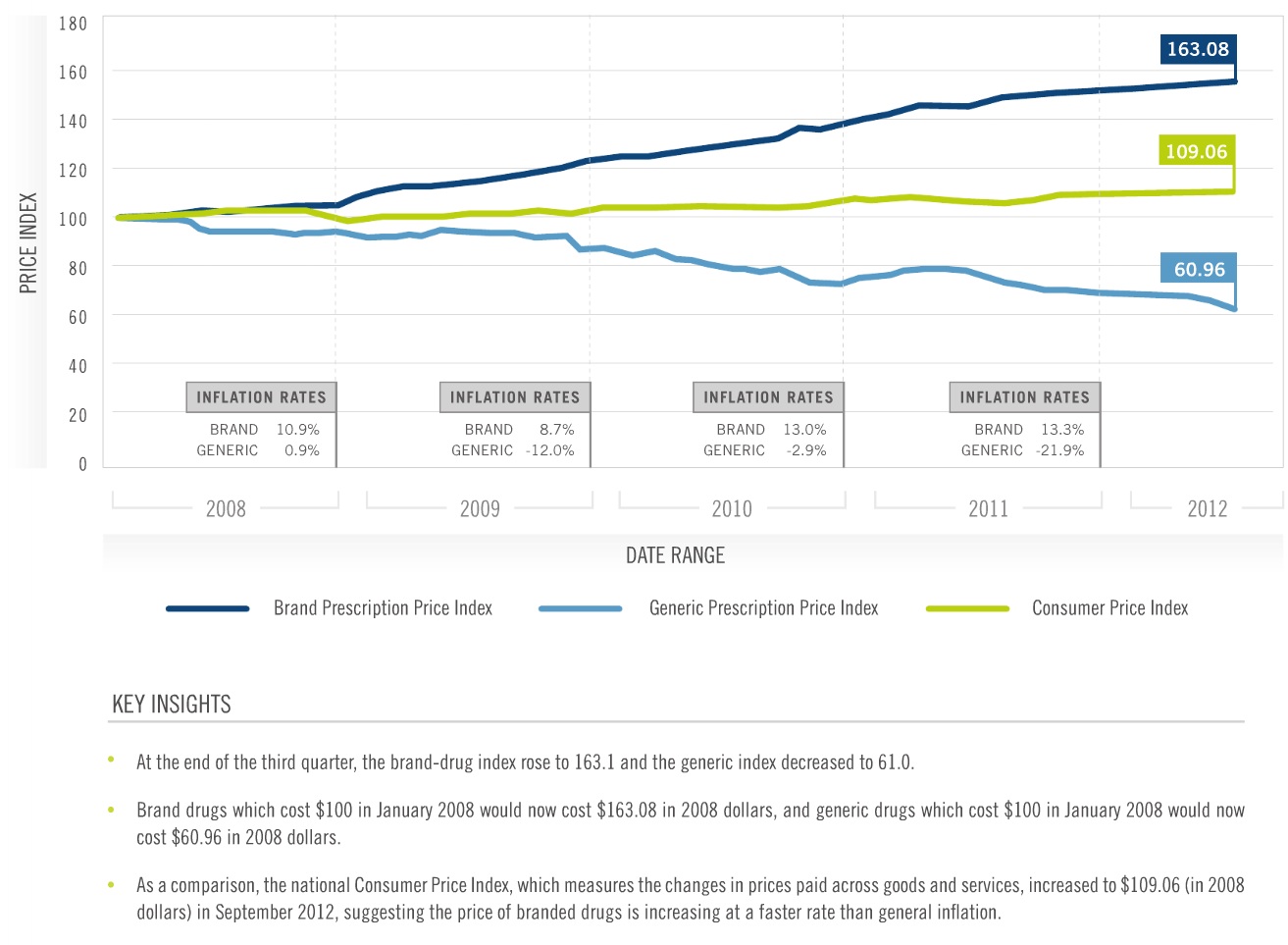
| Open Thread: Why Is US HealthCare So Expensive Posted: 04 Dec 2012 04:30 PM PST Prescription Price Index: Generic versus Brand Names
Source: Express Scripts
US Health Care is 2X as expensive as the rest of the world. Why? Discuss. |
| Posted: 04 Dec 2012 02:00 PM PST 1. Most tweets go unread. Just because you tweet, don’t expect your followers to see it. Few view their feed comprehensively. They check in and check out. Catching only bits and pieces. Even forgetting your fake and dormant followers, which are voluminous, far fewer than fifty percent of your followers see one of your tweets. Actually, I’d be stunned if 10-15% of your active followers see one of your tweets. So, natural reaction would be to repeat your tweet. But this only pisses off those who are truly paying attention. People use Twitter as a snapshot of what’s going on, they check in when they’ve got time to waste and when really important stuff is going on. Tweet, but don’t expect it to pay dividends. It’s a gift to your loyal fanbase, which is a far cry from your total fanbase. As for driving your follower count up… Shy of buying or begging for followers, you can’t. Something else has to drive adoption. Twitter is just like everything else online. A minor piece of the puzzle. I know it’s overwhelming, trying to get traction. But have sympathy for the public, which is bombarded with more information than it’s got time to pay attention to. And when you sneak into their feed, through subterfuge or sheer attack, you only piss people off. People trust their friends. And they’re constantly checking the momentum online, what’s trending, they don’t want to be left out of the discussion. You can’t create mo by inundating people who don’t care with junk.
2. Unsolicited e-mail is ignored. It makes you feel good to send a link to your music, or god forbid attach an MP3. Everybody who gets this e-mail instantly deletes it. If anything, it works against you. So you send a bunch of e-mails from a list you acquired and expect something to happen. It won’t. 3. Creating an app is a waste of time. It’s kind of like CDs. When they were rare, when manufacturing couldn’t keep up with demand, you could sell anything on disc. Back in ’82-84. But then AOL spammed the world with discs and devalued CDs and it became about what was on them more than the format. The app gold rush is over. An app is a service. If people are going online constantly for updates, maybe an app is worth developing. But don’t view it as a profit center. Of course, there will be new, successful apps in the future. But their financial success will be like winning Powerball. If you like those odds, go for it. Otherwise, keep practicing your music. 4. You can’t get a good seat at fair value. It’s just that simple. Blame the acts, blame Ticketmaster, blame promoters, blame StubHub and the scalpers, but don’t blame the public. 5. The sound of MP3s suck. People just don’t care. They don’t want to sacrifice portability. A higher res format will not succeed by telling people what they’ve got is bad, but by creating something so incredible people flock to it. 6. The success of EDM is about the scene. Once upon a time this was the same with rock music. Going to the show was like going to a party. Now it’s like going to a prison that you have to pay to escape from. 7. The bankers don’t create anything. Instead of whining about higher taxes, they should work on transparency, showing their worth, their help in building new businesses. But you can’t illustrate that which does not exist. 8. Most Android owners use few apps. The phone is free, the knowledge is not. They can check their e-mail, text and possibly shoot photos, but beyond that, they’re clueless. 9. Record companies rip off acts. Their plan is to just sign up the ignorant and rape them. Not a long term strategy. WHAT EVERYBODY SHOULD KNOW 1. The American Dream is dead. Your odds of going from poor to rich are worse than in most European nations, including German, Sweden, Denmark and the Netherlands. 2. You can’t make any money in music. Your odds of getting rich are infinitesimal. Like winning the aforementioned Powerball. If you’re in it for the wealth, give up, there are easier ways to get rich. You can use music as a springboard to other opportunities, you can gain notoriety and try to profit on that, then again, most reality TV stars are poor. 3. Radio is about advertising. Expecting music radio to come back is expecting today’s kids to carry Partridge Family lunch boxes to school. Music is an on demand item. The only thing missing is the filter/recommendation engine. Which is not an algorithm. To use the parlance of the techies, radio is too inefficient. 4. Streaming is the future. We live in an on demand world. Bitching about today’s payouts is like complaining your phone bill is too high because you were charged by the hour on AOL. 5. Songs are king. Write a great one. Then you’ll get traction. 6. Success is not instant Look at Rod Stewart. He auditioned for Joe Meek in 1961. He didn’t break through until 1971. 7. Disinformation is the American way. Every group has a full time lobbyist trying to protect its turf. From the Koch Brothers to the record labels. In other words, never believe a single thing the RIAA says. It’s a lobbying organization for the labels, that’s it. It’s like paying your mother to say good things about you. 8. Practice makes perfect. With so much stimulation at hand, few want to be outsiders, alone in their bedroom honing their chops. Everybody wants to be famous. Music has become about marketing as opposed to talent, and the public can tell the difference. 9. First week sales are irrelevant. They get you mainstream press, which people might nod at and then instantly forget. Quick, tell me, what was the number one movie the second week of September? Even better, what was the number one SoundScan album the third week of August? It’s not about individual triumphs, it’s about an accumulation of mindshare. 10. Albums have shorter shelf lives than singles. I know, it’s counterintuitive. Call it the paradox of choice. You’ll check out a track, you can ignore a complete album, it takes up too much time. Forget all the b.s. from the musos about albums. People want more music from those they are fans of. But most people are not hard core fans. Your job is to make them so. Not by appearing in “People,” but by constantly being in their mind. Which is difficult if you’ve got zero traction. But once you hit the tipping point, a steady stream of new stuff, i.e. singles, will pay more dividends for your career than an album. Don’t be beholden to old formats. Do you refuse to use your DVR and love commercials? 11. Executives make more money than acts. Why? They didn’t even start the company! Music executives are chasing the Forbes 400, they should be playing to the acts. Then again, like the rest of the CEOs at public companies, they’re interested in instant results and quick payouts, the future is irrelevant to them, they won’t be there. THE SILVER LINING 1. The history of recorded music is at your fingertips, for free. If you don’t think this is good for listeners/fans, you don’t have ears. 2. If something is good, it can be spread by the alternative network known as the Internet, which is word of mouth on steroids. 3. Even oldsters are tech savvy. They too can participate in word of mouth. It’s just about getting them started. Oftentimes, at NPR. Which you might call radio, but I call a hipster club. 4. It’s cheap to make recordings and distribution is free. Yup, record in GarageBand and put it up on YouTube. The fact that anybody can do this means there’s more need for a filter. 5. You no longer have to tolerate crap. Used to be you had to wait for your song to come on the radio or MTV. No longer. 6. You can have a direct connection with your favorites online. If an act is not doing this, it’s operating with one hand behind its back. People want to know everything about you. Fire your publicist, pitching bland information in mainstream publications no one is reading, and go straight to your fans in an unvarnished fashion. 7. Innovation is constant. We see this in tech, one breakthrough after another. The only reason we haven’t seen this in music is too many are chasing the major label/radio paradigm. However, that’s where too many of the few riches in this business presently reside. Music would be better if you could earn more money making and performing it. But if you want this to happen, don’t get angry with fans for stealing, get angry at an economy which gives untold riches to those who create nothing, like the bankers, or are overpaid, like the CEOs. Once upon a time, musicians were rich and beholden to nobody. Now they’re clowns in the circus kissing the butt of the elephants crapping on them. ~~~ Visit the archive ~~~ ~~~ If you would like to subscribe to the LefsetzLetter |
| Posted: 04 Dec 2012 01:30 PM PST My afternoon train reads:
What are you reading? > • Cut Medicare and Social Security? What’s the rush? (LA Times) |
| Those Idiotic ‘Fiscal Cliff’ Countdown Clocks? All Wrong. Posted: 04 Dec 2012 11:30 AM PST I’ve made my views about what I think of hype about sequestration (aka incessant fiscal cliff nonsense) pretty clear. (See this, this, this and this if you somehow missed it). It won’t surprise you to learn that as a general principle, I find the collection of fiscal cliff clock countdowns to be idiotic on principle alone. It turns out there is another reason to dislike these down-to-the-second reminders of what we all know has been coming for 18 months: They are counting down to a date — December 31st — that is, for all intents and purposes, irrelevant. As Dow Jones’ Vincent Cignarella pointed out, according to the rules in the House of Representatives, the very last day any bill can be introduced to Congress before adjourning is December 18th. Not the 31st, but the 18th. And, Congress is expected to adjourn for the year on December 21st. But that date may matter less than another date: December 17th. That’s when President Obama and his family leave the hellscape that is DC for their annual family vacation in Hawaii. All of those countdown clocks you see on CNBC and Marketwatch and everywhere else counting down to December 31st? Like so much else in the financial press, they are meaningless noise . . .
|
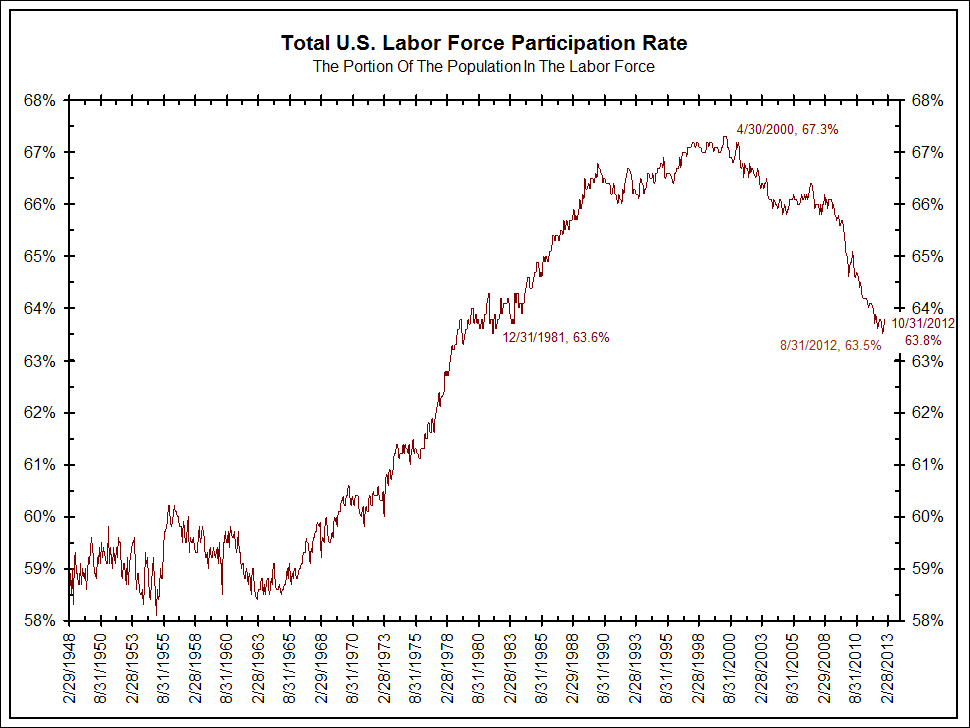
| US Labor Force Participation Rate Posted: 04 Dec 2012 09:00 AM PST
Since its NFP week, I thought it might be interesting to look at some assorted datapoints this week. Today’s focus: US Labor Force Participation Rate. As the chart above shows, this peaked in 1999, and has been trending downwards ever since. There are several reasons why this is:
That last item doesn’t get discussed nearly as much as it should, but the single biggest future trend in the labor force is going to be the ongoing replacement of humans by smart machines. Whether you are a discretionary trader, a reporter, assemble iPhones, do construction of buildings, engage in general manufacturer, drive a car, do surgery, or are simply in the world’s oldest profession (aka a sex worker), there is some combination of software + robot that will eventually start doing your job. I cannot tell you how far in the future this becomes problematic — but its not centuries. The question is whether its decades or years . . . |
| Posted: 04 Dec 2012 06:40 AM PST My morning reads:
What are you reading? > |
| Posted: 04 Dec 2012 05:49 AM PST Not surprisingly, the more detailed Boehner proposal presented to the White House was rejected and the game goes on. Imagine what our Founding Fathers would think of this process after they created a document with specific enumerated powers. I digress to monetary policy where the Reserve Bank of Australia cut interest rates by 25 bps to 3% as expected. Their benchmark rate is back to the lows of April thru Sept ’09. The key difference between the RBA and other central banks though is their desire to keep REAL interest rates positive as they have for at least the last 20 years. In their release they said “Global growth is forecast to be a little below average for a time. Risks to the outlook are still seen to be on the downside…” Notwithstanding the cut, the Aussie$ is matching the highest level vs the US$ since mid Sept. The euro heavy Dollar index itself is at a 6 week low. In the ‘other’ category, the Shanghai index rallied off the lowest level since Jan ’09 by .8% and euro zone PPI rose 2.6% y/o/y vs 2.7% in Sept and compares with the 2.5% that was expected. Data wise in the US, today is the quiet before the important jobs data over the next 3 days and the ISM services index. |
| Tensions rise in South China seas Posted: 04 Dec 2012 05:30 AM PST The Australian Central bank, the RBA, did indeed cut its benchmark rate by 25 bps to 3.0% as expected. Rates are now at their 2009 lows, indeed an over 50 year low. With unemployment creeping up, a weaker mining sector, declining inflation and generally a slowing economy, analysts had expected the move. The RBA remains surprised by the strength of the A$, so do I, I must admit – its currently trading around US$1.0475, actually higher following the interest rate cut by the RBA. However, I would argue that the RBA is at fault. The RBA has been particularly cautious in the past and the market does not expect the central bank to continue to cut rates aggressively – it needs to cut rates by over 100 bps in 2013. In addition, the interest rate differentials with other developed economies remain high and local banks have not passed on the rate cuts to customers. I continue to believe that the RBA will act, finally, next year and that the A$ is overvalued. I will increase my short (against the US$) further, though I must admit its been a pretty boring trade so far; Robert Hardy of Stratfor (an excellent Internet based geopolitical newsletter – you really should subscribe to it) reports that the Chinese English language newspaper, the China Daily, carried a story that the southern island of Hainan has authorised its border police to “board, search and/or seize foreign ships that (the Chinese authorities deem) “illegally” enter the Province’s waters“. Wow. This is big stuff. The Indian navy is preparing to deploy vessels to the South China seas, on “exercises”. In response to a question about China’s announcement that they would board ships, the head of the Indian Navy stated that India had the right to “self-defence”. Recently, Vietnam claimed that Chinese vessels cut the cables of their exploration vessels, which are operating in areas claimed by China. These exploration sites are partly owned by Russian interests, whilst others are co owned by US interests. The Philippines have raised material concerns about Chinese policy, as well. This is a big issue and markets have (dangerously) ignored it so far; Mr Schaeuble, the German finance minister and Mr Juncker, the head of the EZ finance ministers, stated that Portugal and Ireland should not seek to renegotiate the terms of their bail outs, echoing comments by the Dutch PM, Mr Rutte. Oh yeah – no chance guys. Portugal and Ireland must negotiate aggressively to get better terms – I don’t understand why they have not done so as yet; A decision on the bail out of Cyprus has been delayed till 13th December, the same date that the EZ wants to sort out (well for the time being, at least) Greece. The bond buy back proposals should succeed – ends this Friday. Interestingly Greek 10 year yields are up today, having declined in previous sessions, suggesting support for the buy back; EZ finance ministers approved aid amounting to E39.5bn to Spanish banks, much lower than the E100bn initially allocated. The loan will have a 12 1/2 year maturity, with a 10 year grace period and a 1.0% interest rate charge in the 1st year. Will E39.5bn be enough – certainly not?. The amount necessary will prove to be multiples of that ultimately – just follow the Irish example, which has had to provide over E60bn for its banks, and Ireland’s population is just 10% approx of Spain’s. In addition, Spanish banks have been far far slower to provide for losses in respect of their property sector. Spanish November unemployment rose by +1.5% or 74.3k M/M to 4.9mn, though below the increase of 90k expected and 128.2k in October. The number of registered unemployed has risen by 11% Y/Y, with no improvement seen in the near future; EZ October PPI came in at +0.1% M/M, slightly higher than the unchanged expected, though lower than the +0.2% in September. Y/Y, PPI came in at +2.6%, lower than Septembers +2.7%; US November ISM manufacturing came in at 49.5 M/M, lower than 51.4 expected and 51.7 previously. The prices paid component was better at 52.5, as opposed to 53.3 expected and 55.0 in October. Employment (48.4, as opposed to 52.1 previously), inventories (45, as opposed to 50 previously), exports (47, as opposed to 48 previously) and new orders (50.3 as opposed to 54.1) were sharply lower. Respondents cited a slowdown in demand and concern over the fiscal cliff. However, I believe that the data will bounce back in early 2013, when a deal on the fiscal cliff is done – likely. If it not done, well…..; US October construction spending came in at +1.4% M/M, higher than the 0.5% expected and the +0.5% in September. The rise was the largest since September 2009. Residential housing was a key component, up 3.0%, its highest since November 2008 and +21% Y/Y. Non residential construction was up just +0.3% M/M, though +11% Y/Y. The US Commerce Department stated that residential housing contributed +0.32% to the overall +2.7% annualised GDP growth in Q3; The SEC has accused the Chinese affiliates of the Big 4 accounting firms, together with BDO, of breaking securities laws, following the refusal by these firms to provide their internal audit documents on Chinese firms listed in the US. The move could result in a number of Chinese firms being delisted. Chinese laws forbid these firms to share info, though US laws require them to do so !!!!. Hong Kong faces a similar problem. In theory, the audit firms could be barred from auditing US-listed companies. Oops; The IMF has reversed its position and now believes that capital controls can be used, though such measures should be “transparent, targeted and generally temporary“. However, a number of economists suggest that the IMF has not emphasized the impact of loose monetary policy in developed economies, which have resulted in flows into emerging markets and which have, on occasions, required the imposition of capital controls; Outlook Asian markets closed mixed, with the Shanghai Composite recovering late in the day to close some +0.8% higher. Will Chinese markets pick up, for the 1st time for years – too early at present but, on balance, I believe they will. However, I will wait, as I need more confirmation. European markets are flat to higher. US futures suggest a flat opening. The Euro continues to strengthen, currently US$1.3074. The Yen is trading marginally below Yen82. The outcome of the impending Japanese general election can be best described as “confused”. Basically its Japan. Gold is trading at US$1705, with January Brent at US$110.31.. The ECB meets on Thursday – mixed views, with some analysts expecting a 25 bps cut. I do not think so, though the ECB will release updated economic info. I believe that an ECB rate cut is more likely in early 2013. Overall, I have been more positive on Italy (the market is 1%+ higher today) than, for example Spain, for some time. Whilst I remain cautious on Spain, other than as a trading play, I am becoming cautious about Italy as well following the political developments which I reported yesterday. Whilst I continue to believe that Italy is more resilient than the market believes and that its market will perform in the short term, the outcome of the upcoming general elections in spring next year are being ignored by the markets. There is an increasing risk that Mr Monti will be replaced as PM – not good news. Early days, but I will watch even more carefully. Lots of reports of political games re the fiscal cliff in the US. Whilst I believe that a deal will be done – most probably after the deadline – these stories are likely to continue to weigh on US markets. I would like to add to my equity holdings, but will wait for a while longer. Kiron Sarkar 4th December 2012 |
| The War on Christmas: Friendly Fire Edition Posted: 04 Dec 2012 05:00 AM PST For Fox News, the war on Christmas has become a rote observance devoid of all its original meaning. December 3, 2012 (07:23) |
| Posted: 04 Dec 2012 03:16 AM PST Inspired by Ambrose Bierce, Brian M. Lucey crowdsourced (via Twitter) numerous definitions for what he called “The Austerity Dictionary.” Brian is a finance prof at the Trinity College Dublin School of Business, and his complete list has a heavy focus on Ireland. I edited it down to its most universal usages.
The Austerity Dictionary AIB: Another Irish Bailout
|
| Taxation and Leverage in International Banking Posted: 04 Dec 2012 03:00 AM PST |




| You are subscribed to email updates from The Big Picture To stop receiving these emails, you may unsubscribe now. | Email delivery powered by Google |
| Google Inc., 20 West Kinzie, Chicago IL USA 60610 | |



0 comments:
Post a Comment