


The Big Picture |

- More Shopmas Gift Ideas!
- Ritholtz: ‘Dot Com Bonus Envy’ Stymies Wall St. Reform
- 10 Midweek PM Reads
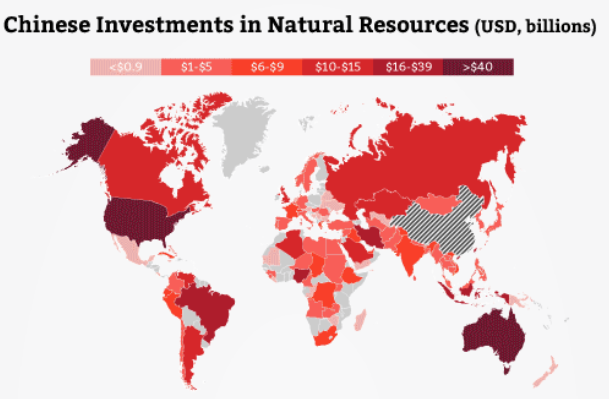
- Chinese investment in North America
- How Much Is the Fed Driving Home Prices?
- ADP job’s report gets cut by hurricane
- First sign of a Chinese stimulus programme ?
- 10 Midweek AM Reads
- China/Europe
- Dealers Are Not Shorting Treasuries
- You Suck at Parking. Seriously.
- Odds & Ends
| Posted: 05 Dec 2012 04:15 PM PST Its the second installment of our annual shopping tradition (2012 first edition is here) — these are some of the more interesting and eclectic items I stumble across each year. Across a broad variety of price points, here is the next Shopmas list for those of you who may have been very, very good this year. The goal is find items that you may not have seen and will make the recipient smile. Select some items and effectuate your own economic stimulus package: ~~~
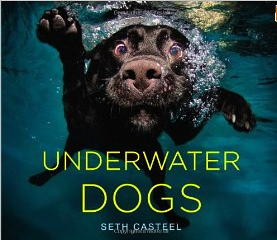
I mentioned Underwater Dogs a few times this year (see this and this) — and now these hilarious photos are gathered in one delightful book. The exuberant, exhilarating photographs of dogs underwater that have become a sensation. More than eighty portraits by award-winning pet photographer Seth Casteel capture new sides of our old friends with vibrant underwater photography that makes it impossible to look away. A perfect stocking stuffer. ~~~ • Nebo 5615 RedLine SE Flashlight $32.69 After last week’s gift post, a few people asked about “that flashlight you mentioned” (discussed here, “My Hero of the Blackout.”) The power and intensity of this compact tactical light is amazing. The Redline SE is the perfect flashlight for Firefighters, EMTs and Police Officers. You can illuminate an entire room in flood mode, or illuminate objects 175 yards away in spot mode. light. 5 modes include 100-Percent, 50-Percent, 10-Percent and power settings + Strobe & SOS allowing batteries to last up to 72 hours. The 250 Lumen, Nebo 5615 runs $33 (note the 310 Lumen Nebo 5620 is $50 but goes on sale at $39). ~~~
This 14-disc career retrospective set includes all twelve of George Carlin s HBO concert specials, spanning nearly thirty years. One of the greatest comedians of all time, Carlin performs his most memorable routines (Baseball and Football, A Place for My Stuff, Losing Things, Al Sleet the Hippie-Dippie Weather Man, Hitler, We Like War, It s Not A Sport, Why We Don’t Need Ten Commandments and Seven Words You Can Never Say on Television). Two bonus discs round out the collection including interviews — Carlin fans will adore this set. ~~~~ • Hugh Johnson’s Wine Companion: The Encyclopedia of Wines, Vineyards and Winemakers $24 Last time, I mentioned Exploring Wine ($39) and several of you wrote to recommend 2 other wine books: The less expensive of the two is the sixth edition of Hugh Johnson’s Wine Companion. Hugh Johnson’s Wine Companion presents a unique approach to wine and wine producers, combining detailed information with practical advice on how to enjoy wine to the fullest. Color maps and photographs and detailed glossaries of the wines of each region are just two of the additions for this exciting new edition.
This is the other book recommended by readers — described as “an indispensable book for every wine lover, from some of the world’s leading wine experts.” Where do wine grapes come from and how are grape varieties related to one another? What is the historical background of each one? Where are they grown? What sort of wines do they make? Using cutting-edge DNA analysis and detailing almost 1,400 distinct grape varieties, as well as myriad correct (and incorrect) synonyms, this book examines grapes and wine as never before. This is a serious book for serious oenophiles!
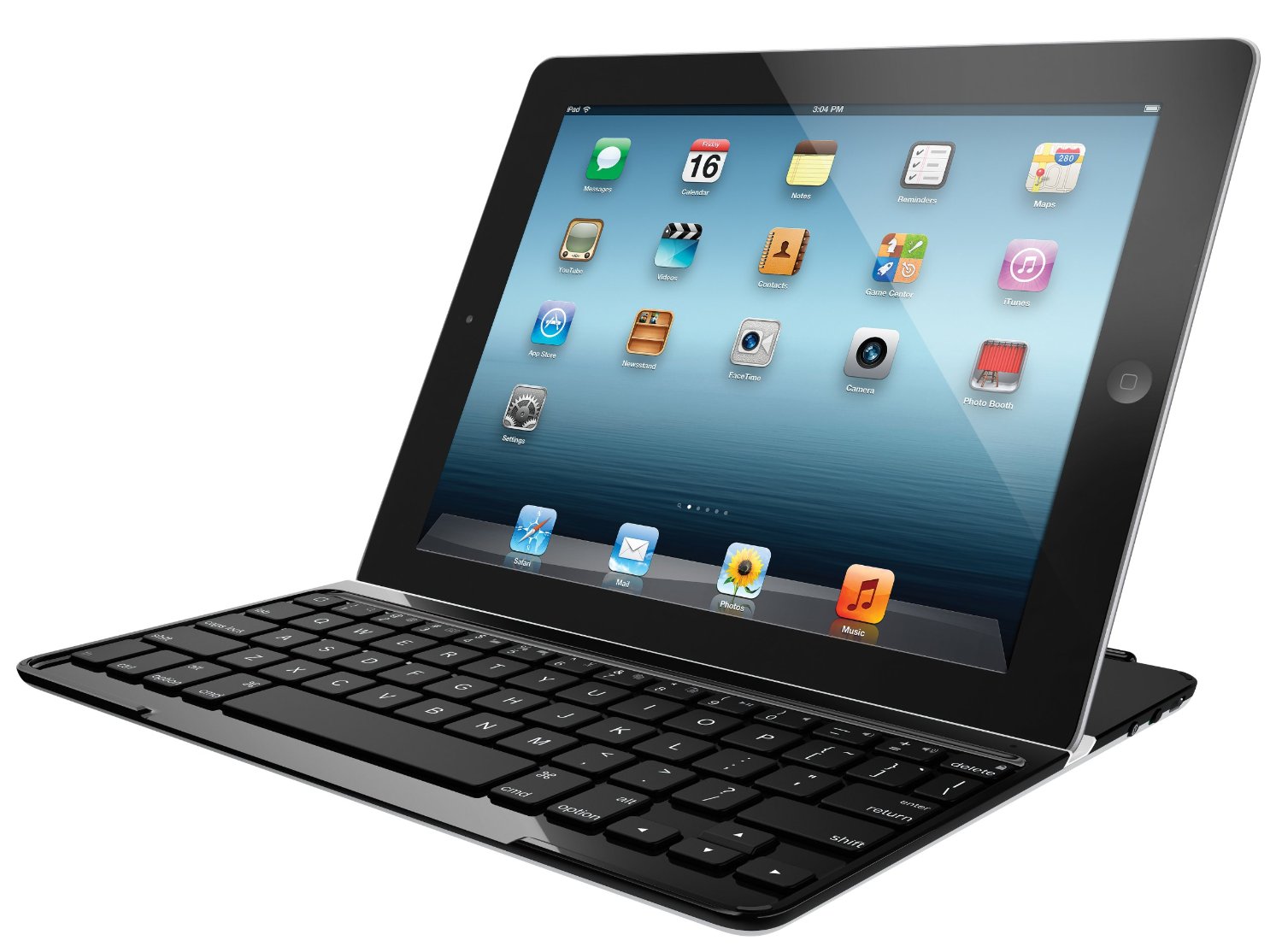
For anyone who loves their iPad but is less than thrilled about the typing on glass, these ultra-lite, portable keyboards are the way to go. They turn your tablet into what is essentially a touch screen ultralite laptop. Clip-and-go design: Magnetic clip instantly attaches keyboard as a cover, which also works as a stand. The same instant on/off that wakes and sleeps your iPad when you open and close the cover. I never go anywhere without mine. ~~~
I love the idea of this company, which I first found in Anguilla: Take old sailboat canvas (sails) and repurpose them into new products. I like this Sea Bag anchor as a large tote for the boat or a family day at the beach. Recycled sail with navy hand spliced rope handles designed for hand carry; zipper top to keep things secure. ~~~ • Beatles Box Set (Stereo) $179
Look, you either know and love the Beatles, or you don’t. Anyone who is a fan and gets this set will be delighted. Digitally remastered 17 disc box set (16 CDs + DVD), the set contains all of the 14 original Beatles albums released between 1963 and 1970 plus the two CD Past Masters collection of non-album tracks (plus other bonus DVD material and documentaries). Note which version you order — I suggest stereo, your annoying brother-in-law wants the original mono, and your weird uncle insists on Vinyl. ~~~
I have the prior version of this camera, and it takes good underwater photos and video. I will be upgrading it for the new Pentax Optio WG-2 Camera, which can take crisper cleaner photos in lower light situations. Durable, 16-megapixel point-and-shoot camera is waterproof, dustproof, coldproof, shockproof, crushproof, and still capable of professional-level images and full 1080p HD video. 36X combined zoom and macro lens. Its waterproof down to 40 feet, shockproof to 5 feet, and freezeproof to 14 F degrees. ~~~ • Alfred Hitchcock: The Masterpiece Collection (Limited Edition) $207.99 The Master of Suspense, the legendary Alfred Hitchcock directed some of the best thrillers ever made. The Masterpiece Collection features 15 iconic films including Psycho, The Birds, Rear Window, Vertigo, North by Northwest and many more. Over 15 hours of insightful bonus features plus an exclusive collectible book, each film has been digitally restored from high resolution film elements for the ultimate Hitchcock experience.
~~~ • Clifford Bailey Lithographs $1,000-$3,000
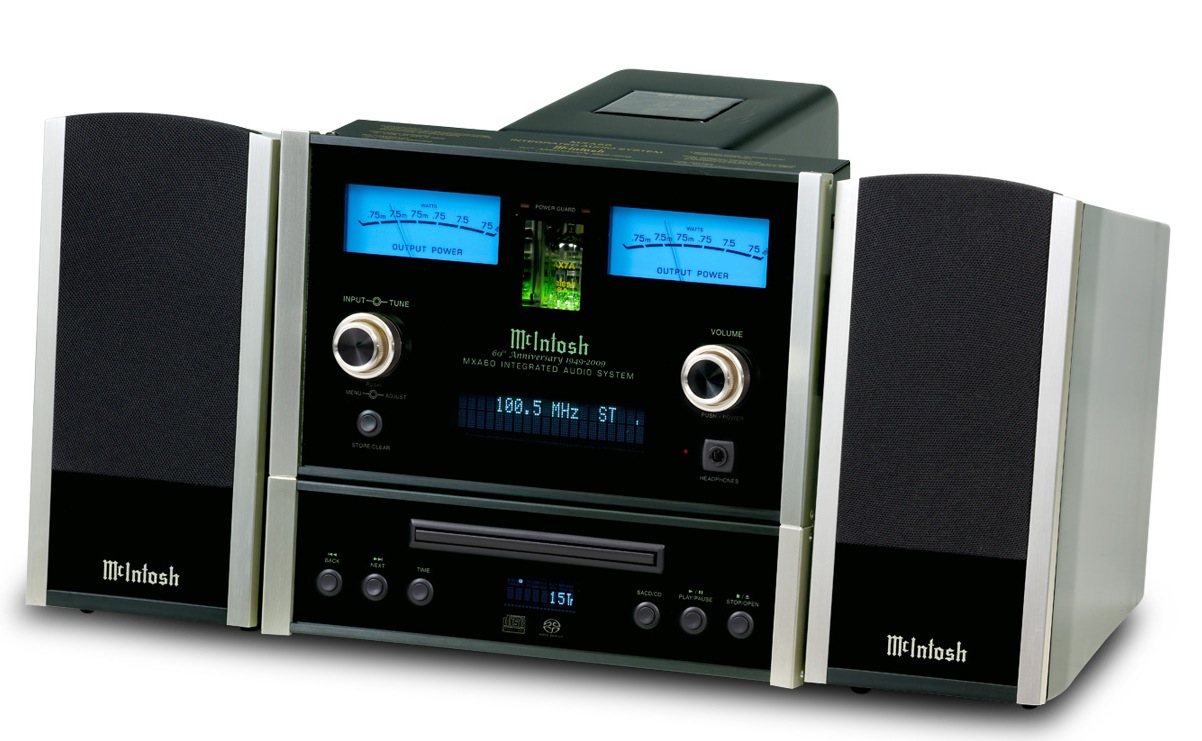
Clifford Bailey paints amongst other things, delightfully whimsical jazz bands in full swing. There is a charming sense to his work, which capture the full energy of improvisation. “The work is playful, intense, funny, twisted, easy to look at and hard to forget. His signature style is original and unique.” The Miami born artist lives and works in Los Angeles. Full bio is here. ~~~ • McIntosh Manhattan $7,000
The system also includes a built in AM/FM/RDS tuner, CD/SACD as well as auxiliary input to playback your favorite source. This reference quality system will blow you away and is built to last a lifetime. If you have discretionary income to burn, want something to impress your friends, take a look at this little beatsie. |
| Ritholtz: ‘Dot Com Bonus Envy’ Stymies Wall St. Reform Posted: 05 Dec 2012 03:15 PM PST The unregulated multi-trillion dollar derivatives market exceeds global GDP and poses a clear danger to the global economy, Chris Whalen, Senior Managing Director at Tangent Capital Partners, and Barry Ritholtz, CEO at Fusion IQ, tell Bloomberg Law’s Lee Pacchia. “The fix is very simple,” says Ritholtz, “repeal the Commodities Futures Modernization Act and suddenly this becomes like every other financial instrument.” Whalen notes that the financial industry is reluctant to change the way derivatives are managed because they generate large returns at a time when banks are less profitable than before. “The super normal returns that they earn from derivatives subsidize the rest of the business,” he says. One way or the other, Ritholtz and Whalen believe the financial industry needs to get used to the idea of making less money. Dec. 5 (Bloomberg Law) |
| Posted: 05 Dec 2012 01:30 PM PST My afternoon train reads:
What are you reading?
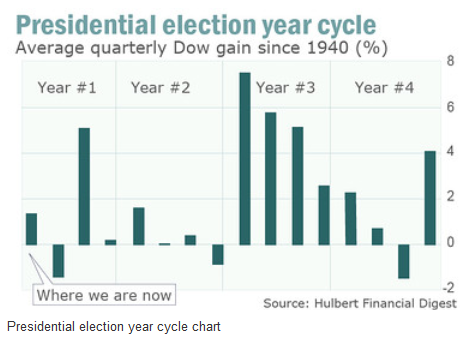
Stocks volatile early in presidential cycle |
| Chinese investment in North America Posted: 05 Dec 2012 11:30 AM PST |
| How Much Is the Fed Driving Home Prices? Posted: 05 Dec 2012 09:00 AM PST
Some people look at me funny when I say that Real Estate is one of the few bright spots in the economy, but that its mostly inorganic. Tim Iacono, who does a masterful job explaining how extraordinary these Fed driven mortgage rates are. The 40 year average is 8.7%, the 20 year average is 6.5%, and current 30 year rates are 3.3%. The chart above is from a post of his — the change just over the past year or so is a ~15% increase in buying power for mortgage users from $240k to $280k on the same $1100 per month.
Source: |
| ADP job’s report gets cut by hurricane Posted: 05 Dec 2012 08:00 AM PST The supposedly new and improved ADP employment report said private sector job gains in Nov totaled 118k, 7k less than expected and down from 157k in Oct. The hurricane though had a large influence on the number as ADP estimates that 86k were lost due to it with the manufacturing, retailing, leisure and hospitality and temp help industries most impacted. Manufacturing in particular shed 16k but on the other hand, construction jobs were up by 23k. In contrast to normal trends, large companies were the biggest incremental net employer on the month while small businesses were the smallest. Bottom line, taking out the influence of the hurricane saw a healthy increase of 204k jobs according to ADP’s estimates but the typical driver of net job gains, small and medium sized businesses were more reluctant than bigger one’s in adding labor costs. The hurricane impact will of course remain with us in reading the Nov data over the next month with the question for 2013 being how much activity we get back from the recovery/normality in the Northeast. The private sector job gain in Friday’s Payroll figure is expected to be 93k. |
| First sign of a Chinese stimulus programme ? Posted: 05 Dec 2012 07:32 AM PST The Australian economy grew by +0.5% in Q3 Q/Q, slower than the +0.6% in Q2 and +1.3% in Q1. GDP rose by +3.1% Y/Y, in line with market expectations. The government sector was the main drag, with state and federal expenditure lower. The mining sector showed clear signs of slowing, as did household expenditure, which was up just +0.3%, the lowest in over 2 years. The A$ is flat on the news; The BoJ deputy governor hinted at further monetary stimulus today, stating that the central bank will debate the issue. The Yen rose above 82 against the US$ – currently Yen 82.08 against the US$; Chinese authorities are to abolish limits on investment in banks by its insurers. In addition the new leadership are pressing ahead with a policy of urbanisation, which suggests another bout of fixed asset expenditure. New residential property prices in Tier 1 cities saw the 1st positive growth in the year. The HSBC November services PMI was lowered to 52.1, as opposed to 53.5 in October. However, HSBC advises that the sector was becoming more optimistic and were hiring more employees. The Shanghai composite rose by +2.9%, the most since September (and back above 2,000) with Hong Kong up over 2.0%. Looks as if the Shanghai Composite will rise further. Copper hit a 7 week high on expectations of increased Chinese demand. Miners should improve on the news; Indian November services PMI came in at 52.1, as opposed to 53.8 in October, a 13 month low. The proposal to allow foreign retailers to enter the Indian market is being voted today in the lower house; Dow Jones reports that the Spanish government will seek a bail out, if the ECB will guarantee that its 10 year bond spread will be no more than 200bps above equivalent German yields. Yeah right. The ECB will not to offer such a guarantee. In addition, Germany is not keen on Spain requesting a bail out/ECB assistance, given Mrs Merkel’s problems with certain members of her coalition, who are opposed to bail outs/further aid. The saga continues; German finance minister, Mr Schaeuble blocked moves to create a banking union yesterday. The Germans object to ECB supervision of their regional banks. The UK objects to the EU proposals on banking union, without safeguards on the ECB’s ability to set technical standards, which France and Germany object to. Finance ministers are to meet to resolve this issue, which was due to be settled by the end of the year; EZ November final services PMI rose to 46.7, higher than the 45.7 expected and 46.0 in October. Germany was better than expected at 49.7 as opposed to 48.0 expected, though France was lower (45.8, as opposed to 46.1 expected) as was Italy (44.6, lower than the 45.9 expected). Spain was higher at 42,.4, from 41.0 in October. The EZ final composite index came in at 46.5, higher than the flash reading of 45.8;
EZ October retail sales came in at -1.2% M/M much lower than the -0.2% expected and the largest decline since April 2012, Y/Y retail sales were down -3.6%, much weaker than the -0.8% expected and the largest decline since May 2009. September data was revised down sharply as well; UK November services PMI fell to 50.2 (the lowest since December 2010), from 50.6 in October and below the forecast of 51.0. New orders declined materially to 49.6, from 52.9, a 2 years low. The composite manufacturing and services PMI rose to 50.2, from 49.6 in October. The services data, whilst marginally in expansion territory, is ominous for Q4 UK GDP, given that services represents over 70% the UK economy; The UK Chancellor admitted that the UK will miss its target to have debt to income declining by 2015/16. In his Autumn Statement, the Chancellor stated that austerity measures will need to be extended to 2018. He announced a £5bn capex programme, combined with government guarantees for another £40bn of infrastructure projects. GDP was reduced to -0.1% for the current year ending 5th April 2013 from +0.8% previously, with a rise to +1.2% next year, lower than the the previous forecast of +2.0% and increasing further to 2.0% in 2014/15. Government borrowings is expected to be 6.9% of GDP this fiscal year (to 5th April 2013) and 6.1% in 2013/14, declining to 5.2% in 2014/15. The UK is to cut corporation tax by 1.0% from April2014. The inflation forecasts ave been raised to +2.5% for next year and +2.2% in 2014. The weaker growth, though worse fiscal outlook threatens the UK’s AAA rating – it is likely that it will be cut next year. Sterling was relatively unchanged on the news; US Q3 non-farm productivity came in at 2.9%, as opposed to 2.8% expected and 1.9% previously. Labour costs were 1.9% lower, much more than the 1.0% expected. ADP employment change cane in at +118k in November, slightly below the 125k expected and the previous 158k; Outlook Asian markets closed higher with China and Hong Kong up over 2.0%. It looks as if there is renewed interest in China, which suggests that the market will rise further. Miners benefited from the Chinese news, though the A$ was pretty flat. European markets are higher, with US futures indicating a slightly higher open – uncertainty over the fiscal cliff dominates. Spot gold is trading at US$1704, with January Brent at US$110.26. The Euro is weaker and is trading below US$1.3074, having been above US$1.31 earlier. Looks as if its time to start building up a short. The uncertainty over Spain will not help sentiment. The Yen, having declined to near 82.35 against the US$, is now trading at 82.09 – I remain bearish. Essentially positive on markets and will be buying on dips. Best Kiron |
| Posted: 05 Dec 2012 06:48 AM PST My morning reads:
What are you reading?
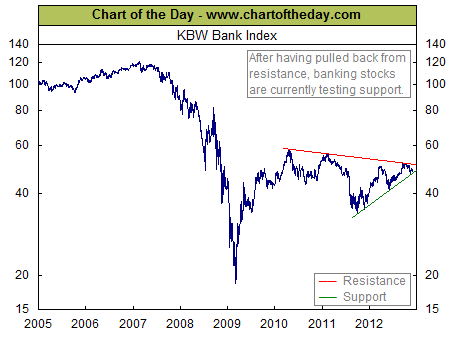
Chart of the Day |
| Posted: 05 Dec 2012 05:34 AM PST A stock market that has performed as bad as Spain in 2012, finally got some love overnight. The Shanghai index rallied 2.9% to a 3 week high just two days after closing at the lowest level since Jan ’09. The Hang Seng index was also up 2.2% to close at the best level since Aug ’11. Chinese authorities will no longer limit insurance company investments in banks and will take other steps to boost economic growth. Data wise in China, the private sector weighted HSBC PMI services index fell to 52.1 from 53.5 in contrast to the state sector index out a few days ago that slightly improved. In Europe, the PMI services index was revised up 1 pt led by Germany and it brought the final services and mfr’g composite index to 46.5 from 45.8. This index has stabilized but remains below 47 for the 8th straight month. EU retail sales in Oct fell more than expected. Ireland, the one country that has benefited from its particular form of austerity saw its unemployment rate fall to 14.6% from 14.7% to the lowest since Dec ’11. Spanish bond yields are higher after they sold just 4.25b of 3s, 7s, and 10s, below their target amount of 4.5b. In the US, the ADP jobs report and ISM services index are the two key data points. II: Bulls 43.6 v 39.3 Bears 25.5 v 27.7. |
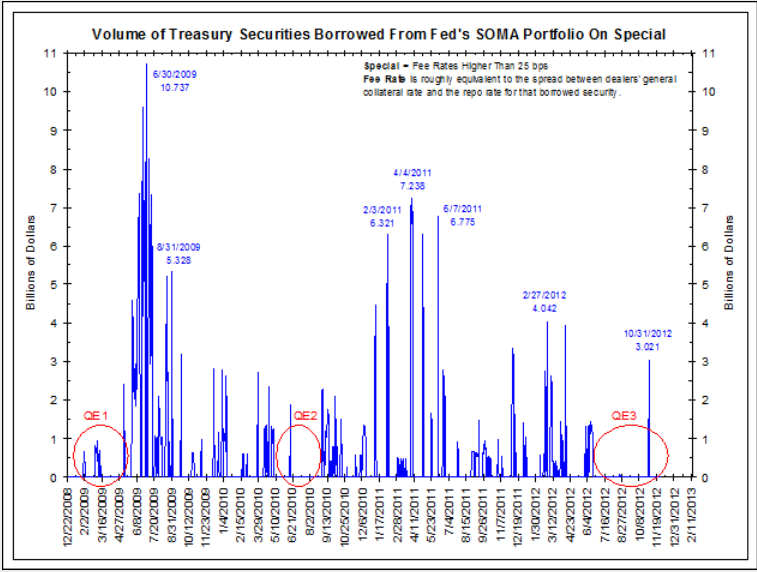
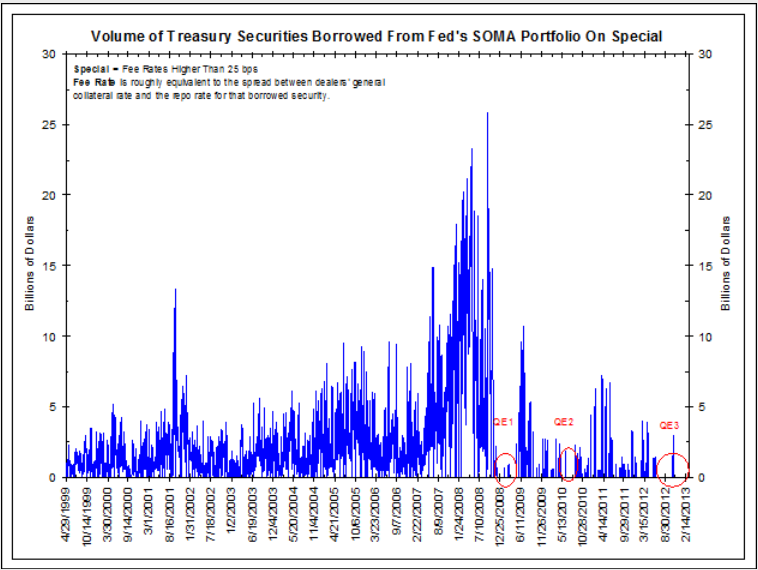
| Dealers Are Not Shorting Treasuries Posted: 05 Dec 2012 05:30 AM PST • CNBC – Volcker Says Rule Is Already Changing Wall Street Comment In a November 8 post we examined the fact that the general collateral repo rate has been trading through the federal funds effective rate, questioning why a secured rate would have a higher rate than an unsecured rate. We concluded with the following: In talking to some of the dealer desks, many pointed to the new capital/leverage restraints of the past several years as the main reason they could not capitalize on such an opportunity. Without being able to expand their balance sheets, their cash was already tied up elsewhere. Others pointed to the fed funds market as being a bit dysfunctional. While fed funds volume prior to the crisis normally reached $250 billion a day, current volume is closer to $20 billion a day. Since the banks/dealers have no need to raise funds, the GSEs are the only real participants left in the fed funds market. While both of these explanations make sense, they have largely been true since the crisis hit full stride in 2008. The GC rate has only materially traded above the fed funds in just the last few months. We believe this latest inversion is yet another market signaling concern over the fiscal cliff. If Washington fails to come to an agreement on the debt ceiling and U.S. debt gets downgraded, the contracts underlying the majority of repo transactions would basically need to be rewritten. As of now these contracts require AAA Treasury securities as collateral, so a downgrade by a second rating agency (S&P already downgraded U.S. debt to AA+) would be problematic as the majority rating would no longer be AAA. In a post last week we highlighted yet another possible explanation for such a disconnect in the markets. As Alhambra Investment Partners pointed out, there have been very few securities borrowed from the Federal Reserve's SOMA portfolio on special since June of this year. Using data from the New York Federal Reserve, we managed to construct the same chart as Alhambra Investment Partners, taking the data back even further. What we find particularly interesting is the lack of specials prior to the announcements of QE1, QE2, and QE3, highlighted by the red ovals.
For the purposes of this chart, a Treasury security is considered to be on special if the fee rate is 25 basis points or more. The fee rate is roughly equivalent to the spread between the dealers' general collateral rate and the repo rate for that borrowed security. So, a security on special is one that trades 25 basis points or more below the general collateral repo rate. Why is the lack of specials notable? As Alhambra Investment Partners explains: In a crude way, the amount or volume of "specials" in the repo market tells us something about the willingness of credit market dealers and speculators to short US treasuries. An elevated volume or number of special repo securities would indicate that there are a lot of short positions in the liquid markets. Conversely, a dearth of specials might indicate a lack of short US treasury positions. As of November 28, the Federal Reserve held $1.64 trillion of Treasury securities. If a dealer were looking to borrow a Treasury security in order to short it, the Federal Reserve and its massive portfolio would be an obvious counterparty. It is worth noting the lack of specials since late July (the October 31 squeeze was a technical issue due to Hurricane Sandy shutting down many NYC dealers). How unusual is it to go so long without any specials? Data from the New York Federal Reserve goes back to 1999 and the current period is by far the longest such period ever seen. The periods before QE1 and QE2 were the next longest periods.
We believe this dislocation is occurring for two reasons – the various rounds of quantitative easing and the Volcker Rule. As the charts above highlight, the periods showing the fewest Treasury securities being borrowed on special tend to occur prior to anticipation of new rounds of QE. In short, nobody wants to short Treasuries during these periods and get run over by the Federal Reserve. Additionally, as the story above suggests, the Volcker Rule is already changing the landscape of Wall Street. The simple fact that banks must reign in their prop desks means the demand for Treasury securities for shorting purposes is decreasing. Conclusion If dealers are either afraid to short because of the Federal Reserve or cannot short because of the Volcker Rule, rates may stay low for much longer than many anticipate. The Volcker Rule is highly unlikely to be repealed anytime soon (it only went into effect mid-year), leaving the Federal Reserve as the only variable in this equation that could change. However, they would only do so if inflation expectations rose to a level that forced them to bring an end to their current open-ended QE. The fact that dealers are unwilling and unable to short the Treasury market is nothing new. The lack of specials in the repo market is just another graphical representation of the dislocation occurring because of the Federal Reserve and the Volcker Rule. Source: Bianco Research |
| You Suck at Parking. Seriously. Posted: 05 Dec 2012 05:00 AM PST
|
| Posted: 05 Dec 2012 05:00 AM PST With the year coming to a close, there are a few loose odds and ends I have been meaning to address. This morning’s post is a random collection of those items: • TBP Mobile App is just about done; the code should be implemented by next week. You can see the beta here: www.Onswipe.com/bigpicture on any IOS or Android device. • Book requests: I keep getting emails asking “What are your favorite behavioral investing books” or “What’s the best books for investors just starting out.” I’ll pull a list together after the holidays. • Site redesign: What’s happened to the site redesign? The programming is essentially finished; the rest is nearly done — waiting on a new header, and the background for the sides. • Tab Glitch: If you are not signed in, you do not see the latest, updated posts in the Think Tanik, Video, Weekend, or Books. This is a Word Press error,t hat I expect the new layout will fix. • Monthly Investment Commentary I get this email all the time: How can we get access to your monthly investment commentary if Im not an asset management client? I’m working on it, but its complicated. Meanwhile, watch the site for posts like this (Time to Reduce Equity Exposure) and this (Time for a Bounce?). • Book plans: Yes, there is a follow up in the works for Bailout Nation (2014) — but sooner, an eBook that I have been playing with in early 2013. • Bloomberg iPad app: I am meeting with the design team at Bloomberg about the issues with the app. If any one has any suggestions to pass along, put them in comments. More later . . . |












| You are subscribed to email updates from The Big Picture To stop receiving these emails, you may unsubscribe now. | Email delivery powered by Google |
| Google Inc., 20 West Kinzie, Chicago IL USA 60610 | |



0 comments:
Post a Comment