


The Big Picture |

- Friday Night Jazz: Remembering Dave Brubeck
- Succinct Summation of Week’s Events (12/7/12)
- Warships of Silicon Valley
- Material downgrade of German 2013 GDP by Bundesbank
- DAX and CAC Break Out
- Low Wage Sectors Drive Employment Growth
- Confidence falls sharply, DC patience thin?
- 10 Friday AM Reads
- Labor Dept said little impact, ADP said big
- Virtual Tour of the National Museum of the U.S. Air Force
- How Meaningless Will November NFP Be?
- Investment Risks and Opportunities In the Post-Election Economy
| Friday Night Jazz: Remembering Dave Brubeck Posted: 07 Dec 2012 02:30 PM PST
Even if you don’t know Brubeck, you probably know of him via the song Take Five. It was on the album Time Out, which was the first million selling jazz disc. Take Five may be the single best known Jazz recording of all time (argue amongst yourselves as to whats better known). Brubeck is one of those rare musicians where you can just about randomly select anything he’s recorded — and its all pretty great. Its perfect music to just kick back and relax to.
I even find his “goofy fun stuff” terrific — check out Quiet as the Moon. It is his “Peanuts inspired” work, and except for a song or two, its not the actual Peanuts music (that was Vince Guaraldi doing the actual Peanuts recording, A Boy Named Charlie Brown).
See also: His Music Gave Jazz New Pop (NYT Obit) When the World Was 'Mad About Brubeck': Dave Brubeck (Stop the Presses) Friday Night Jazz: Gerry Mulligan II (May 23, 2008)
videos after the jump
Take Five Blue Rondo A La Turk St Louis Blues 1961
|
| Succinct Summation of Week’s Events (12/7/12) Posted: 07 Dec 2012 12:30 PM PST Succinct summation of week’s events: Positives
Negatives
|
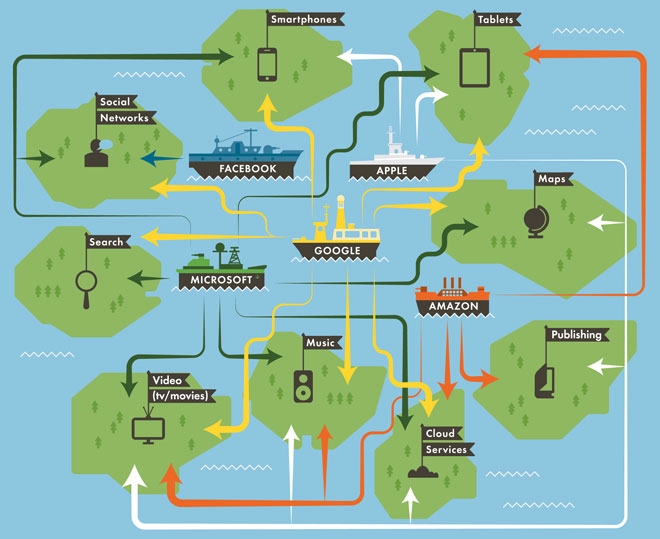
| Posted: 07 Dec 2012 11:00 AM PST Nice illustration of the “epic struggles” that the tech giants — Google, Amazon, Apple, Facebook, and Microsoft — are locked in.
|
| Material downgrade of German 2013 GDP by Bundesbank Posted: 07 Dec 2012 10:23 AM PST The Australian October trade deficit widened to A$2.09bn, from A$1.42bn in September, though better than the A$2.2bn expected. Exports were roughly unchanged, whilst imports rose by +3.0%. Terms of trade has declined by around 15%, from the peak, though is still historically high. PM Gillard stated that the governments policy to post a budget surplus next year will depend on the Australian economy growing at trend rates – sounds as if she is backing off her previous commitment. The A$ is marginally higher – currently US$1.0488 – will look to increase short just above the US$1.05 level;
The Indian government won the politically significant vote to allow majority ownership of multi-brand retailing by foreign investors, in the Upper House of Parliament, by 123 votes to 109 against. The Lower House had passed the non-binding vote. The passage of the bill is a good start for the government’s plans to press for structural reforms. Other reform measures in respect of the banking and insurance sectors are planned;
Bloomberg reports that the majority of ECB members were in favour of a rate cut or would not oppose one at yesterday’s ECB meeting. Apparently, the Germans, (Messers Weidman and Asmussen and the French representative Mr Coeure) were opposed. Mr Coeure arguing for the ECB to remain on hold is a surprise. Informed sources allege that the decision not to cut rates was due to the perceived negative impact of a rate cut, which followed the major downgrade of projections. The ECB cut its 2012 EZ GDP forecast to -0.5% and 2013 to a decline of -0.3%, from a previous forecast of growth of +0.5%. Mr Draghi also hinted at setting a negative deposit rate – not at all sure that will be helpful, as the Japanese experience suggests that you lose control of monetary policy. However, a negative deposit rate is a major sell signal for a currency. Inflation, the ECB’s primary objective, is now forecast to decline to just +1.6% next year and +1.4% in 2014, well below its target of at or just below 2.0%. The ECB will cut interest rates by 25bps in Q1, though these material downgrades suggest it may even happen as early as January 2013;
Yet more political intrigue in Italy. The general secretary of Mr Berlusconi’s political party, the People of Liberty Party (PDL), called for an orderly end of Mr Monti’s government. They have withdrawn support, though have not voted against the current administration. The withdrawal of support could result in early elections in Italy. The PDL is losing support – recent polls suggest that just 17% of voters support the party. The winner, at present, is the centre-left party, the Democratic Party (PD), lead by Mr Bersani, who will, if he forms a government, take over from Mr Monti as PM – recent polls suggest that the PD have support from about 38% of voters – likely more, as support for a party lead by a comedian (who is anti austerity) is likely to fizzle out in a general election. The PD has announced that it will no longer work with the PDL, though pledged their continued support to the Mr Monti administration for the present. S&P warns that it would cut Italy’s credit rating if the economy remains in recession in H2 2013, which it believes is a distinct possibility;
The Bundesbank reduced its 2012 German GDP forecast to +0.7% for this year, down from a previous estimate of +1.0% and savagely lower to just +0.4%, from +1.6% next year. Furthermore, the Bundesbank warned that that the German economy would contract this Q and stagnate in Q1 2013. Inflation is expected to decline to +1.5% next year from +2.1% this year, marginally lower than the +1.6% forecast previously. Unemployment is expected to rise to 7.2%. The materially lower forecasts confirm that Germany is not immune from the downturn in the EZ and internationally and could well help to push the ECB to cut interest rates early (January?) next year – may even get Mrs Merkel/Germany to rethink their “austerity only” policy, given the general elections in September next year;
UK manufacturing output declined by -1.3% in October M/M, the most in 4 months and is yet another bleak set of materially worse economic data from Europe today. The forecast was for a decline of just -0.2%. Total industrial output declined by -0.8%, the 3rd consecutive decline. The data suggests that the UK economy will contract in Q4;
US NFP rose by +146k, much higher than the +85k expected and a revised +138k (+171k previously) in October.. The BLS reported that Hurricane Sandy did not make a difference, which seems counter intuitive. The unemployment rate declined to 7.7% (lower than the 7.9% forecast), the lowest since December 2008, though in reality due to the decline in the participation rate to 63.6%, from 63.8%, as the labour force shrank. Average earnings were better at US$23.63, up from US$23.59 in October. The average work week was unchanged at 34.4 hours. An early Thanksgiving helped, as retailers hired more temporary staff. Having said that, I continue to believe that the US will surprise to the upside. The FED, however, is likely to continue with QE. More politicking in Washington, though I continue to believe that a deal will be done on the fiscal cliff;
University of Michigan consumer sentiment index declined materially to 74.5 in December, from 82.7 in November and much lower than the 82.0 expected. The consumer expectations component declined to a 1 year low of 64.6, from 77.6, with the current conditions component declining to 89.9, from 90.7 in the previous month.
Outlook
Asian markets (ex Hong Kong, Japan and India) closed mainly higher with China +1.6% higher. European markets closed flat, with the exception of Italy which was -0.9% lower given the political drama, with Spain down -0.8%. US markets are currently flat (S&P) to lower by -0.6% (Nasdaq).
The Euro continues to decline and is currently trading at US$1.2938, with the Yen at Yen 82.33. I must admit, I had expected the Euro to weaken even further – it has recovered from briefly trading below US$1.29.
10 year German bunds fell to 1.31%, on flight to safety concerns, whilst equivalent Italian and Spanish yields have risen materially in recent days.
Spot gold is hovering around US$1700, with January Brent at US$106.84, sharply lower from the US$110 level in previous days – still too high.
Continue to short the Euro against the US$ and buy US/UK equities – financials, miners, London based builders and property companies and US/UK focused building material stocks.
I was waiting for the announcement of the Greek bond buy back programme before sending out this newsletter, though no news at present.
Have a great weekend
Kiron Sarkar
7th December
|
| Posted: 07 Dec 2012 09:30 AM PST The girls with the Draghi Tattoo are breaking out. That is, the German DAX and French CAC stock indexes are making new highs. Ever since the ECB's Mario Draghi "whatever it takes to preserver the euro" speech, these markets have performing well and are now breaking out of a three-month consolidation period. The DAX is up over 25 percent in local currency and the best performing equity market we monitor. The CAC has been led higher by a huge rebound in the French banks. Societe Generale is up over 60 percent, BNP Paribas up more than 40 percent, and Credit Agricole up more than 30 percent. We're more confident in the sustainability of the DAX rally. France will be interesting next year. Rester à l'écoute!
(click here if charts are not observable) |
| Low Wage Sectors Drive Employment Growth Posted: 07 Dec 2012 09:02 AM PST
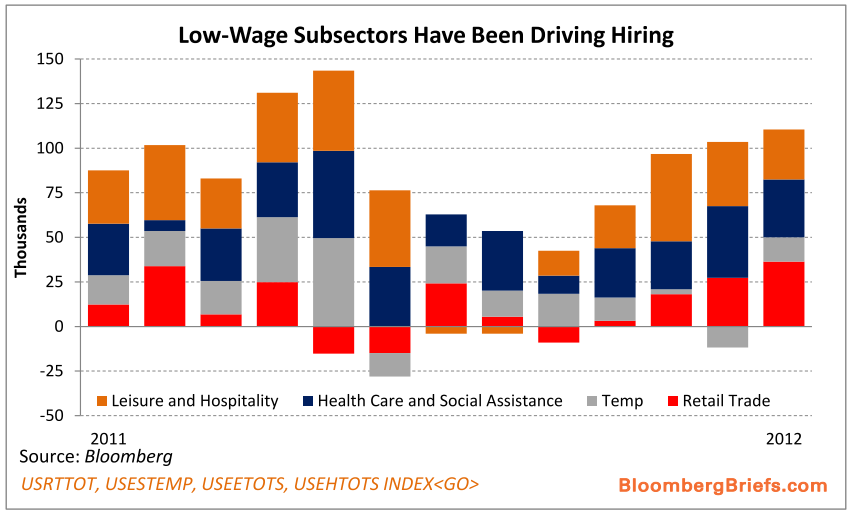
This morning, I mentioned how little I care about the discrete monthly NFP data each month, saying the “overall trend” was what mattered. Specifically, I suggested looking at internals of the report for trends in wages, temp help, hours worked, etc. to determine the overall health of the labor market. This report showed a continuation of a trend I find to be unhealthy: The outside contribution of low wage sectors to the NFP report. Leisure and hospitality, health care and social assistance, retail and temporary jobs — all low wage sectors — have been responsible for over half (51%) of the private sector job growth the last year. Weak wage growth is function of slack in the labor force and a lack of negotiating power amongst job holders and seekers. |
| Confidence falls sharply, DC patience thin? Posted: 07 Dec 2012 08:49 AM PST UoM Consumer Confidence fell sharply in Dec to 74.5 from 82.7 in Nov and below expectations of 82. It’s a 4 month low and is down from the highest level since Sept ’07. Most of the drop came in the Outlook component which fell by 13 pts to the lowest of the year while Current Conditions were down just .8 pts. Also of note, notwithstanding a 5 month low in the avg gallon of gasoline, one year inflation expectations rose to 3.3% from 3.1%, matching the highest since Aug. Five yr inflation expectations rose to 2.9% from 2.8%. Bottom line, confidence is now below the average ytd of 76.7. While its just one measure of consumer sentiment, maybe the constant barrage of back and forth in DC with no resolution yet is having an impact. In terms of the markets response to confidence data, its typically very limited as how one feels doesn’t always correlate to how they behave. |
| Posted: 07 Dec 2012 06:40 AM PST My end of week NFP-free reading:
What are you doing this weekend? > |
| Labor Dept said little impact, ADP said big Posted: 07 Dec 2012 06:10 AM PST Nov Payrolls gained 146k, 147k of which was in the private sector. Expectations were for 85k and 90k respectively. The two prior months were revised down by 49k mostly in the public sector. The main difference between today’s # and ADP was the viewpoint of each on the impact of Hurricane Sandy. The Labor Dept said the storm didn’t “substantively” affect the data whereas ADP Wed said it “wrecked havoc on the job market in Nov, slicing an estimated 86k jobs from payrolls.” The unemployment rate was 7.7% but for the wrong reasons as the Household survey saw a decline of 122k on top of a 350k drop in the size of the labor force. The U6 rate fell to 14.4% from 14.6%. Avg hourly earnings rose .2% m/o/m, in line with estimates but the y/o/y rise of 1.7% is not keeping up with CPI. Avg hours worked at 34.4 was in line and unch with Oct. Also of note, the participation rate fell to 63.6% from 63.8%. The avg duration of unemployment fell a touch to 40 weeks from 40.2. Retail saw a big jump in job gains of 53k and temp had its biggest job gain since June of 18k. Mfr’g shed 7k and construction lost 20k. Bottom line, its hard to believe that the awful Hurricane on the dense area of the tri state area didn’t have much of an impact on total hiring but most analysts thought it did and thus the bar was pretty low going into the report. The markets response higher is thus obvious. Today’s 146k print puts the ytd avg at 151k and the private sector gain of 147k compares with the ytd avg of 154k. Looking to the market action in the next 3 weeks with China stabilizing, Europe calm post Greece buyback (assuming no issues today) and a relief payroll #, the results of the fiscal negotiations remain center stage. The market will celebrate any deal by yr end and focus on the details in 2013 which I believe will be contractionary to growth. |
| Virtual Tour of the National Museum of the U.S. Air Force Posted: 07 Dec 2012 05:00 AM PST click for interactive site |
| How Meaningless Will November NFP Be? Posted: 07 Dec 2012 04:15 AM PST The usual suspects will be in the full throes of the employment situation report/data dump — the most important report of the month! — or, as I prefer to call it, Friday. The clock in the corner of the TV screen will tick down, someone will breathlessly read the headline Unemployment Number and NFP info, Let’s put this into some context: Under normal circumstances, any given NFP number matters very little. The net change in people leaving and starting jobs in any month is tiny — a few 100,000 people out of 150 million or so in the labor pool. It is not a significant number relative to the overall economy. What does matter is the overall trend — is the economy gaining jobs consistently month-after-month? Is it losing jobs? Are those losses accelerating? What about wages? Temp help? Hours worked? These factors can all be looked at as part of the longer term trends to determine the overall health of the labor market. Over the past few years, the trend has been a soft improvement. Unemployment has gradually come down from 10% to 8%; year over year gains in people working has been under 2%. So the employment situation is improving, but rather slowly. This is even more stark when compared to pre-2001 recoveries, which only serves to emphasize that the post-credit crisis recovery is very different than the ordinary recession recovery. Which brings us to today’s number. There are both upside and downside risks to the consensus number, something that theoretically is the case each month, but seems especially potentially random for November 2012. The consensus estimates of economists surveyed by Bloomberg are for a Non-farm payrolls rise of 85,000 workers (versus 171,000 in October) and a steady 7.9% jobless rate. The downside surprise is the possibility that hurricane Sandy significantly reduced not only jobs, but the BLS’ ability to actually track and assemble all of the data that goers into making each month’s NFP. The upside surprise is based on a few factors, such as strong withholding tax data, or the potential for a continuation of the decent 170k from October. My guess? I have no opinion . . . Employment situation report released at 8:30am
|
| Investment Risks and Opportunities In the Post-Election Economy Posted: 07 Dec 2012 03:30 AM PST Investment Risks and Opportunities In the Post-Election Economy with Barry Ritholtz Transcripts after the jump
ON THE RECESSION AND THE FED Well, there is always a recession that is inevitable. This is a normal part of the business cycle. The Fed tightens, things slow down; the Fed loosens up, things get better. The issue that we’re dealing with is that we’re not so much in a post-election economy as we are still in a post-credit-crisis economy. What we’ve learned from looking at history, from looking at the data that Reinhart and Rogoff put together in a lot of their research, is post-credit-crisis economies have very weak job creations, sub-par GDP, poor recovery in housing, poor recovery in jobs. And so we have this muddle-along, mediocre, just-above-stall-speed type of recovery that always looks like we’re on the verge of slipping back into recession, but hasn’t quite stalled. The flip side to that is the Fed has been putting a fire hose worth of liquidity directly into the economy, directly into the market. The problem that we’re running into is as we go through QE14, QE19, QE27, each subsequent QE seems to have less of an impact on the broad economy and has its bigger impact – although that’s insinuating as well – on assets. So we see it in the bond market, we see it in the equity market, but we’re not really seeing it so much in the broad economy outside of things that are purchased with credit. I just got offered a 30-year fixed, no-point mortgage for 3 and 3/8%. That is an insane number considering when I was a kid, mortgages were 9%. It’s hard to fathom the impact that has specifically on housing. As much as people think housing is in a full-blown recovery, it’s really more accurate to say that housing has been stabilized by these absurdly low rates. We also had a mortgage-foreclosure abatement while we were negotiating the settlements of the robo-signing scandal. But outside of that, the rest of the economy is looking a little soft, and the way we see it most of all is in the earnings of the S&P 500. ON THE FISCAL CLIFF First of all, I don’t really care about the fiscal cliff. I find all this to be spasmodic stupidity. “Oh no – the fiscal cliff!” The worst-case scenario about the fiscal cliff is we’ll lose $600 billion in spending we can’t afford and increase taxes that we should have increased a while ago. So $600 billion in a $14 or $15-trillion economy is a relatively modest impact. Might it cause a slowdown? Sure, if we’re running at 2% GDP and this takes half a percent off, we are now running a 1.5% GDP. The only way it really causes a severe recession is if there is a lot of shenanigans that go around, and if everybody causes trouble. Remember what happened when none of the parties would come to the table and behave, we had the downgrade back in the summer of – what was that – 2011? Although ironically, that downgrade did nothing more than help lower rates. Stop and think about how ridiculous that is. America is much less trustworthy as a lender, so lend them money for 1.5% for ten years. It’s ridiculous. Although keep in mind that rating agencies themselves are completely corrupt. I don’t know any asset manager in the United States that pays attention to anything they say or do. Had we had that same attitude before the crisis, we very much could have avoided the crisis. So the downgrade that is being threatened, again, I don’t think it’s a big concern. It’s much ado about very little. The fiscal cliff – hey, it wouldn’t be the worst thing in the world to say you have to pay for what you buy. I know that’s a crazy thought process, but… Ed D’Agostino: You would argue that the fiscal cliff is not the end of the world, so to speak? Barry: No, absolutely not. It’s not the end of the world. Again, it’s $600 billion. Now, the stimulus package – which a lot of people said had no impact – was $800 billion and change. So if $800 billion didn’t help the economy, then how much can $600 billion really hurt the economy? Ideally, if we were rational adults and weren’t engaged in this sort of primal warfare between tribes known as politics, we would all agree that the ideal time to cut spending and raise rates is during an economic expansion. The ideal time to cut rates and raise spending is during a contraction, and John Maynard Keynes said that a long time ago. People only hear half of it. People only hear, “During a recession we cut taxes and raise spending; that’s great.” They forget that Keynes says when you come out of this, you have to take that away. So we’ve had the people who say Keynesianism doesn’t work. Well, if you only do half of it, it sure as hell doesn’t work. Pretty much that’s been the approach of the United States for the past half-century. ON CORPORATE EARNINGS Well, it’s clear that corporate borrowing costs have been exceedingly low. We see IBM and other companies refinancing long-term debt at 1 and 2%, numbers that are quite insane. But the bigger issue that we’re running into is, look at how much of the S&P 500 earnings comes from overseas in general and Europe in particular. Europe is in a recession; I don’t know how else to say that. Spain and Greece are in a depression, although I can’t define what a depression is. It’s like pornography; we know it when we see it. But the rest of Europe outside of Germany is contracting, and I don’t know if Germany can decouple for very long because they export so much stuff to the rest of the Eurozone. So we have a significant slowdown in Europe, if not a full-blown recession. We have an ongoing slowdown in Asia. The United States really is the best of the worst – there is no other way to say it. “Except in the land of the blind, the one eyed man is king,” is my new favorite expression. The United States – partly due to QE, partly due to a very healthy set of balance sheets in corporate America – has been muddling along better than lots of the rest of the world. That doesn’t mean, though, that’s a forever situation. There is a tendency amongst economists to just extrapolate wherever we’re going; and that is how they end up missing the turn. They say, “Oh look, we’re trending upwards, therefore we’re going to keep going.” Well, no; these things are cyclical, and eventually it comes in. My concern about earnings is the ongoing decrease in revenues, the lack of guidance we keep hearing from CEOs, and then the not-necessarily-great earnings numbers we continue to see. It suggests that this cyclical rally that began in March 2009 – and here we are four years later – is getting a little long in the tooth. I can’t tell you if we’re ending November 15, 2012 or if it’s going to go on for a couple of more months or quarters, but it’s pretty straightforward to say we’re up at the peak 107% from the March 2009 lows. The typical post-crisis snapback is about 70%, so we’ve had a nice run and then some. We may be living on borrowed time and we may be living on Fed money; it will end eventually. The Fed’s concern about propping up asset prices is another issue that is a whole separate conversation. I think the whole concept of the wealth effect is wildly overstated. It’s just a correlation error in my opinion. But all that aside, all expansions end, every cyclical bull market within the longer secular bear market. So March 2000, we began a bear market. Here we are a dozen years later, and it’s not quite over. Perhaps it will be parallel to the 1966-1982 bear market. The DOW was at 1,000 in 1966; and sixteen years later the DOW was still 1,000. You ended up losing about 75% of that break-even due to effects of inflation, but it took sixteen years and an oil embargo and Vietnam and Watergate and all of that other stuff that generally causes a negative societal sentiment. Eventually you come out of it; and by the time we got to 1992, we were off to the races. Here we are in 2012, and we’re probably in the seventh or eighth inning of the bear market that started back then. I can’t tell you if it ends next Tuesday or by 2017, but somewhere in that range the bear market that we’ve been suffering through from 2000 will end, and equities will become a lot more attractive and investing will become a lot more easier. In a secular bear market it really is a challenge to separate the risks from the reward. ON SECTORS IN THIS BEAR MARKET Now within that broad, secular bear market, we are looking at the cyclical bull market, which seems to be coming to a top. I’m not ready to say it’s over, but we’ve taken some steps to become more defensive. So in a circumstance like this, you cut back on technology, you cut back on consumer discretionaries, you rotate into things like health care or consumer staples that are more likely to do well regardless of what we see from the economy. By the way, that might be relatively well – meaning if technology falls 30-40%, this will fall 10-20%. Overall, since you never know how accurate your expectations are to what’s going on, you don’t just jump out of the market and go 100% cash. We started the year overweight equities; around the middle of the year we went to equal-weight equities; and at the end of October we’ve raised about 25% cash, and so now we’re underweight equities. You need to have some cash if-when things get cheap enough you want to buy. If you never sell, when stocks get cheaper you don’t necessarily have the cash to buy things, but for now a 25% cash weight intel is our way of assessing the probability of a 25% plus or minus correction; 25-35%. So far we are nowhere near that. Off the top, the market we’re down 6.5, 7%; it’s not like the market is really getting shellacked. By the way, I can’t remember the last time when 6% off a multiyear peak caused such angst. Everybody has been freaking out about this. “Hey, 7% –, the markets moved 7%!” That’s a two-day hiccup; it’s not the end of the world. Maybe our view of the recession is wrong, maybe our view of the earnings are wrong, maybe our view of the correction is wrong, and we go back to make multiyear highs, but if you listen to the way people are screaming about this move – “Oh, this is it; the world is coming to an end!” – it’s quite astonishing. ON EMERGING MARKETS There is a couple of different ways to play emerging markets. In October we moved out of all our emerging markets on a temporary basis. There are a few very interesting things going on in emerging markets. If we’re going into a slowdown, we don’t want to have exposure to energy, which as we see every time there is a slowdown the price of oil plummets, but that is a big chunk of what we see in South America; it’s kind of interesting. The other thing is if you look at the rules overseas in terms of how dividends are treated, outside the United States there is a far friendlier treatment of dividends than stock buybacks. In the United States there is a lot more stock buybacks than dividends, which is unfortunate. I would rather have the cash coming to clients each month than actually the engineering of stock buybacks. If you look overseas, their dividend rates are more attractive, and there are a handful of ETFs and other vehicles that allow you to buy non-European, non-bank entities – meaning emerging market, Asia, South America, Middle-East, Africa – allows you to buy those things that are big dividend yielders without getting exposure to all the sovereign debt issues you have in the European banks. That is a relatively safe way to play things when you come out of the recession. If you want something that is faster, if you want a little more alpha, then you look at telecom in Asia and South America. You look at energy – although again it’s got to be after the recession, not before a recession – and you look at manufacturing. Overseas, a lot of the overseas companies that we see are much, much less expensive than in the United States where the PE is fairly reasonable. I am fond of saying if I didn’t have a job and family here in the United States, I would pick up, move to Europe, and start turning over companies, looking to buy them one by one. Companies in Europe are trading at absurd valuations because everybody seems to think it’s all going to hell in a handbasket. We think that eventually the Europeans figure out a way around their problems; we just don’t know when that is going to happen and how expensive it’s going to be if you are six months or so early. But to buy companies one by one when you have boots on the ground and able. Stuff is trading at not one times sales, it’s trading at one times profits. That is a ridiculous valuation. Dirt cheap, but you’ve got to be there to separate the good companies from the bad. ON GETTING TACTICAL It’s amusing to those of us who grew up tactical, who grew up saying, “Hey, I understand the value of buy and hold.” But if I’m sitting on railroad tracks and I hear noise and a bright light coming at me, it doesn’t mean I have to sit on the tracks because I’m a buy-and-hold guy. So we use a number of inputs to help us make decisions as to when to get out of the way on a tactical basis. It’s a combination of valuation and trend and earnings momentum, and there are other factors that go into it. You don’t want to make the tactical decision too often, because it’s a very imperfect science. It’s a little bit of art and a little bit of science. So we try and do it less frequently than many do. I don’t care about the 5 to 10% moves; I’m never going to catch those, and I know very few people who can consistently catch those. I’m much more concerned about the 25%, 35%, 45% moves. When we have a high degree of confidence that they are coming down the pipe, we’ll take our highest, our most volatile names, our highest beta names off, and we’ll step back a little bit. We did that at the end of October by raising 25% cash. That doesn’t mean that we think the world is coming to an end. I certainly didn’t raise 25% cash because I was concerned about a 7% move down. That’s enough cash off of the equity portfolio to say that if things get worse we can sell more items, but at least we are removing some of our risk in case this does what we fear it might do. On the other hand, if we’re wrong and we’ve lowered our equity exposure that much and the markets then turn around and start heading north, well, it’s not the worst thing in the world; and we can redeploy that capital fairly quickly. We primarily work through ETFs and very deep, liquid stocks, so if I have to turn around tomorrow morning and say, “Okay, I’ve got $50 million to spend; what do I do?” we wouldn’t have a problem putting that to work. WHAT ARE YOUR TOP THREE PICKS? I’ll give you names that I think are defensive in nature but have the potential of doing well over the long haul. Most of my career I never owned Berkshire Hathaway – we added that almost two years ago. It’s done pretty well; it’s done really well in 2012. Any time you have the chance to buy a high-quality name at a very reasonable price, be thrilled to do so. That was one of those things. I know there are people who have drunk the Buffett Kool-Aid: that’s not me. To me this is just a broad company with exposure to a lot of areas. We don’t want to own any of the money-center banks; the Citis, the Bank of Americas, the JP Morgans. We are afraid of them partly because we can’t see what is in their balance sheet and partly because they are just all so mismanaged – including the vaunted JP Morgan, which we owned a small piece earlier in the year and managed to just get a little dinged up when the whale came out. We gave back all our profits and a little more than that. I’m not happy about that. So we’ve been staying clear of that, but we want some exposure. The insurance aspect of Berkshire gives us some exposure to that. The other company in the finance space that we’ve had for a long time is Visa; that’s worked out very well. In terms of defensive names – and by the way, the nice thing about Visa is they are a tollkeeper on Internet transactions, on other credit transactions, and they have no credit risks. It’s up to the banks to actually assume the risk to determine whom they want to give a card to. Visa just takes a little bit of a transaction fee each time, and it’s highly profitable. When we look at the sector of health care, you could go broad ETFs. XLV gives you the top forty or so names in that space. If you want something with a little more potential, take a look at Merck, which is an interesting name in that space. Lastly, if you want to have a foot in consumer staples with a little bit of healthcare aspect to it, we also like Johnson and Johnson. So again, big, deep names. None of these names are going to quadruple by Thursday, but they are also very unlikely to implode the way some of the high flyers might. In this environment, we’re playing our cards a little tight. We’re looking for up-side, but we’re not looking to hit the cover off the ball. In a secular bear market you want to take advantage of opportunities, but not take on a lot of risk because as we see, once the market begins to roll over it can head down pretty quickly without a whole lot of notice. |






| You are subscribed to email updates from The Big Picture To stop receiving these emails, you may unsubscribe now. | Email delivery powered by Google |
| Google Inc., 20 West Kinzie, Chicago IL USA 60610 | |



0 comments:
Post a Comment