| The New American Center Posted: 21 Oct 2013 04:30 PM PDT
This is the first two of 13 charts that help to define the new American “Center”
click for all 13 graphics
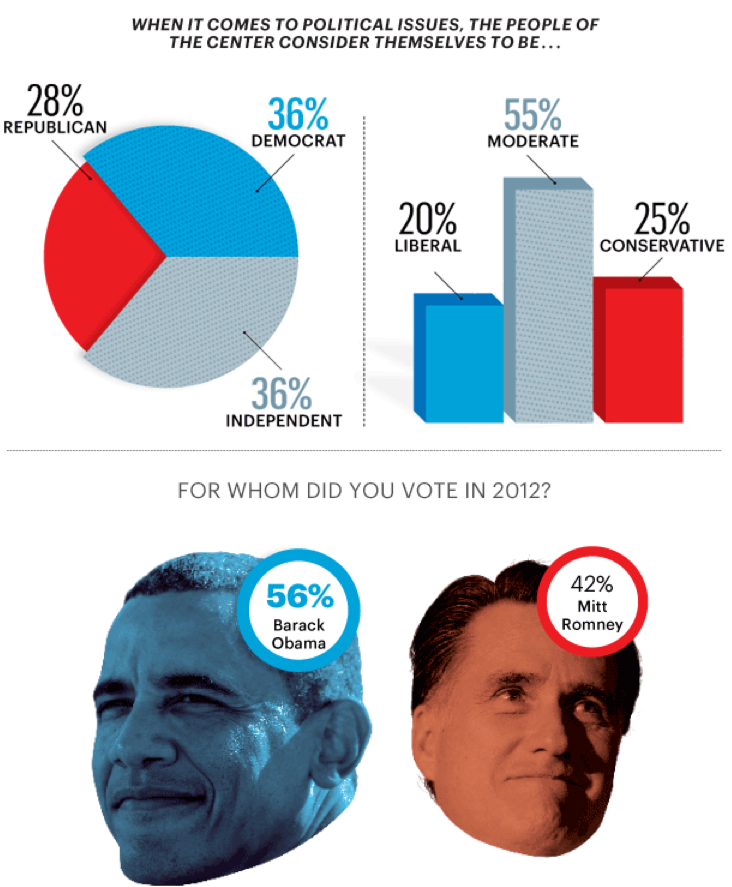
Source: Esquire
 |
| 10 Monday PM Reads Posted: 21 Oct 2013 01:15 PM PDT My afternoon train reading: • Wall Street’s leading bear David Rosenberg turned more bullish, riling some longtime clients (WSJ)
• The Inefficient Market Hypothesis (NY Times) see also The kinda-eventually-sorta-mostly-almost Efficient Market Theory (TBP)
• Jack Bogle on the Cost Matters Hypothesis (CMH) (The Reformed Broker)
• Forget fundamentals, Fed liquidity is king (FT) but see Fed QE Taper Seen Delayed to March as Shutdown Bites (Bloomberg)
• Beware Distorted [Mutual/Hedge Funds] Returns (Barron’s)
• What is Happening with China Home Prices? (World Property Channel) see also Stop Being Wrong About China Buying Our Bonds (Slate)
• Magnetar Goes Long Ohio Town While Shorting Its Tax Base (Bloomberg) see also Why Does The World’s Richest Country Have So Many Failed Cities? (Forbes)
• Are Bear Stearns and WaMu Still Steals for J.P. Morgan? (WSJ)
• Republican Civil War Erupts: Business Groups v. Tea Party (Bloomberg) see also Can we afford citizen-funded elections yet? (Lessig)
• It’s Time for Amazon to Open Its Black Box (Barron’s)
Whats for dinner? The Couch Potato Subsidy

Source: Priceonomics  |
| Historical Global Yields & Defaults, 1800 – Present Posted: 21 Oct 2013 09:00 AM PDT Yields and default
Click to enlarge
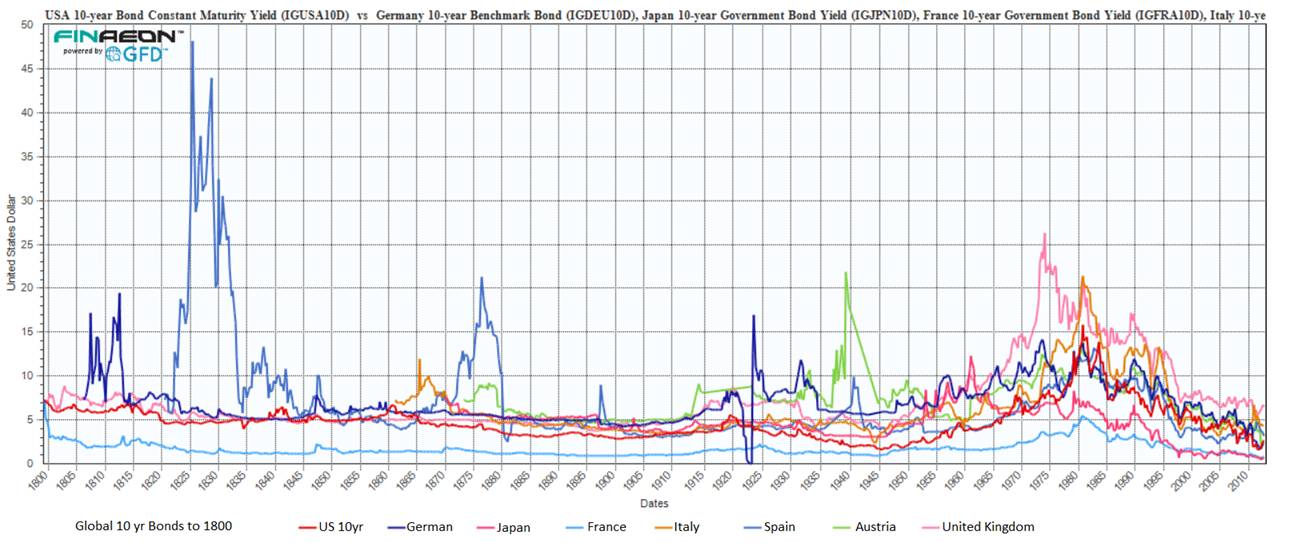 Now that we managed to avoid default, let’s look at some historical examples of Sovereign default. 1. United States 2013
2. Germany 1938,1948
3. Japan 1942, 1946-1952
4. France 8 times between 1558-1788. Last one in 1812
5. Italy 1940. Almost daily speculation of another default since 2008
6. Spain 1809, 1820, 1931, 1834, 1851, 1867, 1872, 1882 and 1936-1939. Since 2008, Spanish yields spiked considerably and have been volatile on the back of another default
7. Austria 1938, 1940, 1945
8. United Kingdom 1822, 1834, 1888, 1932
While default is nothing new for many countries, this would have been for the United States. Many economists have said that a US default would have catastrophic consequences for the global community. Borrowing costs would essentially sky rocket, global equity prices would be leveled, dollars status as a benchmark questioned and most importantly, a reversal into another deeper and darker world recession. Glad we avoided that mess. Source:
Ralph Dillon
Global Financial Data  |
| 10 Monday AM Reads Posted: 21 Oct 2013 05:45 AM PDT My start your week off right reading materials: • The Houdini Market: Since 09 lows, stocks have shaken off flash crash, EU debt crisis, US government shutdown, and a potential default on its debt (Barron’s) see also Fiscal Crisis Leaves Stocks in a Sweet Spot (WSJ)
• About time: Wealth Fund Cautions Against Costs Exacted by High-Speed Trading (NYT)
• JPMorgan is close to a record $13 billion settlement. Is it too big to manage? (Washington Post) see also Who Really Wins if JPMorgan Pays $13 Billion? (Bloomberg)
• How to Find Stocks With Hidden Yields (Barron’s)
• How much did the shutdown cost the economy? (Washington Post)
• China Inc. Battles Big Oil for Century's Biggest Find (Bloomberg) see also Asia Enjoys Stronger Global Demand (WSJ)
• Does Satan worship lower a Las Vegas mansion’s value? (Los Angeles Times)
• It’s time we stopped drinking the thinktank kool-aid (The Guardian)
• So the 5S is (allegedly) killing the 5C. Why is this bad news? (Stratechery)
• How to Be an Educated Consumer of Infographics: David Byrne on the Art-Science of Visual Storytelling (Brain Pickings)
What are you reading?

Source: Bespoke
 |
| Washington’s Open Secret: Profitable PACs Posted: 21 Oct 2013 03:00 AM PDT Most Americans believe it’s illegal for politicians to profit from their public office but, as Steve Kroft reports, that’s not the case.
October 20, 2013 4:37 PM
See also Washington’s open secret: Profitable PACs  |
| Is There Are A Far Greater Level of Wrongdoing at JPMorgan? Posted: 21 Oct 2013 02:45 AM PDT Gordon Kerr, consultant at Cobden Partners, talks with Guy Johnson about the potential $13 billion settlement by JPMorgan to end civil claims over its sales of mortgage bonds. He speaks on Bloomberg Television's "The Pulse."
Bloomberg, Oct. 21 2013
 |





0 comments:
Post a Comment