


The Big Picture |
- The Bernie Madoff of the 1800s and His Perpetual Money Motion Machine
- How the NSA is tracking people right now
- NASA’s 6-Foot Valkyrie Humanoid Robot
- 10 MidWeek PM Reads
- S&P 500 Intra-year Declines vs. Calendar Year Returns
- 10 Wednesday AM Reads
- Why Do Forecasters Keep Forecasting?
- BAML: What to do in 2014
- The Volcker Rule: Faults and Virtues
- Fannie Mae Didn’t Cause the Housing Crisis, Radical Ideologues Did
| The Bernie Madoff of the 1800s and His Perpetual Money Motion Machine Posted: 12 Dec 2013 02:00 AM PST The Bernie Madoff of the 1800s and His Perpetual Money Motion Machine
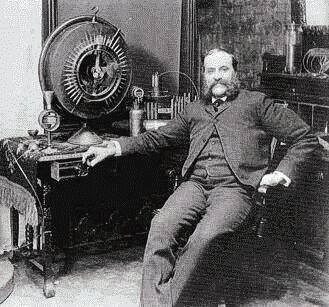
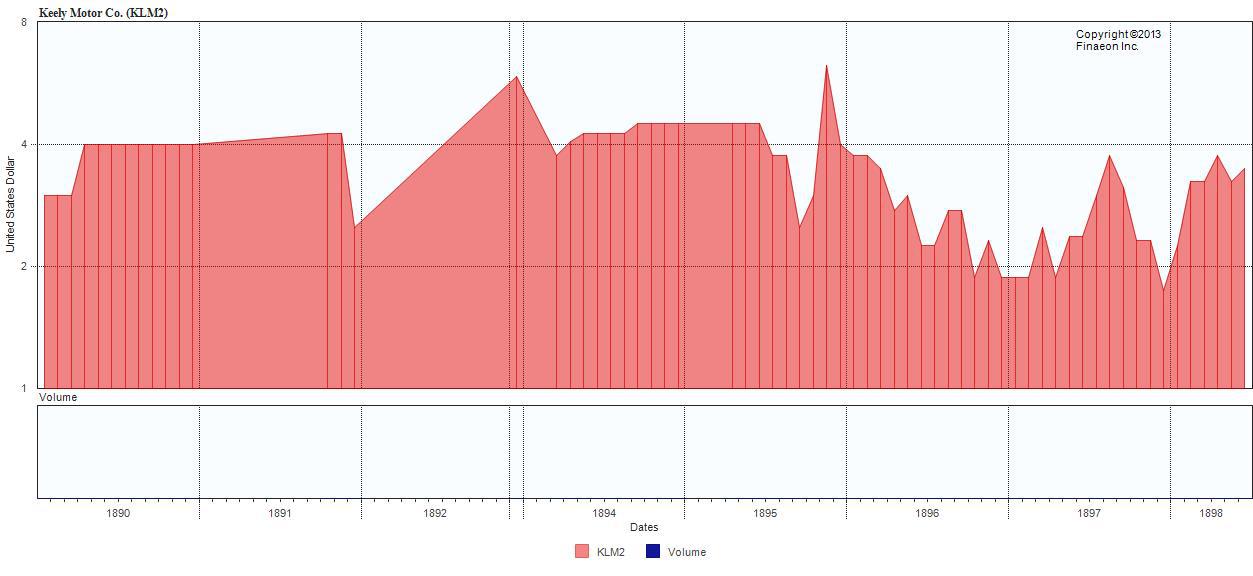
If you wanted to profit from the opportunity of a lifetime, then you should have invested in the Keely Motor Company. Unfortunately, the company no longer exists since Keely died in 1898. While Keely managed to make himself a rich man, his investors did not share the same fate. Nonetheless, the story of his perpetual motion machine will surely fascinate you. H2O EXTRACTS GAS AND ATTRACTS MONEY Born in Philadelphia on September 3, 1837, John Ernst Worrell Keely worked various jobs as a young man, as a member of a theatrical orchestra, a painter, a carpenter, a carnival barker, and as a mechanic. Then in 1872, he announced the discovery of a machine that could revolutionize the world. He said he had discovered a new physical force that could produce phenomenal power, never before heard of. Keely proposed to use the power of atoms in water to create perpetual motion. Since water covers more of the earth than land, the fuel for his machine would be cheap and readily available for all of mankind to benefit from. Keely's basic idea, as he explained it to his awed listeners, was that atoms were in constant vibration, so all you had to do was to harness and channel the random vibrations of the atoms within water and you could produce unlimited energy. If you could get atoms to vibrate in unison, you could use their "etheric force" to run any motor of any size. To promote his discovery, Keely went on a speaking tour to share his great discovery with the world. At each engagement, someone in the audience would ask "How did you come to this great discovery?" Keely would explain to the audience that the revelation had hit him while he was playing a few notes on the violin. The notes on the instrument had set in motion harmonic vibrations, and in a moment of serendipitous inspiration, he had realized that the vibrations of atoms could be used to create energy just as the vibration of notes could be used to create music that could soothe the beast. Keely's next stop was New York where he invited potential investors to the plush hotel he was staying at on Fifth Avenue. There, in his expansive suite with velvet chairs, chandeliers and extravagant mirrors, Keely explained his invention to potential investors while serving them delicacies to eat and liquor and champagne to savor and imbibe. Bankers, businessmen, engineers, lawyers, and other rich investors went to the hotel to invest in the sensation of the century. Soon after, with his first investment of $1 million in hand, he formed the Keely Motor Company. The corporation quickly grew to $5 million in capitalization. His investors wondered why the name of John Ernst Worrell Keely shouldn't stand alongside that of Thomas Alva Edison and Alexander Graham Bell in the pantheon of great American inventors. ETHERIC DISINTEGRATION Keely impressed potential investors with phrases such as "quadruple negative harmonics," "etheric disintegration," and "atomic triplets" when he revealed his ideas to eager listeners. Through the "liberator" which was a system of highly sensitive tuning forces, Keely would unleash the secret powers of the universe through his "hydro-pneumatic, pulsating vacuum energy" to solve the world's energy problems forever. Keely demonstrated his machine to his guests, using his powers of prestidigitation to pour water into his vacuum engine and demonstrate his device. After a little bit, the engine gurgled, then rumbled, then came alive, providing a pressure of 50,000 psi to the amazed onlookers. As The New York Times wrote on June 11, 1875, the “generator” was reported to be about 3 feet in size, made of Austrian gunmetal in one piece, and held about ten or twelve gallons of water. Its inside was made up of cylindrical chambers connected by pipes and fitted with stopcocks and valves. The “receiver” or “reservoir” was about forty inches long by six inches in diameter and connected to the “generator” by a one inch diameter pipe. Keely claimed that his apparatus would generate his “vapor” from water solely by mechanical means without using any chemicals and claimed that it could produce 2,000 psi in five seconds. Whenever Keely demonstrated one of his machines, he would provide an elaborate explanation of how the engine worked, as illustrated by one of Keely's exercises in eloquent embellishment from The New York Times on June 7, 1885: "It is an elaboration of interatomic ether by vibration. The atomic ether vibrates all around the molecules of matter. There is a magnetic force attached to it at the same time, and it assimilates with the molecular atomic aggregations – that is, assimilates with a certain attractive force that it is hard to tell what it is. I call it a vibratory negative. It doesn’t act like a magnet drawing metals toward it. There is a certain magnetic effect about it that causes it to adhere by vibratory rotation to different forms of matter – that is the molecular, atomic, etheric, and ether-etheric. The impulse is given by metallic impulses, the rotary power that is formed by etheric vibration – that is the force that holds it in position." Even if you didn't understand Keely's theories, he had demonstrated to potential investors that his machine actually worked. What else mattered? A VIBRATING DEMONSTRATION On November 10, 1874, Keely demonstrated the first full-scale version of his miracle machine at his laboratory at 1422 North Twentieth Street in Philadelphia, which he called the "etheric generator," later to be called a "vibratory-generator." The motor obtained its power from "intermolecular vibrations of ether" which allowed him to create a machine which he finally named the "hydro-pneumatic pulsating vacuo-motor engine." The press simply called it a perpetual motion machine, though Keely never referred to it as such. Investors and shareholders happily took the long trek to his factory in Philadelphia where he gladly demonstrated the current version of his hydro-pneumatic pulsating vacuo-motor engine to visitors. One spectator at a Keely demonstration described the power of the machine. “Great ropes were torn apart, iron bars broken in two or twisted out of shape, bullets discharged through twelve inch planks, by a force which could not be determined.” Keely often used a harmonica, violin, flute, zither or pitch pipe to activate his machines. With the prospect of investing in the greatest invention of all time, shareholders were eager to be part of the Keely Motor Co. The company showed no profits and paid no dividends because Keely invested all of his capital and proceeds in developing mankind's greatest source of energy. During the 1880s and 1890s, other inventions came into use, Bell's telephone, Edison's electric lights and automobiles, but Keely continued to work on perfecting his wonder of the ages. When Keely was asked when he planned to apply to the Patent Office for his machine, he told his investors that he wasn't going to file a patent lest the secrets of his motor be unveiled and others could steal his ideas. The best thing, he told shareholders, was to keep every aspect of his invention secret until the etheric forces could be unleashed in a machine that made money for the company's investors. Otherwise, some unscrupulous and dishonest pirate could study his designs and introduce a machine similar to his, reducing the company's profits. Keely would occasionally need new capital to continue developing and refine his machine. After all, in the later stages of development, the machine was becoming even more complex and required even more capital. Keely would call a board meeting, where the board would vote to issue more shares and raise additional capital. Old shareholders would purchase additional shares, and new investors would get the opportunity to share in the creation of the world's first perpetual motion machine. Even John Jacob Astor invested in the Keely Motor Co. CONDUCTOR OF MUSIC, ELECTRICITY, AND STOCK One of Keely's biggest supporters was a widow by the name of Mrs. Clara Jessup Bloomfield-Moore, who not only invested $100,000 in the Keely Motor Co., but provided Keely with $2000 a month for personal expenses. When others began to lose faith in Keely because of the inevitable delays, Clara would invest more money and urge others to do the same. Ms. Bloomfield-Moore even wrote articles for prominent magazines of the day, praising Keely and his invention, saying that Keely’s etheric force was “like the sun behind the clouds, the source of all light though itself unseen. It is the latent basis of all human knowledge…” Whenever there were doubts that his engine would finally come to fruition, Keely would unveil his newest advancement in tapping the forces of nature. At one demonstration, he showed investors the "shifting resonator" which carried seven different kinds of vibration, each “being capable of infinitesimal division.” Keely would set the whole contraption going in a variety of ways; sometimes by playing a few notes on his violin, a zither, a harmonica, or even an ordinary tuning fork. Whatever the method, etheric force came forth, starting the motor and impressing the investors. The stock went public on the New York Stock Exchange in January 1890, the greatest place for venture capital in the United States. The stock traded steadily during the 1890s, neither shooting up in a bubble nor collapsing. With no profits and no dividends, there was no reason for the stock to skyrocket until the etheric vibrations were turned into a money-making machine for the company's shareholders.
Unfortunately, there were scientists who were skeptical of Keely's claims. In 1884, the Scientific American ran an article stating that everything Keely had done could be replicated using compressed air. Was some hidden source of compressed air the secret of Keely's wonder machine and not the etheric force he theorized about? Keely dismissed these "scientists" as petty and envious men. Hadn't others scoffed at the steamship, the telephone, the telegraph and the electric light? When Mrs. Bloomfield-Moore suggested that he share his secrets with Thomas Edison and Nikola Tesla to improve the prestige of the company, Keely refused to tell anyone about his creation. He didn't need others to validate his invention, he asserted. DISINTERGRATION OF PROFITS If Keely wasn't the greatest inventor of the nineteenth century, he was probably a greater escape artist other than Houdini. For over 25 years, from 1872 to 1898, Keely was able to convince investors that a workable machine that could make his investors millions would be available next year. Edison, Bell and Tesla produced real results; Keely produced promises. Despite law suits from his own company to reveal his secrets, inquiries by scientists, exposes by the Scientific American, pressure from Mrs. Clara Jessup Bloomfield-Moore, and even a court order that landed him in jail for three days for contempt of court, Keely was always able to wiggle out of the demands for a marketable machine. Every year, from 1872 to 1898, Keely was able to introduce a new variation on his engine to impress shareholders and potential investors with his "vaporic gun" or “hydro-pneumatic-pulsating-vacu-engine”. The only thing Keely could not delay was a visit from the grim reaper. On November 18, 1898, Keely died, twenty-six years after his company had been founded. The company had never made a profit, never paid a dividend, and never even released a product. With Keely dead, investors were worried. Since there was no patent, no blueprints, no marketable machine, had Keely's great discovery died with him? Was mankind to suffer because the grim reaper had come too early? Keely's most ardent supporter, Mrs. Bloomfield-Moore died soon after, and her son, Clarence Moore, wanted to find out whether Keely had been a scientific genius or a scam artist. Moore rented the building that had housed Keely's laboratory, hired two famous electrical engineers from the University of Pennsylvania and prowled through the building. The engineers didn't find the “Hydro-Pneumo-Pulsating-Vacuo-Motor”, the “Compound Disintegrator” or the “Sympathetic Negative Attractor” because much of Keely's machinery had been taken away by Keely's supporters and investors who thought they might be able to replicate his magic. In the basement, however, they found a large cast iron hollow sphere, which had apparently been a reservoir for compressed air. The Philadelphia Press did an expose of Keely on January 19, 1899. The newspaper reported that the sphere was carefully hidden in the cellar floor beneath Keely’s workrooms. False ceilings and floors had been ripped up to reveal mechanical belts and linkages to a silent water motor in the basement two floors below the laboratory. A system of pneumatic switches under the floor boards could be used to turn machinery on and off. This plan was provided in The New York Journal as illustrated below.
Scientists seized upon the discovery to discredit Keely and claim that the Scientific American had been correct. Perhaps Keely had pressed a control with his foot when he played the violin? Supporters of Keely thought the revelations were lies that came from an embittered son who was angry at his mother who hadn't left her money to him. Nevertheless, his supporters maintained, if only Keely had lived a few more years, the world could have enjoyed another Industrial Revolution once Keely's wonder machine solved mankind's energy problems forever. In the 115 years since Keely passed away, no other scientist has been able to replicate his discoveries. Was John Keely a Nikola Tesla whose inventions were ignored, or a Bernard Madoff who cheated foolish investors out of their money? Was Keely a scientist or a scam artist? Was Keely a professor of perfidy and postponement or the lone discoverer of the universe's unknown secrets? You be the judge. |
| How the NSA is tracking people right now Posted: 11 Dec 2013 10:30 PM PST
|
| NASA’s 6-Foot Valkyrie Humanoid Robot Posted: 11 Dec 2013 05:15 PM PST |
| Posted: 11 Dec 2013 01:30 PM PST My afternoon train reading:
What are you reading?
Who Met the Most With Regulators to Try and Shape the Volcker Rule? Big Banks. |
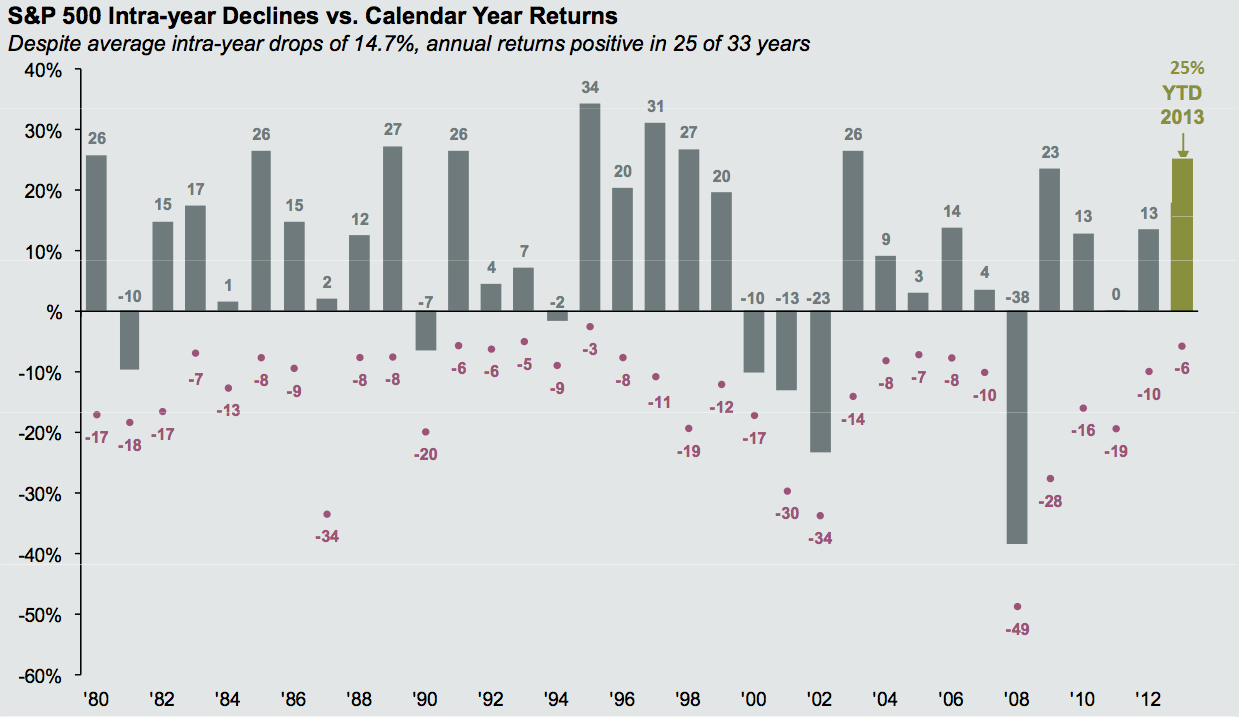
| S&P 500 Intra-year Declines vs. Calendar Year Returns Posted: 11 Dec 2013 09:00 AM PST Click for larger chart
For today's chart, I wanted to look at something unusual: the intra-year pullbacks of the past few decades. As this chart (via JPMorgan Chase & Co.) shows, there is an average market drawdown of 14.7 percent. That period includes a few whopper years. Even if we were to back out the outliers — remove the five biggest drawdowns (34 percent, 30 percent, 34 percent, 49 percent and 28 percent — average drawdown of 35 percent within the year), we still see an 11.5 percent average intra-year drop. Continues here |
| Posted: 11 Dec 2013 06:30 AM PST Good Weds morn. My early gift to you:
Continues Here |
| Why Do Forecasters Keep Forecasting? Posted: 11 Dec 2013 04:30 AM PST Firm / S&P 500 Target / Missed it by this much (%, as of 12.10.2013)
Source: Above the Market
Its that time of year again! All of your favorite prognosticators will soon be trotting out their favorite (albeit worthless) prognostications. You are advised to ignore them with extreme prejudice. This has been a peeve of mine for quite some time, going back to “The Folly of Forecasting” and, more recently, “Get ahead of forecaster folly.” I was reminded of this courtesy of a commentary by Robert Seawright, chief information officer of Madison Avenue Securities. It had the delightful tongue-in-cheek title, “Missed It By *This* Much.” Seawright notes that the "one forecast that is almost certain to be correct is that market forecasts are almost certain to be wrong." His table, which I have reproduced here, reveals just how true that was for S&P 500 predictions in 2013. As of yesterday, the best of the major broker forecasts was only off by about 12 percent, the worst by 30 percent. All told the seers’ average miss was a full 17.5 percent.
Continues here
|
| Posted: 11 Dec 2013 04:00 AM PST The Merrill Lynch Investment Strategy group, Martin Mauro and Cheryl Rowan has their look ahead to 2014. I don’t agree with all of these, but they are interesting and thought provoking:
You can see the full video here. |
| The Volcker Rule: Faults and Virtues Posted: 11 Dec 2013 03:30 AM PST Regulators hope the rule, named for Paul A. Volcker, the former Federal Reserve chairman, can cut risks taken by banks, but tiny holes in the 71-page rule may leave those banks some wiggle room.
|
| Fannie Mae Didn’t Cause the Housing Crisis, Radical Ideologues Did Posted: 11 Dec 2013 03:00 AM PST Source: Yahoo Finance |




| You are subscribed to email updates from The Big Picture To stop receiving these emails, you may unsubscribe now. | Email delivery powered by Google |
| Google Inc., 20 West Kinzie, Chicago IL USA 60610 | |



0 comments:
Post a Comment