


The Big Picture |
- The Story Is Not The Music
- How Much Cash Should You Hold In A Portfolio?
- 10 Weekend Reads
- Good Film, Bad Wolf: Barron’s Cover Film Review
| Posted: 21 Dec 2013 01:00 PM PST Who’s got the time? Beyonce may have delivered a video album that’s got the media and the punters bloviating, but very little of the discussion is about the music, because it’s become secondary to the game. That’s what music is today. I’m surprised Parker Brothers doesn’t have a label. Actually, there are multiple games involved. The game of the executive is to get paid. So when you scratch your head and question short-term thinking, know that you literally have not walked a mile in their shoes. It’s about the contract, not the music. Since most of these companies are owned by the public, not individuals. Come on, who in their right mind would start a record label? Only a delusional young fart, wet behind the ears and too stupid to go to business school. Starting a record label today is akin to going into competition with automakers, in Europe, where sales have tanked. So the game of the indie label is to bitch. That’s the story of the year. Not Ylvis’s Fox video or Katy Perry or Lady Gaga, but how Spotify has become the whipping boy. They’re screeching from their smart phones, beginning Kickstarter campaigns, utilizing all the new technology to complain that the old business model wherein you sold ten tracks for more than ten bucks has been eviscerated. I’m actually chuckling as I write this. Yes, you want to go back to the old days when it was expensive to record and concert tickets were five bucks. Good luck with that. And then there’s the audience. Which is looking for cool. And is overloaded and has no time to waste listening to anything that’s not superior. Anybody trumpeting the sales of Beyonce’s album has missed the point. The rules have changed. Forever. Now it’s whether someone has LISTENED to your album! Come on, how many CDs did you buy before Napster that went unplayed except for the hit. I’ll give you two. I own them. That Alicia Keys debut, with the irresistible “Fallin’”. The rest of that album was garbage, I know, I played it. Ditto on Britney Spears’s debut. Other than “…Baby One More Time” I can’t even name another track. But since those albums sold millions, we were told music was burgeoning, that all was right in the world, even though most of what was sold went unheard. This isn’t about piracy, this is about a correction. The bundle’s been broken. People only want what they want. Make ten incredible tracks and they want all of ‘em, but if you’ve only got one, that’s all they need. That’s the game the audience is playing. And the media is all about the horse race, just like in politics. It doesn’t matter what the music sounds like, just whether the act won, i.e. sold a ton. Actually, the two fields are not that different. You’ve got to be good-looking, with a ton of money and spinmeisters. Yup, the same way you’ve ignored politics is the same way people are ignoring music, because it’s not about music anymore. Come on. Art is about inspiration. How much inspiration is there in records made by committee? It’s all formula, all the time. And there are those trumpeting the diversity of hip-hop, and the cred of indie rockers, but they don’t realize that most of us are not paying attention. Because these genres have become caricatures of what they once were. But you can’t speak this truth in the music business, oh no, because that’s undercutting the game! Wherein we all make a lot of money, party all night and slap each other on the back. And if you don’t agree, you’re part of the problem. And the problem, once again, is not piracy, but indifference. There, I said it. We’ve got a whole system that most people just don’t pay attention to. Music is like curling at the Winter Olympics. People drive by once a year to watch the Grammys, they buy a track or two, but really they’ve got better things to do with their time. So how do we solve this problem? 1. Admit that everybody can’t be rich and famous. Just because you made it, that doesn’t mean we’re interested. 2. Acknowledge that the audience only cares about great. Microsoft can’t sell Windows phones and we’re telling people Selena Gomez is worth paying attention to. We’re wasting bandwidth, and people only have so much. 3. Forget the trappings. The fashion, the money, the lifestyle, they’re obscuring the essence. The Beatles put out an album with a blank cover, the music spoke for itself, today it’s all about imaging and promotion and the music comes last. 4. Forget about radio. It’s calcified. It’s beholden to advertisers. It doesn’t serve the public. Only Top Forty gets any real traction, and any music in new genres is ignored. Music discovery must move online. The so-called “curation.” Labels don’t want this. They like radio, because they control it, it’s a closed shop. But if you want to gain power in today’s musical world, be the person who tells people what to listen to. And don’t give them tons of choice, because people don’t have tons of time, they just get overwhelmed. Just a few tracks please. 5. Stop bitching about streaming. If you’re fighting piracy and streaming you’re embracing the CD and decrying smartphones. Streaming is the best thing that ever happened to the music business. Because it delivers what the audience wants, everything at its fingertips. If that means some people make less, I want you to bring back record stores, expensive CDs, vinyl… Yup, the old game is through, even if you’re playing your LPs, you’re no different from a Civil War reenactor. Please get your head out of your butt and look forward. 6. Know that trumpeting sales figures and marketing success takes away from the music. Yup, you there at home, please name one track from the new Beyonce album that’s all over the news. But you can name “Royals.” It’s as if the music business has turned into Procter & Gamble, a marketing machine purveying unexciting wares, only in the case of music, none of it’s necessary. Yes, that’s the truth. We don’t need music. We need food and water. We like music. But only the best music. So the rich will get richer and the poor will bitch. At least at this point the public is eating the popcorn and rendering an opinion. But if we keep focusing on rote tunes sold by orchestrated campaigns we risk people tuning out. Yup, the game is better that the music. You think everybody cares. But they don’t.
–––– Visit the archive: http://lefsetz.com/wordpress/ |
| How Much Cash Should You Hold In A Portfolio? Posted: 21 Dec 2013 06:30 AM PST How much cash should you hold in your portfolio?
When people discuss their investing portfolios, they typically refer to the stocks, bonds, commodities and real estate they hold. The conversation might also include model weightings, tilt toward and away from different asset classes, and rebalancing. What we rarely hear about is cash. Much of the traditional thinking about cash is well intentioned but unrealistic. Should you have six months of living expenses in the bank for emergencies? Sure. Do you? Probably not. In over 20 years of working in finance, I simply never see that sort of cash cushion among average investors of ordinary means. It is a luxury that only the wealthiest can afford. We looked at a related issue earlier this year when discussing "How to get back into the market after you missed a big rally." That also involved the issue of cash being a drag on portfolio returns. The context there was investors who had gotten skittish, had sold out of various positions and then found themselves unable to muster the discipline to redeploy cash back into risk assets. That is not the cash matter I want to discuss today. It's this: How much cash should there be in your investment portfolios? You may not have given it much thought. It seems to be coming up a lot among the ultra-wealthy. As mentioned before, many of the investment firms that service the wealthy have discovered that these folks are sitting on mountains of cash. Broad surveys from the likes of U.S. Trust, BlackRock, UBS, even American Express have shown that their high-net-worth clients are cash-heavy and, in many cases, asset-light. Why the ultra-wealthy have decided to sit in an asset class that loses value by the second with even modest inflation can most likely be explained by psychology. Call it the "recency effect" — investors are still shellshocked by the four asset crashes in a decade. From their peak years, we had technology/dot-coms fall about 80 percent (2000-02). Housing dropped 35 percent (2005-09), including the related falls in home builders, banks and investment firms of 75 percent. Equity markets crashed 57 percent (2007-09). And, lastly, commodities are off their highs anywhere from 30 to 50 percent (2011-13). Is it any surprise that investors are skittish? Perhaps the financial media bear some blame. There has been nonstop bubble talk. We read that stocks are over-valued. We are told they carry high cyclically adjusted price-earnings valuations relative to GDP. Earnings are at record highs, which is somehow a bad thing. The Dow, the Standard & Poor's 500-stock index and the Russell 2000 keep making record highs, which also is somehow portrayed as bearish. As a side note, let me point out that markets averaged 30 all-time highs per year from 1982 to 2000. Although none of these issues is new, it has been a persistent condition among the commentariat since this bull market began in March 2009. I called this the most hated rally in Wall Street history that year; the vitriol has only gotten worse since. Back to cash and how much to hold in a portfolio. It really depends on who you are, how you are investing and your investment horizon. A hedge fund manager whose clients demand monthly performance reports has different needs than any individual investors with a 20-year time horizon. The needs of that long-term investor differ markedly from someone who is retiring in three years. Warren Buffett has patiently held as much as $20 billion to $40 billion in cash. He thinks of cash not just as an "asset class that is returning next to nothing," but rather as "a call option that can be priced, relative to the ability of cash to buy assets." He put that to good use during the financial crisis, scooping up deeply discounted bargains. Most investors lack Buffett's discipline. When markets are rallying, cash in the portfolio is a drag on performance, returning about zero. The argument I hear for cash in the portfolio is it doesn't go down during market crashes, and it allows the purchases of cheap assets a la Buffett at attractive prices. But investors rarely can make that buy when markets are crashing. They are simply too scared, lacking the fortitude or the nerve to pull the trigger. Even those who managed to avoid the 2008 crash found themselves stuck with way too much cash in their portfolios as markets recovered. Up more than 150 percent since the 2009 lows, many are wondering what to do. Exactly how much cash are we talking? BlackRock President Rob Kapito noted in a Wall Street Journal interview last month that "on average, more than half of portfolios are in cash, earning negative real returns . . . 48 percent of U.S. respondents' investible assets are in cash deposit and savings accounts, and an additional 12 percent are in money-market accounts and certificates of deposit." About 60 percent is a shocking figure — and when we put this in dollar terms, it's even more astounding. American Express's survey of affluent Americans — those folks with at least $100,000 in disposable income — discovered $6 trillion in cash savings. Again, that is a stunningly large number. The alternative to stocks for the skittish is, obviously, fixed income. Given the inevitable increase in rates, many investors have liquidated bonds, further raising their cash balances. Rather than try to time the bond market, the solution here is to hold a ladder of individual A-rated bonds — not a fund subject to redemptions — that will mature over the next three to seven years. As this paper reaches its maturity over time, you simply roll into a similar bond at what is likely to be a higher yield. That is a better strategy than holding cash for the next seven years. The bottom line is this: Cash, in modest increments, has a role in any portfolio. But unless you are Warren Buffett, you should limit it to 2 or 3 percent. Otherwise, you are likely to miss the next bull market. Too many people have already missed this one. ~~~ Ritholtz is chief investment officer of Ritholtz Wealth Management. He is the author of "Bailout Nation" and runs a finance blog, the Big Picture. Twitter: @Ritholtz. |
| Posted: 21 Dec 2013 04:30 AM PST My longer form, weekend reading material to kick off your vacations:
What’s up for the holidays?
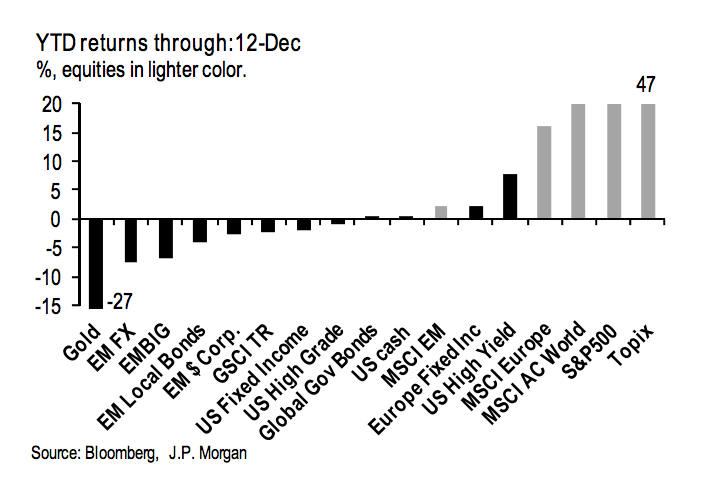
Gold was the worst trade of 2013 |
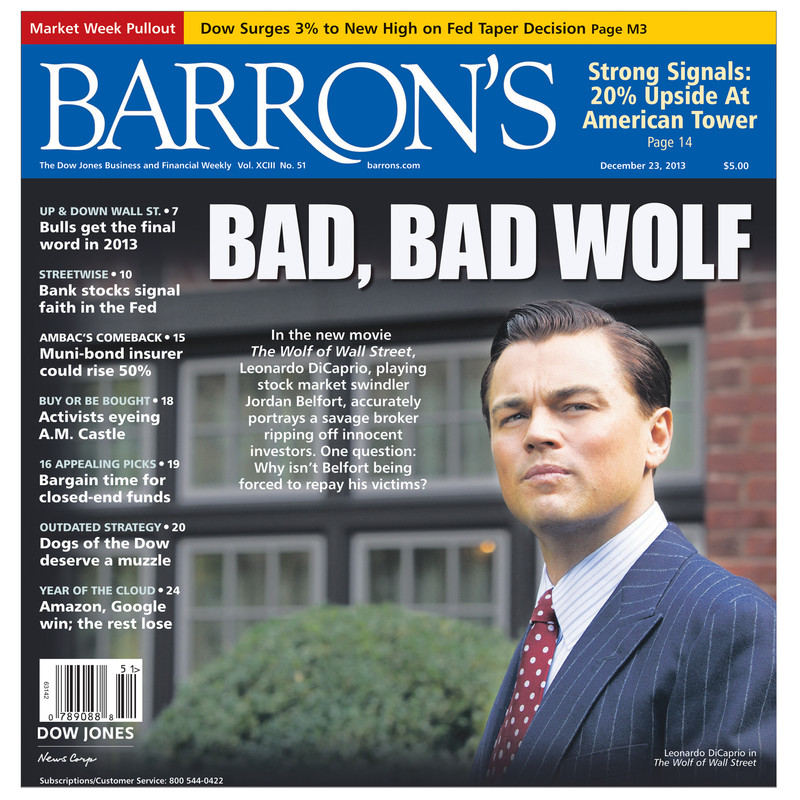
| Good Film, Bad Wolf: Barron’s Cover Film Review Posted: 21 Dec 2013 03:30 AM PST Martin Scorsese’s new movie “The Wolf of Wall Street” raises a question: Will Jordan Belfort ever be forced to repay his victims? Senior editor Jack Hough previews the latest issue of Barron’s Magazine. Photo: Paramount Pictures |
| You are subscribed to email updates from The Big Picture To stop receiving these emails, you may unsubscribe now. | Email delivery powered by Google |
| Google Inc., 20 West Kinzie, Chicago IL USA 60610 | |



0 comments:
Post a Comment