.

{2} GoogleTranslate (H)

English French German Spanish Italian Dutch Russian Portuguese Japanese Korean Arabic Chinese Simplified

Our New Stuff

{3} up AdBrite + eToro

Your Ad Here

Tuesday, December 31, 2013

The Big Picture

The Big Picture


‘Tis two days yet to New Year

Posted: 30 Dec 2013 11:30 AM PST

From the inimitable Art Cashin of UBS:

‘Tis two days yet to New Year
but despite what you're hopin'
The folks in the Board Room
say "the full Eve we’ll stay open"

So we’ll buy and we’ll sell
as the tape crawls along
And though “Bubbly’s” verboten
we may still sing a song

Two Thousand Thirteen
had some spots of high hopes
They may get fumbled away
by those Washington dopes

A brief government shutdown
pushed sides further apart
Let's all hope things improve
as the New Year we start

“If you like it you can keep it”
we heard the President quip
When that didn't work out
in the polls he did slip

We lost special people
as we seem to each year
It just makes us treasure
each one that's still here

Mandela and Thatcher
they reshaped their times
They'll now regale the angels
backed by heavenly chimes

And Peter O'Toole
with his steely blue eyes
Joined the great Joan Fontaine
in God's still bluer skies

Jean Stapleton's "Edith"
has joined Archie on high
And author Tom Clancy
chose October to die

Ed Koch now asks angels
his set quote, "How'm I doin"
Gone is Hugo Chavez
who brought his nation to ruin

Helen Thomas asks questions
of St. Peter these days
Also Frank Lautenberg
left his senator's ways

Jim Hall, jazz guitarist,
played his final great note
Richie Havens, quite different
is now in the same boat

Ray Harryhausen, who
created creatures unreal
Joined Jonathan Winters
every scene he would steal

Van Cliburn's piano angels
hear without faults
As Patti Page sings them
the old Tennessee Waltz

And Frost re-met Nixon
midst the clouds they'll debate
While Tony Soprano
while in Rome met his fate

Scott Carpenter and angels
now together will sup
Roger Ebert gave the harp
a quite hearty thumbs up

Esther Williams swam off
Eydie Gorme took a bow
And Annette Funicello
has joined them both now

And Doctor Joyce Brothers
bid her clients goodbye
While "Dear Abby" Van Buren
gives advice from on high

In Boston, two brothers
put some bombs in a crowd
Although hundreds were injured
that great town stayed unbowed

Wild fires aplenty
burned in state after state
Elsewhere came tornadoes
seems Mother Nature's irate

The Philippines saw a cyclone
winds of 200 miles
Caused immense devastation
to those once lovely isles

A Bangladesh building
did collapse in the spring
Though a thousand folks died
few reforms did it bring

In Syria, chemicals
wiped out a whole town
In a mall in Nairobi
scores of folks were mowed down

FOMO is a slogan
it's "fear of missing out"
Now we're all self-absorbed
that's what that's all about

Wall Street saw stocks soar
but Main Street stayed slow
As the Fed starts to taper
we'll see just how things go

Jeff Bezos announced
a new delivery drone
Edward Snowden revealed
that we'd tapped Merkel's phone

Prince George did arrive
of pictures there was no lack
and sweet tooths were quite pleased
to see Twinkies come back

Paula Deen fell from grace
for some things she once said
The Duck Dynasty guy
made some people turn red

Former Hannah Montana
shocked some fans with a twerk
In Toronto the mayor
some folks called a jerk

Let not this year’s memories
of sadness or sleaze
Disturb you this day
just give your heart ease

Have faith that this New Year
will bring a new sign
And believe in yourself
it will all work out fine

Just lift up your spirits
and some fruit of the vine
And kiss ye a loved one
and sing Auld Lange Syne

And late Tuesday evening
as you watch the ball fall
Wish yourself all the best
Happy New Year to All!!

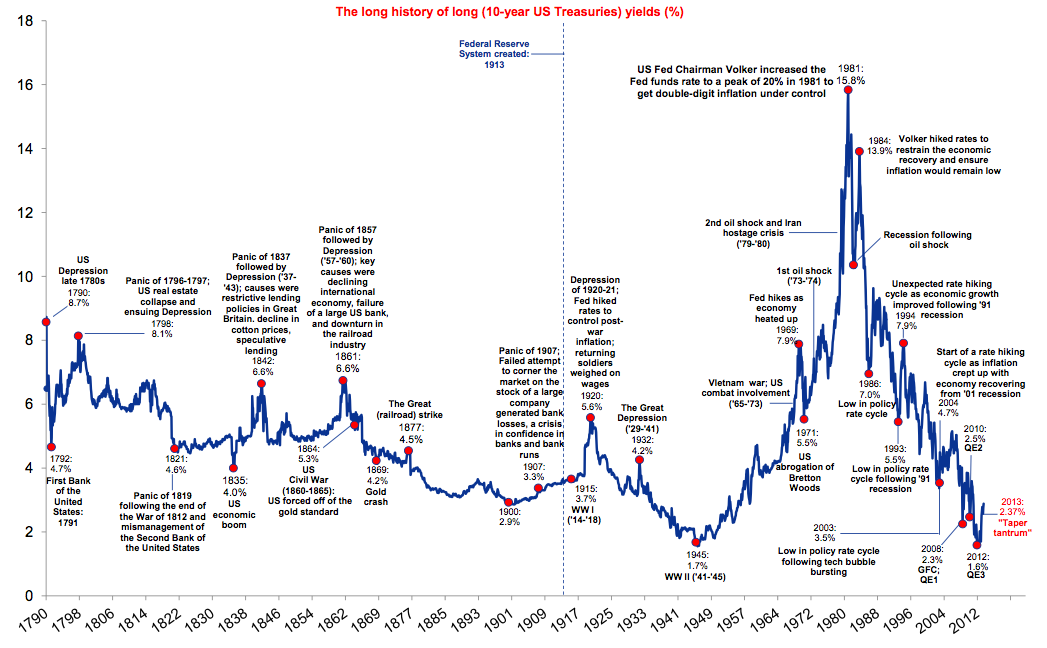
A (Somewhat) Bursting Bond Bubble

Posted: 30 Dec 2013 08:30 AM PST

Another holiday present from Goldman Sachs:


Source: Goldman Sachs, “Top of Mind”, December 18, 2013.

10 Monday AM Reads

Posted: 30 Dec 2013 06:30 AM PST

Welcome to the last week of 2013. Here’s what I’m reading:

• 13 data milestones for 2013 (Pew Research)
Best review I’ve read yet:  'Wolf of Wall Street' (Reformed Broker) see also Meet The Real ‘Wolf Of Wall Street’ in the original 1991 Takedown Of Jordan Belfort (Forbes)
• Trickle Down Thievery and Hoarding (or Banks versus Tech) (Howard Lindzon)
• The Best Financial Advice I Ever Got (or Gave) (WSJ)
• Unemployment and Profits: A dirty little secret (Calculated Risk) see also Dems Turn to Minimum Wage as 2014 Strategy (NY Times)
• Insurers may be at the centre of the next big crisis (FT)
• The Strange Case of Dr. Hayek and Mr. Hayek (Academia.edu)
• The Year Megaplatforms Ruled The Internet (BuzzFeed) but see U.S. Struggles to Keep Pace in Delivering Broadband Service (NY Times)
• NASA: 2012 Was 9th Warmest Year on Record. The 9 Warmest Years Have All Occurred Since 1998. (Dan’s Wild Wild Science Journal)
• Interview with Calvin & Hobbes creator Bill Watterson (Mental Floss)

What are you reading?


Rising Rates Favor Shorter Junk Bonds

Source: WSJ


Sarkar’s Week in Preview

Posted: 30 Dec 2013 04:00 AM PST

US GDP was revised higher to an annualised rate of +4.1% (from +3.6% previously) in Q3, with consumer spending, a key driver of the economy increasing by +2.0% on an annualised basis, higher than the +1.4% previously estimated. Analysts have increased their annualised growth forecasts for the 2nd half of the year to around 3.0%, well above the +1.8% rate in the 1st half. The improvement in US GDP supports the FED's decision to reduce its asset purchase programme. Estimates for Q4 GDP have been revised higher to around +2.5%, though is likely to come in better. Personal incomes rose by +0.2% in November, following a decline of -0.1% in October. Spending rose by +0.5%, mainly due to higher auto sales and increased expenditure on utilities due to the cold weather. Durable goods orders were up +3.5% in November. Excluding transportation, which tends to be volatile, orders rose by +1.2%. Jobless claims were also better than expected. Generally, US economic data is coming in better than expected.

Japan announced its budget for their fiscal year starting 1st April 2014. The budget which amounts to approximately Yen 96bn, is a record and the finance minister announced that they will need to issue Yen 41.25tr of bonds to finance the spending, around 43% of the total. In addition, the finance minister states that Japan could increase spending even further to stimulate growth !!!!. Inflation is rising. Prices, excluding fresh food, increased by +1.2% Y/Y, higher than the rise of +1.1% expected, mainly due to the weaker Yen. CPI was even higher, coming in at +1.5%, the highest since late 2008. However industrial output rose by a lower than expected +0.1% in November M/M, though retail sales were higher than forecast. To date, Japanese businesses have not raised wages. The annual wage round, which occurs shortly, should indicate whether businesses do indeed raise wages. Prime Minister Abe is urging businesses to increase wages. One of the largest business federations have urged their members to raise wages, though the expected increases (around 0.5%) will be much lower than prevailing inflation, with CPI predicted to increase to 3.0%. The real decline in earnings will clearly impact domestic consumption, reducing growth. I remain deeply sceptical of Abenomics and the Bank of Japan's policy. Japanese bond yields have been rising, with the 10 year at 0.74%, though have much further to rise in my view. Japanese investors are beginning to buy foreign bonds.

The Chinese Central Bank, the PBoC announced that it had injected further funds into the financial system to avoid a liquidity crunch. The measures seem to have worked with short term rates declining by over 250 bps over 7 days, the most since 2011. The Yuan rose to its highest level in 20 years, trading around 6.07 to the US$. Chinese local government debt has risen to Yuan 17.9tr (US$ 3.0tr), as at June, according to the National Audit Office. The Office promised to keep a close watch on spending by local governments.

Overview
US data has come in better than expected. As a result, bond markets have declined, with the 10 year Treasury yield rising to around 3.0%. Yields look as they will rise to 3.25%+. The higher US yields could well impact emerging markets. US markets continue to set record highs, though on light volume due to the holidays. The better data also helped Japanese markets which have risen by over 50% in local currency terms this year. The DAX in Europe is also trading at record levels. Markets look as if they will continue to rise into the New Year.

The Yen continues to decline to 5 year lows against both the US$ and the Euro. The weakness of the Yen is causing concern for countries in the region, in particular exporting countries such as China, South Korea and Taiwan. With the current policies in place, I believe that the Yen will decline further. Sterling has been strong, following a string of better economic data, approaching US$1.65. The Euro remains resilient, though has backed off its recent highs of over US$1.38. I must admit, I have been surprised by the resilience of the Euro, though continue to believe that it will decline against the US$ next year.

May I just take this opportunity of wishing you a very happy New Year.

Kiron Sarkar
30th December 2013

5 Richest Cities in the U.S.

Posted: 30 Dec 2013 03:00 AM PST

Based on data from the U.S. Census Bureau, 24/7 Wall Street identified the U.S. metropolitan statistical areas with the highest median household incomes. Douglas McIntyre, 24/7 Wall Street editor-in-chief and CEO, joins Lunch Break.

.

Monday, December 30, 2013

The Big Picture

The Big Picture


The Trust Preferred CDO Market: From Start To (Expected) Finish

Posted: 30 Dec 2013 02:00 AM PST

Spotlight on Men’s Health

Posted: 29 Dec 2013 01:00 PM PST

10 EZ Financial New Year’s Resolutions

Posted: 29 Dec 2013 07:00 AM PST

>


My Sunday Washington Post Business column is out. This morning, I discuss ten easy to follow New Year’s resolutions that will make your finances better.

The print version had the charming headline Get smart!: 10 financial resolutions you can actually keep.

Here’s an excerpt from the column:

“It's that time of year, when many people resolve to be better: Gotta lose 20 pounds, stop smoking, start exercising. Human nature is such that come January, there will be a 20-minute wait for the elliptical machines in the gym . . . and by mid-February, that wait will drop to zero minutes.

Resolutions are usually a terrible way to effect change. Changing habits involves changing your lifestyle, and that requires a deep commitment that most of us lack.

If you've resolved to get your financial life in order, I offer 10 important and easy-to-do steps. None is groundbreaking, but they are all too easily overlooked. If you do all 10, I guarantee that you will be better organized and more aware of your finances. That will lead to better decision-making and lower levels of economic stress.”

Following that are the 10 numbered resolutions, along with a brief explanation of each.

Note: I wrote this to be simple, accessible and easy to follow. I am sure there will be some exceptions to each of these points, so think of them as general principles.

>

Source:
10 financial resolutions you can actually keep
Barry Ritholtz
Washington Post, December 29 2013
http://www.washingtonpost.com/business/10-financial-resolutions-you-can-actually-keep/2013/12/27/8fb431d4-6c0f-11e3-a523-fe73f0ff6b8d_story.html

10 Sunday AM Reads

Posted: 29 Dec 2013 05:15 AM PST

Good Sunday morning. Here’s what I’m reading with my morning coffee:

• Money and Inflation (Economist’s View)
• Twitter's Ballooning Market Cap (WSJsee also Twitter’s stock has nearly tripled since its IPO last month, making the IPO among the best-performing of 2013 (WSJ)
• Seven things you should know about the expiration of unemployment benefits (Washington Post)
• New York: A concrete legacy (FT) see also Signs of Change in News Mission at Bloomberg (NY Times)
• Does journalism have a future? (TLS)
• Be A Learning Machine (Seeking Wisdom) see also Investment: The Concise Encyclopedia of Economics (Library of Economics and Liberty)
• NCAA's Big Gay Choice: Chick-fil-A or Equality? (Daily Beast)
• Climate myths: Global warming stopped in 1998 (New Scientist) see also Utilities Feeling Rooftop Solar Heat Start Fighting Back (Bloomberg)
• Quotes Uncovered: How Lies Travel (Freakonomics)

What’s for brunch?


Stock Rally Fails to Spur Big Inflows into Mutual Funds

Source: WSJ


A Buzzing Beehive of Stars

Posted: 29 Dec 2013 04:00 AM PST

Click for larger photo

Source: Slate

Conan: Local Media Read Retail PR Releases

Posted: 29 Dec 2013 03:30 AM PST

Ever wonder who writes the local news? Trade groups, thats who:

A Christmas Present Or Two Or Ten Edition

Incredibly embarrassing . . .

.

Sunday, December 29, 2013

The Big Picture

The Big Picture


Making It

Posted: 28 Dec 2013 11:00 AM PST

1. You have to NEED to make it.

Wanting to make it is not enough. It must be your one true calling. If you’re willing to be broke, with no direction home, you might possibly make it. Sacrifice is the key element. If you’re not willing to sacrifice your home, your relationship, forgo children and sleep on the floor when you’re forty, don’t expect to make it in music, certainly don’t expect to sustain.

2. You have to be great.

Good is not good enough. You’ve got to blow our minds.

3. You can’t do it alone.

That’s an Internet fiction, from a decade past, that if you just posted something online it could cut through the noise. You need a team:

a. A lawyer

b. A manager

c. An agent.

A lawyer to make sure you don’t sign bad deals that hobble you forever.

A manager to play interference, he who sells himself and makes his own deals is destined to piss people off.

And an agent to get you gigs.

An agent is hardest to get. A manager is never easy. But no act ever made it without a manager.

4. Money

It can’t buy you love, but it can buy you visibility. That’s what you’re looking for today.

The story of 2013 is cacophony, noise. Nothing rises above the din unless it is worked by a team. There’s just too much out there, and no one agrees what is great. So, gatekeepers are everything. I know this is contrary to everything you’ve heard for the last ten years, but this is what noise has wrought. How can you attach yourself to those who will get your message out? You must have the goods when you get your chance, but spontaneous virality is doomed in an era where BuzzFeed is a business BASED on virality and Gawker and other outlets play the same game. If you can’t get on their radar, if you can’t expose a large audience, you’re never gonna make it. Sorry.

5. Believers

Sure, you need fans. But all they can do is pay for your Kickstarter record, and have you noticed we hear no more Kickstarter stories, that the outlet is the new BlackBerry, something that used to be that is no longer? If you’re just speaking to your fans, getting money from them, you might be able to survive, but you’ll never be able to grow.

You need business people, those with power, to believe in you. They need to do favors for you, get you on the radio, get you placed on shows, give you a chance to demonstrate your wares. If you’re totally DIY, you’re gonna be living in your basement.

6. Sustaining

That’s the hardest thing to do these days, not have one hit, but two. The label might sign and promote your single track, and then they’ll drop you when you’ve got no follow-up.

7. Learning

We live in a country where no one can admit they’re wrong. If you’re not willing to question every choice, do it differently next time, you’re never going to make it. Three years ago, almost everything I’ve said above would be different. You could go viral by your lonesome, social networking worked. But times change. You once used your aforementioned BlackBerry and were thrilled to get your e-mail on the run, now it’s all about apps. People hate change, but those who are willing to do so win. Kind of like in Silicon Valley, where it’s called “the Pivot.” Your original idea didn’t work, so you take the core and go in a different direction. You might think you’re a rocker, but truly you might be a country artist. You might think you’re a singer, but you might really be a songwriter, or a producer.

8. Pay little attention to those who are popular.

By the time you get your chance, completely different people and paradigms might rule. Originality is the key to longevity. Be yourself, not someone else.

9. Publicity

Was useless until this year. With so much information, we see publicity as evidence that someone believes in you. The content is less important than the imprimatur, that you’ve risen above. Used to be if we saw your name everywhere, we winced. Actually, we still do, but we now know you’re not a complete wanker.

10. Word of mouth.

Is still king, but too many are promoting for friends and have terrible taste. We’ve all got our trusted filters, and those who count are not afraid of the mainstream. The Internet is littered with those who abhor anything that is truly popular. Don’t get caught in their backwater, unless you want to starve. You want to be popular. Otherwise, get out.

11. Popularity.

Means people like you and your music. It comes with haters, because it’s so hard to break through, people are going to be angry that you did. You’ll be told you’re ugly, that your music sucks, that you can’t sing, that you’ve got no talent, but don’t believe it. It’s so hard to make it that if you have, pat yourself on the back and do your best to survive.

12. Longevity.

One hit and you can get royalties forever. Maybe even live dates. But chances are you’ll have to have a day job. The rule is, the harder it is to do, the better the chance of survival. Which is why doctors can always be employed, even if they bitch about their compensation. The barrier to entry to music is miniscule, so there are always others who are eager to take your place. The more skills you’ve got under your belt, the better your chance at lasting. But don’t be holier than thou that you can read music and got a degree, these are just tools, building blocks, a foundation, it’s what you build on top that counts.

13. Be nice.

It’s the key to making it. If you’re a jerk, no one’s going to want to work for you, go out of their way to promote you. Constantly say thank you and go out of your way to be appreciative. Everybody loves compliments, not just the act.

14. Sour grapes.

Are gonna pull you down. The woulda, shoulda, coulda posse can tell an interesting story over a beer, but these people never succeed. Life is full of challenges, if you haven’t been screwed, you haven’t played the game. The road to success is paved with humiliation, you can complain about it or swallow it and realize it’s dues.

15. There are no guarantees.

Everybody’s time goes by. Most only peak for a short while. Enjoy the ride when you break through.

––––

Visit the archive:   http://lefsetz.com/wordpress/

@Twitter  http://www.twitter.com/lefsetz

If you would like to subscribe to the LefsetzLetter,

10 Weekend Reads

Posted: 28 Dec 2013 04:30 AM PST

Good Saturday morning. Here are my favorite longer format reading materials from the week:

• How Your Data Are Being Deeply Mined (New York Review of Books)
• UBER: The Black Car Company That People Love to Hate (Next City)
• Why the cult of hard work is counter-productive (New Statesman)
• Mental Model: Margin of Safety (Farnam Street)
• Separating Mine From Thine—on the history of land ownership (WSJ)
• Dear Ticketmaster, it’s time to redesign the master of all tickets (Medium)
• Adam Smith, Communitarian (American Conservative) see also God, Hayek and the Conceit of Reason (Standpoint)
• Charlie Chaplin: Split Personalities (Lapham’s Quarterly)
• Vermeer's Secret Tool: Testing Whether The Artist Used Mirrors and Lenses to Create His Realistic Images (Vanity Fair)
• 'And I Cannot Lie': The Oral History of Sir Mix-a-Lot's 'Baby Got Back' Video (Vulture)

What’s up for the weekend?


Municipal Bonds Wrap Up Tough Year

Source: WSJ


The Big Lie About NSA Spying

Posted: 28 Dec 2013 02:00 AM PST

Even Before 9/11, NSA Knew In Real-Time Which Countries Both Parties to Phone Calls Were In

In finding the NSA's metadata collection program legal today, Judge William Pauley III ruled:

The September 11th terrorist attacks revealed, in the starkest terms, just how dangerous and interconnected the world is. While Americans depended on technology for the conveniences of modernity, al-Qaeda plotted in a seventh-century milieu to use that technology against us. It was a bold jujitsu. And it succeeded because conventional intelligence gathering could not detect diffuse filaments connecting al-Qaeda.

Prior to the September 11th attacks, the National Security Agency ("NSA") intercepted seven calls made by hijacker Khalid al-Mihdhar, who was living in San Diego, California, to an al-Qaeda safe house in Yemen. The NSA intercepted those calls using overseas signals intelligence capabilities that could not capture al-Mihdhar's telephone number identifier. Without that identifier, NSA analysts concluded mistakenly that al-Mihdhar was overseas and not in the United States. Telephony metadata would have furnished the missing information and might have permitted the NSA to notify the Federal Bureau of Investigation ("FBI") of the fact that al-Mihdhar was calling the Yemeni safe house from inside the United States.

The Government learned from its mistake and adapted to confront a new enemy: a terror network capable of orchestrating attacks across the world. It launched a number of counter-measures, including a bulk telephony metadata collection program—a wide net that could find and isolate gossamer contacts among suspected terrorists in an ocean of seemingly disconnected data.

This blunt tool only works because it collects everything. Such a program, if unchecked, imperils the civil liberties of every citizen. Each time someone in the United States makes or receives a telephone call, the telecommunications provider makes a record of when, and to what telephone number the call was placed, and how long it lasted. The NSA collects that telephony metadata. If plumbed, such data can reveal a rich profile of every individual as well as a comprehensive record of people's associations with one another.

Judge Pauley is uninformed … and he fell for the "big lie" behind NSA spying.

Bill Binney – the high-level NSA executive who created the agency's mass surveillance program for digital information, senior technical director within the agency who managed thousands of NSA employees, interviewed by CBS, ABC, CNN, New York Times, USA Today, Fox News, PBS and many others -  told Washington's Blog:

[NSA chief Keith] Alexander wants you and everybody (including this clueless judge) to believe that caller ID does not work. First of all, all the calls that are made in the world are routed by machines. And, with machines, you have to tell them exactly what to do. Which means, the routing instructions calling nr and called nr have to be passed through the machines to route the call to get from point A to point B in the world.

So, he is feeding everyone a line of crap. If you buy into this, I have a bridge I would like to sell.

Also, all calls going from one region of the world to another are preceded by 01 or 011 in region "1″ (US/Canada/some islands) or by "00″ in the rest of the world. And that goes both ways on any call.

The Public Switch Telephone Network (PSTN) numbering plan is how we could eliminate all US to US calls right up front and never take them in.

In other words, while Binney headed NSA's global digital communications gathering efforts prior to 9/11, his team knew in real-time which countries calls were made from and received in.  The NSA is lying if it claims otherwise.

ProPublica notes:

"There were plenty of opportunities without having to rely on this metadata system for the FBI and intelligence agencies to have located Mihdhar," says former Senator Bob Graham, the Florida Democrat who extensively investigated 9/11 as chairman of the Senate's intelligence committee.

These missed opportunities are described in detail in the joint congressional report produced by Graham and his colleagues as well as in the 9/11 Commission report.

***

Mihdhar was on the intelligence community's radar at least as early as 1999. That's when the NSA had picked up communications from a "terrorist facility" in the Mideast suggesting that members of an "operational cadre" were planning to travel to Kuala Lumpur in January 2000, according to the commission report. The NSA picked up the first names of the members, including a "Khalid." The CIA identified him as Khalid al Mihdhar.

The U.S. got photos of those attending the January 2000 meeting in Malaysia, including of Mihdhar, and the CIA also learned that his passport had a visa for travel to the U.S.

***

Using their true names, Mihdhar and Hazmi for a time beginning in May 2000 even lived with an active FBI informant in San Diego.

***

Let's turn to the comments of FBI Director Robert Mueller before the House Judiciary Committee last week.

Mueller noted that intelligence agencies lost track of Mihdhar following the January 2000 Kuala Lumpur meeting but at the same time had identified an "Al Qaida safe house in Yemen."

He continued: "They understood that that Al Qaida safe house had a telephone number but they could not know who was calling into that particular safe house. We came to find out afterwards that the person who had called into that safe house was al Mihdhar, who was in the United States in San Diego. If we had had this [metadata] program in place at the time we would have been able to identify that particular telephone number in San Diego."

In turn, the number would have led to Mihdhar and potentially disrupted the plot, Mueller argued.

(Media accounts indicate that the "safe house" was actually the home of Mihdhar's father-in-law, himself a longtime al Qaida figure, and that the NSA had been intercepting calls to the home for several years.)

The congressional 9/11 report sheds some further light on this episode, though in highly redacted form.

The NSA had in early 2000 analyzed communications between a person named "Khaled" and "a suspected terrorist facility in the Middle East," according to this account. But, crucially, the intelligence community "did not determine the location from which they had been made."

In other words, the report suggests, the NSA actually picked up the content of the communications between Mihdhar and the "Yemen safe house" but was not able to figure out who was calling or even the phone number he was calling from.

***

Theories about the metadata program aside, it's not clear why the NSA couldn't or didn't track the originating number of calls to Yemen it was already listening to.

Intelligence historian Matthew Aid, who wrote the 2009 NSA history Secret Sentry, says that the agency would have had both the technical ability and legal authority to determine the San Diego number that Mihdhar was calling from.

"Back in 2001 NSA was routinely tracking the identity of both sides of a telephone call," [9/11 Commission Executive Director Philip Zelikow] told ProPublica.

***

There's another wrinkle in the Mihdhar case: In the years after 9/11, media reports also suggested that there were multiple calls that went in the other direction: from the house in Yemen to Mihdhar in San Diego. But the NSA apparently also failed to track where those calls were going.

In 2005, the Los Angeles Times quoted unnamed officials saying the NSA had well-established legal authority before 9/11 to track calls made from the Yemen number to the U.S. In that more targeted scenario, a metadata program vacumming the phone records of all Americans would appear to be unnecessary.

And see this PBS special, and this ACLU comment.

Indeed, the NSA and other U.S. government agencies had been spying on Midhar for a long time before 9/11.

Initially, an FBI informant hosted and rented a room to Mihdhar and another 9/11 hijacker in 2000.

Investigators for the Congressional Joint Inquiry discovered that an FBI informant had hosted and even rented a room to two hijackers in 2000 and that, when the Inquiry sought to interview the informant, the FBI refused outright, and then hid him in an unknown location, and that a high-level FBI official stated these blocking maneuvers were undertaken under orders from the White House.

As the New York Times notes:

Senator Bob Graham, the Florida Democrat who is a former chairman of the Senate Intelligence Committee, accused the White House on Tuesday of covering up evidence ….The accusation stems from the Federal Bureau of Investigation's refusal to allow investigators for a Congressional inquiry and the independent Sept. 11 commission to interview an informant, Abdussattar Shaikh, who had been the landlord in San Diego of two Sept. 11 hijackers.

Moreover, Wikipedia notes:

Mihdhar was placed on a CIA watchlist on August 21, 2001, and a note was sent on August 23 to the Department of State and the Immigration and Naturalization Service (INS) suggesting that Mihdhar and Hazmi be added to their watchlists.

***

On August 23, the CIA informed the FBI that Mihdhar had obtained a U.S. visa in Jeddah. The FBI headquarters received a copy of the Visa Express application from the Jeddah embassy on August 24, showing the New York Marriott as Mihdhar's destination.

On August 28, the FBI New York field office requested that a criminal case be opened to determine whether Mihdhar was still in the United States, but the request was refused. The FBI ended up treating Mihdhar as an intelligence case, which meant that the FBI's criminal investigators could not work on the case, due to the barrier separating intelligence and criminal case operations. An agent in the New York office sent an e-mail to FBI headquarters saying, "Whatever has happened to this, someday someone will die, and the public will not understand why we were not more effective and throwing every resource we had at certain 'problems.'" The reply from headquarters was, "we [at headquarters] are all frustrated with this issue … [t]hese are the rules. NSLU does not make them up."

The FBI contacted Marriott on August 30, requesting that they check guest records, and on September 5, they reported that no Marriott hotels had any record of Mihdhar checking in. The day before the attacks, the New York office requested that the Los Angeles FBI office check all local Sheraton Hotels, as well as Lufthansa and United Airlines bookings, because those were the two airlines Mihdhar had used to enter the country. Neither the Treasury Department's Financial Crimes Enforcement Network nor the FBI's Financial Review Group, which have access to credit card and other private financial records, were notified about Mihdhar prior to September 11.

***

Army Lt. Col. Anthony Shaffer and Congressman Curt Weldon alleged in 2005 that the Defense Department data mining project Able Danger identified Mihdhar and 3 other 9/11 hijackers as members of an al-Qaeda cell in early 2000.

We reported in 2008:

As leading NSA expert James Bamford – the Washington Investigative Producer for ABC's World News Tonight with Peter Jennings for almost a decade, winner of a number of journalism awards for coverage national security issues, whose articles have appeared in dozens of publications, including cover stories for the New York Times Magazine, Washington Post Magazine, and the Los Angeles Times Magazine, and the only author to write any books (he wrote 3) on the NSA – reports, the NSA was also tapping the hijackers' phone calls inside the U.S.

Specifically, hijackers Khalid al-Mihdhar and Nawaf al-Hazmi lived in San Diego, California, for 2 years before 9/11. Numerous phone calls between al-Mihdhar and Nawaf al-Hazmi in San Diego and a high-level Al Qaeda operations base in Yemen were made in those 2 years.

The NSA had been tapping and eavesdropping on all calls made from that Yemen phone for years. So NSA recorded all of these phone calls.

Indeed, the CIA knew as far back as 1999 that al-Mihdhar was coming to the U.S. Specifically, in 1999, CIA operatives tailing al-Mihdhar in Kuala Lumpur, Malaysia, obtained a copy of his passport. It contained visas for both Malaysia and the U.S., so they knew it was likely he would go from Kuala Lumpur to America.

NSA veteran Bill Binney previously told Washington's Blog:

Of course they could have and did have data on hijackers before 9/11. And, Prism did not start until 2007. But they could get the data from the "Upstream" collection. This is the Mark Klein documentation of Narus equipment in the NSA room in San Francisco and probably other places in the lower 48. They did not need Prism to discover that. Prism only suplemented the "Upstream" material starting in 2007 according to the slide.

Details here and here.

Another high-level NSA whistleblower – Thomas Drake – testified in a declaration last year that an NSA pilot program he and Binney directed:

Revealed the extent of the connections that the NSA had within its data prior to the [9/11] attacks. The NSA found the array of potential connections among the data that it already possessed to be potentially embarrassing. To avoid that embarrassment, the NSA suppressed the results of the pilot program. I had been told that the NSA had chosen not to pursue [the program] as one of its methods for combatting terrorism. Instead, the NSA had previously chosen to delegate the development of a new program, named "Trailblazer" to a group of outside contractors.

Moreover, widespread spying on Americans began before 9/11 (confirmed here, here, here, here and here.

And U.S. and allied intelligence heard the 9/11 hijackers plans from their own mouths:

  • The National Security Agency and the FBI were each independently listening in on the phone calls between the supposed mastermind of the attacks and the lead hijacker. Indeed, the FBI built its own antenna in Madagascar specifically to listen in on the mastermind's phone calls
  • According to various sources, on the day before 9/11, the mastermind told the lead hijacker "tomorrow is zero hour" and gave final approval for the attacks. The NSA intercepted the message that day and the FBI was likely also monitoring the mastermind's phone calls
  • According to the Sunday Herald, two days before 9/11, Bin Laden called his stepmother and told her "In two days, you're going to hear big news and you're not going to hear from me for a while." U.S. officials later told CNN that "in recent years they've been able to monitor some of bin Laden's telephone communications with his [step]mother. Bin Laden at the time was using a satellite telephone, and the signals were intercepted and sometimes recorded." Indeed, before 9/11, to impress important visitors, NSA analysts would occasionally play audio tapes of bin Laden talking to his stepmother.
  • And according to CBS News, at 9:53 a.m on 9/11, just 15 minutes after the hijacked plane had hit the Pentagon, "the National Security Agency, which monitors communications worldwide, intercepted a phone call from one of Osama bin Laden's operatives in Afghanistan to a phone number in the former Soviet Republic of Georgia", and secretary of Defense Rumsfeld learned about the intercepted phone call in real-time (if the NSA monitored and transcribed phone calls in real-time on 9/11, that implies that it did so in the months leading up to 9/11 as well)

But even with all of that spying, the government didn't stop the hijackers … even though 9/11 was entirely foreseeable.  Moreover, the entire "lone wolf" theory for mass surveillance is false.  In reality, 9/11 was state-backed terror.

As such, blaming 9/11 on a lack of ability of the NSA to spy is wholly false.

As TechDirt notes:

The [court's] footnote refers to the 9/11 Commission Report whose findings directly contradict this narrative. The problem was not that the information wasn't there. It was that it wasn't shared. It was the fact that the CIA lost al-Mihdhar, but rather than issue an alert or place him on a watch list, it chose to do nothing. Many things went wrong, but not having the intel wasn't the issue.

Indeed, the Boston Bombing proves that mass surveillance isn't what's needed.  Even though the alleged Boston bombers' phones were tapped – and NBC News reports, "under the post-9/11 Patriot Act, the government has been collecting records on every phone call made in the U.S."mass surveillance did not stop the other terror attack on U.S. soil since 9/11.

In reality – despite the government continually grasping at straws to justify its massive spying program – top security experts say that mass surveillance of Americans . Indeed, they say that mass spying actually hurts U.S. counter-terror efforts (more here and here).

.

Saturday, December 28, 2013

The Big Picture

The Big Picture


Systemic Risk, International Regulation, and the Limits of Coordination

Posted: 28 Dec 2013 02:00 AM PST

Apple MacBook Air Design Flaw

Posted: 27 Dec 2013 11:30 AM PST

Dear Sirs,

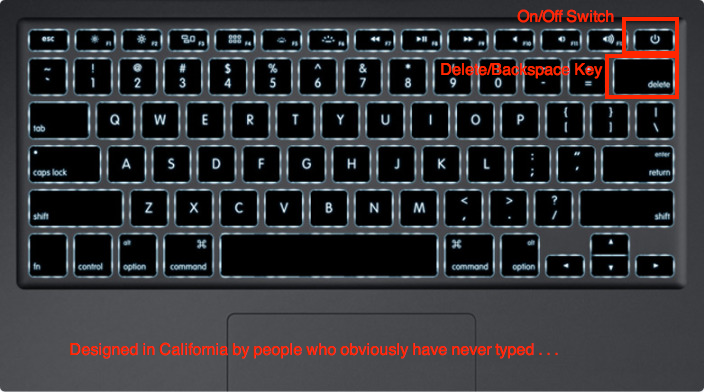
I want to bring to you're attention a terrible design floor in the MacBook Air laptop: Its power switch.

Unlike the MacBoook Pro that it replaced, someone at Apple placed the on/off switch as part of the keyboard. This is a terrible idea. It makes the laptop that much less usable, less efficient and less pleasant to work with. To be blunt, it represents a terrible compromise of utility for the sake of symmetry and appearances.

It is very unApple like.

I don't care of you are the world's greatest typist, eventually, you will accidentally brush this key with your right hand pinkie or ring finger. If you are lucky, you can flip the lid closed, wait a few beats, reopen it, and then enter your password. If the silicon Gods are smiling on you, you can proceed normally. Most of the time, however, you must reboot the entire machine, while muttering "WTF was Jony Ive thinking?" under your breath.

Genius? Hardly.

Making the matter worse, there is no software over ride. I cannot program this key to require a "2 second hold" before taking effect, or even a double click – just the merest wisp of an errant touch ends my session of work.

The good news is twofold: Its a solid state machine, so it reboots quickly. And, when the reboot comes up, all of your work seems to have been saved. In other words, this terrible hardware design is made less painful by an excellent software design.

Thank goodness for small favors.

The on/off is immediately above the very commonly used delete/backspace key, thereby making this error all but inevitable, and revealing its inventor as utterly clueless about Human ergonomics. What makes this so stunning is it comes from a company that, since my MacClassic in 1989, seemed to anticipate, rather than thwart, my intentions.

I have two new laptops to buy for work in January, and while my original plan was to add more MacBook Airs, this flaw makes that much less likely to occur.

Note this was typed on an iMac, which means that I actually go to finish it in one streak, without being interrupted by a poorly designed, poorly placed on off key.

Here's hoping you get your shit together soon,


Barry Ritholtz

~~~


Designed in California by people who apparently have never typed . . .

macbook-air-mid-2011-backlit-keyboard


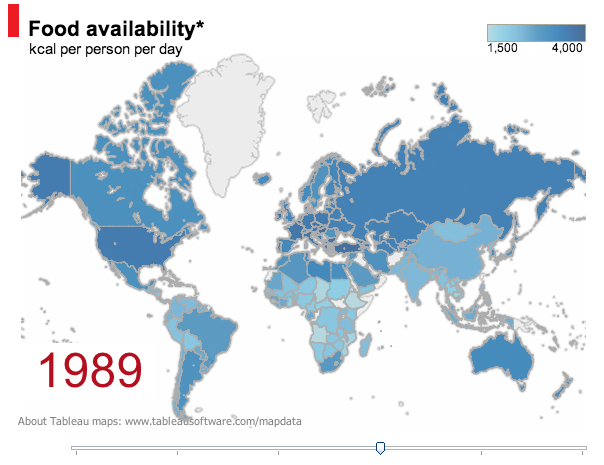
More Food For Thought (& Eating)

Posted: 27 Dec 2013 08:30 AM PST

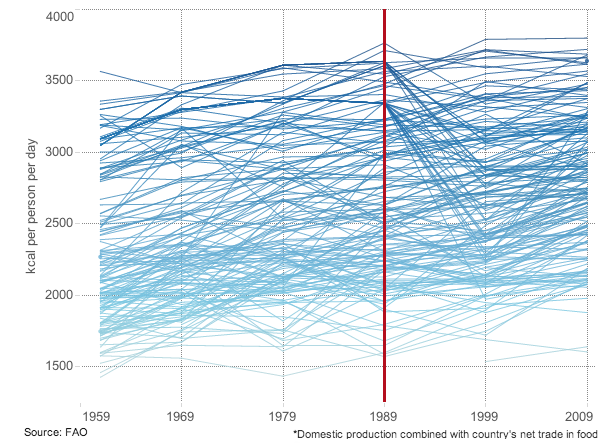
Very cool infographic from the Economist, showing improvements in food availability worldwide:


The world has become better fed over the past 50 years

Click for an interactive graphic.

Source: Economist

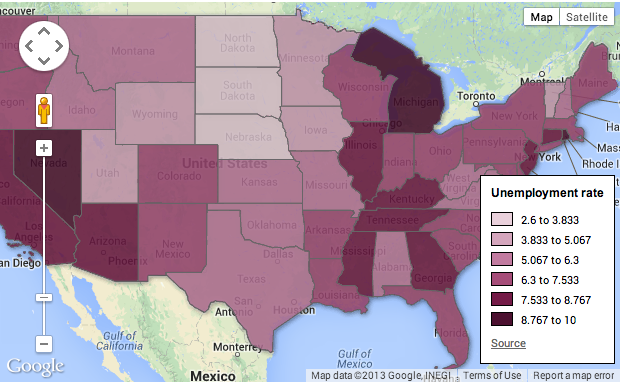
In 27 States, Unemployment At Lowest Levels in 4 Years

Posted: 27 Dec 2013 07:30 AM PST

From the Washington Post:

Unemployment has reached multi-year lows in 27 states, a bit of positive news for state labor markets that are still struggling through a mild recovery.


Click for an interactive map.

Source: Washington Post

10 Friday AM Reads

Posted: 27 Dec 2013 05:00 AM PST

Happy Merry! Some expertly curated reads to end your light, holiday shortened week:

• Bullishness Jumps to Three-Year High (WSJ) but see Mom and Pop Wary of Stocks (WSJ)
• Bob Peck's Top 10 Disruptive Themes for 2014 (Reformed Broker)
• Sorry, haters: Unloved stocks had a great year (MarketWatch)
• Abenomics Drives Japan Hedge Funds to World's Top Performers (Bloomberg)
• Fed wins battle of the exit – for now (FT)
• Why Gold Would Be Useless in an Economic Apocalypse (The Atlantic)
• Bank Of America Economist Torpedoes One Of The Main Arguments For Impending Inflation (Business Insider)
• Send in the Drones? Retailers Ruined This Christmas (Daily Beast) see also Final Tally For All The Amazon Shopping This Holiday Season (Business Insider)
• The Year We Broke the Internet (Esquire)
• The Least Important Writers of 2013 (Gawker)

What are you reading?


10 Year Treasury Yield Touches 3%

Source: WSJ


Military Law Expert: Obama Should Pardon Snowden

Posted: 26 Dec 2013 10:15 PM PST

How Can Obama Let Criminals Like Clapper Go … Yet Go After Snowden?

Professor Jonathan Turley is one of the nation's top military and constitutional law experts.

Turley:

  • Has held a top-secret clearance since the Reagan administration
  • Is the second most cited law professor in the country
  • Has worked as both the CBS and NBC legal analyst during national controversies
  • Ranks 38th in the top 100 most cited 'public intellectuals' in a recent study by a well-known judge
  • Is one of the top 10 lawyers handling military cases
  • Has served as a consultant on homeland security and constitutional issues
  • Is a frequent witness before the House and Senate on constitutional and statutory issues

Turley writes today in the Los Angeles Times:

It may be time for President Obama to show real leadership and acknowledge that Snowden is the reason for the current reform push.

It may be time to pardon Edward Snowden.

***

Snowden is a better candidate for clemency than many believe.

A presidential pardon is not an endorsement of the underlying actions of an individual. To the contrary, the vast majority of pardons follow criminal convictions. Rather, pardons are issued because of mitigating or extenuating circumstances.

***

Sometimes clemency is a way of healing a national divide or bringing closure to a national controversy. George Washington pardoned all of those in the Whiskey Rebellion, and John Adams considered it in "the public good" to pardon Pennsylvania rebels. Likewise, Gerald Ford did not condone the crimes of Richard Nixon, but he viewed a pardon as in the best interest of the country.

Presidential pardons can be issued at any time after an alleged offense, even before a person is charged or convicted. Such was the case with Jimmy Carter's pardon of draft dodgers and Ronald Reagan's pardon of the six officials accused in the Iran-Contra affair.

When considered in light of the thousands of past pardon and commutation recipients, Snowden compares favorably.

***

Snowden faced a system that was entirely uninterested in, if not outright hostile to, hearing about abuses. Indeed, various people had tried to raise questions about the extent of government surveillance in previous years. I represented one prior NSA whistle-blower who disclosed the massive surveillance program, but the public ignored him and he was threatened with arrest.

***

A pardon would demonstrate to both Americans and our allies that the White House is serious about reform, and accepts responsibility for the abuses that have been documented.Finally, a pardon would resolve a glaring contradiction in how the White House has dealt with alleged crimes by national security officials. After all, this is the president who pledged early in his first term that no CIA employee would be investigated, let alone prosecuted, for the Bush torture program. Likewise, no one was prosecuted when CIA officials admitted destroying torture tapes to avoid their use in any future prosecution. Finally, when the NSA program was raised in public, National Intelligence Director James Clapper appeared before Congress and lied about the program. He later said that he gave the least untruthful statement he could think of. But it was nevertheless untrue and potentially a crime for which he could be prosecuted.

***

[Snowden] certainly deserves the same consideration in disclosing abuses that Obama officials received in concealing them from the public.

Indeed, the calls for Clapper's head are growing louder by the day. If he remains unprosecuted, so should Snowden …

.
previous home Next

{8} chatroll


{9} AdBrite FOOTER

{8} Nice Blogs (Adgetize)