


The Big Picture |
- Why Was Asia Resilient? Lessons from the Past and for the Future
- The Shadow Lobbying Complex
- 10 Thursday PM Reads
- Fed Laughter and Housing Prices
- 10 Thursday AM Reads
- Look Out Below, Chinese Ted Spread Edition
- Buffett’s Favorite Indicator Is Worthless as a Buy/Sell Signal
- Americans: Hate big banks, but can’t quit them
- Does the Federal Reserve Staff Still Beat Private Forecasters?
| Why Was Asia Resilient? Lessons from the Past and for the Future Posted: 28 Feb 2014 02:00 AM PST |
| Posted: 27 Feb 2014 06:00 PM PST click for ginormous graphic |
| Posted: 27 Feb 2014 02:00 PM PST My afternoon train reading:
What are you reading?
College Inequality: Selective Schools Don’t Have Any Poor Students
|
| Fed Laughter and Housing Prices Posted: 27 Feb 2014 10:30 AM PST
Earlier this week, we discussed the amount of laughter in FOMC meetings as a sign that the Fed was not fully cognizant of the coming financial storm. Today’s chart adds another component to this, overlaying Fed laughs with Case Shiller residential real estate price index, via Elliot-today. Perhaps the best way to consider this is as a function of mass psychology: The Fed appears to have become complacent, apparently relaxed and self satisfied with their handling of the collapsing of the DotCom/Tech/Telecom bubble after 2,000. Sure, there is some form fitting here as the chart is adjusted 6 months to make them correlate. Regardless, it is the sort of coincidence that would rarely be noticed in real time, and is terribly significant in hindsight. I wonder what the Fed is laughing about now . . . |
| Posted: 27 Feb 2014 07:45 AM PST Good morning, some reads for your Thursday pleasure:
|
| Look Out Below, Chinese Ted Spread Edition Posted: 27 Feb 2014 05:30 AM PST Equity futures are under pressure this morning as concerns about a shadow-banking credit crunch in China increase. A Chinese credit-market risk gauge is hitting new highs amid growing concerns that leverage and credit risk have reached unsustainable levels. Observers are comparing this to the widening in the Ted spread — a measure of risk in certain eurodollar securities compared with Treasuries — in 2007, which turned out to be a key precursor to the financial crisis. The comparison to the U.S. financial crisis was first observed last June, if not earlier. Goldman Sachs Group Inc. has noted that China's "bond market has grown from virtually nonexistent into one of the world's largest." As of the end of 2013, local government debt had "swollen to 17.9 trillion yuan ($2.95 trillion), underscoring risks to the financial system." |
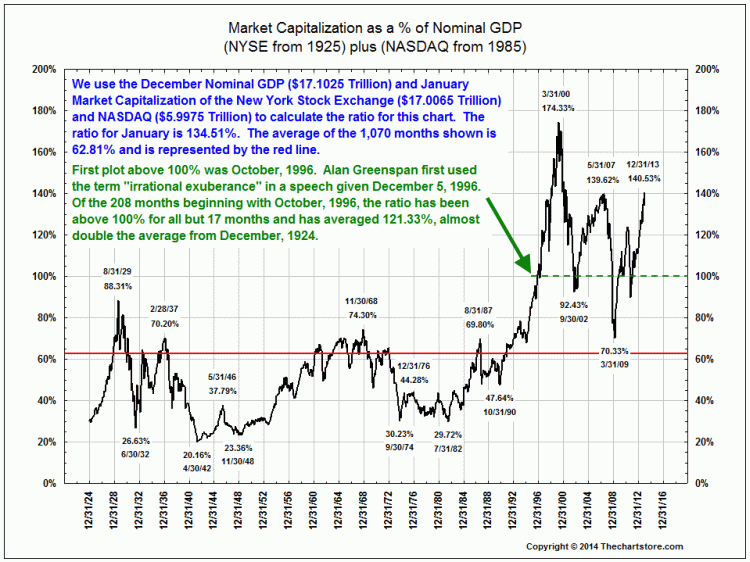
| Buffett’s Favorite Indicator Is Worthless as a Buy/Sell Signal Posted: 27 Feb 2014 03:30 AM PST
Today I am going to make a somewhat nuanced argument about the dangers of indicators and metrics for valuing stocks. Let's use arguably the greatest investor of all time, Warren Buffett, and what he describes as, "probably the best single measure of where valuations stand at any given moment." Buffett’s favorite metric compares the total price of all publicly traded companies to gross domestic product. This metric can also be thought of as a way to judge the valuations for all U.S. companies relative to the total amount of U.S. economic activity. According to Buffett, when the resulting figure is above 100 percent, stocks are overvalued. A Google search for "Warren Buffett’s favorite indicator" will return several million hits and you can find dozens of articles citing the indicator — it is most often used to prove that stocks are pricey. The reality of its meaning is much more complex . . . continues here |
| Americans: Hate big banks, but can’t quit them Posted: 27 Feb 2014 03:00 AM PST
|
| Does the Federal Reserve Staff Still Beat Private Forecasters? Posted: 27 Feb 2014 02:30 AM PST |


| You are subscribed to email updates from The Big Picture To stop receiving these emails, you may unsubscribe now. | Email delivery powered by Google |
| Google Inc., 20 West Kinzie, Chicago IL USA 60610 | |



0 comments:
Post a Comment