


The Big Picture |
- Why Is the Job-Finding Rate Still Low?
- Cosmos with Neil deGrasse Tyson
- 10 Thursday PM Reads
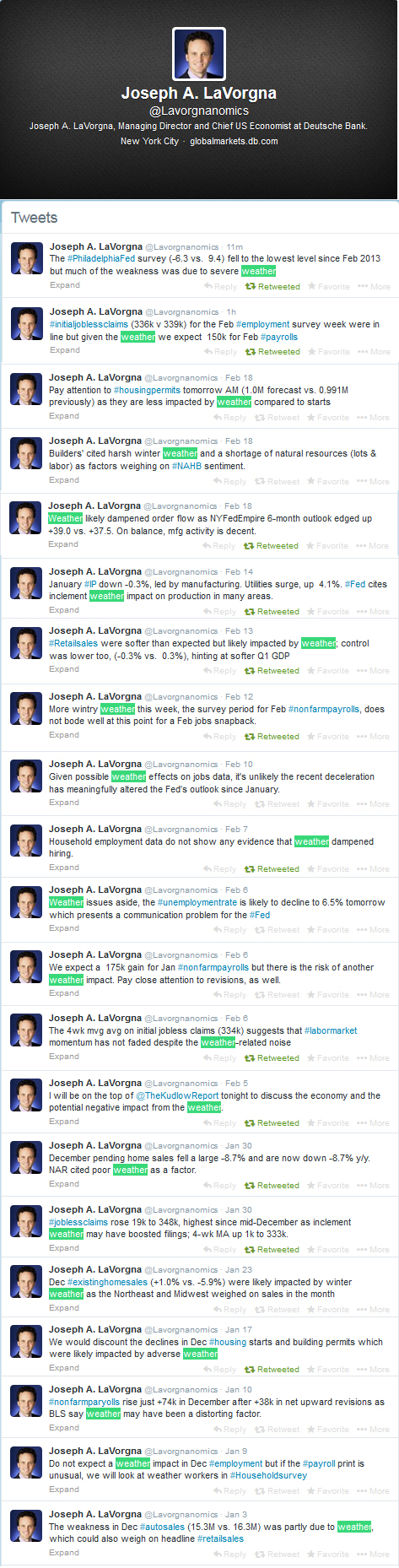
- Blame it on the Weather . . .
- 10 Thursday AM Reads
- Rejoice, For Spring Has Sprung! At Last, the End of Winter is Upon Us
- The Beginning of Everything: The Big Bang
| Why Is the Job-Finding Rate Still Low? Posted: 07 Mar 2014 02:00 AM PST Why Is the Job-Finding Rate Still Low?
Fluctuations in unemployment are mostly driven by fluctuations in the job-finding prospects of unemployed workers—except at the onset of recessions, according to various research papers (see, for example, Shimer [2005, 2012] and Elsby, Hobijn, and Sahin [2010]). With job losses back to their pre-recession levels, the job-finding rate is arguably one of the most important indicators to watch. This rate—defined as the fraction of unemployed workers in a given month who find jobs in the consecutive month—provides a good measure of how easy it is to find jobs in the economy. The chart below presents the job-finding rate starting from 1990. Clearly, the job-finding rate is still substantially below its pre-recession levels, suggesting that it is still difficult for the unemployed to find work. In this post, we explore the underlying reasons behind the low job-finding rate. According to the search and matching theory developed by Diamond, Mortensen, and Pissarides (see, for example, Pissarides [2000], Mortensen and Pissarides [1994], and Diamond [1982]), it is costly for workers and firms to form suitable matches because of the uncoordinated nature of the labor market. Workers must devote considerable time to sending out resumes, contacting job agencies, and interviewing for jobs, and firms must consume resources posting vacancies and recruiting candidates with suitable skills and talents. The process that matches workers to firms is typically summarized by a matching function, which determines the number of jobs formed given the number of vacancies and unemployed workers. According to the matching function, the main determinants of the job-finding rate are the ratio of job openings to the number of unemployed, (v/u), elasticity, α, and the matching efficiency, x: The vacancy-unemployment ratio summarizes demand and supply conditions in the labor market. When there are many job openings per unemployed individual, it is naturally easier to find jobs; conversely, it becomes harder to find jobs when there are many unemployed individuals competing for a small number of job openings. The parameter matching efficiency captures various factors that affect the efficiency of the matching process. An increase in skill or geographic mismatch, a decline in search effort of workers, or a decline in recruiting effort of employers would all lower the matching efficiency in the labor market. The elasticity, α, captures the responsiveness of the job-finding rate to the availability of jobs. As seen in the charts above, both the vacancy-to-unemployment ratio and matching efficiency declined during the Great Recession and have not recovered since. The matching efficiency is constructed under the assumption that the elasticity, α, was unchanged over this period. It is important to understand the contribution of each factor to the recent behavior of the job-finding rate, since the vacancy-to-unemployment ratio reflects labor market conditions, while matching efficiency is a measure of how well the labor market forms new matches. To isolate the contribution of these two factors, we regress the job-finding rate (unemployment-to-employment transition rate) on the vacancy-unemployment ratio using data until November 2007. The chart below shows that this regression captures the pre-recession behavior of the job-finding rate very well. We then use the relationship estimated using pre-recession data to generate predicted values for the job-finding rate starting in December 2007, as indicated by the bar. The predicted job-finding rate is an estimate of what the job-finding rate would be if matching efficiency had remained at its pre-recession level, but vacancies and unemployment had evolved as they did through the recession. As seen below, the actual job-finding rate currently lies below the predicted job-finding rate. However, one can also see that even the predicted job-finding rate still sits at 23.4 percent, significantly below its 2007 average of 27.8 percent. This implies that even if matching efficiency had returned to its pre-recession level and the economy had moved to the predicted line, the job-finding rate would still be significantly below its pre-recession levels. Our calculations suggest that while the efficiency of the U.S. labor market has not yet recovered, the most important factor is still the low vacancy-to-unemployment ratio. Finally, one can ask whether the observed decline in matching efficiency has been more or less pronounced in different sectors of the economy. The charts below examine this question for several representative industries, both in levels and using December 2007 normalized levels as the starting point. The plots show that matching efficiency has experienced declines across the board, with the possible exception of construction, where matching efficiency has returned to something close to December 2007 levels. We conclude that while matching efficiency has declined and remained low in virtually all industries, the most important factor in the low job-finding rate is the persistently low level of vacancies per unemployed. Disclaimer
|
| Cosmos with Neil deGrasse Tyson Posted: 06 Mar 2014 04:30 PM PST COSMOS: A SPACETIME ODYSSEY, the thrilling new 13-part series from EP/writer Ann Druyan and EP Seth MacFarlane, premieres Sunday, March 9 at 9/8c on FOX. Subscribe now for more COSMOS clips See more of Cosmos on our official site |
| Posted: 06 Mar 2014 01:45 PM PST My afternoon train reading:
What are you reading?
Some Companies Alter the Bonus Playbook
|
| Posted: 06 Mar 2014 09:30 AM PST In response to this morning’s Polar Vortex discussion, a friend sends this in:
|
| Posted: 06 Mar 2014 07:00 AM PST Good morning. Some reads to peruse while we wait for the next geopolitical crisis to erupt:
|
| Rejoice, For Spring Has Sprung! At Last, the End of Winter is Upon Us Posted: 06 Mar 2014 06:00 AM PST Polar Vortex be gone! At long last, the end of this terrible winter of discontent is nearing. We can say with some degree of confidence that the light at the end of tunnel is not an oncoming locomotive. Today is very likely to be the pivot day marking the end of this endless season. With temperatures in New York City and its environs in the teens, warmer, sunnier days await. Tomorrow we move into the 40s, the weekend will even see the 50s. Cheer as March ends with higher average temperatures than it began with. Celebrate the Crokus pushing up through the frozen ground. A full run of blossoms begin to tentatively show their selves in April, after hiding for the entire season below ground. Rejoice SAD sufferers – Seasonal Affective Disorder – the clocks will mercifully get nudged forward, bringing an extra hour of daylight into the darkness of our days. The spring equinox is merely 10 days after, and for the next 6 months you can enjoy more sunlight than darkness (weather permitting).
|
| The Beginning of Everything: The Big Bang Posted: 06 Mar 2014 03:00 AM PST Has the universe a beginning or was it here since forever? Well, evidence suggests that there was indeed a starting point to this universe we are part of right now. But how can this be? How can something come from nothing? And what about time? We don’t have all the answers yet so let’s talk about what we know. shared by Philipp Dettmer | published Mar 03, 2014 in Science |


| You are subscribed to email updates from The Big Picture To stop receiving these emails, you may unsubscribe now. | Email delivery powered by Google |
| Google Inc., 20 West Kinzie, Chicago IL USA 60610 | |



0 comments:
Post a Comment