


The Big Picture |
- When and How To Exit Quantitative Easing?
- Wall Street Meddles With Restaurant Chain
- 10 Wednesday PM Reads
- What Happens if the FOMC Gets Too Hawkish?
- California Teachers takes Harvard to School
- 10 Wednesday AM Reads
- Business Cycle Index
| When and How To Exit Quantitative Easing? Posted: 18 Sep 2014 02:00 AM PDT
|
| Wall Street Meddles With Restaurant Chain Posted: 17 Sep 2014 06:30 PM PDT |
| Posted: 17 Sep 2014 02:15 PM PDT My afternoon train reads:
What are you reading?
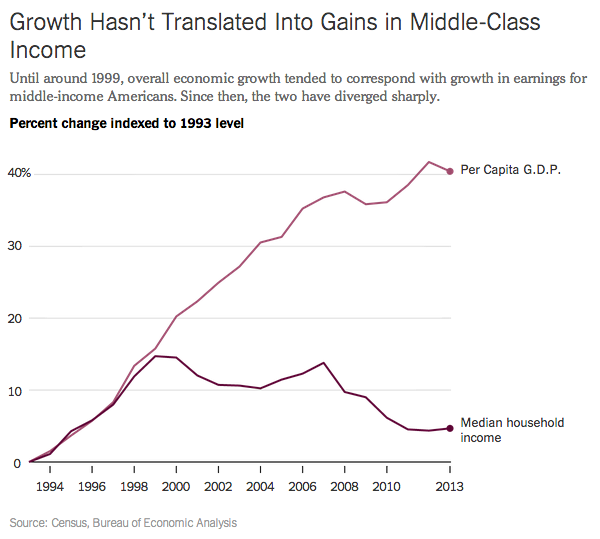
You Can’t Feed a Family With GDP
|
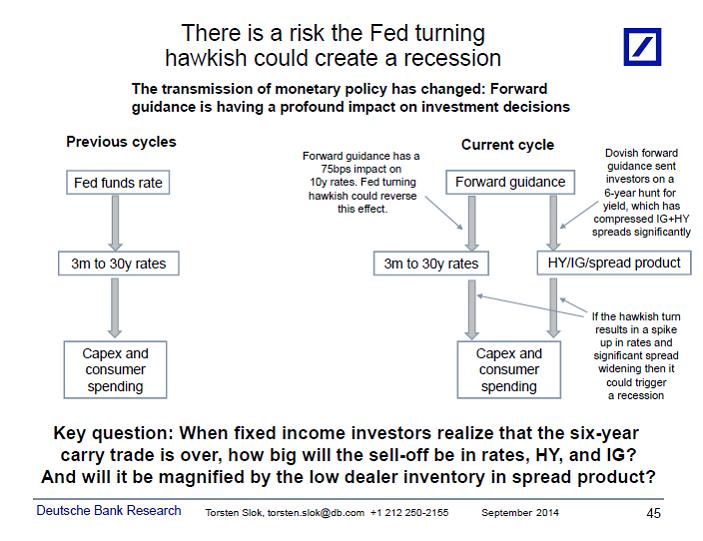
| What Happens if the FOMC Gets Too Hawkish? Posted: 17 Sep 2014 10:30 AM PDT
Source: Deutsche Bank Securities
Torsten Slok, chief international economist for Deutsche Bank AG, warns about the hawks on the Federal Open Market Committee getting too, well, hawkish. The flowchart above shows the different transmission mechanisms of monetary policy. Slok uses it to highlight the widening spread between investment-grade and high-yield junk bonds. If and when investors decide that the Fed's extraordinary accommodation is ending, a bond selloff could occur. Such a sell-off might affect consumer spending and corporate capital expenditure. According to Slok, if the selloff is large enough in various fixed-income markets, it might even cause a recession. The FOMC announcement comes today at 2:00 p.m. (Washington time). |
| California Teachers takes Harvard to School Posted: 17 Sep 2014 08:30 AM PDT For a long time, the fund managers at Yale's endowment were the industry’s gold standard. Inevitably, as in so many things Ivy, this was noticed by rival Harvard. The so-called Yale Model, developed by David Swensen and his colleague Dean Takahashi, was rich with alternative investments, private equity, commodities and real estate and other items that weren’t plain vanilla stock and bond investments. The success of the Yale Model led to lots of copycats. The problem was that other schools could duplicate the look, but not quite the feel of Yale’s endowment investments, but without Swensen’s unique talents. He even wrote a book explaining how to be like Yale's endowment titled, “Pioneering Portfolio Management: An Unconventional Approach to Institutional Investment.” For a while, Harvard came close to matching Yale’s success. It had a worthy rival for Swensen in investment chief Jack Meyer. At one point, Harvard Management Co. was throwing off superior returns. Fortune observed that the "120 or so people who work there are masters of short-term trading, initiating as many as 250,000 transactions a year. Their bets have often focused on undervalued situations and arbitrage opportunities in global stock and bond markets." But as Fortune reported in 2005, Meyer was paid more than $7 million dollars a year — seven times what Swensen was making. Paying successful managers handsomely looked justifiable. But it ran up against certain notions of Ivy League decorum. The negative perception of a richly compensated managerial team led to the sort of touchy-feely academic posturing that most of us in the real world find silly. Offended by the high cost of this talented team of managers, the brain trust that is the Harvard professorial class, with encouragement from alumni, forced changes that ultimately worked to the detriment of the endowment — and the university as a whole.
|
| Posted: 17 Sep 2014 05:00 AM PDT Its FOMC day — perhaps the first one in a long time where the outcome is not preordained. Until 2pm, some reads to keep you informed and entertained:
|
| Posted: 17 Sep 2014 03:00 AM PDT Interesting trio of charts from Russell showing the Business Cycle Index (BCI). The goal of the BCI is to forecast the strength of economic expansion or recession in the coming months, along with forecasts for other prominent economic measures. How well it does that is a subject of debate. Inputs to the model include non-farm payroll, core inflation (without food and energy), the slope of the yield curve, and the yield spreads between Aaa and Baa corporate bonds and between commercial paper and Treasury bills. A different choice of financial and macroeconomic data would affect the resulting business cycle index and forecasts.
Source: Russell Investments |


| You are subscribed to email updates from The Big Picture To stop receiving these emails, you may unsubscribe now. | Email delivery powered by Google |
| Google Inc., 20 West Kinzie, Chicago IL USA 60610 | |



0 comments:
Post a Comment