


The Big Picture |
- Why the Fed Is So Wimpy
- 10 Wednesday PM Reads
- The Carbon Map
- Big Gains for the 1 Percent’s 1 Percent
- How Credit Came to Rule – and Ruin – Our Economy
- 10 Wednesday AM Reads
- Declining Homeownership among “Prime” First-Time Home Buying Candidates
| Posted: 02 Oct 2014 02:00 AM PDT Why the Fed Is So Wimpy
Another in what seems to be a small parade of scandals involving secretly recorded tapes of Federal Reserve regulators emerged last week. What a number of writers (including me) have written about regulatory capture over the past decade was brought out into the open, at least for a while. My brilliant young friend (40 seems young to me now) Justin Fox, editorial director of the Harvard Business Review and business and economic columnist for Time magazine, published a thoughtful essay this week, outlining some of the issues surrounding the whole concept of banking regulations. Yes, the latest scandal involved Goldman Sachs, and it took place in the US, but do you really think it's much different in Europe or Japan? Actually, there are those who argue that it's worse in those places. This does not bode well for what happens during the next crisis (and there is always a next crisis, hopefully far in the future, though they do seem to come more frequently lately). Writes Justin: The point here is that if bank regulators are captives who identify with the interests of the banks they regulate, it is partly by design. This is especially true of the Federal Reserve System, which was created by Congress in 1913 more as a friend to and creature of the banks than as a watchdog. Two-thirds of the board that governs the New York Fed is chosen by local bankers. And while amendments to the Federal Reserve Act in 1933 shifted the balance of power in the Federal Reserve System from the regional Federal Reserve Banks (and the New York Fed in particular) to the political appointees on the Board of Governors in Washington, bank regulation continues to reside at the regional banks. Which means that the bank regulators' bosses report to a board chosen by … the banks. For those who would like a bit more bearish meat, I offer you a link to John Hussman's latest piece, "The Ingredients of a Market Crash." I'm in Washington DC today at a conference sponsored by an association of endowments and foundations. They have a rather impressive roster of speakers, so I have found myself attending more sessions than I normally do at conferences. Martin Wolf and David Petraeus headline a very thoughtful group of managers and economists, accompanied by an assortment of geopolitical wizards. I've learned a lot. No follow-on note today. I need to get back to my classroom education… Your loving the fall weather analyst, John Mauldin, Editor ~~~~~~~~~~~
Why the Fed Is So Wimpy By Justin Fox
Regulatory capture – when regulators come to act mainly in the interest of the industries they regulate – is a phenomenon that economists, political scientists, and legal scholars have been writing about for decades. Bank regulators in particular have been depicted as captives for years, and have even taken to describing themselves as such. Actually witnessing capture in the wild is different, though, and the new This American Life episode with secret recordings of bank examiners at the Federal Reserve Bank of New York going about their jobs is going to focus a lot more attention on the phenomenon. It's really well done, and you should listen to it, read the transcript, and/or read the story by ProPublica reporter Jake Bernstein. Still, there is some context that's inevitably missing, and as a former banking-regulation reporter for the American Banker, I feel called to fill some of it in. Much of it has to do with the structure of bank regulation in the U.S., which actually seems designed to encourage capture. But to start, there are a couple of revelations about Goldman Sachs in the story that are treated as smoking guns. One seems to have fired a blank, while the other may be even more explosive than it's made out to be. In the first, Carmen Segarra, the former Fed bank examiner who made the tapes, tells of a Goldman Sachs executive saying in a meeting that "once clients were wealthy enough, certain consumer laws didn't apply to them." Far from being a shocking admission, this is actually a pretty fair summary of American securities law. According to the Securities and Exchange Commission's "accredited investor" guidelines, an individual with a net worth of more than $1 million or an income of more than $200,000 is exempt from many of the investor-protection rules that apply to people with less money. That's why rich people can invest in hedge funds while, for the most part, regular folks can't. Maybe there were some incriminating details behind the Goldman executive's statement that alarmed Segarra and were left out of the story, but on the face of it there's nothing to see here. The other smoking gun is that Segarra pushed for a tough Fed line on Goldman's lack of a substantive conflict of interest policy, and was rebuffed by her boss. This is a big deal, and for much more than the legal/compliance reasons discussed in the piece. That's because, for the past two decades or so, not having a substantive conflict of interest policy has been Goldman's business model. Representing both sides in mergers, betting alongside and against clients, and exploiting its informational edge wherever possible is simply how the firm makes its money. Forcing it to sharply reduce these conflicts would be potentially devastating. Maybe, as a matter of policy, the United States government should ban such behavior. But asking bank examiners at the New York Fed to take an action on their own that might torpedo a leading bank's profits is an awfully tall order. The regulators at the Fed and their counterparts at the Office of the Comptroller of the Currency and the Federal Deposit Insurance Corporation correctly see their main job as ensuring the safety and soundness of the banking system. Over the decades, consumer protections and other rules have been added to their purview, but safety and soundness have remained paramount. Profitable banks are generally safer and sounder than unprofitable ones. So bank regulators are understandably wary of doing anything that might cut into profits. The point here is that if bank regulators are captives who identify with the interests of the banks they regulate, it is partly by design. This is especially true of the Federal Reserve System, which was created by Congress in 1913 more as a friend to and creature of the banks than as a watchdog. Two-thirds of the board that governs the New York Fed is chosen by local bankers. And while amendments to the Federal Reserve Act in 1933 shifted the balance of power in the Federal Reserve System from the regional Federal Reserve Banks (and the New York Fed in particular) to the political appointees on the Board of Governors in Washington, bank regulation continues to reside at the regional banks. Which means that the bank regulators' bosses report to a board chosen by … the banks. Then there's the fact that Goldman Sachs is a relative newcomer to Federal Reserve supervision – it and rival Morgan Stanley only agreed to become bank holding companies, giving them access to New York Fed loans, at the height of the financial crisis in 2008. While it's a little hard to imagine Goldman choosing now to rejoin the ranks of mere securities firms, and even harder to see how it could leap to a different banking regulator, it is possible that some Fed examiners are afraid of scaring it away. All this is meant not to excuse the extreme timidity apparent in the Fed tapes, but to explain why it's been so hard for the New York Fed to adopt the more aggressive, questioning approach urged by Columbia Business School Professor David Beim in a formerly confidential internal Fed report that This American Life and ProPublica give a lot of play to. Bank regulation springs from much different roots than, say, environmental regulation. So what is to be done? A lot of the classic regulatory capture literature tends toward the conclusion that we should just give up – shut down the regulators and allow competitive forces to work their magic. That means letting businesses fail. But with banks more than other businesses, failures tend to be contagious. It was to counteract this risk of systemic failure that Congress created the Fed and other bank regulators in the first place, and even if you think that was a big mistake, they're really not going away. More recently, there's been a concerted effort to take a more nuanced view of regulatory capture and how to counteract it. The recent Tobin Project book, Preventing Regulatory Capture: Special Interest Influence and How to Limit It, sums up much of this thinking. While I've read parts of it before, I only downloaded the full book an hour ago, so I'm not going to pretend to be able to sum it up here. But here's a thought – maybe if banking laws and regulations were simpler and more straightforward, the bank examiners at the Fed and elsewhere wouldn't so often be in the position of making judgment calls that favor the banks they oversee. Then again, the people who write banking laws and regulations are not exactly immune from capture themselves. This won't be an easy thing to fix. update: The initial version of this piece listed the Office of Thrift Supervision as one of the nation's bank regulators. As David Dayen pointed out (and I swear I knew at some point, but had totally forgotten), it was subsumed by the OCC in 2011. ~~~ Justin Fox is Executive Editor, New York, of the Harvard Business Review Group and author of The Myth of the Rational Market. Follow him on Twitter @foxjust. |
| Posted: 01 Oct 2014 02:30 PM PDT My afternoon train reads:
What are you reading?
The Wage Stagnation Myth
|
| Posted: 01 Oct 2014 12:30 PM PDT Click for a pretty cool and interactive video infographic. |
| Big Gains for the 1 Percent’s 1 Percent Posted: 01 Oct 2014 10:00 AM PDT
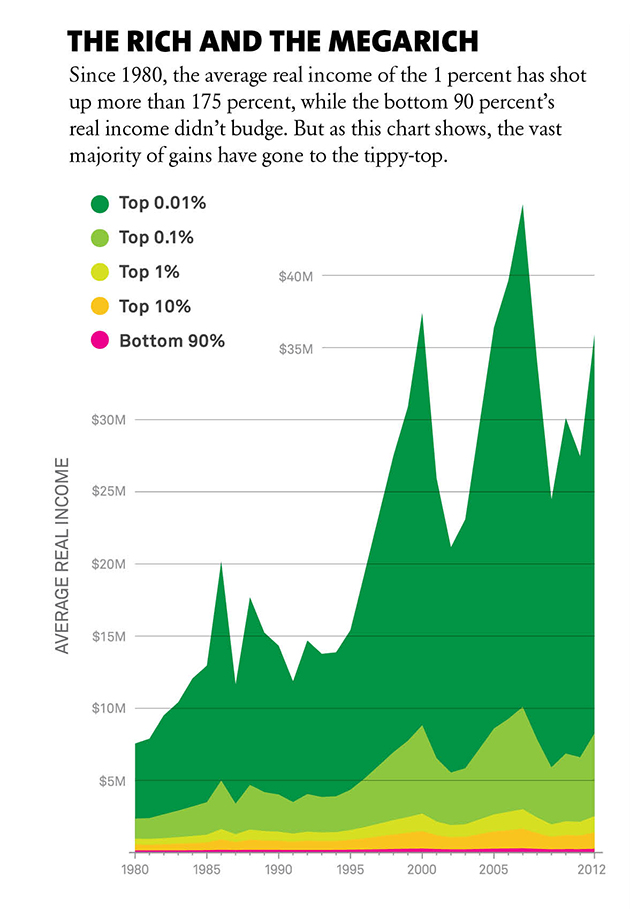
Last time we looked at this subject, we noted that There's Rich, Then There’s the 0.01%. Since then, the disparity between rich and poor, as well as the rich and the really rich have widened further. As the chart above shows, the gap between the bottom 90% (in pink) and the top 1% (in light green) has expanded. But that differential is dwarfed by the changes between the top 0.01% – naturally shown in the dark green color of money – and everyone else. Using data from Berkeley's Economics professor Emmanuel Saez as well as the data that Thomas Piketty made available. |
| How Credit Came to Rule – and Ruin – Our Economy Posted: 01 Oct 2014 07:30 AM PDT On this day 56 years ago, the U.S. economy began to undergo a momentous change. It was Oct. 1, 1958, and the company known best for its Travelers Cheques introduced a new product: The charge card. Although American Express technically wasn’t the first company to introduce a charge card, it was the first to make its cards ubiquitous, and in the process changed the concept of where and how credit could be used. The nation hasn’t been the same since From those humble beginnings, the use of credit spread throughout the county. The Depression-era generation was loath to become indebted to any bank or lender after seeing what could happen in a credit crisis. It’s no coincidence that the widespread use of credit didn’t occur until a new generation came of age. Along with that new generation came the birth of the suburban bedroom community. Homes were bought with mortgages and furnished with revolving debt. Cars purchased with dealer financing were the glue that held the edifice together. All of these items were out of reach for the average family, unless purchased with credit. This is no small matter. As you can see from the Federal Reserve's most recent Flow of Funds report, the total indebtedness of U.S. households is a staggering $14 trillion dollars. What makes the unstoppable rise of credit so significant is the role it played in the 2007-09 financial crisis, and the subsequent recovery. Credit crunches are different from ordinary recessions. Not only are they more severe, as Carmen Reinhart and Ken Rogoff have documented in “This Time Is Different: Eight Centuries of Financial Folly,” but their character is significantly different. Consider an ordinary recession . . . continues here
|
| Posted: 01 Oct 2014 04:30 AM PDT Welcome to October — my favorite month! We do occasionally have some (ahem) disruptions in the markets, it is the transitional period from September, the worst month to the best 6 months of the year. Read all about it:
|
| Declining Homeownership among “Prime” First-Time Home Buying Candidates Posted: 01 Oct 2014 03:00 AM PDT |

| You are subscribed to email updates from The Big Picture To stop receiving these emails, you may unsubscribe now. | Email delivery powered by Google |
| Google Inc., 20 West Kinzie, Chicago IL USA 60610 | |



0 comments:
Post a Comment