.

{2} GoogleTranslate (H)

English French German Spanish Italian Dutch Russian Portuguese Japanese Korean Arabic Chinese Simplified

Our New Stuff

{3} up AdBrite + eToro

Your Ad Here

Monday, December 15, 2014

The Big Picture

The Big Picture


IMF: An Overview of Macroprudential Policy Tools

Posted: 15 Dec 2014 02:00 AM PST

From IMF: "An Overview of Macroprudential Policy Tools":

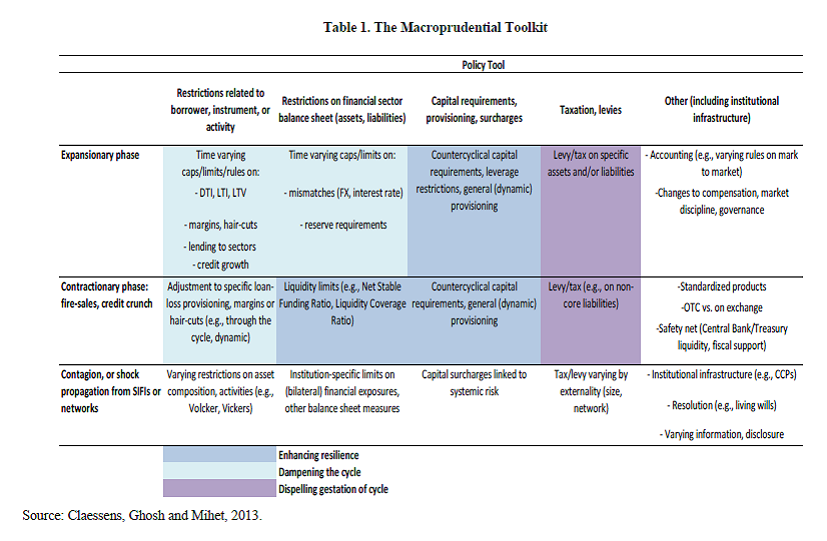
Macroprudential policies – caps on loan to value ratios, limits on credit growth and other balance sheets restrictions, (countercyclical) capital and reserve requirements and surcharges, and Pigouvian levies – have become part of the policy paradigm in emerging markets and advanced countries alike.

A long-standing puzzle in international finance is the durability of the dollar's share of foreign exchange reserves – which remains above 60%, while the weight of the US economy in global output has fallen to less than a quarter. We argue that the dollar's role may reflect instead the share of global output produced in countries with relatively stable dollar exchange rates – the "dollar zone". If a currency varies less against the dollar than against other major currencies, then a reserve portfolio with a substantial dollar share poses less risk when returns are measured in domestic currency. Time series and cross-sectional evidence supports the link between currency movements and the currency composition of reserves.

Source: IMF: "An Overview of Macroprudential Policy Tools"

New Evidence: US Government Intentionally Lied Us Into Iraq War

Posted: 14 Dec 2014 05:00 PM PST

Alleged Meeting Between 9/11 Hijacker and Iraqi Official Was Debunked by U.S. Intelligence Agencies Before It Was Trumpeted As War Justification … U.S. Pressured Czech Government to Lie

There is extensive evidence that the U.S. government intentionally lied us into the Iraq war.

Here's a quick refresher:

  • Pulitzer prize-winning journalist Ron Suskind reported that the White House ordered the CIA to forge and backdate a document falsely linking Iraq with Muslim terrorists and 9/11 … and that the CIA complied with those instructions and in fact created the forgery, which was then used to justify war against Iraq. And see this

The chairman of the Senate Armed Services Committee (Carl Levin) provided a new piece of evidence this week:

Bush administration officials misled the nation in advance of the Iraq War ….

Levin will introduce a letter he received from CIA Director John Brennan, declassifying for the first time some details of a March 2003 CIA cable warning the Bush administration against references to the allegation that Mohammad Atta, the leader of the 9/11 hijackers, had met before the attacks in Prague, Czech Republic, with an Iraqi intelligence officer. He also introduced a translated excerpt from a book by the former head of Czech counterintelligence, describing U.S. pressure to confirm that the meeting took place. In fact, no such meeting occurred. And he called on Brennan to fully declassify the CIA cable.

***

On March 6, 2003, just two weeks before U.S. troops would cross the Iraqi border, President Bush held a prime-time televised press conference. In that press conference he mentioned the Sept. 11, 2001, terror attacks eight times, often in the same breath as Iraqi dictator Saddam Hussein. There was a concerted campaign on the part of the Bush administration to connect Iraq in the public mind with the horror of the Sept. 11 attacks. That campaign succeeded. According to public polls in the week before the Iraq war, half or more of Americans believed Saddam was directly involved in the attacks. One poll taken in September 2003, six months after we invaded Iraq, found that nearly 70 percent of Americans believed it likely that Saddam Hussein was personally involved in the Sept. 11 attacks. Americans who believed in a link between Iraq and 9/11 overwhelmingly supported the idea of invading Iraq. Of course, connections between Saddam and 9/11 or al Qaeda were fiction.

America's intelligence community was pressed to participate in the administration's media campaign. Just a week after the President's prime-time press conference, on March 13, 2003, CIA field staff sent a cable to CIA headquarters, responding to a request for information about a report that Mohammad Atta, the leader of the Sept. 11 hijackings, had met in 2001 with an Iraqi intelligence official in the Czech capital of Prague. In stark terms, this CIA cable from the field warned against U.S. government officials citing the report of the alleged Prague meeting.

Yet the notion of such a meeting was a centerpiece of the administration's campaign to create an impression in the public mind that Saddam was in league with the al Qaeda terrorists who attacked us on 9/11. On multiple occasions, including national television appearances, Vice President Dick Cheney cited reports of the meeting, at one point calling it "pretty well confirmed." Officials from Donald Rumsfeld's Pentagon, who set up a sort of rogue intelligence analysis operation, briefed senior officials with a presentation citing the Prague meeting as a "known contact" between Iraq and al Qaida.

***

Here is what the Vice President said on December 9, 2001, in an interview on "Meet the Press:" "It's been pretty well confirmed that he [Atta] did go to Prague and he did meet with a senior official of the Iraqi intelligence service in Czechoslovakia last April, several months before the attack."

Far from "pretty well confirmed," there was almost no evidence that such a meeting took place. Just a single unsubstantiated report, from a single source, and a mountain of information indicating there was no such meeting, including the fact that travel and other records indicated that Atta was almost certainly in the United States at the time of the purported meeting in Prague.

It was highly irresponsible for the Vice President to make that claim. Calling a single, unconfirmed report from a single source "pretty well confirmed," as he did on Dec. 9, 2001, was a reckless statement to make on such a grave topic as war, in the face of overwhelming doubt that such a meeting occurred.

Yet Vice President Cheney's reckless statements continued, even as evidence mounted that there was no Prague meeting.

***

The Vice President made those statements in the face of a July 2002 Defense Intelligence Agency analysis, which reported that there was no evidence that Atta was in the Czech Republic at the time. He made those statements despite a Defense Intelligence Agency memorandum in August 2002 rejecting the claims by a rogue intelligence analysis shop at the Pentagon that the meeting was an example of a "known contact" between Iraq and al Qaida.

***

Tenet writes in his memoir that he had to object to the President that the speech went "way beyond what the intelligence shows. We cannot support the speech and it should not be given."

***

The [recent] letter [from CIA director Brennan] contains no indication that he had asked the Czech government for its view, as he committed to do. But Director Brennan's letter includes, and therefore finally declassifies, this very clear statement from the cable: "[T]here is not one USG [counterterrorism] or FBI expert that … has said they have evidence or 'know' that [Atta] was indeed [in Prague]. In fact, the analysis has been quite the opposite.

Again, that cable was sent to CIA headquarters on March 13, 2003 – a week before our invasion of Iraq. But the Vice President of the United States, Dick Cheney, continued to suggest the meeting may have taken place.

***

There is a second recent revelation about how the "Prague meeting" progressed from unsubstantiated report to justification for war. It comes from Jiri Ruzek, who headed the Czech counterintelligence service on and after 9/11. Mr. Ruzek published a memoir earlier this year, which we have had translated from Czech. It recounts the days after the terror attack, including how his nation's intelligence services first reported a single-source rumor of a Prague meeting between Atta and al-Ani, how CIA officials under pressure from CIA headquarters in turn pressured him to substantiate the rumor, and how U.S. officials pressured the Czech government when Czech intelligence officials failed to produce the confirmation that the Bush administration sought.

Mr. Ruzek writes, "It was becoming more and more clear that we had not met expectations and did not provide the 'right' intelligence output." Mr. Ruzek goes on: "The Americans showed me that anything can be violated, including the rules that they themselves taught us. Without any regard to us, they used our intelligence information for propaganda press leaks. They wanted to mine certainty from unconfirmed suspicion and use it as an excuse for military action. We were supposed to play the role of useful idiot thanks to whose initiative a war would be started."

Oil As A Weapon

Posted: 14 Dec 2014 12:00 PM PST

Art Cashin of UBS shares the following observations from Don Coxe this past week. I thought it was interesting, and wanted to pass it along:

“The incomparable Don Coxe, one of the very best observers and analysts of global commodities recently wrote this:

Most observers thought the Organization of Petroleum Exporting Countries (OPEC) would cut its production to protect its members' incomes and slash frackers' profits. If these were ordinary times in the Mideast, that forecast would have been accurate.
But this has been a year of major geopolitical crises in the region, and the Sunni Arab oil states have found themselves facing grim challenges.

By October, it was becoming clear to us and others that Saudi Arabia and its Gulf Emirate allies could not afford to continue petro-pricing business as usual with sectarian wars exploding out of control, threatening the entire region.

In particular, they were infuriated that the Shia regime in Syria was being propped up by Iran and Russia. Moreover, Iran seemed to be getting closer to becoming a nuclear power with each month. Amid the chaos, the Islamic State terrorists had suddenly become a formidable challenge to the entire region, and they were getting increasing revenues from oil properties they had seized.

The Saudis had long since concluded that U.S. President Barack Obama was a weak reed – at best. So, we believe they felt forced to stop the cash flows to Syria, Iran and the Islamic State and deter Russia. They decided to keep pumping oil, allegedly to fight fracking, but also to weaken their regional foes.

No one knows how long this strategy will continue. The Gulf States have trillions in sovereign wealth funds to back their budgets.”

Fascinating stuff. Thanks, Art.

Barron’s: “My Favorite Bloggers”

Posted: 14 Dec 2014 06:30 AM PST

barrons logo


Some kind words about your humble scribe in this week’s Barron’s:

“But investors also need a top-down perspective on global economics and market mechanics from those with access to the powerful and/or influential. Two of my favorites are Nouriel Roubini and Barry Ritholtz, both seasoned market observers, well schooled in accounting, statistics, and other disciplines needed to unravel the intersections between government policies, economics, and stocks. In other words, they deliver the big picture, which happens to be the name of Ritholtz's free blog (ritholtz.com/blog).

About 400,000 visitors a month read and/or watch Ritholtz holding forth on everything from trading opportunities to macro economics. They include money managers, economists, and politicos, he says, but also "mom-and-pop investors."

mfbRitholtz's own eclectic background in math, science, and the social sciences has taken him into several professions. He spent several years as a practicing attorney, many more as a stock trader, and finally, as chief executive of quantitative research house FusionIQ (fusioniqrank.com). He left that job in 2013 to start Ritholtz Wealth Management, a financial-planning firm with more than $175 million in assets under management.

The Big Picture started pre-Internet when, as a trader, Ritholtz wrote a daily report commenting on everything from quantitative to behavioral economics. A contributor to many financial journals—most recently, Bloomberg View—Ritholtz has never been accused of being politically correct or even politic. Witness his articles at ritholtz.com on the $1.5 billion Pimco bonus pool, or at bloombergview.com on the "all-weather portfolio" promulgated by self-help guru Tony Robbins.

"We manage money for a living, and there is no such thing as an all-weather portfolio for every investor," says Ritholtz, who was one of those who warned—in print—of the impending crash of 2008.”

What a delight and honor to be featured in Barron’s. Thank you for the kind words!


Source:
My Favorite Bloggers
Mike Hogan
Barron’s December 12, 2014 11:56 p.m. ET  
http://online.barrons.com/articles/the-blogs-of-nouriel-roubini-and-barry-ritholtz-1418446566

10 Sunday Reads

Posted: 14 Dec 2014 04:00 AM PST

My morning afternoon train reads:

• This Week Was A Stark Reminder Of How Fast Good Stock Markets Can Turn Bad (Business Insider) but see It's the waiting part that's hard (Above the Market)
• ‘My seven biggest investment regrets’ (Telegraph)
• 122 Things Everyone Should Know About Investing and the Economy (Fool)
• Some Cheerful Signs in the Labor Market, Even for Those Not Now Looking  (NYT)
• The spending bill includes a huge insurance industry giveaway too (Mother Jones) see also Insurers Use Deals to Avoid as Much as $100 Billion in Taxes (DealBook)
• Silicon Valley might kill banks but not banking (FT Alphaville)
• What to Do If You're Smarter than Your Boss (Harvard Business Review)
• Google Street View blurs all of the Beatles’ faces—except one (Daily Dot)
• There's No Way Bush and Cheney Didn't Know What the CIA Was Doing (Slate) see also Bush ‘fully informed’ of CIA methods (BBC)
• Jon Pareles's Favorite Albums and Songs of 2014 (NYT)

What are you reading?


Pinpointing Part of Brain That Triggers Addiction

Source: Drug, Discovery, and Development


.

0 comments:

Post a Comment

previous home Next

{8} chatroll


{9} AdBrite FOOTER

{8} Nice Blogs (Adgetize)