


The Big Picture |

- Senate Report: JP Morgan Chase Whale Trades
- Jaw-Dropping Crimes of the Big Banks
- JPMorgan: MF Global-like Segregation of Client Funds
- 10 Thursday PM Reads
- Sentiment Getting Frothy
- Should Insurance Regulators Handle Derivatives?
- Josh Rosner’s JPM Analysis
- 10 Thursday AM Reads
- The Fed’s Exit
- JPMorgan: LONDON CALLING
- Plight of the Laysan Albatross: Midway Film
- Investing/Trading Rules, Aphorisms & Books (Spring 2013)
| Senate Report: JP Morgan Chase Whale Trades Posted: 15 Mar 2013 03:00 AM PDT  |
| Jaw-Dropping Crimes of the Big Banks Posted: 14 Mar 2013 10:30 PM PDT
Preface: Not all banks are criminal enterprises. The wrongdoing of a particular bank cannot be attributed to other banks without proof. But – as documented below – many of the biggest banks have engaged in unimaginably bad behavior. You Won't Believe What They've Done …Here are just some of the improprieties by big banks:
The executives of the big banks invariably pretend that the hanky-panky was only committed by a couple of low-level rogue employees. But studies show that most of the fraud is committed by management. Indeed, one of the world's top fraud experts – professor of law and economics, and former senior S&L regulator Bill Black – says that most financial fraud is "control fraud", where the people who own the banks are the ones who implement systemic fraud. See this, this and this. Even the bank with the reputation as being the "best managed bank" in the U.S., JP Morgan, has engaged in massive fraud. For example, the Senate's Permanent Subcommittee on Investigations released a report today quoting an examiner at the Office of Comptroller of the Currency – JPMorgan's regulator – saying he felt the bank had "lied to" and "deceived" the agency over the question of whether the bank had mismarked its books to hide the extent of losses. And Joshua Rosner – noted bond analyst, and Managing Director at independent research consultancy Graham Fisher & Co – notes that JP Morgan had many similar anti money laundering laws violations as HSBC, failed to segregate accounts a la MF Global, and paid almost 12% of its 2009-12 net income on regulatory and legal settlements. But at least the big banks do good things for society, like loaning money to Main Street, right? Actually:
We can almost understand why Thomas Jefferson warned:
John Adams said:
And Lord Acton argued:
No wonder a stunning list of prominent economists, financial experts and bankers say we need to break up the big banks.  |
| JPMorgan: MF Global-like Segregation of Client Funds Posted: 14 Mar 2013 04:30 PM PDT Josh Rosner ( This is part 5 of 5; Yesterday evening, we published the Introduction. We will be releasing a different part each evening and morning culminating in the release of Rosner's complete report on Friday morning. On that date, the Senate Permanent Subcommittee on Investigations will release their final report on JPM's CIO Group (aka the London Whale). Prior installments are here: Intro, part 2 part 3, and part 4. ~~~ Segregation of Client Funds JPMorgan's handling of customer monies should be another cause for concern. The Company's executives and its Board have repeatedly failed to address ongoing problems and have exposed shareholders to the costs associated with repeated fines. The problems appear only to come to light only after being discovered as a result of customer problems but, once discovered the Firm is routinely permitted, without admitting wrongdoing, to make an offer for civil settlement. These offers are accepted on the expectation that internal control violations will be remedied and, as a result, matters that might otherwise have potentially led to criminal charges are settled for fines. On September 9, 2009, the CFTC sanctioned JPMorgan for failing to properly segregate customer funds and for failing to report these "under-segregations" on a timely basis[i]. The CFTC accepted JPMorgan's offer of settlement without requiring the Company to either admit or deny wrongdoing, as a result the firm was able to avoid an administrative proceeding that could have uncovered more regulatory and legal violations. This matter relates to activities that occurred between May and June 2007 but it is unknown if this was the entirety of the period of violations or if it was only the period the regulator chose to identify. According to the CFTC, JPM failed to segregate $725 million of its own money from a $9.6 billion account. The CFTC cited numerous violations resulting from "under segregation", "untimely computation of segregation", "untimely notification of under segregation" and "failures to supervise". The Company was allowed to settle for $300,000. In June 2010, in demonstration that the failures to segregated funds that the CFTC had settled were not isolated occurrences, the British Financial Services Authority fined JPMorgan a record 33.32 million British pounds for failing to "adequately protect between $1.9 billion and $23 billion of client money between November 2002 and July 2009."[ii] In this instance, the FSA determined that the error remained undetected for nearly seven years". On April 4, 2012, JPM was again found, by the CFTC, to be in violation of segregation rules. Once again, to avoid administrative proceedings in the face of findings of violations of law, the Company made an offer of settlement that the CFTC accepted without requiring the Company to admit or deny wrongdoing. The Company was fined $20 million in civil money penalties and, once again, directed to remedy control problems[iii]. As in prior instances the firm’s internal controls were inadequate and failed to discover these violations before a problem arose. The CFTC found that from at least November 2006 though September 2008, JPM accepted deposits of customer funds from Lehman Brothers, Inc. In violation of law JPMorgan extended credit to Lehman Brothers for 22 months based on these customer funds because JPM determined, wrongfully, those funds were to be included in Lehman Brothers net free equity. After the bankruptcy of Lehman Brothers, again in violation of law, JPMorgan refused repeated requests by the Trustee and the Commission to release those Lehman customer funds to the Trustee of Lehman's estate. While there have been no findings against JPMorgan, ongoing legal wrangling by the Company seems to offer some basis to believe that similar problems in the segregation of funds may have also occurred related to the failure of Peregrine Financial[iv] and MF Global[v].
[i]http://www.cftc.gov/ucm/groups/public/@lrenforcementactions/documents/legalpleading/enfjpmorganorder09092009.pdf Instituting Proceedings Pursuant to 6(c) and 6(d) of the Commodity Exchange Actand Making Findings and Impossing Remidial Sanctions.” Last modified 2009. http://www.cftc.gov/ucm/groups/public/@lrenforcementactions/documents/legalpleading/enfjpmorganorder09092009.pdf . [ii] http://www.reuters.com/article/2010/06/03/us-britain-fine-jpmorgan-idUSTRE6521J520100603 Ridley, Kirstin. “UK fines JPMorgan record $49 million.” Reuters, June 3, 2010. http://www.reuters.com/article/2010/06/03/us-britain-fine-jpmorgan-idUSTRE6521J520100603. [iii]http://www.cftc.gov/ucm/groups/public/@lrenforcementactions/documents/legalpleading/enfjpmorganorder040412.pdf Commodities Future Trading Commission. “Instituting Proceedings Pursuant to 6(c) and 6(d) of the Commodity Exchange Actand Making Findings and Impossing Remidial Sanctions.” Last modified 2012. [iv] http://observer.com/2012/08/jpmorgan-would-prefer-peregrine-financial-group-trustee-not-subpoena-jamie-dimon/ and http://www.huffingtonpost.com/2012/07/12/pfg-customer-account-jpmorgan-chase_n_1668386.html Clark, Patrick. “JPMorgan Would Prefer Peregrine Financial Group Trustee Not Subpoena Jamie Dimon.” New York Observer, August 6, 2012. http://observer.com/2012/08/jpmorgan-would-prefer-peregrine-financial-group-trustee-not-subpoena-jamie-dimon/. Gongloff, Mark. “In PFG Scandal, JPMorgan Chase Had Surprising Role: It Held Customer Accounts.” Huffington Post, July 12, 2012. http://www.huffingtonpost.com/2012/07/12/pfg-customer-account-jpmorgan-chase_n_1668386.html . [v] http://www.forbes.com/sites/halahtouryalai/2012/06/04/jpmorgans-other-messy-problem-mf-globals-missing-money/ Touryalai, Halah. “JPMorgan’s Other Messy Problem: MF Global’s Missing Money.” Forbes, June 4, 2012. http://www.forbes.com/sites/halahtouryalai/2012/06/04/jpmorgans-other-messy-problem-mf-globals-missing-money/ .  |
| Posted: 14 Mar 2013 01:30 PM PDT My afternoon train reading:
What are you reading?
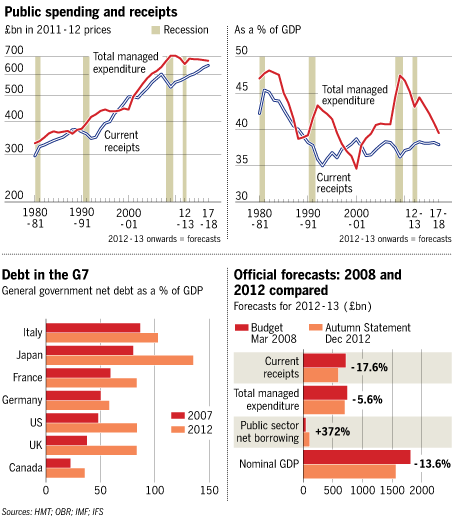
Britain's austerity is indefensible  |
| Posted: 14 Mar 2013 09:30 AM PDT
Bullish sentiment posted its largest weekly gain in nearly three years. Expectations that stock prices will rise over the next six months, surged 14.4% to 45.4%. This spike in optimism was the largest since July 15, 2010. Bearish sentiment — expectations that stock prices will fall over the next six months — dropped 6.5 points to 32.0%. Pessimism remains above historical average of 30.5%. Note the sentiment swings: Just 2 weeks ago, 28.4% of AAII members described themselves as optimistic — the lowest level since November 2010. Sampling of AAII sentiment survey responses after the jump.
This week's special question asked AAII members how the new record highs set by the Dow Jones industrial average has influenced their opinion about the attractiveness of stocks. Responses were mixed. The largest group of respondents (approximately 30%) said the new record highs had no impact. Approximately 18% of respondents expect stock prices to pull back in the short term, though some AAII members think the pullback will be followed by a rebound to even higher prices. Roughly 17% said they are now more cautious or bearish, while 11% said they are more bullish. A couple of respondents said it is harder to find bargains in the current environment. Here is a sampling of the responses:
This week’s AAII Sentiment Survey:
Historical averages:
 |
| Should Insurance Regulators Handle Derivatives? Posted: 14 Mar 2013 08:30 AM PDT Barry Ritholtz, CEO at Fusion IQ, and Tangent Capital Partners’ Bob Rice talk with Bloomberg Law’s Lee Pacchia about the current state of the derivatives market and a recent initiative by ISDA to write new standards for credit-default swaps. (if Video does not load, click here)  |
| Posted: 14 Mar 2013 08:00 AM PDT Josh Rosner has done a yeoman’s job looking closely at JPM’s finances, regulatory violations, and trading losses. I found much of what he wrote surprising. In particular, I was surprised to learn that JPM:
Prior installments are here:
 |
| Posted: 14 Mar 2013 06:55 AM PDT My morning reads:
What are you reading?
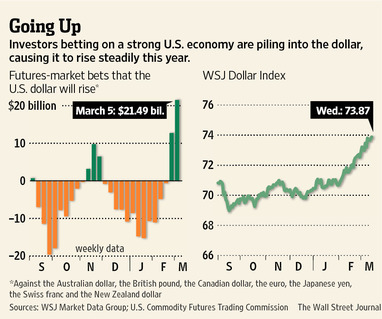
The Almighty Dollar Is Back  |
| Posted: 14 Mar 2013 05:30 AM PDT The markets have begun to wonder whether the Fed (and other central banks) will ever be able to exit from its Quantitative Easing policy. We believe there is only one reasonable exit the Fed can take. Rather than sell its portfolio of bonds or allow them to mature naturally, we believe the Fed's only practical exit will be to increase the size of all other balance sheets in relation to its own. This "exit" will be part of a larger three-part strategy for resetting the over-leveraged global economy, already underway. The first stage is policy-administered monetary inflation – QE in which the Fed is de-leveraging bank balance sheets by adding bank reserves. The second phase will be policy-induced price inflation – hyper-inflating the general price level enough to diminish the burden of debt repayment and gain public support for monetary system change. (Imagine today the Fed proclaims all one dollar bills are ten dollar bills. Goods and service prices would increase 10x, more or less, as would wages, asset prices, revenues, costs, etc. The only item on the balance sheet that would not increase 10x would be the notional amount of systemic debt owed.) We believe the third phase of the strategy will be a monetary reset that recaptures popular confidence following the hyper-inflation. Below, we list a progression of facts and reason supporting these conclusions: • As the Fed monetizes Treasury debt (or, as it claims, temporarily adds Treasuries and MBS to its balance sheet prior to selling them or letting them mature sometime in the future, thereby draining reserves), the obligations of the US Treasury (i.e., obligations of US taxpayers) to the US banking system are increasing dollar for dollar. • The US banking system is: 1) the largest American creditor to the Treasury; 2) the largest warehouse of US taxpayer wealth (via deposits); 3) the largest (infinitely capitalized) intermediary for public US capital markets, and; 4) the monopoly issuer of US dollars and USD-denominated credit. In short, the US banking system is the issuer of the world's reserve currency and supports conditions to maintain USD hegemony. • Thus, it seems reasonable to assume that the interests of maintaining a healthy US banking system rise above or are at least equal to the economic interests of Americans, and to a large extent their government. • Significantly higher US interest rates would implicitly harm the Fed's balance sheet (which is not marked to market) and explicitly harm the loan books (assets) of private bank balance sheets (marked to market), potentially placing bank capital ratios in jeopardy and undermining confidence. (While significantly higher interest rates would ostensibly increase the value of adjustable rate bank loans not near their cap levels, they would also decrease the creditworthiness of borrowers' loan collateral values, lowering lending activity.) • The Fed's balance sheet is infinite and the Fed creates the currency with which its balance sheet may grow. The Fed will always have more money at its disposal with which to buy bonds and set benchmark interest rates than the quantity of bonds for sale, sine qua non. • Thus, it seems reasonable to assume that there will not be a sudden rise in US market interest rates unless the Fed wants such a rise. Nominal economic growth or even price inflation will not necessarily act as a trigger for higher Treasury yields (but it may be reasonable to fear higher yields within tertiary bond markets in which the Fed/banks do not have significant exposure). • The relevant issue for Treasury investors is not the risk of capital loss from bond price depreciation, but rather the risk of capital loss in real terms – negative real returns as coupon interest and principal repayment do not keep pace with price inflation (i.e., the loss of future purchasing power of Treasury P&I vis-à-vis consumer goods, services and equity assets). • The mix of economic growth (leading to higher tax receipts) and/or government austerity needed to reverse ongoing debt growth over time is mathematically impossible to achieve within the context of a stable social environment. The US public sector and US households are in a compounding debt trap in which there is no exit. Thus, debt is growing and being shifted presently, not being extinguished, and this portends the likeliest future path. • Real output growth from current debt/leverage levels cannot be generated from a coincident increase in more systemic credit/debt. So, the policy solution cannot be issuing new credit and transferring debt with the goal of generating increasing demand and nominal output growth. (And we further argue that wealth concentration that results directly from asset price inflation is a very relevant and direct constraint on real economic growth.) • The US economy (and all indebted advanced economies) is shrinking in real terms presently and fiscal measures are incapable of providing a sustainable remedy. This is precisely the catalyst forcing today's aggressive monetary policy action. • The only solution is true systemic de-leveraging (banks, households and governments). Banks are already in the process of being de-levered through QE in the form of bank reserve creation. • There are only two ways to de-lever balance sheets: 1) letting debt deteriorate naturally, which would cause a 1930s style deflationary depression, and/or; 2) creating new base money in the form of bank reserves (first) and circulated currency (second). Both reduce leverage ratios (unreserved credit-to-money available with which to repay systemic debts). • The only two ways for the US government to de-lever without creating a deflationary depression would be: 1) Treasury sells assets (e.g. land, resources, shipping lanes etc.) and uses the proceeds for debt repayment, and/or 2) Treasury has the Fed devalue (inflate) the US dollar against a monetary asset on its balance sheet. The former would threaten US sovereignty and the latter would threaten the purchasing power of US dollars (i.e., the perceived current savings of US dollar holders). • To gain US public and geopolitical support for policy-administered deleveraging through devaluation and a fundamental shift in the world's monetary system, confidence in the current regime would have to be lost. The most effective tool for achieving this broadly would be price inflation. • Over the last forty years, the rate of price inflation has been about 2% per year (about a 125% compounded growth rate), which has diminished the purchasing power of the USD by about 55%. In other words, one dollar in 1972 is worth about forty-six cents today. Policy-administered US dollar devaluation would apply the same principle, but the inflation would occur suddenly and, discretely. Following a hyper-inflationary episode, the public would be conditioned for another resetting of the global monetary system (its fifth in one hundred years). • Central banks, led by the Fed, would have to re-price and monetize an equity asset rather than debt assets. The only monetize-able equity asset on official balance sheets is gold (which may explain why central banks of emerging economies are voracious buyers presently). • Re-monetizing gold would be popular within indebted advanced economies and therefore politically expedient. While net savers of US dollars would be harmed from the devaluation, net debtors would be helped. (The burden of repaying existing debts would be greatly diminished vis-à-vis inflated wages and asset prices.) Thus, those holding cash and bonds would suffer and those with mortgage, school, auto, and consumer debt would benefit. On balance, a policy-administered USD devaluation would be greatly welcomed within advanced economies. It would position politicians and central banks as economic saviors. • For the first time in memory all global currencies are baseless, including the lone reserve currency, and there is no other scarce currency that provides an alternative for global savers seeking a better store of future purchasing power. This implies that the Fed, with or without the encouragement of the BIS Global Economic Committee of thirty global central bankers, may unilaterally and effectively expedite a global currency devaluation. A policy-administered USD devaluation would force all other fiat currencies to respond in kind or to adopt the US dollar as its currency (maintaining USD hegemony). • The global system would revert to the gold/dollar exchange standard used between 1945 and 1971 (i.e., Bretton Woods). Currency devaluation against precious metals has long precedent (including the USD in 1933). • As we have discussed in the past, the mechanics for currency devaluation are straightforward and would be simple to exercise.[1] • Global banks, having already been de-levered and finding the quality of their loan books to be pristine following the devaluation, would be eager to lend again. (The fractional reserve banking system would not be altered.) The devaluation would be economically stimulative. In our view, public arguments by Fed members and observers of future balance sheet reduction using normal asset sales or amortization seem specious. The most visible, politically expedient and most likely path seems to be the path usually taken: inflation. In the case of the Fed and other central banks, we assert the magnitude of the systemic leverage problem will be met with equal inflationary force. Source:  |
| Posted: 14 Mar 2013 05:00 AM PDT Josh Rosner ( This is part 4 of 5; Yesterday evening, we published the Introduction. We will be releasing a different part each evening and morning culminating in the release of Rosner's complete report on Friday morning. On that date, the Senate Permanent Subcommittee on Investigations will release their final report on JPM's CIO Group (aka the London Whale). Prior installments are here: Intro, part 2 and part 3. ~~~ LONDON CALLING In the wake of at least $6.2 billion in losses and an earnings restatement in the CIO's office, which manages JPM's excess cash and should therefore be run by top talent, the regulatory response has been surprisingly muted. The two reports issued by JPM in early January were unrevealing and illustrate the current state of regulatory capture where large financial institutions are concerned. When Freddie and Fannie suffered accounting scandals early last decade, with Freddie understating earnings and Fannie overstating them, the Companies' and their regulator (OFHEO) recognized the importance of credible investigations. Freddie hired an outside firm to do an independent investigation[i] and their regulator embarked on two detailed and meaningful investigations.[ii] After these investigations were complete, OFHEO issued exhaustive and meaningful demands on the companies in the form of Consent Orders[iii]. On January 14, 2013, without the benefit of a similarly complete investigation, the Federal Reserve issued two fairly narrow Consent Orders to JPMorgan.[iv] The first order related to violations of the Bank Secrecy Act and anti-money laundering requirements, the second to the losses in the Chief Investment Office. Neither of these orders appears to have resulted from any meaningful investigation and neither addressed the many other recent failures of the Company's internal controls. When the rod is spared, as seems to be the standard approach to dealing with violations by our biggest banks, we find ourselves reminded that spoiled children behave badly. The ability of any management team to steer a company with a balance sheet as large as JPM’s seems an impossible feat, one that bears inquiry and consideration. While the "London whale" losses are generally viewed in isolation they are little more than the most dramatic recent example of poor internal controls. A Whale's Tale – a Whitewash Report When compared to the report the Board of Freddie Mac undertook, JPM's "Task Force" was a whitewash. Freddie initiated a truly independent investigation by an unaffiliated firm and directed all employees of the Company to fully cooperate with the investigation. There were no limitations proscribed on the scope of the review and as the investigators or the Firm's independent auditors discovered additional matters they were also looked into[v]. In contrast, JPMorgan's "Task Force" issued a report of questionable independence and limited in scope. Michael Cavanagh, co-Chairman of JPMorgan's investment bank, led the "Task Force". Cavanagh reports directly to Jamie Dimon and is both a longtime "lieutenant" and his possible successor[vi]. For Michael Cavanagh to be tasked with investigating another executive that reported directly to Jamie Dimon[vii] about losses in a unit that he knew, as early as 2010, appeared to have inadequate controls[viii] is more troubling. As former SEC Chairman Harvey Pitt said, “It’s incomprehensible to me that they did these reports internally, it’s like asking Joe Paterno to do the Penn State [sexual abuse] investigation instead of [former FBI director] Louis Freeh… having picked Cavanagh to do this strikes me as potentially foolish in the extreme, the only reason you do a review this way is because you don’t want to find anything unduly damaging[ix].” The Task Force Report While we will offer some assessments of the primary content of the report it is important to recognize that, as is often the case, some of the most valuable information is buried in the footnotes. As a result, we will first focus on many of those items. - Footnote 2: The description of "what happened" is not a technical analysis of the Synthetic Credit Portfolio or the price movements in the instruments held in the Synthetic Credit Portfolio. Instead, it focuses on the trading decision-making process and actions taken (or not taken) by various JPMorgan personnel. The description of activities described in this Report (including the trading strategies) is based in significant measure on the recollections of the traders (and in particular the trader who had day-to-day responsibility for the Synthetic Credit Portfolio and was the primary architect of the trades in question) and others. The Task Force has not been able to independently verify all of these recollections. This footnote raises questions about the thoroughness of the investigation. - Footnote 10: John Hogan, who succeeded Mr. Zubrow as the Firm's Chief Risk Officer in January 2012, did not have sufficient time to ensure that the CIO Risk organization was operating, as it should. Nevertheless, the Task Force notes that there were opportunities during the first and second quarters of 2012 when further inquiry might have uncovered issues earlier. While it may in fact be true that John Hogan did not have sufficient time to address the control problems in the CIO's office, the reality remains that problems in risk management of the CIO's office existed, and were known to the firm's most senior management[x] possibly for several years prior to the 2012 trading losses. This reality calls into question the accuracy of the firm's filings[xi] and compliance with Title III of the Sarbanes-Oxley Act[xii]. Investors may well wonder whether, as long as those weak controls were generating outsized profits; management was not interested in correcting those control weaknesses. - Footnote 20: Although the Task Force has reviewed certain general background information on the origin of the Synthetic Credit Portfolio and its development over time, the Task Force's focus was on the events at the end of 2011 and the first several months of 2012 when the losses occurred.
Given the preexistence of problems in risk controls in the CIO's Office it is unclear why the scope of the investigation would have been limited to late 2011 and 2012. It seems fair to consider that a broader inquiry might have highlighted failures by the firm's senior-most management to address, in a timelier manner, the poor oversight and weak control environment. - Footnote 26: This Report sets out the facts that the Task Force believes are most relevant to understanding the causes of the losses. It reflects the Task Force's view of the facts. Others (including regulators conducting their own investigations) may have a different view of the facts, or may focus on facts not described in this Report, and may also draw different conclusions regarding the facts and issues. In addition, the Task Force notes that its mandate did not include drawing any legal conclusions, and accordingly, this Report does not purport to do so. While it remains unclear whether the firm's primary regulator or other regulatory bodies are conducting credible investigations, the legal and financial risks to the firm, stemming from the losses in the CIO's office, should remain an ongoing cause for concern. - Footnote 30: Shortly before this exchange, Ms. Drew and Mr. Wilmot had notified Messrs. Dimon and Braunstein that CIO (as part of its budgeted RWA reduction) would reduce the Synthetic Credit Portfolio's RWA by year-end 2012, from $43 billion to $20.5 billion. This exchange took place in January 2012 and, given the size of the exposures, it seems fair to believe that Jamie Dimon would have paid sufficient attention to the exposures. Denial of awareness of the degree of the problems only supports our view that the firm is too big to adequately manage. - Footnote 43: This was one in a series of e-mails that the other trader wrote to himself and to other traders in the last two days of January, all expressing similar views about the performance of the Synthetic Credit Portfolio, and the options available as to how best to manage it. The report notes that "On January 31, that executive sent an e-mail to the same trader – which he also forwarded to Ms. Drew – in which he stated that the Synthetic Credit Portfolio was not behaving as intended and described the Synthetic Credit Portfolio's performance as "worrisome"" and goes on to say that "Ms. Drew also received separate daily profit-and-loss reports on the Synthetic Credit Portfolio." It seems implausible that Jamie Dimon would never have directly instructed Ina Drew to keep him apprised of the management of positions in an office that he long knew had control issues and, since at least January, knew of the enormity of the positions. - Footnote 86: Mr. Dimon had not been in the office from April 2 until his return on April 12. This seems to be another attempt by the "Task Force" to exonerate Jamie Dimon and refers to the statement that "Mr. Dimon had been briefed on the issue and the work being performed, although he had not been involved firsthand in many of the discussions that had taken place during that period." If, as we now know he was aware of the risks and size of the positions, this rationale calls into question his ability to manage the firm. The report offers little insight into the degree of the internal control problems, how long they existed prior to this trading catastrophe, and what specific information Jamie Dimon possessed or when he became aware of the problems. Statements in the press, that he had allowed the CIO's Office to operate with different risk controls and less oversight than the rest of the firm, were neither acknowledged nor addressed. Neither were reports that Jamie Dimon placed trades in the CIO book, a risky proposition – as John Corzine can attest – for an executive who has little time to mind his trades. The report also suggests that the armies of examiners within our largest banks are either captured or not up to the task of oversight. Similarly, the Board of Directors' Risk Policy Committee appears to ignore the control environment that existed in the CIO's office before this event. The Risk Committee's report to the Board demonstrates they were not fully apprised of the operating environment in the CIO's Office. While they appear not to have been properly informed of the problems that existed,[xiii] it seems that they may have also failed to make sure they had a grasp of the key risks to the Firm. One has to wonder how the regulator can avoid forcing the replacement of Board members for significant failures that include:
These breakdowns of controls are not isolated. The long list of regulatory run-ins outlined here and the costs that they represent are important factors to consider when determining management effectiveness and the operating results of the Firm. [i] http://faculty.haas.berkeley.edu/jaffee/Papers/FreddieReport.pdf Baker Botts, LLP. “Report to the Board of Directors of The Federal Home Loan Mortgage Corporation.” Internal Investigation of Certain Accounting Matters December 10,2002-July 21,2003. July 22, 2003. http://faculty.haas.berkeley.edu/jaffee/Papers/FreddieReport.pdf . [ii]Office of Federal Housing Enterprise. “Report on the Special Examination of Fannie Mae”, May 2006, available at http://www.fhfa.gov/webfiles/747/FNMSPECIALEXAM.pdf and Office of Federal Housing Enterprise. “Report on the Special Examination of Freddie Mac, December 2003 available at http://www.fhfa.gov/webfiles/749/specialreport122003.pdf [iii] http://www.fhfa.gov/webfiles/944/consentorder12903.pdf and http://www.fhfa.gov/webfiles/941/attachsettlement.pdf Oversight, Office of Federal Housing Enterprise. “In the Matter of The Federal Home Loan Mortgage Corporation (“Freddie Mac”).” December 9, 2003. http://www.fhfa.gov/webfiles/944/consentorder12903.pdf . —. “In the Matter of The Federal National Mortgage Association (“Fannie Mae”).” May 23, 2006. http://www.fhfa.gov/webfiles/941/attachsettlement.pdf . [iv] http://www.federalreserve.gov/newsevents/press/enforcement/20130114a.htm Board of Governors of the Federal Reserve System. January 14, 2013. http://www.federalreserve.gov/newsevents/press/enforcement/20130114a.htm . [v] http://faculty.haas.berkeley.edu/jaffee/Papers/FreddieReport.pdf Baker Botts, LLP. “Report to the Board of Directors of The Federal Home Loan Mortgage Corporation.” Internal Investigation of Certain Accounting Matters December 10,2002-July 21, 2003. July 22, 2003. http://faculty.haas.berkeley.edu/jaffee/Papers/FreddieReport.pdf . (See also: Our investigation included (i) review of over 250,000 pages of hard copy documents (600 boxes of documents remain to be reviewed); (ii) over 200 interviews; (iii) review of electronic documents and files, including the imaging of hard drives, evaluations of e-mails, and conducting key word searches yielding two terabytes of electronic evidence; (iv) listening to over 11,000 minutes of tapes of telephone conversations; and (v) examinations of relevant employee performance reviews and personnel files.") [vi] http://hereisthecity.com/2010/04/01/jpmorgan_to_expand_investment_/ and http://www.businessweek.com/printer/articles/43632?type=bloomberg and http://blogs.wsj.com/deals/2012/05/14/jamie-dimons-mr-fix-it-michael-cavanagh/HITC Business. “JPMorgan – A letter From Jamie Dimon.” http://hereisthecity.com/2010/04/01/jpmorgan_to_expand_investment_/ . Erik Schatzker, Christine Harper and Mary Childs. “Bloomberg Archives: JPMorgan Shifts CIO to Prop Trading.” Bloomberg Businessweek, April 13, 2012: http://www.businessweek.com/printer/articles/43632?type=bloomberg . Moyer, Liz. “Jamie Dimon's Mr. Fix It: Michael Cavanagh.” The Wall Street Journal, May 14, 2012: http://blogs.wsj.com/deals/2012/05/14/jamie-dimons-mr-fix-it-michael-cavanagh/ . [vii] http://www.businessweek.com/printer/articles/43632?type=bloomberg (see Schatzker, Erik, Christine Harper and Mary Childs. “Bloomberg Archives: JPMorgan Shifts CIO to Prop Trading.” Bloomberg Businessweek, April 13, 2012. http://www.businessweek.com/printer/articles/43632?type=bloomberg . (See: JPMorgan also said Ina Drew, who ran global treasury at JPMorgan prior to the acquisition, would report directly to Dimon. Drew's title changed in February 2005 to "chief investment officer," according to the 2005 year-end filing.) [viii]http://online.wsj.com/article/SB10001424052702303768104577460792166155830.html The Wall Street Journal. “J.P. Morgan Knew of Risks.” June 12, 2012: http://online.wsj.com/article/SB10001424052702303768104577460792166155830.html . (See: "In 2010, another bad trade caught the attention of a senior finance executive who notified top J.P. Morgan executives. Joseph Bonocore, then chief financial officer of the CIO, became concerned when London-based traders lost about $300 million in a few days on a foreign exchange-options trade, without any offsetting gains to balance out the losses. Mr. Bonocore brought the matter to Barry Zubrow, then J.P. Morgan’s chief risk officer, and Michael Cavanagh, then chief financial officer, both of whom reported to Mr. Dimon. Messrs. Zubrow and Cavanagh, who remain at the bank in other top roles, gave Mr. Bonocore authority to order that the position be reduced… Mr. Dimon recalls being told of the trades, a person close to him said.") [ix] http://finance.fortune.cnn.com/2013/01/18/jpmorgan-london-whale-investigation/ Gandel, Stephen. “JPMorgan’s London Whale review: Inside job.” CNN Money, January 18, 2013: http://finance.fortune.cnn.com/2013/01/18/jpmorgan-london-whale-investigation/ . [x] " Schatzker, Erik, Dawn Kopecki and Bradley Keoun. “House of Dimon Marred by CEO Complacency Over Unit'sUnit’s Risk", Erik Schatzker, Dawn Kopecki and Bradley Keoun,.” Bloomberg, June 12, 2012. (See: Dimon treated the CIO differently from other JPMorgan departments, exempting it from the rigorous scrutiny he applied to risk management in the investment bank, according to two people who have worked at the highest executive levels of the firm and have direct knowledge of the matter. When some of his most senior advisers, including the heads of the investment bank, raised concerns about the lack of transparency and quality of internal controls in the CIO, Dimon brushed them off, said one of the people, who asked not to be identified because the discussions were private.") [xi] http://www.sec.gov/Archives/edgar/data/19617/000001961712000264/jpm-2012063010q.htm p.119 (See: "The valuation control function is also responsible for determining any valuation adjustments that may be required… The determination of such adjustments follows a consistent framework across the Firm.") [xii] 107th Congress, “PUBLIC LAW 107–204—JULY 30, 2002.” Last modified 2002. http://www.sec.gov/about/laws/soa2002.pdf . [xiii] Board Review Committee Report, p. 5-6. (See: "CIO also made an annual presentation to the Audit Committee on the control environment in CIO. Following this presentation to the Audit Committee in July 2011, the Audit Committee reported to the Board that the CIO's presentation stated that the overall control environment and business processes of CIO remained strong. In connection with its December 13, 2011 meeting, the Risk Policy Committee received a report prepared for it and the Audit Committee on the Firm's Risk Management Control Environment, which covered Firmwide risk management as well as risk management for the lines of business and CIO. That report addressed, among other things, risk management priorities for 2012, the status of responses to regulatory-driven initiatives, risk technology issues and initiatives, issues with model risk governance, and the status of control assessment issues (including matters requiring attention ("MRAs") identified by regulators) and action plans to address them. These reports did not raise issues with regard to under-resourcing or other deficiencies in the risk management function in CIO, or a lack of appropriate risk limits or compliance with risk limits at CIO.")  |
| Plight of the Laysan Albatross: Midway Film Posted: 14 Mar 2013 04:30 AM PDT Click for video  |
| Investing/Trading Rules, Aphorisms & Books (Spring 2013) Posted: 14 Mar 2013 03:50 AM PDT Way back in 2011, we pulled together a run of some of the Trading Rules & Aphorisms that show up on the site. It turned out to be a popular post, and I added “Rules” as a new category. Thus, we update this semi- annually. These are my traders, analysts, economists and investors views’ on what to do — and what not to do — when it comes to markets that have been published on TBP. Here is the latest update:
If you have any suggestions for any good lists of rules I may have missed, please link to them in comments. If they are worthy, they will get added to the list. My own trading rules and favorite Trading Books are after the jump
My (Ritholtz) own rules
All of the books ever mentioned on The Big Picture can be found by clicking the Bookshelf link. But you can see our major overviews on investing related books in these lists: Newbies: Anyone who is interested in finance as a career, I suggest these two books as a starter — they cover trading and markets generally:
If you want some book ideas for Technicals, have a go at these:
Don't think you need a full reference library; any pair of these books should do. I am working on a few new book lists, and they will get published over time.  |




| You are subscribed to email updates from The Big Picture To stop receiving these emails, you may unsubscribe now. | Email delivery powered by Google |
| Google Inc., 20 West Kinzie, Chicago IL USA 60610 | |



0 comments:
Post a Comment