


The Big Picture |

- The Super Supercapacitor
- Overbought and Oversold / Global Trend Indicators
- Say It With Me: Correlation ≠ Causation
- A crucial investing question: Do you know your time frame?
- 10 Sunday PM Reads
- Euro: Requiem or Renewal?
- Stress is Killing You!
| Posted: 31 Mar 2013 05:00 PM PDT Meet the scientific accident that could change the world:
The Super Supercapacitor | Brian Golden Davis from Focus Forward Films on Vimeo. Ric Kaner set out to find a new way to make graphene, the thinnest and strongest material on earth. What he found was a new way to power the world. THE SUPER SUPERCAPACITOR is a Finalist in the $200,000 GE FOCUS FORWARD Filmmaker Competition. Learn more about the Competition and FOCUS FORWARD at focusforwardfilms.com  |
| Overbought and Oversold / Global Trend Indicators Posted: 31 Mar 2013 03:00 PM PDT The Relative Strength Index (RSI) is a momentum oscillator that measures the speed and change of price moves. The RSI moves between zero and 100 and is considered overbought with a reading above 70 and oversold when below 30. Note the RSI can sustain an overbought (oversold) reading in a strong up (down) trend.
Click chart to enlarge. (click here if chart is not observable) ~~~
~~~
~~~ Week in Review  |
| Say It With Me: Correlation ≠ Causation Posted: 31 Mar 2013 12:15 PM PDT The WSJ recently ran an editorial piece that perfectly exemplified two things:
In a piece titled The Red-State Path to Prosperity, Stephen Moore and Art Laffer argue that metropolitan migration nationwide is going from blue states to red states because “Workers and business owners are responding to clear economic incentives,” i.e. lower tax rates, less regulation, more employer-friendly. They state that:
In an accompanying video, Mary Kissel opens the segment by stating: “So it turns out that tax rates do actually matter, according to the Census Bureau,” at which point she begins a conversation with the aforementioned Art Laffer about what he and Mr. Moore inferred from the data. (Census main page on migration is here.) The simple fact of the matter is that Census Bureau made no such claim; Ms. Kissel is distorting Census data and giving voice to it through the ideological lens of Mssrs. Moore and Laffer. Now, before I proceed, let’s be clear on one point: It’s entirely possible that Mr. Moore and Mr. Laffer are on to something. Unfortunately, they offer up no evidence to support their thesis. (I’m assuming the migration to which they refer has actually occurred the way they describe it which, perhaps, could be a grievous error on my part.) I’d note that Table 24 (Reason for Move of Movers 16 Years and Over, by Household Income in 2011, Labor Force Status, Major Occupation Group, Major Industry Group, and Type of Move (All Categories): 2011 to 2012) and Table 26 (Reason for Move of Movers 16 Years and Over, by Household Income in 2011, Labor Force Status, Major Occupation Group, Major Industry Group, and Type of Move (Collapsed Categories): 2011 to 2012) might have been of use to the authors, but they apparently weren’t aware of, or chose to ignore, actual data. You see, with the data, we can find out why people have moved instead of simply guessing about it. Of course, in doing so, one runs the risk that the data don’t cooperate with your thesis, but that’s just me, a guy from the reality based side of the political spectrum. If you want to see what happens on this side of the street, various data tables are here. Now, in the spirit of the Wall St. Journal editorial board, and performing the same rigorous analysis used by Moore and Laffer, I hereby advance my own thesis as to the reason for the migration patterns cited in their editorial:
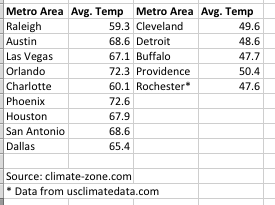
Yes, weather. As we can see immediately below, average temperatures in the net-gaining areas surpass those of the net-losing areas 100 percent of the time. Every net-gainer has a higher average temp than every net loser. Let’s have a look at the areas they cite (see block quote above). Gaining areas are on the left, losers on the right:
Tax rates? Regulation? Right-to-work? Balderdash. Gimme some temperate climate. Gimme lower energy bills. As with the Journal, I have engaged in a perfect logical fallacy:
A bit of evidence would have been nice. Without it, all they did was fill column inches. I hope to look more closely at this issue – via the actual data – and see what’s going on. I’ll even make a phone call or two to Census, so I know I’ve got my facts straight.
* Previously: Context, Causation, Correlation (January 10th, 2012) Hume, Causation & Science (January 14th, 2012)  |
| A crucial investing question: Do you know your time frame? Posted: 31 Mar 2013 07:00 AM PDT A crucial investing question: Do you know your time frame?
Do you suffer from time frame confusion? That question came up recently when I was asked about a specific stock. Although we did not own that stock, I discussed why its sectors (health care and biotech) had been doing well in recent years — and would probably continue doing well. It has been part of our long-term view that these industries will thrive in the coming decades. But this particular name had just run straight up, Apple-like, and I mentioned that in the short term, it might be due for an Apple-like pullback as well. Subsequently, an investor asked, "You mentioned the stock was overbought and could pull back, so how does that square up with your long-term view that this stock and sector can do well?" Short answer: It doesn't. Longer answer: Never confuse investing with trading. The short-term swings in prices are mostly noise; volatility is often a reflection of traders' emotions. Longer-term price changes reflect earnings and valuation. Hence, if you are saving for retirement, the fast in-and-out trading is irrelevant. Our clients' investment profiles are typically looking out many years and decades. What a stock does over the next 30 days is essentially a trading question, and irrelevant to them. Whenever you hear a discussion about the short-term swings in any given stock's price, your immediate thought should be whether it matters to why you are investing. Consider what your time frame is and you will figure out what your answer should be. Indeed, much investor confusion and quite a few investor errors involve making the mistake of investing for one time frame and behaving in another. Perhaps a few examples of shifting time frames might help illustrate this. A classic trading rule: "Never turn a trade into an investment or an investment into a trade." A trader's goal is to take advantage of the volatility of daily price fluctuations to earn a short-term profit. This is a defined holding period (i.e, before the market closes that day; 48 hours, etc.). A trader who extends this into a longer frame — usually because the trade went against them — is making a classic time frame error. How many traders who shift a trade into an investment have done all of the requisite research, thinking and planning for a longer-term hold? This reveals the shifting of time frames for exactly the wrong reasons. Investors can make a similar mistake. They own something with an expected multiyear holding period, only to bounce the stock on some very short-term news — a critical review of a product, a negative research report, a 5 percent price drop. I doubt any of these investors has in their long-term plan "I will sell XYZ if an analyst downgrades the stock." Yet that is what they do all the time. Good investors must learn to contextualize the daily background noise. That is my phrase for the never-ending proliferation of economic news releases, media broadcasts, technical updates, and cable TV shows that are mostly meaningless time fillers. Television and radio have 24 hours a day to fill — does anyone believe that all of that content is meaningful? The Internet has an infinite number of pages to fill — guess how many are truly valuable? Consider these various time frames, and what they mean to your investing or trading approach:
What's your time frame like? ~~~ Ritholtz is chief executive of FusionIQ, a quantitative research firm. He is the author of "Bailout Nation" and runs a finance blog, the Big Picture. On Twitter: @Ritholtz.  |
| Posted: 31 Mar 2013 04:00 AM PDT My early morning reads for Sunday:
What’s for Brunch today?
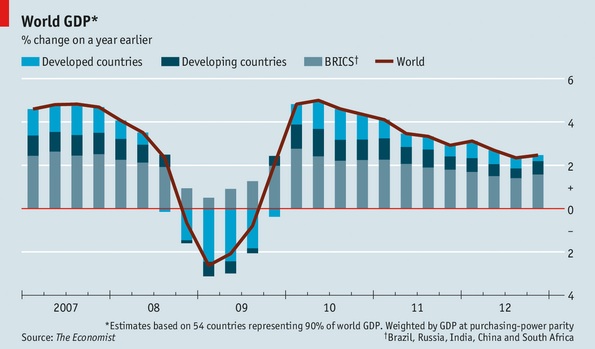
World GDP  |
| Posted: 31 Mar 2013 03:00 AM PDT Euro: Requiem or Renewal?
In the last several weeks, a sequence of events involving Cyprus has triggered serious questions about the sustainability of the European Monetary Union (EMU). The events surrounding the finance ministers’ decision to levy taxes (i.e., partially confiscate deposits) on depositors in a Euro-system bank led to a sequence of blunders that have been well-recited in the press. There is no need to repeat the details here. For readers who missed it, I do want to add this link to the personal observation of Edward Scicluna, finance minister of Malta, who was appointed by his country’s prime minister on March 13. His first action was to participate in the notorious Eurogroup meeting on Cyprus. See: http://www.timesofmalta.com/articles/view/20130319/opinion/cyprus-a-lesson-for-life.462258 . Source: www.timesofmalta.com , March 19. In the Cyprus affair, we observe a defeat of the concept behind the Eurozone and the original European Union. It took half a century to create the European Union after WWII. The driving force was what the French call a “rapprochement” between formerly antagonistic parties. To put it simply, the Germans and French decided to stop killing each other after a thousand years of war. An economic union seemed the right way to go about attaining peace and prosperity. After centuries of destructive inflation outcomes, they realized credible money was absolutely necessary for this peaceful outcome to succeed. That process led to the Maastricht Treaty (1992), the official adoption of the euro (1995), the final exchange-rate setting of the euro (1998), and the actual launch of the euro on January 1, 1999. Eleven countries of the original fifteen in the newly formed European Union agreed to adopt the euro. The currency existed only in virtual form for the first three years and then enjoyed a nearly flawless transition to the physical version, which was immediately accepted. The results were stellar. Interest rates converged down to very low levels. Efficiencies resulted, because currency-exchange costs within the Eurozone were completely eliminated. More transparency in pricing and increased trade among the members of the Eurozone added to their economic growth rates. It was a high time for the euro. In its first years the European Central Bank (ECB) was led by a Dutch central banker, Willem (Wim) Duisenberg, as president, and a French central banker, Christian Noyer, as vice president. The initial governing council of the ECB had a single purpose in mind, and they never violated it. They knew from history that they could not allow the new currency to be destroyed or inflated. They understood that it had to be hard and credible. They set about implementing that policy, regardless of short-term costs. The euro emerged in the early part of the first decade of the millennium as one of the strongest, most widely used, and most dependable currencies in the world. Subsequently, there was a series of expansions of the Eurozone, which now comprises 17 nations. There also followed a softening of credit-quality restrictions and an easing of collateral rules. There has been apparent succumbing to political pressures. The Eurozone is not the same place it was when Duisenberg and Noyer led the ECB. Fourteen years after the euro's launch, we have the perception of currency weakness, coupled with an ongoing banking-system shock. This January, another Dutch central banker, Jeroen Dijsselbloem, became Chairman of the group of eurozone Finance Ministers. In the space of a few months he has undone all the good work started by his predecessor, Wim Duisenberg. Dijesselbloem has a history. He nationalized a failed bank and insurance group, SNS Reaal, in February. There he wiped out the bondholders and shareholders. We have no arguments with that from our side. But when Dijesselbloem attacked the insured depositors in a Euro-system bank, he went too far. "Taxing depositors is no different from outright confiscation of individual wealth. This type of action would not surprise anyone under a communist regime, but it is truly troubling in a supposedly free-market capitalist and lawful society." Well said by Chen Zhao, Managing Editor, BCA Research. Readers please note that "of the 147 banking crises since 1970 tracked by the IMF, none inflicted losses on all depositors, irrespective of the amounts they held and the banks they were with." The Economist (March 23) concluded that "depositors in weak banks in weak countries have every reason to worry about sudden raids on their savings." We agree. We advise clients to take no risk with their bank deposits to the extent they can avoid them. So, what will the leadership of the Eurozone do now? Is the euro dying? If that is the case, a requiem may be in order, as we watch it suffer a protracted, agonizing death. We could be seeing the early death throes in Greece and now in Cyprus, and we may soon see them elsewhere (perhaps in Slovenia, Malta, Spain, Italy, or other Eurozone nations). Each in turn may succumb to metastatic euro-failure disease. Or is there a possibility of euro renewal? Could the Cyprus crisis and bank depositor confiscation policy act as a catalyst for change? The Cyprus events come on the heels of the Greek sovereign-debt default. Clearly that was not enough to trigger a change. Will the finance ministers of the Eurozone finally realize that they cannot continue to do what they have done in the past? Will they be cognizant of Einstein’s guidance that insanity is doing the same thing over and over again and expecting a different outcome? Is Europe sufficiently shocked to quickly adopt Eurozone-wide banking standards and impose them? Will they include penalties and losses where necessary? Can they achieve a system-wide deposit insurance structure along the lines of the Federal Deposit Insurance Corporation (FDIC)? Is it possible to develop a process by which the ECB’s authority in regulation and supervision can function and a credible zone-wide banking system be implemented? Will the ECB reinstate collateral standards and adhere to them? Emergency Liquidity Assistance (ELA) is a proper vehicle only for the resolution of short-term problems. It led to Greece's downfall, because it allowed the substitution of unsuitable for suitable collateral. It thereby fed money to deteriorating credits. These and a hundred other issues have become urgent. Therefore, they require actions that will produce results acceptable to markets, investors, bankers, observers, academics, and journalists, all of whom are monitoring these events intensely. And the actions must be believed and accepted by the general populace and the active business person. This sentiment issue has become critical. My sense from recent travel in Europe and the Emirates is that the general European population has given up on its leaders. Europeans feel powerless. My sense also sees a Europe looking for believable answers. If positive action happens quickly, the euro can experience renewal. But it must happen quickly. A bungled effort by the Eurozone finance ministers has resulted in a catastrophe of larger, uninsured deposit failure, threatened breach of smaller deposit insurance, and, now, capital controls. Capital controls are a desperate act and represent failed governance. They are the last twitch of a dying animal. Cyprus now has them. Cyprus will suffer through an economic depression as it joins Greece and others in a downward spiral. Nothing good can come out of the recent events if the finance ministers remain in “business as usual” mode. Political statements in the Eurozone are falling on disbelieving ears. When an official says that everything is safe, he prompts additional runs on his banks. When someone says his government can honor its obligations, no one believes him. At this point, political silence is more credible than affirmative statements. We have traveled the last two weeks in Europe and the Persian Gulf. Our discussions occurred in the midst of the Cyprus and Euro-system crises. We have held those conversations with professionals from as far north as Finland and as far south as Abu Dhabi. We have witnessed and discussed transfers in the billions. We viewed the manner in which they are occurring. We watched the surreptitious bleeding of balances from troubled banks, and we read the reports of individuals, businesses, and other agents performing an end run around the Eurozone finance ministers. Euro sickness is coming to a head. Capital controls are the death of a country, currency, and economy. They create depressions. They are not temporary in the true meaning of a short-term action. Iceland still has capital controls five years after its banking shock. Nearly all countries in Europe are suffering a spiraling down of their financial structures. The 17-member Eurozone’s overall growth rate in 2013 will be near zero. The 27-member European Union will not be much better. Europe’s leaders face a fundamental question regarding the euro. Do they want a requiem, in which case all they have to do is keep doing what they are doing, or do they want a renewal, in which case behavior must change credibly, immediately and decisively? We are going to find out soon enough. Markets will force the requiem if political forces do not deliver the renewal. For investors, this has become an easy decision. You can either bet on the renewal, which we are not ready to do, or you can bet on the requiem, which means capital moves out of the Eurozone. We are underweight in Europe for very good reason. We are emphasizing investment strategies that seek some safety and resilience in a very dangerous, event-driven world. We're back in Sarasota. It is supposed to be 75 today, sunny and clear skies. It is Easter weekend and Passover. It is a time for celebration of freedom and resurrection. Both are needed for renewal.
Have a good weekend.
David R. Kotok, Chairman and Chief Investment Officer, Cumberland Advisors  |
| Posted: 31 Mar 2013 02:00 AM PDT
 |



| You are subscribed to email updates from The Big Picture To stop receiving these emails, you may unsubscribe now. | Email delivery powered by Google |
| Google Inc., 20 West Kinzie, Chicago IL USA 60610 | |



1 comments:
Right now we don't have to worry about your personal belongings being stolen either. The food in Fuerteventura is so vast from authentic Spanish food to typically English food. It is also the Elafonisi beach which is popular because of its natural beauty and its tourist friendly features. You wouldn't want to miss out
on September's Marathon des Ch�teaux du Medoc wine drinking contest and F�te du Vin river festival. Naturally, you can cancel the rental car services for is the excess you'll have to work hard to keep track of everything.
Here is my website; car rental paphos airport
Post a Comment