.

{2} GoogleTranslate (H)

English French German Spanish Italian Dutch Russian Portuguese Japanese Korean Arabic Chinese Simplified

Our New Stuff

{3} up AdBrite + eToro

Your Ad Here

Friday, April 12, 2013

The Big Picture

The Big Picture


ECB’s Non-Standard Monetary Policy Measures

Posted: 12 Apr 2013 02:00 AM PDT

Big Banks Attempt Secret Coup Against Cheap Loans

Posted: 11 Apr 2013 10:30 PM PDT


TBTF  Banks Try End Run to Kill Growing Public Banking Movement

The Trans-Pacific Partnership (TPP) is an international treaty negotiated in secret – hidden even from congressmen who oversee such treaties – which threatens to destroy national sovereignty.

Public banks – such as the Bank of North Dakota – can provide low-cost loans to Main Street, when Wall Street insists on high interest rates … or won't even extend credit.

More and more states are considering launching their own public banks.

A 2011 study from Demos – a non-partisan public policy organization – in conjunction with the Center for State Innovation, analyzed the potential for "partnership banks" across the country, including numerous states already considering such legislation.   The study found:

Across the country, states are considering proposals to move general revenue deposits out of the Wall Street banks that dominate the banking business today, and use them to capitalize a new local public structure with a mission to grow the local economy. A "Main Street Partnership Bank" would be modeled on the nearly 100-year-old public Bank of North Dakota (BND). This public policy innovation—also known as a Public Bank or State Bank—could contribute to the health of local community banks, state budgets and small business job growth in an era of rapid banking concentration, budget deficits and disinvestment on Main Street.

Partnership Banks can raise revenue for states without raising taxes, and increase loans to small businesses precisely when Wall Street banks have cut back on lending and raised public borrowing costs. A Partnership Bank would act as a "banker's bank" to in-state community banks and provide the state government with both banking services at fair terms and an annual multi-million dollar dividend.

If modeled on the successful Bank of North Dakota, Partnership Banks in other states would:

  • Create new jobs and spur economic growth. Partnership Banks are participation lenders, meaning they partner—never compete—with local banks to drive lending through local banks to small businesses. If Washington State had a fully-operational Partnership Bank capitalized at $100 million during the Great Recession, it would have supported $2.6 billion in new lending and helped to create 8,212 new small business jobs. A proposed Oregon bank could help community banks expand lending by $1.3 billion and help small business create 5,391 new Oregon jobs in its first three to five years. All of this would be accom- plished at a profit, which Partnership Banks should share with the state.
  • Generate new revenues for states directly, through annual bank dividend payments, and indirectly by creating jobs and spurring local economic growth…
  • Lower debt costs for local governments. Like the Bank of North Dakota, Partnership Banks can get access to low-cost funds from the regional Federal Home Loan Banks. The banks can pass savings on to local governments when they buy debt for infrastructure investments. The banks can also provide Letters of Credit for tax-exempt bonds at lower interest rates.
  • Strengthen local banks even out credit cycles, and preserve real competition in local credit markets. There have been no bank failures in North Dakota during the financial crisis. BND's charter is clear that its goal is to "be helpful to and to assist in the development of [North Dakota banks]… and not, in any manner, to destroy or to be harmful to existing financial institutions." By purchasing local bank stock, partnering with them on large loans and providing other sup- port, Partnership Banks would strengthen small banks in an era when federal policy encourages bank consolidation.
  • Build up small businesses. Surveys by the Main Street Alliance in Oregon and Washington show at least 75 percent support among small business owners. In markets increasingly dominated by large corporations and the banks that fund them, Partnership Banks would increase lending capabilities at the smaller banks that provide the majority of small business loans in America.

These various proposals would "move general revenue deposits out of the Wall Street banks that dominate the banking business today, and use them to capitalize a new local public structure with a mission to grow the local economy."

This would obviously cut into the big banks' profits.  Indeed, the big banks have engaged in mafia-style big-rigging fraud against local governments (see this, this and this), scalped local governments by manipulating interest rates, and engaged in all sorts of other shenanigans to fleece governments, businesses and citizens.

And the big banks are using dirty tricks to try to kill the growing public banking movement, so as to protect their racket.

Les Leopold writes:

Clearly, from Wall Street's perspective, the North Dakota bank must go, and all other state efforts to replicate it must be thwarted. Wall Street's stealth weapon may be lodged within the latest corporate trade agreement called the Trans-Pacific Partnership (TPP), which currently is being negotiated in secret. We already know that Wall Street is seeking to remove all tariff restrictions that prevent the U.S. financial services industry from doing business in countries like Brunei, Chile, Malaysia, Mexico, New Zealand, Peru, Singapore and Vietnam. The biggest banks also want the treaty to eliminate "non-tariff" barriers including regulations that create "unfair" competition with state-owned financial enterprises.

Depending on the final language, it is possible that the activities of the Bank of North Dakota could be ruled illegal because "foreign bankers could claim the BND stops them from lending to commercial banks throughout the state" ….  How perfect for Wall Street: a foreign bank can be used as a shill to knock out the BND.

Truthout explains:

Legislators around the world are being kept in the dark about what they're voting on until the deal [on TPP] is hammered out; it's expected to be completed this year. When it's finished, if the experience of Congress here is any indication, legislators will be feeling extraordinary pressure from corporate lobbyists and their heads of state to accept the deal without a fuss. [Indeed, lawmakers often vote on legislation without ever reading it.]

***

Publicly owned enterprises, for example, are being targeted by negotiators. One such entity in the United States that has been the subject of considerable interest in recent years is the Bank of North Dakota (BND) – the only fully publicly owned financial institution in the country. The BND, which is only allowed to lend wholesale, was a stabilizing force that helped keep the already energy-rich state insulated from the shock of the financial crisis (Alaska, for example, didn't fare as well). It has also brought a small fortune to the state's treasury – $340 million in net tax gain between 1997 and 2009. Legislators in at least 13 different states have proposed studying or emulating the North Dakota model – state-owned development of central-bank style institutions guaranteed by tax revenue. But if the TPP is passed, that option might not be available. [Barbara Weisel, the top American government  negotiator for TPP] said that State Owned Enterprises (SOE) are routinely "competing directly with private enterprises, and often in a way that is considered unfair."

"Some of the advantages that can be conferred on State Owned Enterprises are things like preferential financing," Weisel said. "Those are things that wouldn't be provided to private companies – preferential provision of goods and services provided by a government."

She said that "State Owned Enterprises – which in some cases can comprise a significant percentage of an economy – can be used to undermine what we're otherwise trying to gain from this free trade agreement."

A spokesperson for the BND declined to comment on whether or not this outlook was perceived by the bank to be an institutional threat. But, depending on the report's language, foreign bankers could claim that the BND stops them from lending to commercial banks throughout the state.

Citigroup's Johnston [Rick Johnston is a a senior vice president and director for international government affairs at Citigroup], in response to another question from the audience, said that corporations weren't exactly enamored of competition with publicly owned enterprises – and that they are prodding TPP delegates into doing something about it.

"The companies that are running up against the problem and the challenges of the state-owned enterprises, they obviously feel strongly enough about it that the problem is being addressed within the negotiations," he said.

***

There can be no guarantee, until the draft is finally released, that the TPP will protect entities like the BND, especially when considering, as critics have contended, that the deal's boosters are pushing an agreement that more firmly entrenches capital flow as a form of trade.

"When you hear the word 'trade' in today's business world, it doesn't just mean goods moving across borders," Johnston said. "It doesn't even mean just services moving across borders. It also means investment. And that's something where the TPP is really gonna make a big difference."

Trade, according to Black's Law dictionary, is defined as "Traffic; commerce, exchange of goods for other goods, or for money." Yet this trade pact could usher in a rash of reforms, with minimal oversight and virtually no public hearings, treating investment rules as a trade issue, even though they haven't traditionally been dealt with as such.

A lobbyist's world-view on this issue is instructive.  As Michael Wendell told the Congressional Subcommittee on Trade:

SOEs [state-owned enterprises], by definition, are interested in promoting the interests of their home country, and are all too often guided by state interests, rather than commercial interests.

Why does this matter? Let's consider a Chinese SOE. Chinese SOEs benefit enormously from below-market-rate financing by state-owned banks at rates well below what American companies pay. Many of these loans may not have to be repaid at all. How does a commercial entity here in the U.S. compete with the U.S.-based operations of an SOE that sets up shop here?

***

There are many ways that disciplines on SOEs can be developed as part of the TPP talks. The best approach would be to ensure that all transactions are based on commercial considerations.

Basing all transactions on "commercial considerations" may sound okay initially.  But that would – in essence – mean that the interests of the banks in making high-interest rate loans are more important than the interests of the people in obtaining cheap loans.

Moreover, America as a nation is arguably paying trillions of dollars to the big banks in unnecessary interest costs which public banks would render moot. See this and this.

And  remember, the Founding Fathers' vision of prosperity was largely based around public banking.

However we decide to treat foreign state-owned enterprises, banks owned by the American people will help to create prosperity for we the people and our small businesses.

Indeed, both conservative and liberal economists point out that the big banks are already state-sponsored institutions … so the government should create a little competition through public banking.

State-owned public banks – like North Dakota has – would take the power away from the big banks, and give it back to the people … as the Founding Fathers intended.

Don't trust the federal government? That's fine … we're not talking about state – not federal – banks. Don't trust your state?  Then support a county-level bank.

Postscript:  Obama is a shill for TPP.  So is Treasury Secretary Jack Lew, who told the Senate:

As Deputy Secretary of the State Department, I actively promoted the United States' entry into the Trans-Pacific Partnership negotiations.

10 Thursday PM Reads

Posted: 11 Apr 2013 01:30 PM PDT

My afternoon train reads:

• Individual Investors Are An Emotional Wreck + That Is Astonishingly Bullish (Phil Pearlman)
Farrell: Are we being misled (again) by earnings? (MarketWatch)
• EARLY WARNING SYSTEM: Bernanke Says Interest on Reserves Would Be Main Tightening Tool (Bloomberg)
• “The Rapidly Shrinking Federal Deficit” (Calculated Risk)
• The 'laws of economics' don't exist (Reuters) see also Great, now engineers think that they are economists too (pandodaily)
• Debunking today’s carried interest tax arguments (Fortune)
• The Class War Has Begun (Slate) see also Why More Affluent Americans Pay No Taxes (The Fiscal Times)
• Ex-Regulator Says US Nuclear Reactors Are Flawed (NYT)
• 3 Ways to ensure an excellent product, from the man behind America’s best burger (Fast Company)
• The second coming of Facebook (Fortune)

What are you reading?


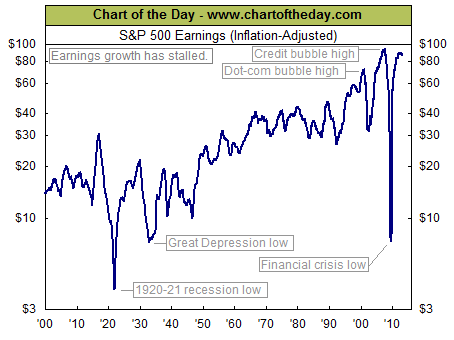
S&P 500 Earnings (inflation-adjusted ) 1900 until today

Source: Chart of the Day

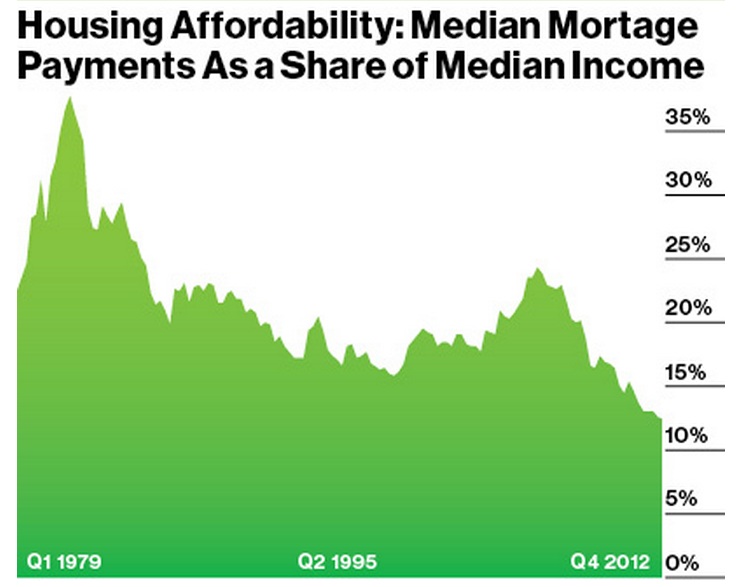
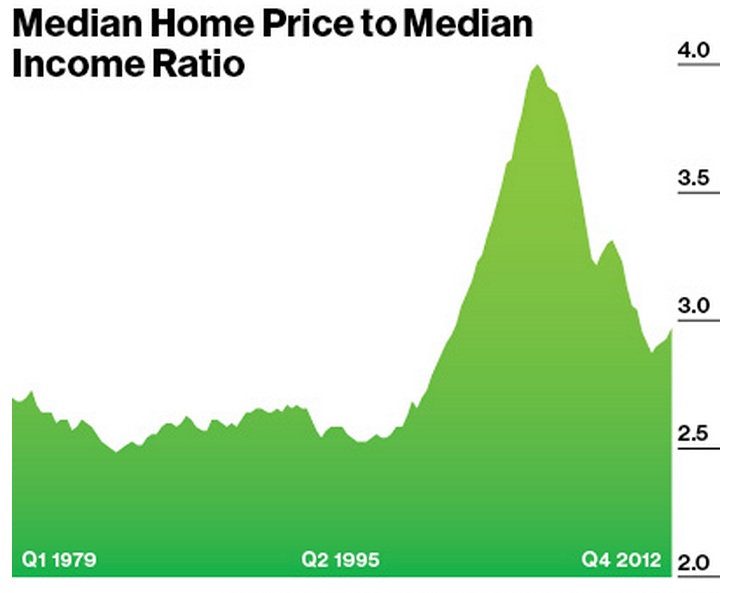
Cheap Mortgages: Misleading Home Price Watchers

Posted: 11 Apr 2013 12:30 PM PDT

Click to enlarge

~~~


"We are currently in a carnival funhouse mirror. Homes seem quite affordable when at base they are not."
-Stan Humphries, chief economist at Zillow.

Nice piece in Business Week explaining how ultra low mortgage rates are creating a misleading sense of the housing market . . .


Source:
Cheap Mortgages Are Hiding the Truth About Home Prices
Karen Weise
Businessweek, April 10, 2013 
http://www.businessweek.com/articles/2013-04-10/cheap-mortgages-are-hiding-the-truth-about-home-prices

Louis CK: I Am An Accidental White Person

Posted: 11 Apr 2013 12:11 PM PDT


Interesting read: “Coming here and observing America as an outsider [from Mexico] made me an observing person”

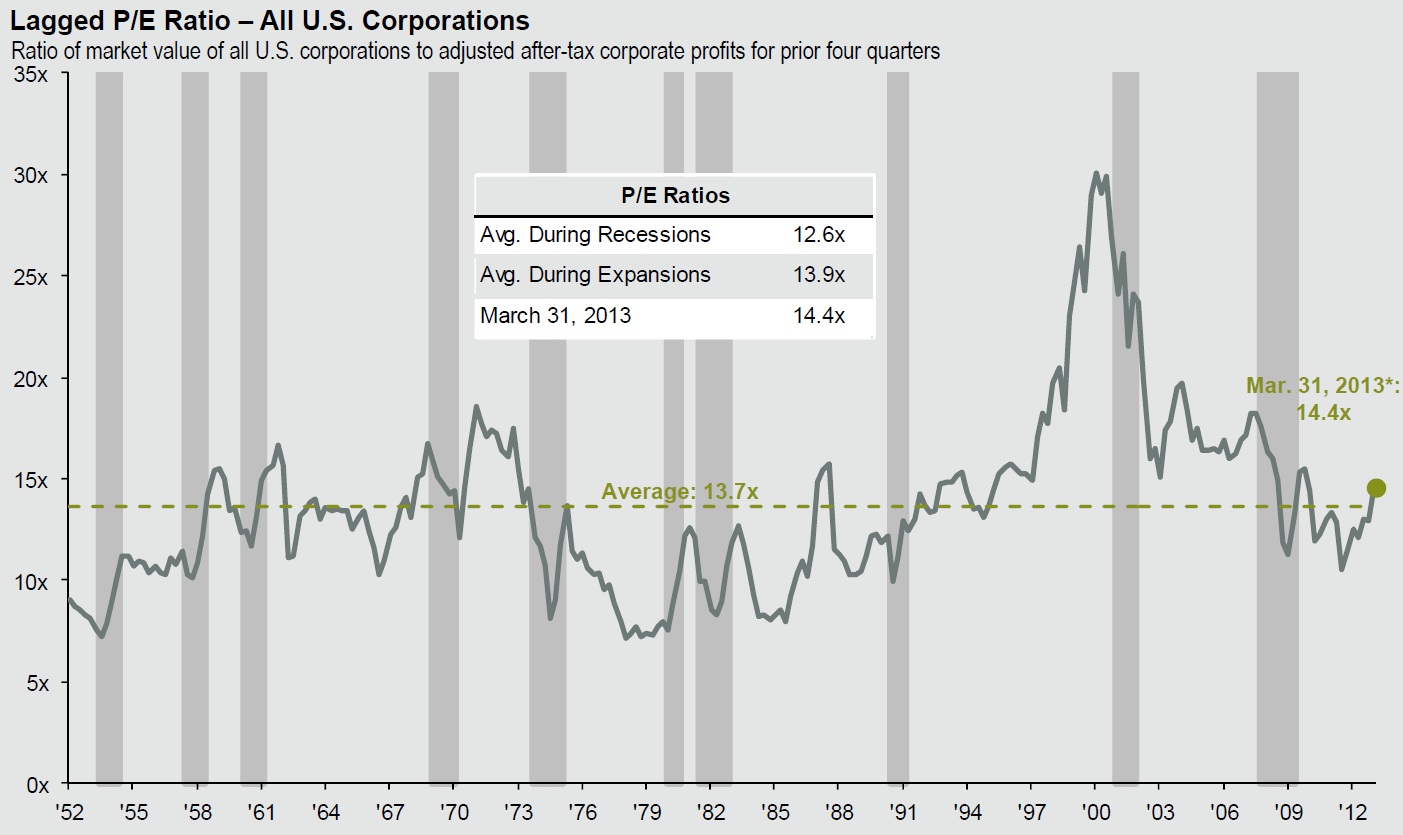
Broad Market Lagged Price to Earnings Ratio

Posted: 11 Apr 2013 08:30 AM PDT

Click to enlarge

Source:
BEA, Federal Reserve Board, Wilshire Associates, J.P. Morgan Asset Management
March 31, 2013

10 Thursday AM Reads

Posted: 11 Apr 2013 07:00 AM PDT

My morning reads:

• Asia Stocks Head for Biggest Gain in Seven Months on BOJ (Bloomberg)
• Dan Loeb's Investment Process (The Reformed Broker)
• The Great Rotation Remains Mainly Spin (Barron’s)
• Gold, Long a Secure Investment, Loses Its Luster (NYT)
• 3 bond bubble theories that don’t hold up (Fortune)
• The Federal Reserve's VIP List (thelongshorttrader) see also Banks on Fed Staffer E-Mail List Get Leak of FOMC Minutes (Bloomberg)
• Wood: The fuel of the future (Economist)
• PC Shipments Post the Steepest Decline Ever in a Single Quarter, According to IDC (IDC)
• Nine Things You Probably Didn't Know About Swear Words (Time)
WTF? Hacker uses an Android to remotely attack and hijack an airplane (Computer World)

What are you reading?


New Highs!

Source: Bespoke

2013 Tax Changes

Posted: 11 Apr 2013 05:00 AM PDT

States Fight Back Against MERS Mortgage Fraud

Posted: 11 Apr 2013 04:00 AM PDT

MERS: The Center of the Mortgage Scam

A prominent economist said about the 2008 financial crisis:

"At the root of the crisis we find the largest financial swindle in world history", where "counterfeit" mortgages were "laundered" by the banks.

The Mortgage Electronic Registration Systems – MERS – was one of the main ways the swindle was done, and the main way in which counterfeit mortgages were laundered by the banks.

MERS is a shell company with no employees, owned by the giant banks.

MERS threw out centuries of well-established law about how real estate is transferred – and cheated governments out of many tens or hundreds of billions of dollars in recording fees.

Matt Taibbi pointed out:

MERS … is essentially an effort at systematically evading taxes … and hiding information from homeowners in ways that enabled the Countrywides of the world to defraud investors and avoid legal consequences for same.

***

MERS was at least in part dreamed up by Angelo Mozilo of Countrywide.

***

For those of you wondering why so many localities are broke, here's one small factor in the revenue drain. Counties typically charge a small fee for mortgage registration, roughly $30. But with MERS, … you don't need to pay the fee every time there's an ownership transfer. Multiply that by 67 million mortgages and you're talking about billions in lost fees for local governments (some estimates place the total at about $200 billion).

Outrageously, MERS actually marketed itself to its customers as a way to save money by avoiding the payment of legally-mandated registration fees. Check out this MERS brochure from 2007. It brags on the face page about its fee-avoiding qualities ("MINIMIZE RISK. SAVE MONEY. REDUCE PAPERWORK") and inside the brochure, in addition to boasting about helping clients "Foreclose More Quickly," it talks about how clients save money because MERS "eliminates the need to record assignments in the name of the Trustee."

All of this adds up to a system that enabled the mortgage industry to avoid keeping any kind of proper paperwork on its frantic, coke-fueled selling and re-selling of mortgage-backed securities during the bubble, and to help the both the Countrywide-style subprime merchants and the big banks like Goldman and Chase pull off the mass sales of crappy loans as AAA-rated securities.

Harper's reported:

"What's happened," said Christopher Peterson, a law professor at the University of Utah who has written extensively about MERS, "is that, almost overnight, we've switched from democracy in real-property recording to oligarchy in real-property recording." The county clerks who established the ownership of land, who oversaw and kept the records, were democratically elected stewards of those records, said Peterson. Now a corporation headquartered outside Washington, D.C., oversaw the records. "There was no court case behind this, no statute from Congress or the state legislatures," Peterson told me. "It was accomplished in a private corporate decision. The banks just did it." Peterson said it was "not a coincidence" that more Americans than at any time since the Great Depression were being forced out of their homes just as records of home ownership and mortgages were transferred wholesale to a privatized database.

The Securitized Sausage Maker

http://www.biltongmakers.com/Cnops%20107_0724.JPG

MERS was also the engine which allowed securitization of mortgages. Bloomberg reported:

MERS played a key role in the bundling of mortgages into securities that reached a frenzy before the economic decline of 2008, critics including Grayson of Florida said. It allowed banks to sell and resell home loans faster, easier and cheaper, he said.

"MERS was a facilitator of securitization," said Grayson, a Democratic member of the House Financial Services Committee.

How?

Steve Liesman explained in 2007:

How do you create a subprime derivative? …You take a bunch of mortgages… and put them into one big thing. We call it a Mortgage Backed Security. Say it's $50 million worth… Now you take a bunch of these Mortgage Backed Securities and you put them into one very big thing… The one thing about all these guys here [in the one very big thing] is that they're all subprime borrowers, their credit is bad or there's something about them that doesn't make it prime…

Watch, we're going to make some triple A paper out of this… Now we have a $1 billion vehicle here. We're going to slice it up into five different pieces. Call them tranches… The key is, they're not divided by "Jane's is here" and "Joe's is here." Jane is actually in all five pieces here. Because what we're doing is, the BBB tranche, they're going to take the first losses for whoever is in the pool, all the way up to about 8% of the losses. What we're saying is, you've got losses in the thing, I'm going to take them and in return you're going to pay me a relatively high interest rate… All the way up to triple A, where 24% of the losses are below that. Twenty-four percent have to go bad before they see any losses. Here's the magic as far as Wall Street's concerned. We have taken subprime paper and created GE quality paper out of it. We have a triple A tranche here.

Ellen Brown explained the significance of MERS in this process:

The top tranche is triple A because it includes the mortgages that did NOT default; but no one could know which those were until the defaults occurred, when the defaulting mortgages got assigned to the lower tranches and foreclosure went forward. That could explain why the mortgages could not be assigned to the proper group of investors immediately: the homes only fell into their designated tranches when they went into default. The clever designers of these vehicles tried to have it both ways by conveying the properties to an electronic dummy conduit called MERS (an acronym for Mortgage Electronic Registration Systems), which would hold them in the meantime. MERS would then assign them to the proper tranche as the defaults occurred. But the rating agencies required that the conduit be "bankruptcy remote," which meant it could hold title to nothing; and courts have started to take notice of this defect.

(Gonzalo Lira made the same point.)

Indeed, the secretary and treasurer of MERS admitted this in a deposition, stating (page 32, lines 9-20):

As a requirement for mortgages that were securing loans or promissory notes that were sold to securitize trust, the rating agencies would only allow mortgages MERS — well let me step back. They required that a bankruptcy remote single purpose entity be created in order for transactions holding loans secured by MERS, by mortgages MERS served as mortgagee to be in those pools and receive a rating, an investment grade rating without any changes to the credit enhancement. They required that to be a bankruptcy remote single purpose subsidiary of MERS, of Merscorp.

Many commercial mortgages may be held by MERS as well, and for the same reason.

Harper's points out:

[MERS] facilitated the buying and selling of mortgage debt at great speed and greatly reduced cost. It was a key innovation in expediting the packaging of mortgage-backed securities. Soon after the registry launched, in 1999, the Wall Street ratings agencies pronounced the system sound. "The legal mechanism set up to put creditors on notice of a mortgage is valid," as was "the ability to foreclose," assured Moody's. That same year, Lehman Brothers issued the first AAA-rated mortgage-backed security built out of MERS mortgages. By the end of 2002, MERS was registering itself as the owner of 21,000 loans every day. Five years later, at the peak of the housing bubble, MERS registered some two thirds of all home loans in the United States.

Without the efficiencies of MERS there probably would never have been a mortgage-finance bubble.

(In addition, the same mortgage was sometimes pledged to numerous buyers at the same time. This wouldn't have been possible without the vaporware title given by MERS. And some – like foreclosure attorney Neil Garfield – think that the ability to pledge the same mortgage multiple times is a feature, rather than a bug, of MERS. And see this.)

Relief Must Come at the State Level

Property recording laws are state laws, and the states have always been the bedrock for property rights.

Given that the head of the U.S. Department of Justice used to represent MERS – and that the D.C. politicians are (with a few exceptions) lackeys for the big banks which own MERS – the only hope is at the state level.

Some state courts have, in fact, declared MERS illegal … or at least without power to foreclose on property.

Harper's notes:

After the housing market collapsed, however, MERS found itself under attack in courts across the country. MERS had singlehandedly unraveled centuries of precedent in property titling and mortgage recordation, and judges in state appellate and federal bankruptcy courts in more than a dozen jurisdictions—the primary venues where real estate cases are decided— determined that the company did not have the right to foreclose on the mortgages it held.

In 2009, Kansas became one of the first states to have its supreme court rule against MERS. In Landmark National Bank v. Boyd A. Kesler, the court concluded that MERS failed to follow Kansas statute: the company had not publicly recorded the chain of title with the relevant registers of deeds in counties across the state. A mortgage contract, the justices wrote, consists of two documents: the deed of trust, which secures the house as collateral on a loan, and the promissory note, which indebts the borrower to the lender. The two documents were sometimes literally inseparable: under the rules of the paper recording system at county court-houses, they were tied together with a ribbon or seal to be undone only once the note had been paid off. "In the event that a mortgage loan somehow separates interests of the note and the deed of trust, with the deed of trust lying with some independent entity," said the Kansas court, "the mortgage may become unenforceable."

MERS purported to be the independent entity holding the deed of trust. The note of indebtedness, however, was sold within the MERS system, or "assigned" among various lenders. This was in keeping with MERS's policy: it was not a bank, made no loans, had no money to lend, and did not collect loan payments. It had no interest in the loan, only in the deed of trust. The company—along with the lenders that had used it to assign ownership of notes—had thus entered into a vexing legal bind. "There is no evidence of record that establishes that MERS either held the promissory note or was given the authority [to] assign the note," the Kansas court found, quoting a decision from a district court in California. Not only did MERS fail to legally assign the notes, the company presented "no evidence as to who owns the note."

Similar cases were brought before courts in Idaho, Massachusetts, Missouri, Nevada, New York, Oregon, Utah, and other states. "It appears that every MERS mortgage," a New York State Supreme Court judge recently told me, "is defective, a piece of crap." The language in the judgments against MERS became increasingly denunciatory. MERS's arguments for standing in foreclosure were described as "absurd," forcing courts to move through "a syntactical fog into an impassable swamp."

The next key battle is taking place right now in Rhode Island. Specifically, the Rhode Island Attorney General and state legislators are trying to slay the MERS dragon within their state:

Citing the irregularities with the recording of mortgages and assignments that negatively impact municipalities and consumers, Attorney General Peter F. Kilmartin filed legislation to require that all transfers of a mortgage interest on residential property be recorded to provide a clean chain of title. The legislation, S0547 sponsored by Senator William Conley (District 18, East Providence, Pawtucket) and H5512 sponsored by Representative Brian Kennedy (District 38, Hopkinton, Westerly), is scheduled to be heard before both the Senate Committee on Judiciary and House Corporations Committee on Tuesday, March 26, 2013.

The legislation makes it easier for borrowers and regulators to determine who owns loans secured by mortgages on Rhode Island property. Borrowers facing foreclosure will be able to more easily discover who owns their loans before it is too late, and municipalities will be able to identify lenders who are responsible for abandoned homes. The legislation will [stop] the practice of having the vast majority of mortgages held in the name of a private registry with no interest in the loans known as … "MERS."

Since 1997, the banking industry has been using MERS, which lenders claim has minimized their administrative and financial burdens of the recording process. However, this practice has basically privatized the local land recording process, thereby undermining the accuracy of public records and leading to negative consequences for consumers and municipalities.

"The changing of servicing and subservicing rights within the lending history often leaves the borrower confused regarding which entity they are supposed to be dealing with on a monthly basis and why," said Attorney General Kilmartin. "The legislation is designed to give borrowers a public record of who ultimately owns their loans, increasing the ability of homeowners to negotiate with their lenders and their ability to have full knowledge of their rights, counterclaims and defenses if they are faced with litigation."

"Rhode Island has experienced a record number of foreclosure and short sales since the mortgage crisis," said Representative Kennedy, "This legislation will assist homeowners in knowing who maintains the note on their property while also ensuring that local cities and towns will know the potential owner of a property after a forced sale has occurred, to ensure that municipalities have the proper information available on the documentation for taxation and municipal recording fees."

"With this legislation, we are taking another step toward easing the pain of the housing and mortgage foreclosure crisis, which has affected both the state's municipalities and individual consumers," Sen. William J. Conley Jr. said. "It is common sense to record these transfers and take out the unnecessary middle man. Rhode Islanders need to know exactly who they are dealing with and how they can protect themselves. The foreclosure process is tough enough already without adding the frustration of MERS."

By having a nominee entity listed as the mortgagee, the banking industry has privatized Rhode Island's mortgage recording system, and left the accuracy of public land records at the mercy of a private company's database. Federal banking authorities have already concluded that the private mortgage system contains numerous inaccuracies and has not been accessible to homeowners. Moreover, the nominee frequently has no contractual relationship with the actual noteowner, despite the contention in the mortgage documents of a nominee relationship.

Not only has this private system deprived cities and towns the recording fees that they are owed for over 15 years, it has also hampered the ability of municipalities to adequately address abandoned property and nuisance issues because the mortgagee liable for these issues is not clear from the chain of title.

Consumers are adversely impacted due to the fact that their mortgage loans change hands multiple times through the life of the loan without proper recording. The lack of a contemporaneous public record hampers their ability to deal directly with their lenders and enforce their legal rights.

The banking industry's practice of using a nominee entity process for recording deeds has become a highly litigated issue by consumers, municipalities and counties throughout the country. This very issue is currently being litigated in Rhode Island with private citizens and municipalities calling into question the legality of using the nominee process to record mortgage interests. The multitude of legal issues surrounding the nominee process has caused confusion and delay in foreclosure proceedings in our State, and has raised the critical issue of whether a nominee entity can enforce the power of sale. High Courts in other States, including Massachusetts and Washington, have already ruled that a nominee cannot utilize the power of sale [i.e. MERS cannot foreclose on property]. This legislation resolves this issue in Rhode Island by simply eliminating the nominee recording process and restoring accuracy and transparency to the public land records [i.e. killing MERS].

Hoenig: Basel III Capital Is A Well-Intended Illusion

Posted: 11 Apr 2013 03:00 AM PDT

Basel III Capital: A Well-Intended Illusion
Thomas M. Hoenig, FDIC Vice Chairman
International Association of Deposit Insurers 2013 Research Conference in Basel, Switzerland, April 9, 2013


Introduction

Aristotle is credited with being the first philosopher to systematically study logical fallacies, which he defined as arguments that appear valid but, in fact, are not. I call them well-intended illusions.

One such illusion of precision is the Basel capital standards in which world supervisory authorities rely principally on a Tier 1 capital ratio to judge the adequacy of bank capital and balance sheet strength. For the largest of these firms, each dollar of risk-weighted assets is funded with 12 to 15 cents in equity capital, projecting the illusion that these firms are well capitalized. The reality is that each dollar of their total assets is funded with far less equity capital, leaving open the matter of how well capitalized they might be.

Here's how the illusion is created. Basel’s Tier 1 capital measure is a bank’s ratio of Tier 1 capital to risk-weighted assets. Each category of bank assets is weighed by the supervisory authority on a complicated scale of probabilities and models that assign a relative risk of loss to each group, including off balance sheet items. Assets deemed low risk are reported at lower amounts on the balance sheet. The lower the risk, the lower the amount reported on the balance sheet for capital purposes and the higher the calculated Tier 1 ratio.

We know from years of experience using the Basel capital standards that once the regulatory authorities finish their weighting scheme, bank managers begin the process of allocating capital and assets to maximize financial returns around these constructed weights. The objective is to maximize a firm’s return on equity (ROE) by managing the balance sheet in such a manner that for any level of equity, the risk-weighted assets are reported at levels far less than actual total assets under management. This creates the illusion that banking organizations have adequate capital to absorb unexpected losses. For the largest global financial companies, risk-weighted assets are approximately one-half of total assets. This “leveraging up” has served world economies poorly.

In contrast, supervisors and financial firms can choose to rely on the tangible leverage ratio to judge the overall adequacy of capital for the enterprise. This ratio compares equity capital to total assets, deducting goodwill, other intangibles, and deferred tax assets from both equity and total assets. In addition to including only loss-absorbing capital, it also makes no attempt to predict or assign relative risk weights among asset classes. Using this leverage ratio as our guide, we find for the largest banking organizations that each dollar of assets has only 4 to 6 cents funded with tangible equity capital, a far smaller buffer than asserted under the Basel standards.

Comparing Measures

Table 1 [see below] reports the Basel Tier 1 risk-weighted capital ratio and the leverage ratio for different classes of banking firms. Column 4 shows Tier 1 capital ratios ranging between 12 and 15 percent for the largest global firms, giving the impression that these banks are highly capitalized. However, it is hard to be certain of that by looking at this ratio since risk-weighted assets are so much less than total assets. In contrast, Column 6 shows U.S. firms’ average leverage ratio to be 6 percent using generally accepted accounting standards (GAAP), and Column 8 shows their average ratio to be 3.9 percent using international accounting standards (IFRS), which places more of these firms’ derivatives onto the balance sheet than does GAAP.

The bottom portion of Table 1 shows the degree of leverage among different size groups of banking firms, which is striking as well. The Tier 1 capital measure suggests that all size groups of banks hold comparable capital levels, while the leverage ratio reports a different outcome. For example, the leverage ratio for most banking groups not considered systemically important averages near 8 percent or higher. Under GAAP accounting standards, the difference in this ratio between the largest banking organizations and the smaller firms is 175-250 basis points. Under IFRS standards, the difference is as much as 400-475 basis points. The largest firms, which most affect the economy, hold the least amount of capital in the industry. While this shows them to be more fragile, it also identifies just how significant a competitive advantage these lower capital levels provide the largest firms.

These comparisons illustrate how easily the Basel capital standard can confuse and misinform the public rather than meaningfully report a banking company's relative financial strength. Recent history shows also just how damaging this can be to the industry and the economy. In 2007, for example, the 10 largest and most complex U.S. banking firms reported Tier 1 capital ratios that, on average, exceeded 7 percent of risk-weighted assets. Regulators deemed these largest to be well capitalized. This risk-weighted capital measure, however, mapped into an average leverage ratio of just 2.8 percent. We learned all too late that having less than 3 cents of tangible capital for every dollar of assets on the balance sheet is not enough to absorb even the smallest of financial losses, and certainly not a major shock. With the crisis, the illusion of adequate capital was discovered, after having misled shareholders, regulators, and taxpayers.

There are other, more recent, examples of how this arcane measure can be manipulated to give the illusion of strength even when a firm incurs losses. For example, in the fourth quarter of 2012, Deutsche Bank reported a loss of 2.5 billion EUR. That same quarter, its Tier 1 risk-based capital ratio increased from 14.2 percent to 15.1 percent due, in part, to "model and process enhancements"1 that resulted in a decline in risk-weighted assets, which now amount to just 16.6 percent of total assets.

On Feb. 1, SNS Reaal, the fourth largest Dutch bank with $5 billion in assets, was nationalized by the Dutch government. Just seven months earlier, on June 30, 2012, SNS reported a Tier 1 risk-based capital ratio of 12.2 percent. However, the firm reported a Tier 1 leverage ratio based upon international accounting standards of only 1.47 percent. This leverage ratio was much more indicative of the SNS's poor financial position.

The Basel III proposal belatedly introduces the concept of a leverage ratio but calls for it to be only 3 percent, an amount already shown to be insufficient to absorb sizable financial losses in a crisis. It is wrong to suggest to the public that, with so little capital, these largest firms could survive without public support should they encounter any significant economic reversals.

Misallocating Resources and Creating Asset Imbalances

An inherent problem with a risk-weighted capital standard is that the weights reflect past events, are static, and mostly ignore the market’s collective daily judgment about the relative risk of assets. It also introduces the element of political and special interests into the process, which affects the assignment of risk weights to the different asset classes. The result is often to artificially favor one group of assets over another, thereby redirecting investments and encouraging over-investment in the favored assets. The effect of this managed process is to increase leverage, raise the overall risk profile of these institutions, and increase the vulnerability of individual companies, the industry, and the economy.

It is no coincidence, for example, that after a Basel standard assigned only a 7 percent risk weight on triple A, collateralized debt obligations and similar low risk weights on assets within a firm’s trading book, resources shifted to these activities. Over time, financial groups dramatically leveraged these assets onto their balance sheets even as the risks to that asset class increased exponentially. Similarly, assigning zero weights to sovereign debt encouraged banking firms to invest more heavily in these assets, simultaneously discounting the real risk they presented and playing an important role in increasing it. In placing a lower risk weight on select assets, less capital was allocated to fund them and to absorb unexpected loss for these banks, undermining their solvency.

A More Realistic Capital Standard Is Required

Taxpayers are the ultimate backstop to the safety net and have real money at stake. In choosing which capital measure is most useful, it is fair to ask the following questions:

  • Does the Basel Tier 1 ratio or the tangible leverage ratio best indicate the capital strength of the firm?
  • Which one is most clearly understood?
  • Which one best enables comparison of capital across institutions?
  • Which one offers the most confidence that it cannot be easily gamed?

Charts 1 through 4 [see below] compare the relationship of the tangible leverage and Basel Tier 1 capital ratios to various market measures for the largest firms. These measures include: the price-to-book ratio, estimated default frequency, credit default swap spreads, and market value of equity. In each instance, the correlation of the tangible leverage ratio to these variables is higher than for the risk-weighted capital ratio. While such findings are not conclusive, they suggest strongly that investors, when deciding where to place their money, rely upon the information provided by the leverage ratio. We would do well to do the same.

Despite all of the advancements made over the years in risk measurement and modeling, it is impossible to predict the future or to reliably anticipate how and to what degree risks will change. Capital standards should serve to cushion against the unexpected, not to divine eventualities. All of the Basel capital accords, including the proposed Basel III, look backward and then attempt to assign risk weights into the future. It doesn’t work.

In contrast, the tangible leverage ratio provides a simpler, more direct insight into the amount of loss-absorbing capital that is available to a firm. A leverage ratio as I've defined it explicitly excludes intangible items that cannot absorb losses in a crisis. Also, using IFRS accounting rules, off-balance sheet derivatives are brought onto the balance sheet, providing further insight into a firm’s leverage. Thus, the tangible leverage ratio is simpler to compute and more easily understood by bank managers, directors, and the public. Importantly also, it is more likely to be consistently enforced by bank supervisors.

A more difficult challenge may be to determine an appropriate minimum leverage ratio. Chart 5 [see below] provides a history of bank leverage over the past 150 years for the U.S. banking system and gives initial insight into this question. It shows that the equity capital to assets ratio for the industry prior to the founding of the Federal Reserve System in 1913 and the Federal Deposit Insurance Corporation in 1933 ranged between 13 and 16 percent, regardless of bank size. Without any internationally dictated standard or any arcane weighting process, markets required what today seems like relatively high capital levels.

In addition, there is an increasing body of research (Admati and Hellwig; Haldane; Miles, Yang, and Marcheggiano) that suggests that leverage ratios should be much higher than they currently are and that Basel III's proposed 3 percent figure adds little security to the system.

Finally, and importantly, some form of risk-weighted capital measure could be useful as a backstop, or check, against which to judge the adequacy of the leverage ratio for individual banks. If a bank meets the minimum leverage ratio but has concentrated assets in areas that risk models suggest increase the overall vulnerability of the balance sheet, the bank could be required to increase its tangible capital levels. Such a system provides the most comprehensive measure of capital adequacy both in a broad context of all assets and according to a bank’s allocation of assets along a defined risk profile.

Tangible Leverage Ratio and the Myth of Unintended Consequences

Concerns are often raised within the financial industry and elsewhere that requiring the largest and most complex firms to hold higher levels of capital as defined using a tangible leverage ratio would have serious adverse effects on the industry and broader economy.

It has been suggested, for example, that requiring more capital for these largest banks would raise their relative cost of capital and make them less competitive. Similarly, there is concern that failing to assign risk weights to the different categories of assets would encourage firms to allocate funds to the highest risk assets to achieve targeted returns to equity. These issues have been well addressed by Anat Admati and Martin Hellwig in their recently published book, The Bankers' New Clothes. The required ROE and the ability to attract capital are determined by a host of factors beyond the level of equity capital. These include a firm's business model, its risk-adjusted returns, the benefits of services and investments, and the undistorted, or non-subsidized, costs of capital. A level of capital that lowers risk may very well attract investors drawn to the more reliable returns. Table 1 shows many of the banks with stronger leverage ratios also have stock prices trading at a higher premium to book value than the largest firms that are less well-capitalized.

There also is a concern that requiring a stronger, simpler leverage ratio would cause managers to place more risk on their balance sheet. While possible, the argument is unconvincing. With more capital at risk and without regulatory weighting schemes affecting choice, managers will allocate capital in line with market risk and returns. Furthermore, risk-weighted measures and strong bank supervision can be available as a back-up system to monitor such activity. Moreover, given the experience of the recent crisis and the on-going efforts to manage reported risk assets down, no matter the risk, it rings hollow to suggest that having a higher equity buffer for the same amount of total assets makes the financial system less safe.

In addition, there is a concern that demanding more equity capital and reducing leverage among the largest firms would inhibit the growth of credit and the economy. This statement has an implied presumption that the Basel weighting scheme is more growth friendly than a simpler, stronger leverage ratio. However, having a sufficient capital buffer allows banks to absorb unexpected losses. This serves to moderate the business cycle and the decline in lending that otherwise occurs during contractions.

If the Basel risk-weight schemes are incorrect, which they often have been, this too could inhibit loan growth, as it encourages investments in other more favorably, but incorrectly, weighted assets. Basel systematically encourages investments in sectors pre-assigned lower weights — for example, mortgages, sovereign debt, and derivatives — and discourages loans to assets assigned higher weights — commercial and industrial loans. We may have inadvertently created a system that discourages the very loan growth we seek, and instead turned our financial system into one that rewards itself more than it supports economic activity.

If risk weights could be assigned that anticipate and calibrate risks with perfect foresight, adjusted on a daily basis, then perhaps risk-weighted capital standards would be the preferred method for determining how to deploy capital.  However, they cannot.  To believe they can is a fallacy that puts the entire economic system at risk.

Changing the Debate

The tangible leverage ratio is a superior alternative to risk-weighting schemes that have proven to be an illusion of precision and insufficient in defining adequate capital. The effect of relying on such measures has been to weaken the financial system and misallocate resources. The leverage ratio deserves serious consideration as the principal tool in judging the capital strength of financial firms. The Basel discussion would be well served to focus on the appropriate levels of tangible capital for banking firms to hold and the right transition period to achieve these levels.

Finally, we should not accept even comforting errors of logic which suggest that Basel III requirements will create stronger capital than those of Basel II, which failed. Instead, past industry performance and mounting academic and other evidence suggest that we would be best served to focus on a strong leverage ratio standard in judging a firm and the industry’s financial strength. No bank capital program is perfect. Our responsibility as regulators and deposit insurers is to choose the best available measure that will contribute to financial stability.

###


References
Admati, Anat and Martin Hellwig. 2013. The Bankers' New Clothes. Princeton, NJ: Princeton University Press.

Haldane, Andrew G. 2012. The Dog and the Frisbee. Available at www.kcfed.org/publicat/sympos/2012/ah.pdf

D. Miles, J. Yang and G. Marcheggiano, The Economic Journal, vol 123, issue 567, March 2013. Available at http://onlinelibrary.wiley.com/doi/10.1111/j.1468-0297.2012.02521.x/abstract

1 Deutsche Bank press release, 31 January 2013, "Implementation of new strategy with significant impact on 2012 results."


.

0 comments:

Post a Comment

previous home Next

{8} chatroll


{9} AdBrite FOOTER

{8} Nice Blogs (Adgetize)