


The Big Picture |

- Why There Is So Much Pro-War Reporting
- Succinct Summation of Week’s Event (May 17, 2013)
- Ritholtz: “Give the Market the Benefit of the Doubt”
- De-equitization Juicing Market Gains
- Google and Tesla: Too Late to Touch?
- Wrong Like It’s Their Job
- Gundlach of DoubleLine Goes Prime Time
| Why There Is So Much Pro-War Reporting Posted: 17 May 2013 10:30 PM PDT 5 Reasons that Both Mainstream Media – and Gatekeeper "Alternative" Websites – Are Pro-War
Why There Is So Much Pro-War ReportingThere are five reasons that the mainstream media and the largest alternative media websites are both pro-war. 1. Self-Censorship by JournalistsInitially, there is tremendous self-censorship by journalists. A survey by the Pew Research Center and the Columbia Journalism Review in 2000 found:
Similarly, a 2003 survey reveals that 35% of reporters and news executives themselves admitted that journalists avoid newsworthy stories if "the story would be embarrassing or damaging to the financial interests of a news organization's owners or parent company." Several months after 9/11, Dan Rather told the BBC that American reporters were practicing "a form of self-censorship":
Rather said in 2008:
Keith Olbermann agreed that there is self-censorship in the American media, and that:
Former Washington Post columnist Dan Froomkin wrote in 2006:
MarketWatch columnist Brett Arends wrote yesterday:
Self-censorship obviously occurs on the web as well as in old media. As Wikipedia notes:
2. Censorship by Higher-UpsIf journalists do want to speak out about an issue, they also are subject to tremendous pressure by their editors or producers to kill the story. The 2000 Pew and Columbia Journalism Review survey notes:
The Pulitzer prize-winning reporter who uncovered the Iraq prison torture scandal and the Mai Lai massacre in Vietnam, Seymour Hersh, said:
In fact many journalists are warning that the true story is not being reported. And see this announcement. A series of interviews with award-winning journalists also documents censorship of certain stories by media editors and owners (and see these samples). It's not just the mainstream media. The large "alternative" media websites censor as well. For example:
There are many reasons for censorship by media higher-ups. One is money. The media has a strong monetary interest to avoid controversial topics in general. It has always been true that advertisers discourage stories which challenge corporate power. In 1969, Federal Communications Commission commissioner Nicholas Johnson noted that tv networks go to great lengths to please their sponsors. Some media companies make a lot of money from the government, and so don't want to rock the boat. For example, Glenn Greenwald notes:
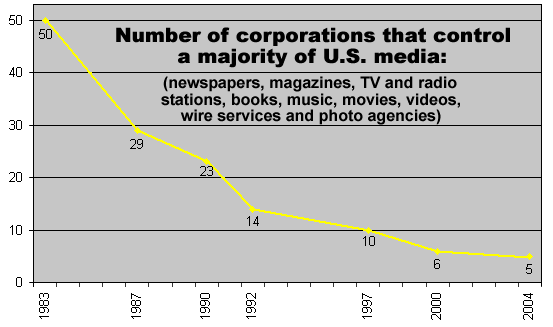
In addition, the government has allowed tremendous consolidation in ownership of the airwaves during the past decade. Dan Rather has slammed media consolidation:
This is documented by the following must-see charts prepared by: And check out this list of interlocking directorates of big media companies from Fairness and Accuracy in Media, and this resource from the Columbia Journalism Review to research a particular company. This image gives a sense of the decline in diversity in media ownership over the last couple of decades: The large media players stand to gain billions of dollars in profits if the Obama administration continues to allow monopoly ownership of the airwaves by a handful of players. The media giants know who butters their bread. So there is a spoken or tacit agreement: if the media cover the administration in a favorable light, the MSM will continue to be the receiver of the government's goodies. The large alternative media websites also censor news which are too passionately anti-war. The biggest social media websites censor the hardest-hitting anti-war stories. And see this. Huffington Post – the largest liberal website – is owned by media giant AOL Time Warner, and censors any implication that a Democratic administration could be waging war for the wrong reasons. So HuffPost may criticize poor prosecution of the war, but would never say that the entire "War on Terror" as currently waged by the Obama administration is a stupid idea. Similarly, Drudge Report – the largest conservative website – never questions whether the government's engagement in offensive military action around the world is strengthening or weakening our national security. The largest "alternative" websites may weakly criticize minor details of the overall war effort, but would never say that more or less worldwide war-fighting is counterproductive. They may whine about a specific aspect of the war-fighting … but never look at the larger geopolitical factors involved. They all seem to follow Keith Olbermann's advice:
3. Drumming Up Support for War Anthony Freda: www.AnthonyFreda.com In addition, the owners of American media companies have long actively played a part in drumming up support for war. It is painfully obvious that the large news outlets studiously avoided any real criticism of the government's claims in the run up to the Iraq war. It is painfully obvious that the large American media companies acted as lapdogs and stenographers for the government's war agenda. Veteran reporter Bill Moyers criticized the corporate media for parroting the obviously false link between 9/11 and Iraq (and the false claims that Iraq possessed WMDs) which the administration made in the run up to the Iraq war, and concluded that the false information was not challenged because:
As NBC News' David Gregory (later promoted to host Meet the Press) said:
But this is nothing new. In fact, the large media companies have drummed up support for all previous wars. For example, Hearst helped drum up support for the Spanish-American War. And an official summary of America's overthrow of the democratically-elected president of Iran in the 1950′s states, "In cooperation with the Department of State, CIA had several articles planted in major American newspapers and magazines which, when reproduced in Iran, had the desired psychological effect in Iran and contributed to the war of nerves against Mossadeq." (page x) The mainstream media also may have played footsie with the U.S. government right before Pearl Harbor. Specifically, a highly-praised historian (Bob Stineet) argues that the Army's Chief of Staff informed the Washington bureau chiefs of the major newspapers and magazines of the impending Pearl Harbor attack BEFORE IT OCCURRED, and swore them to an oath of secrecy, which the media honored (page 361) . And the military-media alliance has continued without a break (as a highly-respected journalist says, "viewers may be taken aback to see the grotesque extent to which US presidents and American news media have jointly shouldered key propaganda chores for war launches during the last five decades.") As the mainstream British paper, the Independent, writes:
The article in the Independent discusses the use of "black propaganda" by the U.S. government, which is then parroted by the media without analysis; for example, the government forged a letter from al Zarqawi to the "inner circle" of al-Qa'ida's leadership, urging them to accept that the best way to beat US forces in Iraq was effectively to start a civil war, which was then publicized without question by the media. So why has the American press has consistently served the elites in disseminating their false justifications for war? One of of the reasons is because the large media companies are owned by those who support the militarist agenda or even directly profit from war and terror (for example, NBC was owned by General Electric, one of the largest defense contractors in the world … which directly profits from war, terrorism and chaos. NBC was subsequently sold to Comcast). Another seems to be an unspoken rule that the media will not criticize the government's imperial war agenda. And the media support isn't just for war: it is also for various other shenanigans by the powerful. For example, a BBC documentary proves:
See also this book. Have you ever heard of this scheme before? It was certainly a very large one. And if the conspirators controlled the newspapers then, how much worse is it today with media consolidation? (Kevin Dutton – research psychologist at the University of Cambridge – whose research has been featured in Scientific American Mind, New Scientist, The Guardian, Psychology Today and USA Today – also notes that media personalities and journalists – especially when combined in the same persons – are likely to be psychopaths. Some 12 million Americans are psychopaths or sociopaths, and psychopaths tend to rub each others' backs.) 4. AccessDan Froomkin, Brett Arends and many other mainstream reporters have noted that "access" is the most prized thing for mainstream journalists … and that they will keep fawning over those in power so that they will keep their prized access. But there is another dynamic related to access at play: direct cash-for-access payments to the media. For example, a 3-time Emmy Award winning CNN journalist says that CNN takes money from foreign dictators to run flattering propaganda. Politico reveals:
That may be one reason that the mainstream news commentators hate bloggers so much. The more people who get their news from blogs instead of mainstream news sources, the smaller their audience, and the less the MSM can charge for the kind of "nonconfrontational access" which leads to puff pieces for the big boys. 5. Censorship by the GovernmentFinally, as if the media's own interest in promoting war is not strong enough, the government has exerted tremendous pressure on the media to report things a certain way. If they criticize those in power, they may be smeared by the government and targeted for arrest (and see this). Indeed, the government treats real reporters as terrorists. Because the core things which reporters do could be considered terrorism, in modern America, journalists are sometimes targeted under counter-terrorism laws. The government spies on reporters. Not only has the government thrown media owners and reporters in jail if they've been too critical, it also claims the power to indefinitely detain journalists without trial or access to an attorney which chills chills free speech. After Pulitzer Prize winning journalist Chris Hedges, journalist Naomi Wolf, Pentagon Papers whistleblower Daniel Ellsberg and others sued the government to enjoin the NDAA's allowance of the indefinite detention of Americans – the judge asked the government attorneys 5 times whether journalists like Hedges could be indefinitely detained simply for interviewing and then writing about bad guys. The government refused to promise that journalists like Hedges won't be thrown in a dungeon for the rest of their lives without any right to talk to a judge. An al-Jazeera journalist – in no way connected to any terrorist group – was held at Guantánamo for six years … mainly to be interrogated about the Arabic news network. And see this. Wikileaks' head Julian Assange could face the death penalty for his heinous crime of leaking whistleblower information which make those in power uncomfortable … i.e. being a reporter. As constitutional lawyer Glenn Greenwald notes:
Former attorney general Mukasey said the U.S. should prosecute Assange because it's "easier" than prosecuting the New York Times. But now Congress is considering a bill which would make even mainstream reporters liable for publishing leaked information (part of an all-out war on whistleblowing). As such, the media companies have felt great pressure from the government to kill any real questioning of the endless wars. For example, Dan Rather said, regarding American media, "What you have is a miniature version of what you have in totalitarian states". Tom Brokaw said "all wars are based on propaganda. And the head of CNN said: Indeed, former military analyst and famed Pentagon Papers whistleblower Daniel Ellsberg said that the government has ordered the media not to cover 9/11:
Of course, if the stick approach doesn't work, the government can always just pay off reporters to spread disinformation. Famed Watergate reporter Carl Bernstein says the CIA has already bought and paid for many successful journalists. See also this New York Times piece, this essay by the Independent, this speech by one of the premier writers on journalism, and this and this roundup. Indeed, in the final analysis, the main reason today that the media giants will not cover the real stories or question the government's actions or policies in any meaningful way is that the American government and mainstream media been somewhat blended together. Can We Win the Battle Against Censorship?We cannot just leave governance to our "leaders", as "The price of freedom is eternal vigilance" (Jefferson). Similarly, we cannot leave news to the corporate media. We need to "be the media" ourselves. "To stand in silence when they should be protesting makes cowards out of men." "Our lives begin to end the day we become silent about things that matter." "Powerlessness and silence go together. We…should use our privileged positions not as a shelter from the world's reality, but as a platform from which to speak. A voice is a gift. It should be cherished and used." "There is no act too small, no act too bold. The history of social change is the history of millions of actions, small and large, coming together at points in history and creating a power that governments cannot suppress." "All tyranny needs to gain a foothold is for people of good conscience to remain silent"  |
| Succinct Summation of Week’s Event (May 17, 2013) Posted: 17 May 2013 01:00 PM PDT Succinct Summations week ending May 17, 2013. Positives:
Negatives:
 |
| Ritholtz: “Give the Market the Benefit of the Doubt” Posted: 17 May 2013 09:00 AM PDT Click for video Source: Yahoo Finance
 |
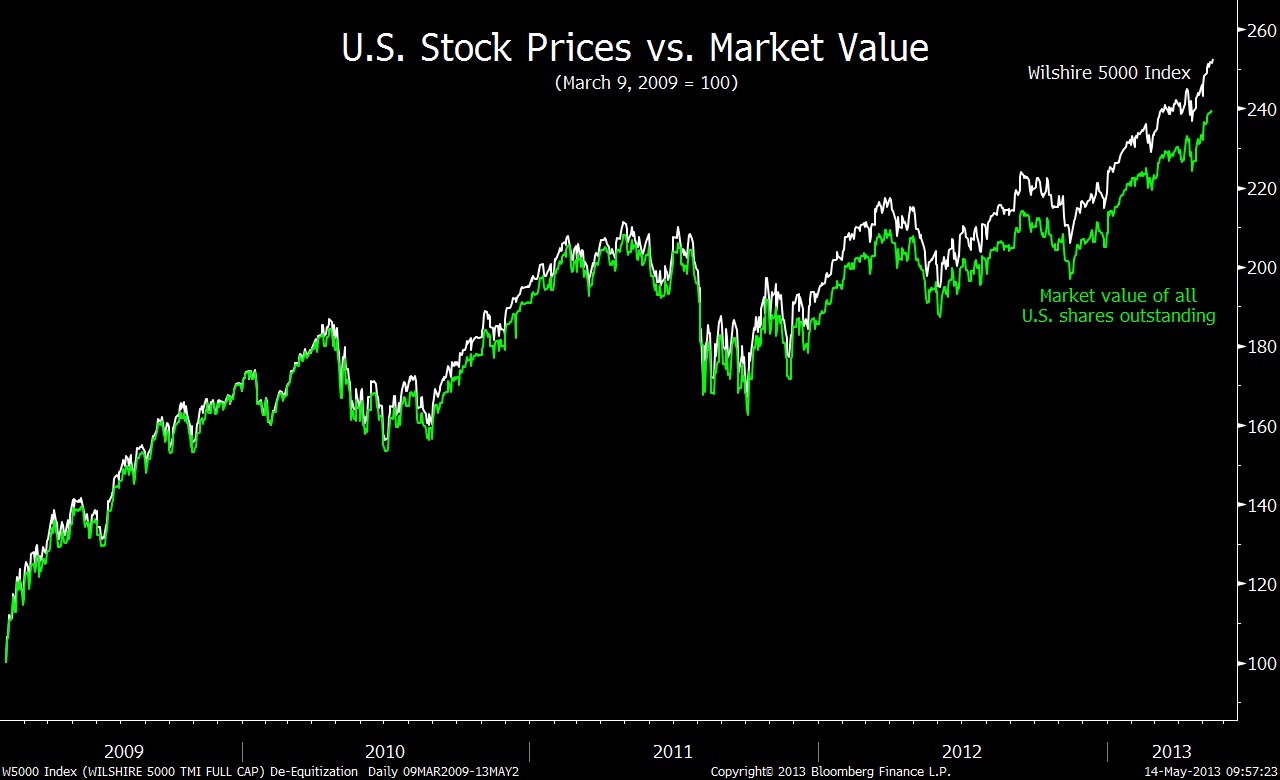
| De-equitization Juicing Market Gains Posted: 17 May 2013 08:30 AM PDT Click to enlarge
Fewer U.S. shares are available to purchase, which is driving prices higher. Repurchases are magnifying gains in U.S. stocks, and are poised to lift prices further, as seen in the Wilshire 5000 Total Market Index. According to Bloomberg, it has risen “more than the market value of all U.S. companies since the current bull market started in March 2009. The gap was about 13 percentage points.” “The difference comes from a reduction in the number of shares. The resulting de-equitization is giving a boost to this stock-market rally," wrote Pierre Lapointe, head of global strategy and research at the Montreal-based Pavilion Global Markets. The S&P 500 now has 2.3% fewer shares than it did in July 2011, when share total reached its high for the bull market. The drop in total stock outstanding accounted for 25% of the past year's earnings-per-share growth for companies in the index.  |
| Google and Tesla: Too Late to Touch? Posted: 17 May 2013 05:00 AM PDT |
| Posted: 17 May 2013 04:00 AM PDT @TBPInvictus here. Things have not been going well of late for the ideologues who also wax economic regarding inflation, interest rates, austerity, etc. They’ve been wrong at every turn. Luskin, Ferguson, Bowyer, Laffer, Kudlow, the WSJ editorialists, and so on. Been a bad five or so years. As Barry has repeatedly pointed out, it is not good to mix your politics with your investing. Money loser every time. I continue to be amazed that folks who can be so devastatingly wrong, for so long, on such a broad array of topics, can continue to hold sway. Perhaps some research can be done on that front. Interestingly, these same folks were stunningly wrong about a decade ago about when they banged the drum for war against Iraq. Overthrowing Saddam, of course, was a high priority for the neocons, and they needed to drum up broad support to get folks on board. What better lever to pull than to claim that oil prices would drop through the floor once Saddam was out of the picture and Iraqi oil flowed freely? I was blogging in 2006 at my good friend Don’s site, blah3.com. Very regrettably, he (or his host) had a major meltdown and virtually all of the content was lost (which is a shame, because I had done some really good work there that I’d really like to revisit). I have reviewed some of it from time to time at archive.org, but the site wasn’t crawled enough for me to recover most of my stuff. This piece, however, was picked up at another site and seems relevant to the implosion of a certain way of thinking. Here was the conservative line on what would happen to oil prices after we ousted Saddam (sans the links I had in the original, all emphasis mine):
The Journal went for the Daily Double and vehemently argued that the cost associated with “containment” of Saddam would be multiples of the cost of simply toppling him:
Moral of the story: Keep your politics out of your investing.  |
| Gundlach of DoubleLine Goes Prime Time Posted: 17 May 2013 03:00 AM PDT |




| You are subscribed to email updates from The Big Picture To stop receiving these emails, you may unsubscribe now. | Email delivery powered by Google |
| Google Inc., 20 West Kinzie, Chicago IL USA 60610 | |



0 comments:
Post a Comment