.

{2} GoogleTranslate (H)

English French German Spanish Italian Dutch Russian Portuguese Japanese Korean Arabic Chinese Simplified

Our New Stuff

{3} up AdBrite + eToro

Your Ad Here

Tuesday, May 28, 2013

The Big Picture

The Big Picture


Quantitative Easing, Central Bank Purchases and Corporate Buybacks Account for Much of the Rise In Stock Prices

Posted: 27 May 2013 10:30 PM PDT

The 3 Reasons Why Stocks Have Skyrocketed Over the Past Couple of Years


Stocks have soared because the Fed's quantitative easing has – intentionallypumped them up.

They've also skyrocketed because the Fed and other central banks are directly buying stocks.

NBC News reports on a third major reason that stocks took off … corporate buybacks:

It's the narcissist rally.

***

You may want to spare a thought, and a healthy dose of worry, for what is one of the biggest, and least appreciated, reasons for the rally: buybacks.

Flush with cash and a world of opportunity at their doorstep, companies have decided there's nothing more attractive than themselves. So, they're offering big money to buy back their own stock. This year, big U.S. companies have given the go-ahead for $286 billion of buybacks, up 88 percent from the same period last year, according to Birinyi Associates, a market research firm. If the pace continues for the rest of the year, the tally will exceed the record set in 2007.

Every manner of company is caught up in the buying binge, including home-improvement chains, makers of farm equipment and jet engines, airlines, sellers of soft drinks and of hard liquor alike. Not one to miss a hot trend, Apple recently authorized as much as $50 billion of buybacks.

Investors like buybacks because they suggest companies think their stock is cheap. They also help reduce the number of shares outstanding, which automatically increases earnings per share. And higher earnings per share often, though not always, lead to rising stock prices.

But buybacks are also crucial to the rally for a reason that's not widely known. Companies are one of the few big stock purchasers nowadays. Nearly every other big player in the stock market has been selling more than they've been buying.

Pension funds have been selling. Local and state governments have been selling. Investment brokerages have been selling. And, yes, until recently, even Main Street investors.

You can see this in the data released by the Federal Reserve each quarter, and it's a sea of red — save for corporate buying, that is, buybacks plus purchases of other companies. In total, U.S. companies, not counting banks and other financial firms, have bought more than $1 trillion of stock in the five years through 2012, net of stocks they've issued.

***

However much they spend, each dollar of buybacks appears to be having a greater effect on raising the prices of certain stocks. That's because fewer shares are changing hands each day. On Wall Street, it's referred to as a "drying up" of liquidity. And like in any market, a purchase or sale when fewer people are trading can push prices up and down much more.

DirecTV bought $1.4 billion of its own shares in the first quarter, or 7.8 percent of all trades in the company's stock, according to data from Birinyi Associates. DirecTV rose 12.8 percent in the same period, two points more than the Standard and Poor's 500. IBM bought $2.6 billion of its shares in the first quarter, or 5.6 percent of what was traded. It rose 11.8 percent.

***

Companies that do buy back their own stock are seeing prices soar, and almost immediately.

On Friday, Northrup Grumman jumped 4 percent after announcing it had authorized $4 billion of buybacks. The military contractor said it expects buybacks will cut its shares outstanding by 25 percent by the end of 2015.

Another big share buyer, Home Depot, rose 5.7 percent on Feb. 26 after it announced a $17 billion buyback program. The S&P 500 rose 0.6 percent that day. If the retailer spends all the authorized in its plan, it will remove 18 percent of the shares outstanding at current prices, which will make the impact of a next round of purchases even more powerful.

Stocks of companies that have authorized the 10 biggest buybacks so far this year have risen 2.2 points more than the S&P 500 in the week after their announcements….

Gregory Milano, CEO of consultancy Fortuna Advisors, has run studies showing that companies that spend the most on buying back their own stock tend to underperform because they don't spend enough on opening new factories, research or otherwise building their business for the long term.

Andrew Smithers, who runs a London-based investment consultancy, thinks buybacks have pushed stocks more than 40 percent higher than they're worth. In his book "The Great Deformation," former U.S. budget director David Stockman says Corporate America is drunk on buybacks and that they've helped push stocks up too far, too.

***

Forty percent of the increase in the earnings per share of S&P 500 companies in the past 12 months came from reducing the number of shares through buybacks, estimates Barry Knapp, chief U.S. stock strategist at Barclays Capital.

Postscript:  Max Keiser points out that quantitative easing and corporate buybacks are related.  Specifically, the Fed's easy monetary policy means that big corporations can borrow cheaply … and then use the money to buy back their own stock.

Of course, most of the trading is done by high frequency trading these days.

Audio: The Long And Happy Lives Of Lobsters

Posted: 27 May 2013 04:00 PM PDT

As best scientists can tell, lobsters age so gracefully they show no measurable signs of aging: no loss of appetite, no change in metabolism, no loss of reproductive urge or ability, no decline in strength or health. Lobsters, when they die, seem to die from external causes. (Full transcript here)


Source:
The Long And Happy Lives Of Lobsters
Robert Krulwich
NPR November 16, 2007
http://www.npr.org/2007/11/16/16349118/the-long-and-happy-lives-of-lobsters

U.S. Corporate Tax Rates Vary Greatly

Posted: 27 May 2013 09:00 AM PDT


click for interactive graphic
Corp Tax


Cool interactive visualization that allows you to see how much various companies are paying in corporate taxes. You can hover over a circle to see what: each firm pays in taxes versus their total revenue &  profits, plus the tax rate.

Or, break it down by industry, with a very cool animation showing the sector breakdown. Nice search function, too

Very neat.


Source:
Who Will Crack the Code?
DAVID LEONHARDT
NYT, May 25, 2013
http://www.nytimes.com/2013/05/26/opinion/sunday/who-will-crack-the-code.html

10 Monday Reads

Posted: 27 May 2013 05:00 AM PDT

Good Memorial Day morning. It looks to be a lovely day, so before heading out to the beach or lake or picnic or where ever you may be off to, have a look at my roundup of found interesting items:

• What Type of Financial Investor Are You? (Howard Lindzon)
• Goldman pushes hedge funds for your 401(k) (Fortune) see also Rob Arnott: Most hedge funds disappoint (Fortune)
• How to Spot the Next Short Squeeze (MoneyBeat)
• The Falling-Bridge Lesson: The U.S. Infrastructure Failure Is Still Totally Inexcusable (Atlantic) see also Bridge Collapse in Washington State Sends Cars Into River (Bloomberg)
• What All Classical Economic Thinkers Can Agree About (Forbes)
• Europe's Lost Keynesians (Project Syndicate) see also The banking crisis as a giant carry trade gone wrong (Vox)
• Nikkei 225 Deformed as Japan Yardstick by Fast Retailing's Rise (Bloomberg)
• Reminder: Shit Gets Better (TRB) see also California Faces a New Quandary, Too Much Money (NYT)
• Yes, Silicon Valley, You Are as Exactly as Vain as They Say (Valley Wag)
• Battle of the Beach (WSJ)

What are you reading?


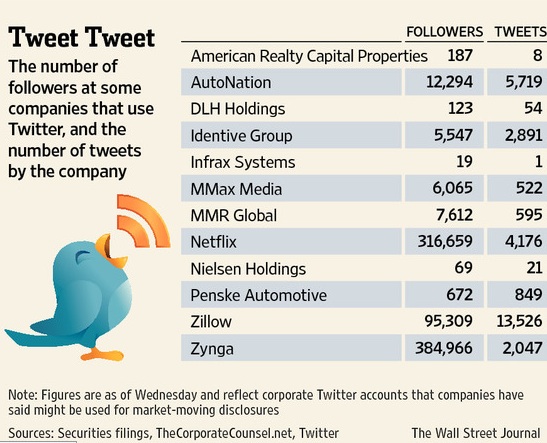
Earnings Not Yet a Viral Sensation
Graphic
Source: WSJ

McLaren MP4-12C vs Lamborghini Aventador

Posted: 27 May 2013 04:00 AM PDT

Crazy cool comparison engine from TwinRev — punch any two supercars into the tool and generate a full side by side analysis.

From an automotive shopping perspective, when this thing goes down market so you can compare an Honda Accord versus a Toyota Camry or an Infiniti G37 versus a BMW 335, it will be an incredibly powerful — and valuable — piece of software.


Graphic


Source: TwinRev

Modern-day Robin Hood Applies Business Skills to Philanthropy

Posted: 27 May 2013 03:00 AM PDT


Source: CBS

.

0 comments:

Post a Comment

previous home Next

{8} chatroll


{9} AdBrite FOOTER

{8} Nice Blogs (Adgetize)