


The Big Picture |

- Market Whackage Open Thread
- A gadget’s life: From gee-whiz to junk
- Octopus Ballet
- Look Out Below!
- World’s Strongest Banks
- Wolf: Greek Debt Crisis “An Absolute Nightmare”
- Sitting is Killing You
- Trade Deficit jump all Petro
- Dear Bull . . .
- Interrogation Experts From Every Branch of the Military and Intelligence Agree: Torture DOESN’T Produce Useful Information
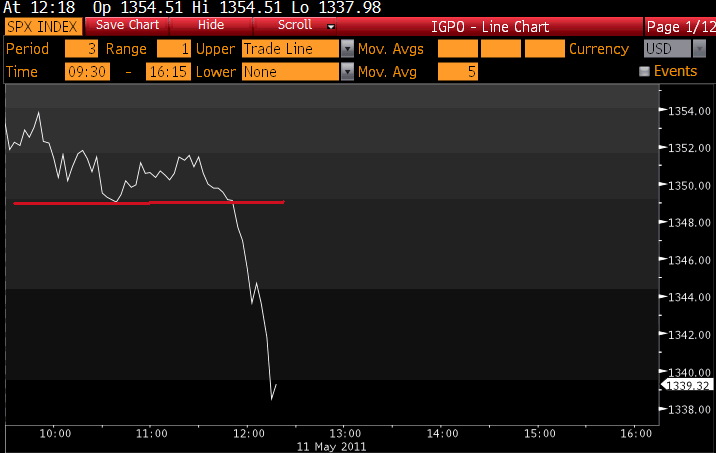
| Posted: 11 May 2011 05:15 PM PDT Markets took a nice shellacking today on a strong dollar, weak energy, (Oil and Gasoline), and rumors of a big margin call from a futures trader. The Dow lost 130 points, SPX dropped 14, while the Nasdaq gave up 27 — each was off about 1%. Is this the beginning of the end? A pause that refreshes? Just another step on the path to QE3 ? What say ye? ~~~ |
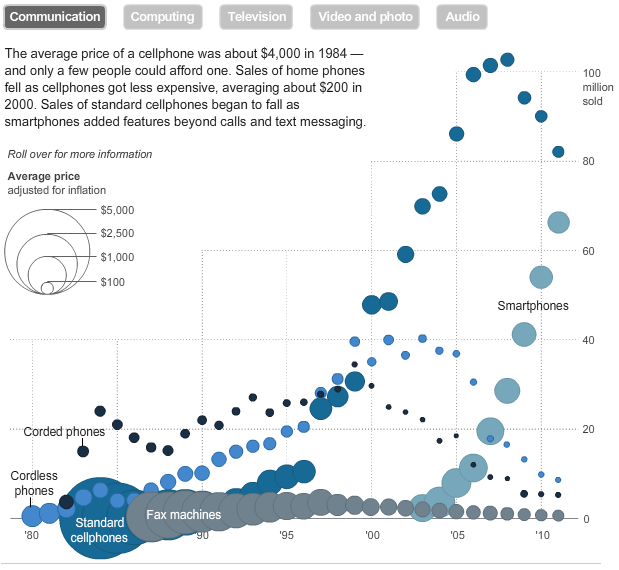
| A gadget’s life: From gee-whiz to junk Posted: 11 May 2011 12:30 PM PDT A very cool look at the cost and popularity of gadgets since the 1980s – covering phones, computers, TV, video, and audio. You can clearly see the "digital revolution" start around 2000, killing off earlier technologies; it's also interesting to see the cost of any gizmo fall over time (the circles get smaller). >
Source: Alicia Parlapiano Washington Post |
| Posted: 11 May 2011 10:00 AM PDT This white octopus was filmed with a high-definition underwater video camera at 6600 feet depth 200 miles off the coast of Oregon in September 2005 as part of the VISIONS ’05 expedition led by Professors John Delaney and Deborah Kelley of the University of Washington. Little is known about the deep-sea octopuses that live in proximity to the hydrothermal vent fields associated with the underwater volcanoes of the Hat tip boingboing |
| Posted: 11 May 2011 09:26 AM PDT
> Dollar rally, Gasoline futures limit down, and a softening market = mucho ugliness intraday. grantham said he tends to be early, but he seems to have nailed this one perfectly: Time To Be Serious (and probably too early) Once Again. Watch for an attempt at a snapback after lunch . . . |
| Posted: 11 May 2011 08:30 AM PDT
> The list of the World’s strongest bank is dominated by Canadians, and headed by Singapore's Oversea-Chinese Banking (OCBC). No. 2 is Svenska Handelsbanken AB of Sweden. Just three U.S. banks — Fifth Third Bancorp (No. 7), JPMorgan Chase & Co. (No. 14) and (WTF?!?) Citigroup (No. 16) — make the top 20. > Source: |
| Wolf: Greek Debt Crisis “An Absolute Nightmare” Posted: 11 May 2011 07:44 AM PDT ~~~ Source: |
| Posted: 11 May 2011 07:12 AM PDT |
| Posted: 11 May 2011 07:09 AM PDT The March Trade Deficit widened to $48.2b from $45.4B in Feb and is the 2nd widest since late ’08 but in March the increase was solely due to higher petroleum imports which alone rose more than $8b m/o/m. Ex petro, the trade deficit would have fallen by $3b as overall exports rose 4.6% to a record high which squares with the positive momentum that manufacturers have experienced year to date. |
| Posted: 11 May 2011 07:00 AM PDT Dear Bull, On July 14th, 2010 I wrote a “letter” to short sellers warning them to “be very, very careful here into year end” and that “we are set up for a big rally over the next 5 1/2 months.” I cited a calming down in European credit stress, a better than feared earnings season at the time, the Nov election possibilities, an underinvested buyside and lastly and the most important, a Fed that would remain extraordinarily easy. I thought though at the time that 2011 would bring new worries but QE2 gave the market fresh legs to where we stand today. I am now putting out a warning to you, the long only, mostly long PM. The road is about to get rougher as QE2 is near its end at the same time US economic growth is moderating and central banks around the world continue to raise rates (the BoE is going to be forced to soon). Also, Europe is reaching a tipping point now with Greece and investor sentiment remains very bullish or at least not bearish at all. Do you know anyone that is set up for a market drop? I don’t. The correction in commodities over the past week is the first shaking of the tree that should not be ignored and will be the precursor to a painful 10%+ correction in stocks over the next few months. Both rallied hand in hand since late August and thus won’t be separated in market action. |
| Posted: 11 May 2011 05:30 AM PDT Virtually all of the top interrogation experts – both conservatives and liberals (except for those trying to escape war crimes prosecution) – say that torture doesn’t work: • Army Field Manual 34-52 Chapter 1 says:
• The C.I.A.’s 1963 interrogation manual stated:
• According to the Washington Post, the CIA’s top spy – Michael Sulick, head of the CIA's National Clandestine Service – said that the spy agency has seen no fall-off in intelligence since waterboarding was banned by the Obama administration. “I don't think we've suffered at all from an intelligence standpoint.” • The CIA’s own Inspector General wrote that waterboarding was not “efficacious” in producing information. • A 30-year veteran of CIA's operations directorate who rose to the most senior managerial ranks (Milton Bearden) says (as quoted by senior CIA agent and Presidential briefer Ray McGovern):
• A former high-level CIA officer (Philip Giraldi) states:
• Another former high-level CIA official (Bob Baer) says:
• Michael Scheuer, formerly a senior CIA official in the Counter-Terrorism Center, says:
• A retired C.I.A. officer who oversaw the interrogation of a high-level detainee in 2002 (Glenn L. Carle) says:
• A former top Air Force interrogator who led the team that tracked down Abu Musab al-Zarqawi, who has conducted hundreds of interrogations of high ranking Al Qaida members and supervising more than one thousand, and wrote a book called How to Break a Terrorist writes:
He also says:
And he repeats:
He said last week:
• The FBI interrogators who actually interviewed some of the 9/11 suspects say torture didn’t work • Another FBI interrogator of 9/11 suspects said:
• A third former FBI interrogator — who interrogated Al Qaeda suspects — says categorically that torture does not help collect intelligence. On the other hand he says that torture actually turns people into terrorists • A declassified FBI e-mail dated May 10, 2004, regarding interrogation at Guantanamo states “[we] explained to [the Department of Defense], FBI has been successful for many years obtaining confessions via non-confrontational interviewing techniques.” (see also this) • The FBI warned military interrogators in 2003 that enhanced interrogation techniques are “of questionable effectiveness” and cited a “lack of evidence of [enhanced techniques'] success. • “When long-time FBI director Mueller was asked whether any attacks on America been disrupted thanks to intelligence obtained through "enhanced techniques", he responded "I don't believe that has been the case." • The Senate Armed Services Committee unanimously found that torture doesn’t work, stating:
• The military agency which actually provided advice on harsh interrogation techniques for use against terrorism suspects warned the Pentagon in 2002 that those techniques would produce “unreliable information.” • General Petraeus says that torture is unnecessary, hurts our national security and violates our American values • Retired 4-star General Barry McCaffrey – who Schwarzkopf called he hero of Desert Storm – agrees. • The number 2 terrorism expert for the State Department says torture doesn’t work, and just creates more terrorists. • Former Navy Judge Advocate General Admiral John Hutson says:
He also says:
• Army Colonel Stuart Herrington – a military intelligence specialist who interrogated generals under the command of Saddam Hussein and evaluated US detention operations at Guantánamo – notes that the process of obtaining information is hampered, not helped, by practices such as "slapping someone in the face and stripping them naked". Herrington and other former US military interrogators say:
• Major General Thomas Romig, former Army JAG, said:
• Brigadier General David R. Irvine, retired Army Reserve strategic intelligence officer who taught prisoner interrogation and military law for 18 years with the Sixth Army Intelligence School, says torture doesn’t work • The head of all U.S. intelligence said:
• Former counter-terrorism czar Richard A. Clarke says that America’s indefinite detention without trial and abuse of prisoners is a leading Al Qaeda recruiting tool. • A former U.S. interrogator and counterintelligence agent, and Afghanistan veteran said,
• The first head of the Department of Homeland Security – Tom Ridge – says we were wrong to torture.The former British intelligence chairman says that waterboarding didn't stop terror plots. • A spokesman for the National Security Council (Tommy Vietor) says:
• The Marines weren’t keen on torture, either • As Vanity Fair reports:
• Neuroscientists have found that torture physically and chemically interferes with the prisoner’s ability to tell the truth • An Army psychologist – Major Paul Burney, Army's Behavior Science Consulting Team psychologist – said (page 78 & 83):
• An expert on resisting torture – Terrence Russell, JPRA's manager for research and development and a SERE specialist – said (page 209):
And – according to the experts – torture is unnecessary even to prevent “ticking time bombs” from exploding (see this, this and this). Indeed, a top expert says that torture would fail in a real ‘ticking time-bomb’ situation Indeed, it has been known for hundreds of years that torture doesn’t work: • In the ancient Far East, torture was used as a way to intimidate the population into obedience (rather than a method for gaining information) • As a former CIA analyst notes:
• Top American World War 2 interrogators got more information using chess or Ping-Pong instead of torture than those who use torture are getting today • The head of Britain’s wartime interrogation center in London said:
• The national security adviser to Vice President George H.W. Bush (Donald P. Gregg) wrote:
• Top interrogators got information from a high-level Al Qaeda suspects through building rapport, even if they hated the person they were interrogating by treating them as human Postscript: Even if – despite the above – you still believe that torture produces helpful information, you should note that the U.S. government used Communist torture techniques specifically designed to produce FALSE Confessions. |


| You are subscribed to email updates from The Big Picture To stop receiving these emails, you may unsubscribe now. | Email delivery powered by Google |
| Google Inc., 20 West Kinzie, Chicago IL USA 60610 | |
 The Big Picture (ritholtz)


0 comments:
Post a Comment