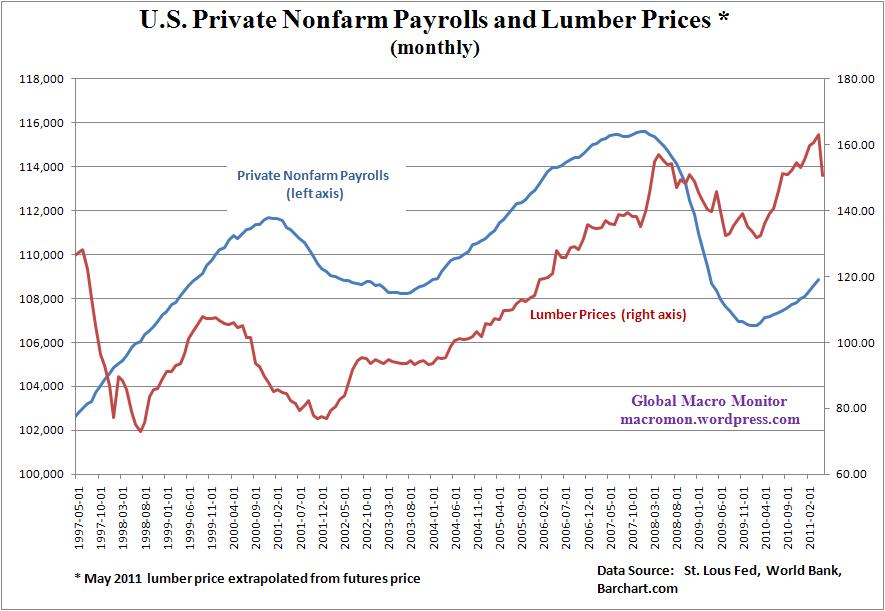
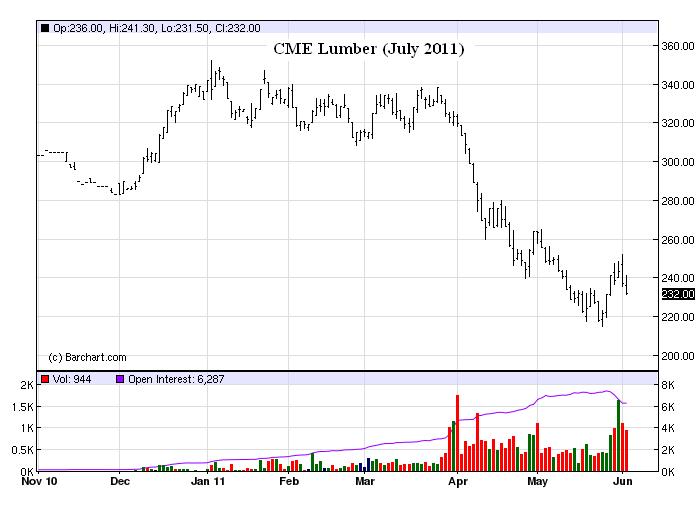
| Lumber Prices: Leading Indicator for Private Nonfarm Payrolls? Posted: 02 Jun 2011 06:00 PM PDT In the chart below we take a look at the relationship between lumber prices and private nonfarm payrolls. Clearly they tend to move together on a monthly basis. One of the transmission mechanisms of monetary policy is the impact of interest rate changes on the construction sector, which has historically been a leader of past economic recoveries. This is clearly not the case in the current balance sheet growth recession, so we are not as confident in the lumber price/nonfarm payroll relationship. Nevertheless, lumber futures have been under heavy pressure since the end of March, down over 30 percent, no doubt, partially the result of the double dip in housing prices. It will interesting to see how, or if, the correction in lumber shows up in the private nonfarm payroll number tomorrow. ~~~ 
 (click here if charts are not observable) (click here if charts are not observable)
 |
| Late Afternoon Reading Posted: 02 Jun 2011 01:30 PM PDT Quite a few fascinating items added to Instapaper today — these are what I will be reading on the way home tonight: • The Tiffany Economy: A Tale of Two Recoveries (Morningstar)
• Is the Slow Economic Data Due to Japan or Something Deeper? (Be Spoke)
• Geithner and Goldman, Thick as Thieves (Truth Dig)
• May Consumer Bankruptcy Filings Fall 16% Year-Year (US Bankruptcy Institute)
• Manhattan Builders Plan Biggest Decade for Towers Since '80s (Bloomberg)
• All eyes on Bernanke, but QE3 has sailed (Market Watch)
• When the Value of Housing Ruins the Home (WSJ)
• Jann Wenner: Magazines’ Rush to iPad Is ‘Sheer Insanity and Insecurity and Fear’ (Ad Age)
• Pixar’s Motto: Going From Suck to Nonsuck (Fast Company)
• New Twitter follow: Market Wisdom: Quotes from famous traders and managers on investing and money (Twitter)
What are you reading?  |
| How Bad Is Housing? Posted: 02 Jun 2011 01:15 PM PDT <Click on chart for larger image> 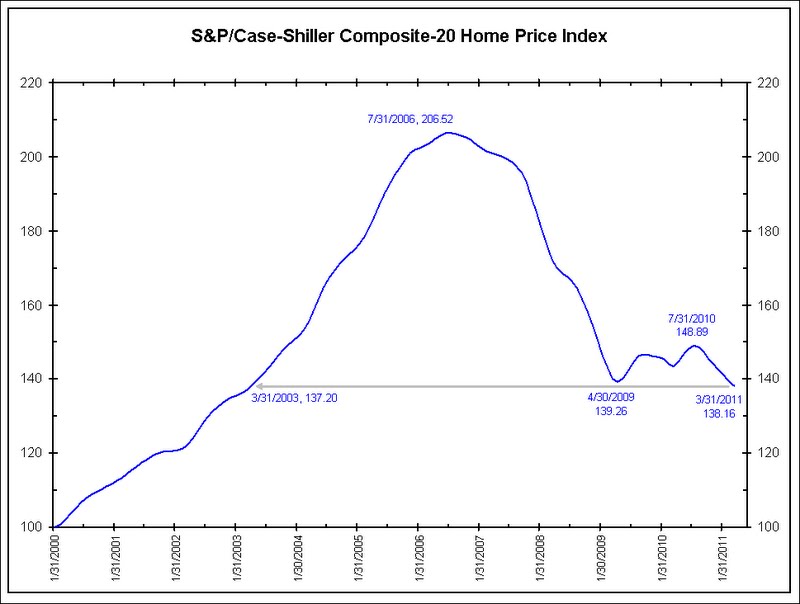
• The Wall Street Journal – Housing Imperils Recovery Home prices have sunk to 2002 levels, effectively wiping out almost a decade's worth of home equity across the U.S. and imperiling the fragile economic recovery as Americans confront the falling value of their biggest investment. A closely watched home-price index released Tuesday, the S&P/Case-Shiller National Index, showed that prices nationwide fell 4.2% in the first quarter after declining 3.6% in the fourth quarter of 2010. The index had seen increases in 2009 and early 2010."Home prices continue on their downward spiral with no relief in sight," said David M. Blitzer, chairman of S&P's index committee. The report signals "a double dip in home prices across much of the nation," he said. That doesn't bode well for the economy, which historically has depended on home buying and other consumer spending to rebound. Falling prices hurt economic growth in a number of ways. Not only do homebuyers curb spending when their homes are losing value, but continued price erosion keeps families stuck in homes they can't sell because they are worth less than what they owe.
• The Associated Press – Cities that weathered housing bust now suffering Home prices in big metro areas have sunk to their lowest since 2002, the Standard & Poor's/Case-Shiller 20-city monthly index showed Tuesday. Since the bubble burst in 2006, prices have fallen more than they did during the Great Depression. The index, which covers metro areas that include about 70 percent of U.S. households, is updated every quarter and provides a three-month average. The March data is the latest available. Foreclosures have forced prices down so much that some middle-class neighborhoods have turned into lower-income areas within months. Prices are expected to keep falling until the glut of foreclosures for sale is reduced, companies start hiring in greater force, banks ease lending rules and more people think it makes sense again to buy a house. In some markets, that could take years. The latest report points to a "double dip in home prices across much of the nation," said David Blitzer, chairman of the Index Committee at Standard & Poor's.
Comment
The chart above shows the Case/Shiller Index is at its lowest level since 2003, not its lowest level since 2002 as noted above. Either way, house prices are extremely depressed. The Wall Journal • Five Questions on Tuesday's S&P/Case-Shiller Why is housing still so weak?
Many households can't move because they owe more than their homes are worth. Even households that aren't underwater have seen such a big loss of wealth that they may be unwilling to sell at current prices. Credit also remains tight. While mortgage rates are low, borrowers that don't have perfect credit and that can't make a 20% down payment often aren't going to qualify for the lowest rates. Insurance premiums on loans backed by the Federal Housing Administration, which allows down payments as low as 3.5%, have risen twice in the last year. And banks are scrutinizing borrowers' incomes and tax returns, looking for any possible red flag. Many buyers aren't willing to buy unless sellers give a decent discount—call it insurance against future price declines. Sellers already think they're giving away the store, and may balk at further price cuts. Against this backdrop of anemic demand, the supply of homes is high as banks push more foreclosed properties onto the market. Banks are less reluctant to cut prices to unload homes quickly than traditional sellers, and because those homes sometimes require more work, they tend to sell for less. Many of those homes are being sold at discounts to investors that are willing to make all-cash bids, which can reduce the appraised value of all homes in that neighborhood.
The New York Times: • Bottom May Be Near for Slide in Housing
For real estate, some economists say, an end to the seemingly endless decline in housing values might be in sight.Not immediately. At the moment, prices are still dropping. In 20 large cities, prices fell 0.8 percent in March from the previous month, according to the Standard & Poor's Case-Shiller Home Price Index released Tuesday. That pushed the closely watched index below its level of two years ago to a new post-bubble low, and put it 33.1 percent under its July 2006 peak. Few analysts expect housing prices to rebound anytime soon. But quite a few are predicting that the market is close to the moment when things will stop getting worse, which will be a major improvement all by itself. "By far the bulk of the downturn of housing prices is beyond us," said Paul Dales of Capital Economics. He expects the market to slip 5 percent further, slightly more than he was expecting a few months ago. "There are some amazingly favorable signs. Housing is the most undervalued it's been in 35 years," Mr. Dales said. "At some point, it's going to do very well."
Comment
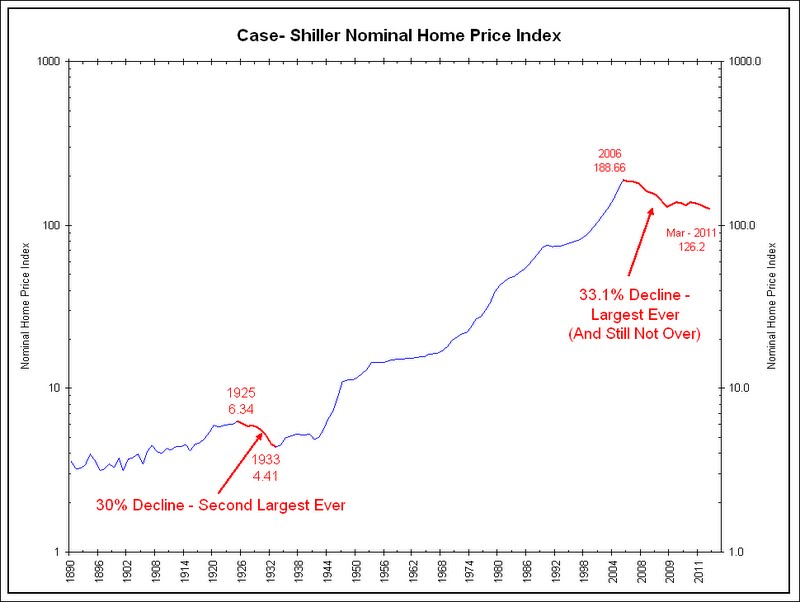
Many stories are noting that the current housing decline is greater than the decline of the Great Depression. This comes from the Case/Shiller Annual Index which goes back to 1890. Case/Shiller used the Grebler-Blank-Winnick data from 1890 to 1947 (explanation, data). This data shows home prices fell 30% during the Great Depression (1925 to 1933) and the median price of a Washington DC home fell 27% over the same period. So, while Barry Ritholtz's Big Picture post below is conceptually correct to point out that every other price index fell 75% to 90% during the Great Depression, Grebler-Blank-Winnick's housing data from that period does not show house prices fell to quite that extent. Knowing this, let us take a stab at explaining why housing fared so much better than other prices during the Great Depression: Home-ownership levels were much lower during the Great Depression. In 2006 ownership levels peaked around 70%. In the 1930s they were never above 50% (data). More homes were owned outright (no mortgage) in the 1930s versus today. The typical mortgage in the 1930s required a 50% down payment and carried a 5-year term. The percentage of homes owned outright in the 1930s was much higher than it is today (source). Given the two points above, there were fewer forced liquidations in the 1930s compared to today. Underwater mortgages were a rare event, not the common event that they are today. In other words, housing was a source of strength during the Great Depression while it is the weak link dragging down the economy during the Great Recession and its aftermath. <Click on chart for larger image>
 <Click on chart for larger image>
 The Big Picture (Blog) – Barry Ritholtz: Is Residential Real Estate Worse than During Depression? Both the Housing markets and available financing were widely different, then versus now. In addition to the lower Home ownership levels (66.2% vs 47.8%), it was more concentrated among the wealthy as opposed to broad-based ownership now. Many more people lived on family farms early in the 20th century (than today). And, more homes were owned outright (no mortgage) in the 1930s versus today. I have to track down the data, but I recall it was over 70% in the 1920s with no mortgage versus about 40% today. But the biggest and most important difference was financing: Mortgages were 3 to 5 year, interest only, with a balloon payment of the amount borrowed at the end. After that 3 year period, you either resigned with the bank, or sold the land and paid off the note. There was no such thing as a 30 year fixed rate mortgage in the 1920s or '30s. THAT would have had a huge impact on prices. Banks were failing by the 1000s; even someone with the means to roll their mortgage over might have foudn the bank did not have the ability to do so. With few buyers and almost no credit, the odds favor that RE prices would fall quite substantially. How much? One study of Manhattan (Estate Prices During the Roaring Twenties and the Great Depression) that looked at market-based transactions home prices between 1920 and 1939 found that Home prices plummeted 67% during the great depression. Yes, home prices are bad. They are nearing the 35% drop we forecast back in 2005. But worse than the Great Depression? I don't think so . . .
 |
| US Personal Income, 1969-2009 Posted: 02 Jun 2011 11:30 AM PDT From Fast Company, the last of our NFP/Wages graphics: >
click for larger graphic
 >
BLS releases NFP report is tomorrow at 8:30 am  |
| Comparing Wages Across the U.S. Posted: 02 Jun 2011 09:30 AM PDT Click for interactive map
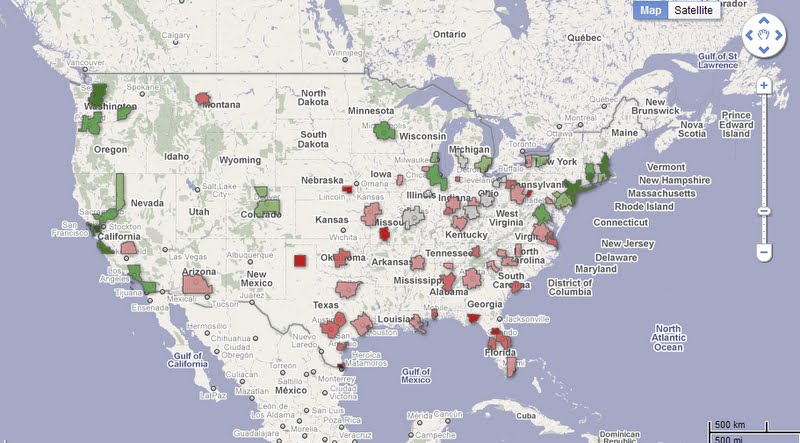 > NFP week continues here at TBP. Our latest chart p0rn: This WSJ interactive map of wage growth (or the lack thereof) across the US of A >
Source:
Comparing Wages Across the U.S.
Sara Murray
WSJ, May 25, 2011
http://blogs.wsj.com/economics/2011/05/25/comparing-wages-across-the-u-s/  |
| 10 Year Bond Breaks 3.00% Posted: 02 Jun 2011 08:27 AM PDT 2.98% at this moment; Not a good thing:
> U.S. Treasury 10 Year 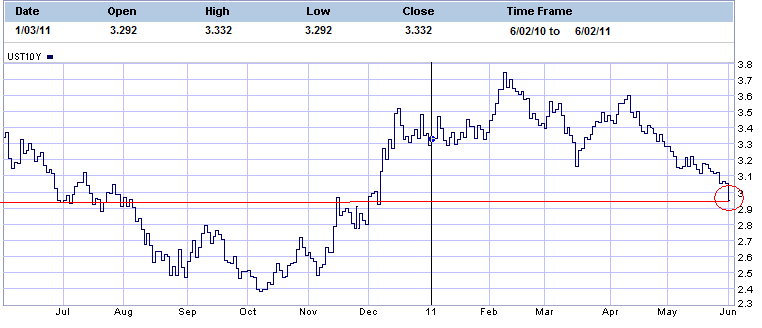
Source: Dow Jone
 |
| Daily Show: Me Lover’s Pizza With Crazy Broad Posted: 02 Jun 2011 08:00 AM PDT HILARIOUS: Donald Trump disrespects New Yorkers by taking Sarah Palin to a pizza chain and eating his stacked slices with a fork. >  |
| Moody’s review on banks more academic Posted: 02 Jun 2011 07:54 AM PDT Here is more color on the Moody’s announced review of the credit ratings of the large banks which for a few minutes resulted in S&P selling. We’ve since bounced back because the view of Moody’s is solely related to the reduced expectations for the same amount of government support for the banks going forward rather than any sudden change in company operating fundamentals. “Today’s rating actions reflect Moody’s view that, in light of developments on the Dodd-Frank Act that have occurred to date, the unusual levels of uplift incorporated into the ratings of BAC, C and WFC may no longer be appropriate.” They will review whether the banks ratings should “include only pre-crisis levels of government support.”  |
| Virtual Casino: Robert Wilmers vs Jamie Dimon Posted: 02 Jun 2011 07:45 AM PDT I’ve been meaning to discuss this Joe Nocera piece, The Good Banker, which is my favorite thing he’s done since moving to the OpEd pages. “In the run-up to the financial crisis, the giant national banks — which he viewed as a distinct species from the typical American bank — had done things that deserved condemnation. And, he added, "They are still doing things that I don't think are very good."Such as? "It has become a virtual casino," he replied. "To me, banks exist for people to keep their liquid income, and also to finance trade and commerce." Yet the six largest holding companies, which made a combined $75 billion last year, had $56 billion in trading revenues. "If you assume, as I do, that trading revenues go straight to the bottom line, that means that trading, not lending, is how they make most of their money," he said. This was a problem for several reasons. First, it meant that banks were taking excessive risks that were never really envisioned when the government began insuring deposits — and became, in effect, the backstop for the banking industry. Second, bank C.E.O.'s were being compensated in no small part on their trading profits — which gave them every incentive to keep taking those excessive risks. Indeed, in 2007, the chief executives of the Too Big to Fail Banks made, on average, $26 million, according to Wilmers — more than double the compensation of the top nonbank Fortune 500 executives. (Wilmers made around $2 million last year.) Finally — and this is what particularly galled him — trading derivatives and other securities really had nothing to do with the underlying purpose of banking. He told me that he thought the Glass-Steagall Act — the Depression-era law that separated commercial and investment banks — should never have been abolished and that derivatives need to be brought under government control. "It doesn't need to be studied for two years," he said. "I would put derivative trading in a subsidiary and tax it at a higher rate. If they fail, they fail."
So much awesomeness in 3 short paragraphs . . . Source:
The Good Banker
JOE NOCERA
NYT, May 30, 2011
http://www.nytimes.com/2011/05/31/opinion/31nocera.html See also:
2010 M&T Bank Annual Report: Message to Shareholders
Robert G. Wilmers
M&T Bank, February 18, 2011
http://mtb.mediaroom.com/2010message PDF  |
| Bianco: Time to Let Markets Adjust on Their Own Posted: 02 Jun 2011 07:30 AM PDT |





0 comments:
Post a Comment