


The Big Picture |

- Weekend Reading List
- Report: Economy Failing Because U.S. Built On Ancient Indian Burial Grounds
- Did the Fed Print Money in QE1 and QE2?
- Succinct Summation of Week’s Events (6.03.11)
- Groupon’s IPO’s “Novella of Risks”
- Tom Keene interviews Bill Gross on Fed Policy
- How To Tell If We Are In A Stock Market Bubble
- ECRI Leading Indicators: Slowing Growth
- BNN Media Appearance: June 2, 2011
- Friday AM Reads
| Posted: 04 Jun 2011 02:00 AM PDT Some interesting reads for your weekend pleasure:
What are you reading? |
| Report: Economy Failing Because U.S. Built On Ancient Indian Burial Grounds Posted: 03 Jun 2011 03:34 PM PDT In The Know panelists discuss a new congressional report linking all of America’s problems to the fact that our entire nation was built on top of Native American graves.
|
| Did the Fed Print Money in QE1 and QE2? Posted: 03 Jun 2011 01:00 PM PDT Did the Fed Print Money in QE1 and QE2? Bob Eisenbeis is Cumberland's Chief Monetary Economist. Prior to joining Cumberland Advisors he was the Executive Vice President and Director of Research at the Federal Reserve Bank of Atlanta. Bob is presently a member of the U.S. Shadow Financial Regulatory Committee and the Financial Economist Roundtable. His bio is found at www.cumber.com. He may be reached at Bob.Eisenbeis@cumber.com. In a Wednesday opinion piece in the WSJ, George Melloan, a former columnist and deputy editor of the Journal's editorial page, penned a piece opining on the policy problem the Federal Reserve has gotten itself into with its QE1 and QE2. His concern is one that we at Cumberland pointed out more than a year ago. That is, in returning to a normal policy regime and reducing the amount of high-powered money in the system, the Fed will have to shrink its balance sheet. But doing so by selling assets while raising interest rates, which seems to be the latest plan outlined in the most recent FOMC minutes, the Fed will incur capital losses, and this may inhibit its will to begin to return to a more normal policy stance. Indeed, for about two years now we have been tracking weekly the estimated duration of the Federal Reserve's capital and the amount of flexibility the Fed would have to raise rates before the market value of its assets exceeded the value of its liabilities http://www.cumber.com/content/index/duration.pdf. Our current calculations indicate that this would happen if the term structure shifted up by about 40 basis points. This is far less than the increase that would be required to return to a normal interest-rate/policy regime. There is nothing new in either Melloan's concern or the work by Ford and Todd in Forbes that he appears to have relied upon to support his argument. While Melloan's concerns are valid, his comparison of the Fed to a normal commercial bank, and particularly the argument that the Fed has not printed money to engage in QE1 and QE2 but rather has borrowed money from banks at obscenely low interest rates, is totally wrong. In the fall of 2008, during the financial crisis, the Fed engaged in a number of special-purpose programs – namely the Term Discount Window Facility, the Term Securities Lending Facility, the Term Auction Facility, the Primary Dealer Credit Facility, and three programs to acquire asset-backed securities, and engaged in reciprocal currency swaps with foreign central banks. As a result, the Fed's assets expanded from about $900 billion before the crisis to nearly $2.5 trillion. The corresponding increase in Federal Reserve liabilities was accounted for by a $600 billion increase in bank excess reserves, and the remainder was in the form of reverse repos. In effect, made loans and did so by giving the bank borrower a deposit at the Fed, thereby printing high-powered money. It is important to recognize that once created, deposits at the Fed can only be significantly reduced by one of six mechanisms: a reduction in private bank borrowings from the Fed, a sale of assets by the Fed, a conversion of deposits at the Fed into currency, a shrinkage in the size of the U.S. banking system, a temporary reverse repo with the private sector by the Fed, or a reduction in outstanding swap lines with foreign central banks. All other private entity transactions do not create or destroy deposits at the Fed, but simply change their ownership. Perhaps the clearest example of printing money, to illustrate the point, is the reciprocal currency swap program the Fed entered into during the financial crisis with several foreign central banks. The ECB, for example, gave the Fed a euro deposit at the ECB in return for a dollar deposit at the Fed. Accounting-wise, the ECB's liabilities went up by the amount of the euro deposit granted to the Fed, while its assets went up by the dollar amount of the deposit it received from the Fed. Similarly, the Fed's assets went up by the amount of its euro currency holdings at the ECB, and its dollar liabilities went up reflecting the dollar deposit it had granted to the ECB. Both central banks printed money. The ECB then used its newly acquired dollars to provide dollar loans to European banks. When the ECB made a dollar loan to a foreign bank, the ownership of the dollar deposit at the Fed shifted from the ECB to the borrowing foreign bank. When the loan was paid back, the ownership of the dollar deposit shifted back to the ECB, the swap transaction was reversed and the assets and liabilities of both central banks returned to their pre-swap levels. The Fed's emergency lending programs phased out as loan programs shrank and reverse repos were retired. Had the Fed not embarked upon QE1 and subsequently QE2, its balance sheet would have shrunk. But with the start of QE1 and QE2 the rundown in the Fed's assets due to shrinkage of its lending programs was offset by the simultaneous purchase of agency mortgage-backed securities and purchases of long-term Treasuries. In fact, those purchased exceeded the amount of outstanding emergency loans the Fed had previously granted. From an accounting perspective, the loan programs shrank, excess reserves were retired, and the Fed simultaneously reprinted money to purchase the MBS and Treasury securities. It did not borrow money from commercial banks. Put another way, the money printed to fund the emergency loan programs, and more, was morphed into MBS and Treasury securities and this is clearly shown in a chart of the Fed's assets http://www.cumber.com/content/misc/fed.pdf. Think about it. Where would the excess reserves come from that banks held with the Federal Reserve, if the Fed hadn't originally made the emergency loans or subsequently purchased assets? If Mr. Melloan's analysis were correct, the excess reserves, which are assets to the private banking system, would have had to come from shrinkage of their assets and deposits, thereby turning required reserves into excess reserves, or by keeping their balance sheets the same size and shifting the composition of their assets by reducing loans and securities and increasing their reserves at the Federal Reserve. Just before the crisis in August 2007, banks held only $45 billion in total reserves, and $40 billion of that was in the form of required reserves. Clearly, shrinkage of deposits could not have funded the huge increase in excess reserves in the banking system that came with the Fed's emergency lending programs. What about a shift in the composition of bank assets from loans and securities to deposits at the Fed? Data show that while bank loans have declined by about $600 billion, securities holdings have increased by about $600 billion. Therefore, the so-called borrowing from commercial banks could not have come from declines in their securities and loans. So, George Melloan has totally mischaracterized the source of funding for the Federal Reserve's QE1 and QE2 asset purchases. The Fed first printed high powered money through its emergency lending programs and as those programs were phased out the Fed again purchased agency mortgage-backed securities and Treasuries from the public by printing money, and the proceeds of those purchases show up as customer deposits in banks, with the offsetting asset being not new loans but excess reserves held at the Fed. Bob Eisenbeis, Chief Monetary Economist |
| Succinct Summation of Week’s Events (6.03.11) Posted: 03 Jun 2011 12:30 PM PDT Succinct summation of week’s events: Positives:
Negatives:
|
| Groupon’s IPO’s “Novella of Risks” Posted: 03 Jun 2011 12:00 PM PDT |
| Tom Keene interviews Bill Gross on Fed Policy Posted: 03 Jun 2011 10:02 AM PDT Bill Gross, manager of the world’s biggest bond fund at Pacific Investment Management Co., discusses the outlook for Federal Reserve monetary policy after today’s U.S. May jobs report showed payrolls rose less than forecast. Gross speaks with Tom Keene on Bloomberg Radio’s “Bloomberg Surveillance.” Lakshman Achuthan, managing director at the Economic Cycle Research Institute, also speaks.
(This is an excerpt from the full interview). |
| How To Tell If We Are In A Stock Market Bubble Posted: 03 Jun 2011 09:24 AM PDT Joseph Saluzzi (jsaluzzi-at-ThemisTrading.com) and Sal L. Arnuk (sarnuk-at-ThemisTrading.com) are co-heads of the equity trading desk at Themis Trading LLC (www.themistrading.com), an independent, no conflict agency brokerage firm specializing in trading listed and OTC equities for institutions. Prior to founding Themis, Sal and Joe worked for more than 10 years at Instinet Corporation, pioneers in the field of electronic trading, and at Morgan Stanley. ~~~
Bubble. The word keeps popping up a lot lately in the financial markets. After the internet bubble in the late nineties and the more recent housing bubble, investors are constantly trying to identify bubbles before they happen and make sure they do not get caught up in them when they bust. The classic 19th century book "Extraordinary Popular Delusions & the Madness of Crowds"
Today, we are faced with a second wave of possible Internet bubbles. The recent sharp rise in the IPO LinkedIn has caused some to say that we are already in another bubble. Yesterday, we got news that Groupon has filed for an IPO even though the company has not turned a profit yet (no doubt they felt the timing was right after the success of LinkedIn). The WSJ has a headline today that reads "Groupon to Gauge Limits of IPO Mania". But how do we really know if this is a bubble? Most bubbles pop and leave a tremendous amount of wreckage in their path before they are even identified. Three academics think they have the answer to identifying bubbles. Professors Jarrow, Protter and Kchia have recently written a paper titled "Is there a bubble in LinkedIn's stock price?" http://arxiv.org/abs/1105.5717 You may remember Professors Jarrow and Protter also from their other recently released paper "A Dysfunctional Role of High Frequency Trading in Electronic Markets" Read Paper Here where they argued "high frequency traders can create a mispricing that they unknowingly exploit to the disadvantage of ordinary investors". We liked that paper alot. In their latest paper, the Professors have developed a "procedure based on a sophisticated mathematical model for detecting asset price bubbles in real time." They chose to test their model on LinkedIn stock and guess what, they found that LinkedIn is in a price bubble. Their paper is very interesting but we must admit the math calculations which they use to prove their model are way above our pay grade. We encourage any of you math wizards out there to check out the paper. Now, let's put that model to work on Groupon as soon as it comes public. |
| ECRI Leading Indicators: Slowing Growth Posted: 03 Jun 2011 08:58 AM PDT The usual charts from from ECRI (BusinessCycle.com) shows a deceleration, not outright recession: >
From ECRI |
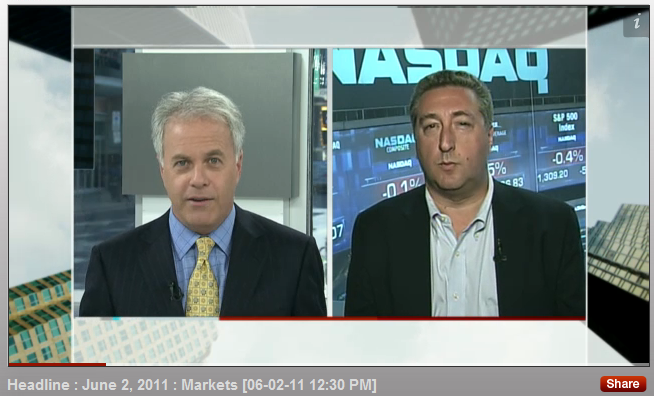
| BNN Media Appearance: June 2, 2011 Posted: 03 Jun 2011 06:58 AM PDT BNN speaks to Barry Ritholtz, CEO and Director for Equity Research for Fusion IQ. > Click for video ~~~ |
| Posted: 03 Jun 2011 06:33 AM PDT Once you digest today’s punk unemployment data, here are some worthwhile Friday reads:
What are you reading? |


| You are subscribed to email updates from The Big Picture To stop receiving these emails, you may unsubscribe now. | Email delivery powered by Google |
| Google Inc., 20 West Kinzie, Chicago IL USA 60610 | |



0 comments:
Post a Comment