


The Big Picture |

- Week in Review: The Power of Zero To Be Tested?
- Felix Zulauf: Storm clouds over markets
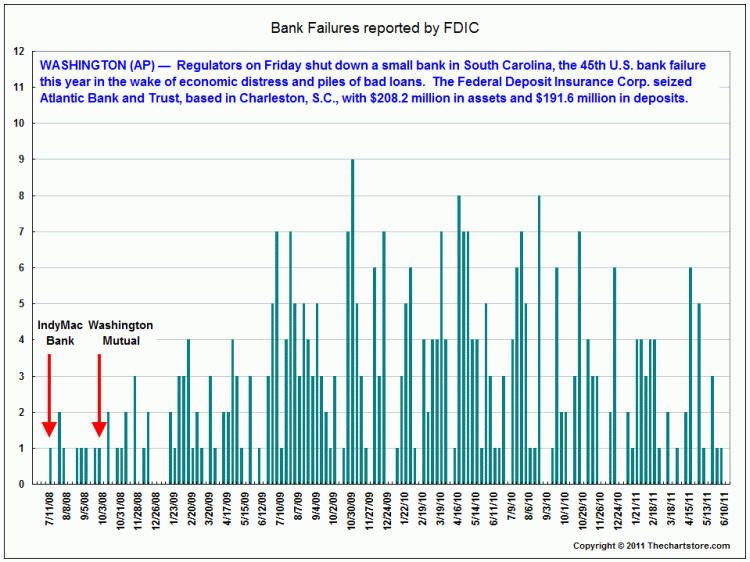
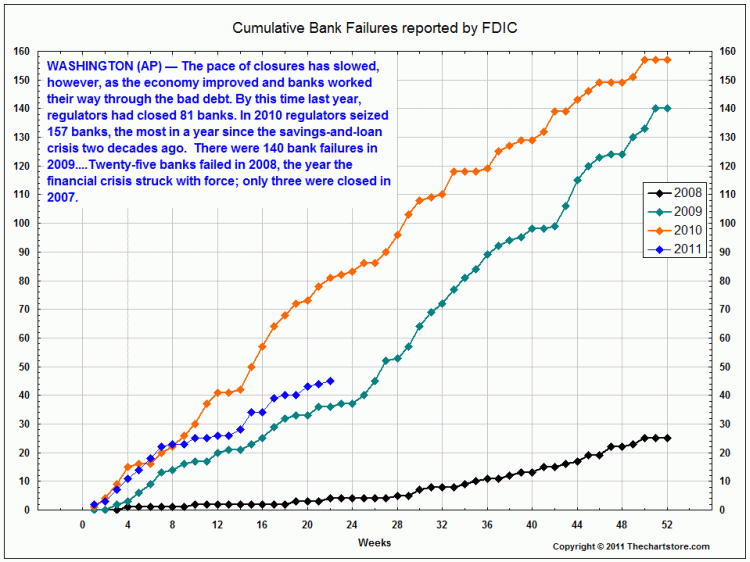
- FDIC Bank Failures
- Helsinki
- The World Economy after the Financial Crisis
- Oh, No, Not the End of the World (Again)
- 2011 Private Employment is 2% Below 2001 Levels
- Time to Order the New Bugs!
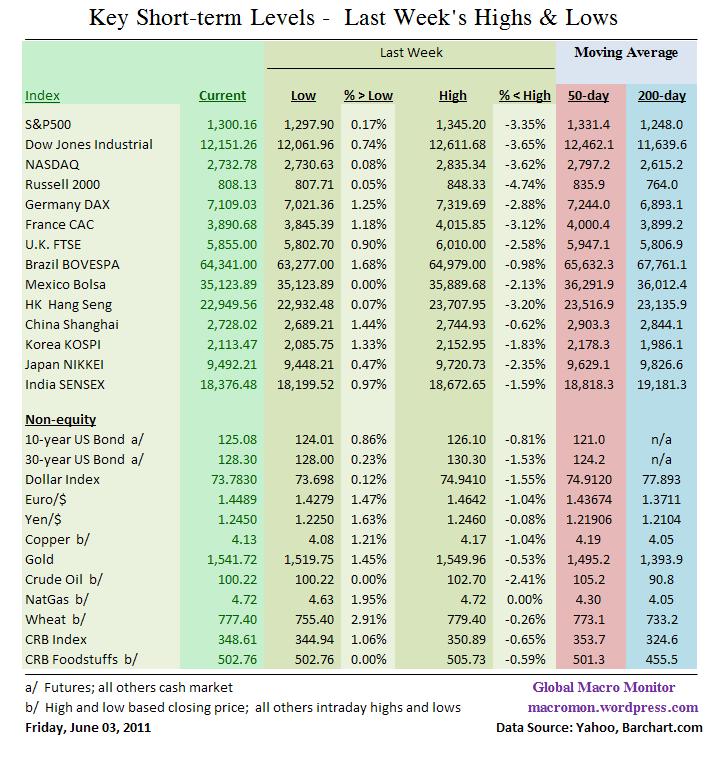
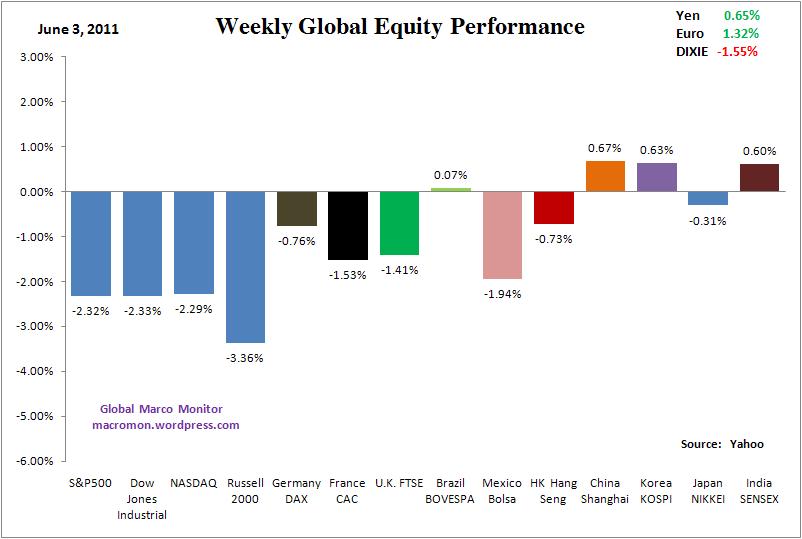
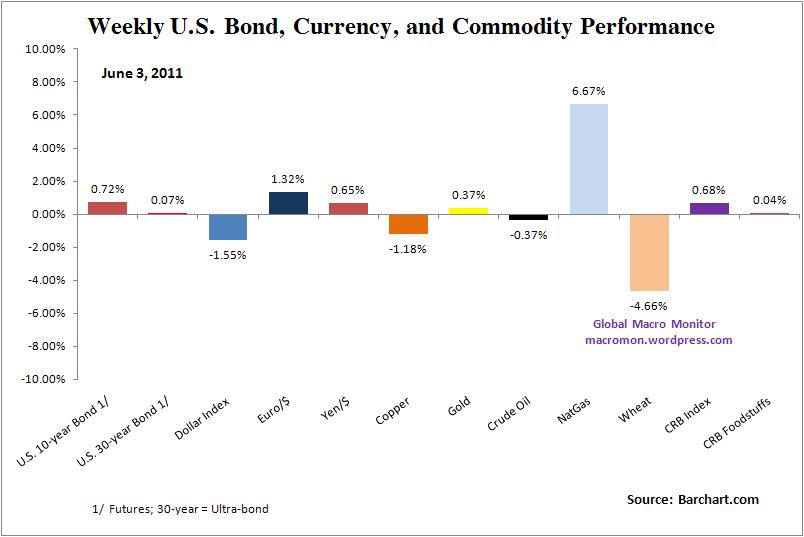
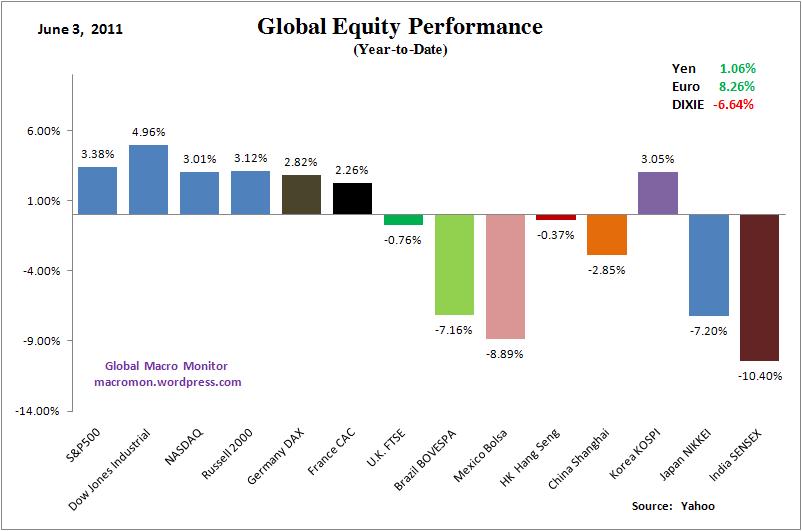
| Week in Review: The Power of Zero To Be Tested? Posted: 06 Jun 2011 01:00 AM PDT The S&P500 and Dow Jones Industrials suffered their worst weekly loss of the year, both down 2.3 percent. The U.S. and European equity indices had bearish outside moves and all major global equity indices we track closed the week below their 50-day moving averages. Asia fared better only due to the fact they closed before the release of Friday's weak employment data. Investors and traders have definitely sold in May and gone away in the S&P500, Dow Jones, and all three European equity indices, which have had negative closes for five weeks in a row. On the positive side, the Brazilian BOVESPA looks like it's trying to put in a bottom and the Shanghai Composite was able to hold its January's important closing low of 2677 after trading down to 2689 early in the week. We will be watching Asia closely at the open on Sunday night as their equity markets have a chance to react to Friday's employment report. Apple, the general of this bull market, closed up 1.79 percent on the week and could be a catalyst for a market bounce if Mr. Jobs surprises at the company's worldwide developers conference this week. Many traders are short the stock going into the conference on the expectation nothing of significance will be announced. Shorting Apple? Ouch! U.S. Treasury bonds closed stronger, but were unable to take out Wednesday's highs even on the dismal employment data. The dollar closed down for the second straight week and we find it interesting that risk assets have been unable to rally on the weak dollar. Though it's too early to tell, keep this on your radar as the weak dollar/risk on trade may be a changin'. The power of zero (interest rates) as a risk-on market prop may be about to face its first serious test. The toxic brew, which would signal something more serious than a garden variety correction, would be the combination of a weaker dollar, equity and bonds moving lower, crude oil and gold moving higher. Not yet a high probability event, in our opinion, and let's hope we don't see it, but keep it on your McSwan list. A credible and sustainable long-term debt/fiscal program included in a Congressional debt ceiling deal would go a long way in easing the concerns of the ratings agencies and increase the confidence of foreign investors in their dollar holdings. Further dithering will be costly. Good luck this week!
|
| Felix Zulauf: Storm clouds over markets Posted: 05 Jun 2011 11:00 PM PDT Felix Zulauf, former head of asset management at UBS, warns that storm clouds are gathering over the markets. He discusses with John Authers, head of Lex, his grim outlook: that Europe faces a double dip, China is slowing, bonds “look awful” and an overheating commodities sector will be hurt badly. He was interviewed at the CFA Institute Annual Conference in Edinburgh. > click for video |
| Posted: 05 Jun 2011 06:57 PM PDT |
| Posted: 05 Jun 2011 06:38 PM PDT Helsinki
There is not a single meal at the GIC gathering in Helsinki that does not include comments about Greece, and it is not because the fare features imported feta cheese. Sovereign debt in Europe is on everyone's mind. Three of the seventeen members of the Euro system are in trouble; Greece is a basket case. There is universal agreement that Greece is now illiquid and insolvent. The latest compromise is another temporary bandage. Our American idiom "kicking the can down the road' fits perfectly. However, kicking the can does not fix the problem. All indications are that Greece is the one member of the euro system that cannot recover. Greek taxpayers are notorious cheats. The Greek economy is spiraling downward. Commercial and residential real estate prices continue to fall. Currently, the country is indebted in excess of 330 billion euros, increasing daily. At the same time, the GDP is 230 billion euros and falling. The economy of Greece is shrinking. The unemployment rate is well into the high teens and rising. This is not a formula for economic recovery. The key issue for Greek debt is the banking system in Europe. The European Central Bank is responsible for the currency and is a funding source of the commercial banks. Those banks are under each country’s national banking system in the seventeen-member euro-zone. They do not have reserves for sovereign debt defaults. The ratings of Greek debt have now fallen to junk status. If Greece defaults, the banks then have to respond on that debt. When they respond, they will take losses, and the losses could erode or eliminate their capital. A banking-system collapse risks contagion in Europe. It is this contagion risk that strikes fear into the heart of the European Central Bank. Fear prompts short-term solutions for this festering wound. However, a long-term solution of restructuring the debt could trigger clauses in credit default swap contracts, causing a massive dislocation in some financial institutions. Could voluntary restructuring of debt occur? Perhaps, but only when the debt can be assembled in the hands of institutional holders. Then they may engage in a voluntary restructuring transaction and not trigger a default clause in a credit default swap contract. The whole issue is quite technical, and countless eyes watch intently as these events continue to unfold. We are in Helsinki, Finland, to discuss the issue of sovereign debt: how to manage it and what to do about countries that get too much in debt and cannot service their debt or grow their way out of it. Finland is a country that has been through financial crisis and corrected itself, imposing discipline and austerity. Finland avoided the last round of financial chaos. Along with its collaborative countries in the Baltic region, Finland didn't have a Madoff, a Fannie Mae, a Lehman Brothers, or an AIG. This leads one to ask why. What were the disciplines in place? How did these countries in Northern Europe keep from getting buried? Why did the peripheral, southern countries like Greece not experience the same outcome? The GIC meetings are delving into these questions with discussions that are equally cautious and fascinating. A number of central bankers are participating, discussing the differences in monetary policy among their countries. In private conversations this is explored in greater depth. Those conversations and round tables at the GIC are held under the Chatham House Rule, so takeaways are not attributable to the participants. Through much exploration, discussion, and debate, we conclude that there is no conclusion. The character and discipline in financial systems, countries, and cultures are different around the world. It is clear there is something at work in Northern Europe that avoids difficulties, and there is something else at work in peripheral Southern Europe that has put several countries in jeopardy. Greece has become the poster child for such activity. On a final note, Helsinki in June is a beautiful place to visit. Sunset is at 10:30 pm, and the sun rises at 4:00 am. During this time of year, the sky is darkened only between the hours of midnight and 2:00 am. The temperature is delightful, and the city's squares and parks are decorated with white, pink, yellow, and red tulips and lilacs in full bloom. Adding to its natural beauty, the welcoming people of Finland make this to be a grand experience. This time will be valued, however short it may be, with Greece's sword of Damocles hanging over the bankers' heads. David R. Kotok, Chairman and Chief Investment Officer |
| The World Economy after the Financial Crisis Posted: 05 Jun 2011 02:56 PM PDT
This week, I will be visiting Brussels to visit some clients (and prospective clients). While I am there, I will be on a panel disucssing the Post-Crisis economy with Norbert Walter (former chief economist at Deutsche Bank), Larry Jeddeloh, Chief investment officer at TIS Group, and Whenever I speak to European fund managers or asset allocators, I always get the sense they were expecting something else. “Refreshing” is a phrase I hear a lot on the continent — I am the Lymon of American commentators. It should be interesting. |
| Oh, No, Not the End of the World (Again) Posted: 05 Jun 2011 09:00 AM PDT
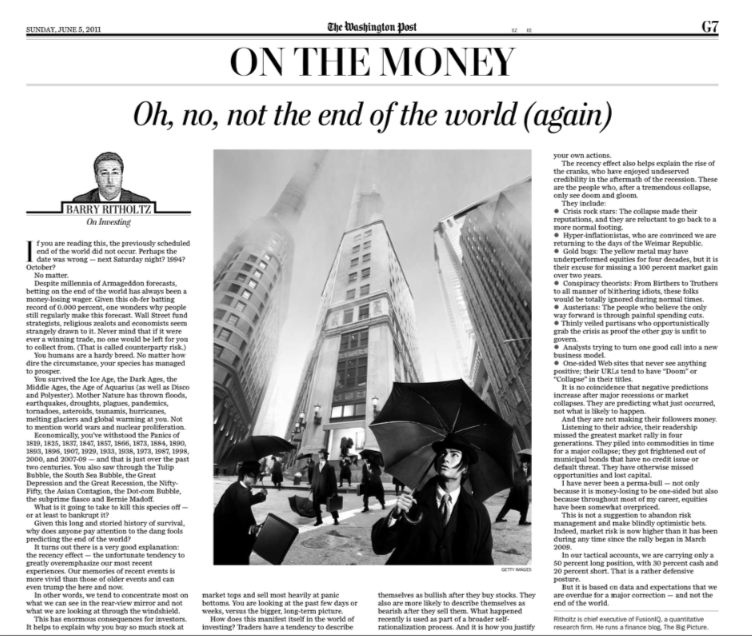
> I have a new column out in the Washington Post on why the crazies come out after major market and economic crises, titled Oh, No, Not the End of the World (Again). (Which I like better than the online headline “After a recession, the least rational rise (temporarily) to prominence. Ignore them”) Excerpt:
You can check out the full online column here, or click the graphic below for the print edition >
> Source: |
| 2011 Private Employment is 2% Below 2001 Levels Posted: 05 Jun 2011 06:46 AM PDT From the Liscio Report, via Alan Abelson, May Employment data shows that a limp recovery is growing limper.
That is a truly astonishing datapoint: An unprecedented 10 Year loss of private sector jobs going back as far as reliable data has been available.
One last tidbit from the Liscio report: “It’s probably wrong to think of this as the leading edge of a new recession: This kind of slow growth is just what you’d expect from a post-financial crisis recovery.” That is classic Reinhart & Rogoff, and exactly what I have been quoting for a year now . . . > Source: |
| Posted: 05 Jun 2011 06:08 AM PDT I am not what you call an organic gardener. As much as I like to get my hands dirty, plant things and watch them grow, I am not afraid to engage in the occasional bout of chemical warfare with some pests. However, before I break out Agent Orange, each year around late May/early June, I order some of my favorite bugs. We release Lady Bugs in the flower garden, and strategically locate a few Praying Mantids Egg Cases. Both seem to keep the pest population down. Now if I could only find a (non-chemical) solution for Mosquitoes . . . ~~~
|





| You are subscribed to email updates from The Big Picture To stop receiving these emails, you may unsubscribe now. | Email delivery powered by Google |
| Google Inc., 20 West Kinzie, Chicago IL USA 60610 | |



0 comments:
Post a Comment