


The Big Picture |

- Open Thread: Apple CEO Steve Jobs Resigns
- Wednesday PM Reads
- XM Satellite Radio 124: POTUS (Today 3-6pm)
- Real Estate Sales: Life in Luxury
- Market Capitalization as a % of GDP
- More support for the August 9, selling climax-induced bullish position?
- Real Money Redesign
- Mazda RX-8 Bites The Dust
- “Me want shiny stuff”
- Durable orders up but Aug changed things
| Open Thread: Apple CEO Steve Jobs Resigns Posted: 24 Aug 2011 04:01 PM PDT Discuss |
| Posted: 24 Aug 2011 02:00 PM PDT My afternoon reading material:
What are you reading? |
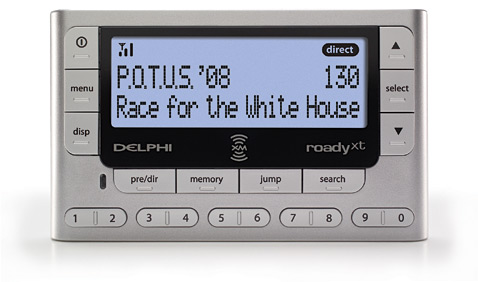
| XM Satellite Radio 124: POTUS (Today 3-6pm) Posted: 24 Aug 2011 11:32 AM PDT
> Hey you XM Satellite Radio listeners! I will be guest hosting for Pete Dominick today, and for the next Wednesdays, from 3-6PM ET on P.O.T.U.S. SiriusXM 124 3:05 Floyd Norris, NYT (phone) Financial news Should be lots of fun! |
| Real Estate Sales: Life in Luxury Posted: 24 Aug 2011 11:00 AM PDT ~~~ Source: |
| Market Capitalization as a % of GDP Posted: 24 Aug 2011 10:35 AM PDT |
| More support for the August 9, selling climax-induced bullish position? Posted: 24 Aug 2011 10:00 AM PDT More support for the August 9, selling climax-induced bullish position? ~~~ So far, the August 9 intraday S&P 500 Index trading low has held. It was 1100. It has been tested twice in the futures market. In each case a sharply down futures price was reversed and the market closed up. Thus, those two tests do not appear in the trading records in New York. They do appear in Asian and European market trading. We have remained fully invested through this turmoil and continue that way. We believe that the US stock market had a peak-to-trough bear selloff that lasted from the April 29 top of 1363 to the August 9 low of 1100. Those 263 points are about 20% of the S&P 500 Index. The selling-climax issue is important but not enough by itself to make a fully invested decision. The reason is that we do not know if the climax was an interim climax or the final one. We will not know that for another few months. Another indicator gives us some additional comfort in our bullish position. We give specific credit to First Trust for reporting it. This approach measures the results of the US stock market after it has experienced a down day of over 6%. Since 1950, there have been 16 episodes in which the S&P 500 sold off by more than 6%. We had episode number 16 on August 8. The S&P was off by 6.66%. Of the 15 other episodes, only two did not result in higher stock prices after one year. One of those was the selloff after Lehman-AIG on September 29, 2008, when the market lost 7.62%. The other was the selloff on October 13, 1989, when the market fell 6.12%. In every other case, the stock market was higher one year after a 6% down day. The average gain was 21.25%, and that is after averaging in the two loss experiences. The higher gains were in the 34%-to-45% range, and there were four such gains among the 15 episodes. So what does this mean for 2011 and 2012? History would argue that the stock market is headed higher, and maybe much higher. Some of the valuation metrics we use suggest the same. Others compare stocks with bonds (Ned Davis) or gold (Ritholtz) and argue the valuation disparity. Our view is that stocks are mostly washed out. This is especially true of the financial sector. My email runs 10 to 1 against banks, bankers, and other financial professionals and their enterprises. They are the target of nearly universal disdain. At Cumberland, we think it is time to be adding weight to the financial sector. We do it with selected ETFs. We are doing that and are taking up the weights. For us it is the first time since 2007 that we are raising weights in the financial sector instead of lowering them. Was August 9 the final selling climax? We will not know for a while. Nevertheless, every day increases the odds that it was. That said, Friday's Bernanke speech and any other event could send the market in any direction. That is how it works when uncertainty is so high. We are fully invested in our US stock market ETF accounts. We are terrified bulls but still bulls. We think the market (S&P 500 index) has a chance to reach 1350-1400 by yearend and over 2000 by the end of the decade. It is 1165 as this is written. We look forward to discussing this outlook with Tom Keene on Bloomberg TV tomorrow, (Thursday) between noon and one. And again on Bloomberg radio with Tom Keene and Ken Prewitt between 7 and 9 AM on Friday morning. This assumes another earthquake does not derail the travel plans. David R. Kotok, Chairman and Chief Investment Officer |
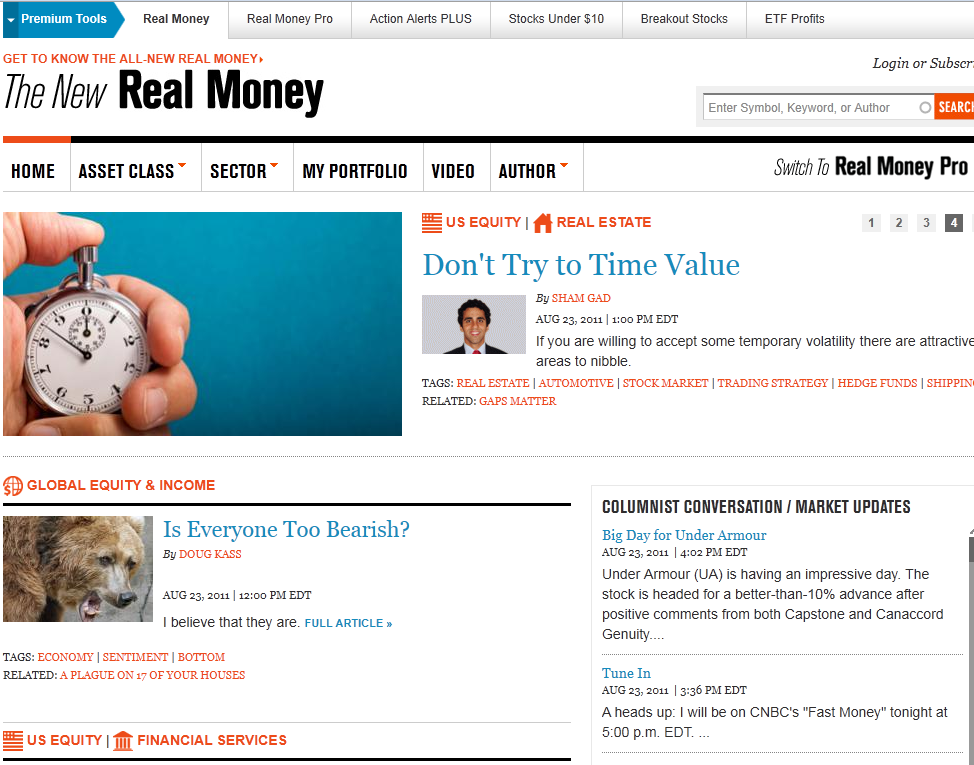
| Posted: 24 Aug 2011 09:15 AM PDT Looks like the guys at TSCM have totally cleaned up the interface for Real Money. This is a well done, needed improvement for their premium site: >
|
| Posted: 24 Aug 2011 08:55 AM PDT
Declining sales and new emission standards forced Mazda to finally pull the plug on the RX-8, the last of its rotary engine sports cars. > Here’s Motorward:
I had an RX8 about 5 years ago — the car was quirky, surprisingly exotic for a $30k — it didn’t start well cold, occasionally had some problems with flooding engine, and IMO, was underpowered by 50-10HP — but overall was terrific a well balanced car, with great steering and handling, good looks, and was a very tossable sport car. Here’s what I wrote about the car in 2004
There are a few 100 units left — go see if you can buy one at a deep discount… >
~~~ Source: |
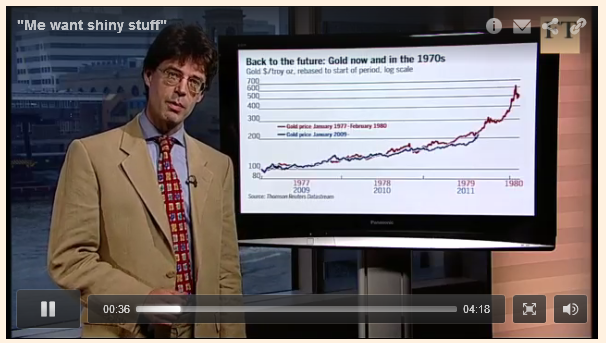
| Posted: 24 Aug 2011 07:14 AM PDT The urge goes back to the ancients: “me want shiny stuff”. But is there now a risk the gold price is entering bubble territory? Investment editor James Mackintosh examines the 1970s gold bubble, as well as the correlation between price and real yields. > click for video |
| Durable orders up but Aug changed things Posted: 24 Aug 2011 06:44 AM PDT Headline Durable Goods rose 4%, twice expectations led by a 43.4% rise in nondefense aircraft orders and 11.5% gain in vehicles/parts as Japan supplies came back on line. Ex these and taking out defense aircraft saw orders rise .7%, better than expectations of down .5% and June was revised up. However, the core reading of non defense capital goods ex-aircraft fell by 1.5%, about in line with forecasts. Orders for computers/electronics and primary metals were up while electrical equipment, machinery and fab metals were lower. Shipments, which get directly plugged into GDP, rose 2.5% and because inventories rose just .8%, the inventory to shipments ratio fell to 1.79 from 1.82, the lowest since March. Bottom line, from the markets perspective, the unexpected gain in orders ex transports was enough to bring us back but the decline in the core cap ex component still points to a still very uneven economy and specifically, today’s data is from July and we know the world changed in Aug. |



| You are subscribed to email updates from The Big Picture To stop receiving these emails, you may unsubscribe now. | Email delivery powered by Google |
| Google Inc., 20 West Kinzie, Chicago IL USA 60610 | |



0 comments:
Post a Comment