


The Big Picture |

- S&P500 Takes the “Road Not Taken”
- Banks Still Fabricating Docs, Commiting Foreclosure Fraud
- Late Afternoon Reads
- Workaholics: Standard work hours around the world
- Harvard Deconstructed: The Taming of the Zoo
- ‘Houseboats’ for Rough Economic Waters
- Are We Nearing Peak Corporate Profits ?
- ISM better than feared but still sluggish
- Blog Traffic Goes (Short Term) Bullish in August
- 10 Thursday AM Reads
| S&P500 Takes the “Road Not Taken” Posted: 01 Sep 2011 10:00 PM PDT
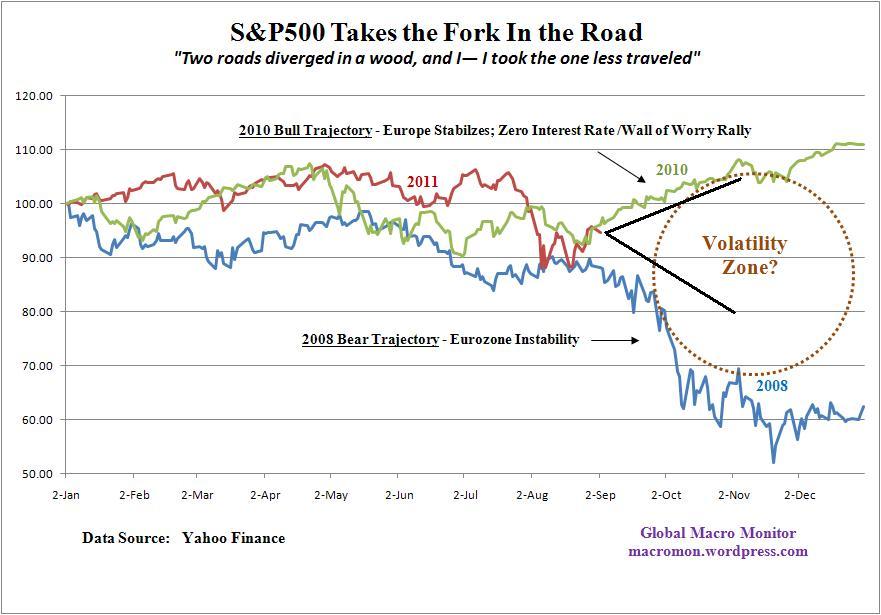
> Robert Frost may have been the greatest contrarian trader, no? Our post of August 22nd, S&P500 Faces a Fork in the Road, noted the S&P500 faced a fork in the road. One path, the 2010 bullish trajectory bolstered by Jackson Hole; the other, the bearish 2008 trajectory, the result of, say, a European sovereign induced banking crisis. From the post to yesterday's close, the S&P500 was up almost 8.5 percent generating its "best eight-day gain since 2009." Not a lot of fundamental news to explain the rally so let's just call it for what it is/was, a Robert Frost rally. The road not taken, less crowded, and most shorted was the path of least resistance in a quiet market with very little macro headlines. We noted hedge funds, some with almost no tolerance for short-term pain, had opened their biggest net short positions in the S&P500 since early 2008. Hence the rally. Where to now? We're not certain, but Bespoke does note September is the cruelest month for stocks, the S&P500 is having trouble at 1230, which is right at the 50 percent retracement of the recent crash, and the Europeans will be returning from their holiday at Swan Lake. Even given our uncertainty where equities are headed, we note most global stock indices have attempted to put in W bottoms and it therefore essential the August 9th 1101 low on the S&P500 holds. Our sense, however, volatility is about to pick up in the next two months. Our best guess is the S&P500 and other equity indices will enter an expanding triangle pattern (see chart below) in September and October before deciding how to close the year. Best to buckle up. But, hey, what do we know? >
|
| Banks Still Fabricating Docs, Commiting Foreclosure Fraud Posted: 01 Sep 2011 04:00 PM PDT As hard as it may seem to believe, the largest mortgage servicers are still fabricating documents for use in foreclosures. That’s according to an article in American Banker, titled Robo-Signing Redux: Servicers Still Fabricating Foreclosure Documents. Key points:
This is why a full investigation must be absolutely mandatory prior to any settlements with the lenders or servicers. > Source: Banks Continue to Fabricate Documents, Commit Foreclosure Fraud |
| Posted: 01 Sep 2011 01:30 PM PDT I’m sitting on the beach today. Much to Mrs Big Picture’s consternation, here’s what I am reading on the iPhone:
What are you reading? |
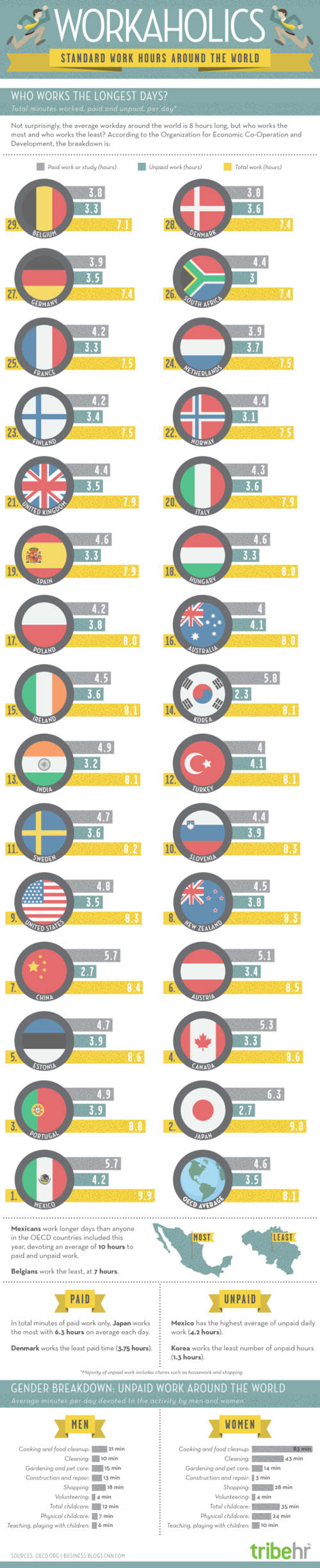
| Workaholics: Standard work hours around the world Posted: 01 Sep 2011 12:00 PM PDT Perfect infoporn in advance of tomorrows NFP: > Click To Enlarge: |
| Harvard Deconstructed: The Taming of the Zoo Posted: 01 Sep 2011 11:00 AM PDT
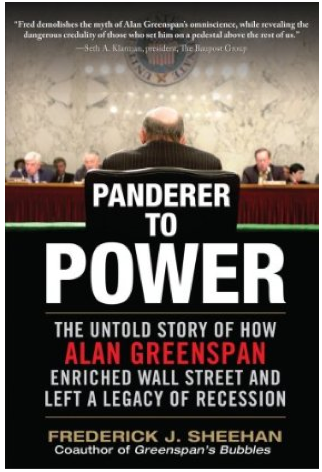
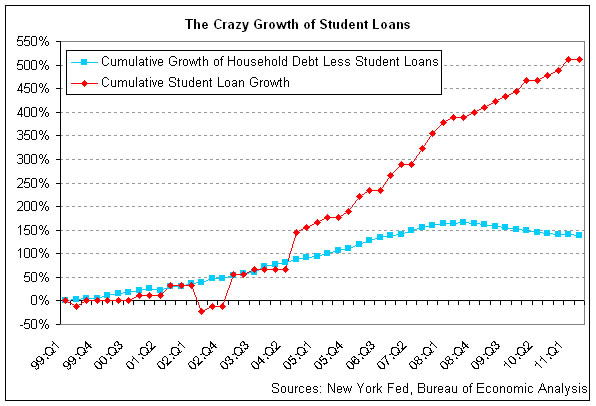
His new book, Panderer for Power: The True Story of How Alan Greenspan Enriched Wall Street and Left a Legacy of Recession, was published by McGraw-Hill in November 2009. He was Director of Asset Allocation Services at John Hancock Financial Services in Boston. In this capacity, he set investment policy and asset allocation for institutional pension plans. ~~~ The Atlantic magazine has illustrated the unsustainable growth of student debt in the chart below. In David Indiviglio’s August, 18, 2011, article, “Student Loans Have Grown 511% Since 1999,” the author notes: “Obviously the number of students didn’t grow by 511%. So why are education loans growing so rapidly? One reason could be availability. The government’s backing lets credit to students flow very freely…. [U]niversities are raising tuition aggressively since students are willing to pay more through those loans.” Indiviglio concentrates his attention on the future problem for the students, though that is secondary, except, of course, to the students in hock and out-of-luck lenders. Colleges and universities in the United States are a short sale. Great Courses are a long. The latter is the model to ponder.
The number of colleges will plummet. This is due to the loss of nerve, confidence, substance, direction, integrity – will that do? – of teaching in America. Just look at that chart: what a picture of insatiable greediness and self-indulgence among the colleges. No thought to the unbearable debt deposited on their students. Angelo Mozilo, the grand poobah of subprime mortgages, is correctly vilified for coaxing financial naives into debtors’ prison, but the same tactics by the education establishment goes unremarked. In another Atlantic article, “The Debt Crisis at American Colleges,” authors Andrew Hacker and Claudia Dreifus write: “[C]olleges have embraced a host of extraneous activities – from obscure sports to overseas centers – and tacked most or all of their tabs onto students’ bills. Unlike businesses, which cut losing operations, colleges simply hike their tuitions.” Will former Harvard Professor Elizabeth Warren’s ill-defined federal agency, watchdog over slatternly marketing hoaxes by financial institutions, apply the same standards to deceptive, college sales practices? A century ago, John Jay Chapman, Harvard alum, was a pain-in-the-neck to Harvard College President Charles William Eliot. He tried to sack the president. In 1909, Chapman wrote that his college had diluted its resolve to teach the truth: “The men who control Harvard to-day are business men, running a large department store…. Devising new means of expansion, new cash registers and credit systems – systems for increasing their capital and the volume of trade….The wonderful ability of the American business man for organization is now at work consolidating the Harvard graduates into a corps which seems to have the same sort of enthusiasm about itself as a base-ball team…. (This is excerpted from “The Hundred Year Bubble,” a dissertation originally published in the January 2010 issue of the Gloom, Boom & Doom Report on America’s unwillingness to set limits over the past century, and the parallel inflation of money, self-improvement, self-delusion, and self-gratification.) Chapman’s alarm may be difficult to understand today, but he had the advantage of living during a sharp break in the then-nearly-300-year history of Harvard College: before and after it took the low road. Eliot was an early exemplar of the “New Education” thesis that sought a “universal utility” in American education. This inflation of mission and of human potential, captured in Eliot’s substitution of vocabulary for thought, is collapsing. Others also rued the dangerous downgrading of the American mind at the universities. In 1908, Albert Straus, then partner at the investment firm of J.W. Seligman and Company, told a Columbia University audience: “[W]e are slaves to our phrases; what begins by being a metaphor ends by dominating our thinking…[W]e often reason about these matters as though the pictures that our words call up were real.” And Straus never saw MTV. Colleges today have set many missions for themselves, not many of which are in the interests of their students. They disguise their reluctance to teach with slogans and images: “empowering students to achieve professional and personal success in dynamic careers and in a diverse global society by providing a comprehensive and supportive educational experience, fostering academic integrity, and encouraging lifelong learning.” (Berkeley College, Boston) Only by carrying the imprimatur of a college, or of a government bureaucracy (really, one in the same, they are slaves to each other), does the public accept such a pile of flotsam as making sense. (Yes: Bernanke and his fellow imposters.) A globally-known investor wrote to me after “Scarlett O’Hara’s Risk-Free Rate” that Harvard is finished and will be insolvent. The collapse of America’s colleges, and of the primary- and secondary-school farm systems, will probably be a good thing overall, difficult as it will be to understand during the unfolding: It may clear out the zoo. Gloom, Boom & Doom Report, Marc Faber quoted a study from the Goldwater Institute that found between “1993 and 2007, the number of full-time administrators per 100 students at America’s leading universities grew by 39 percent, while the number of employees engaged in teaching, research, or service only grew by 18 percent.” In the Summer 2011 edition of City Journal, Heather MacDonald writes: “This past academic year, for example, a Bowdoin College student interested in American history courses could have taken ‘Black Women in Atlantic New Orleans,’ ‘Women in American History, 1600-1900,’ or ‘Lawn Boy Meets Valley Girl: Gender in the Suburbs,’ but if he wanted to take a course in American political history, the colonial and revolutionary periods, or the Civil War, he would have been out of luck.” Noteworthy is the larger topic Mac Donald discusses in “Great Courses, Great Profits.” A company called Great Courses is making gobs of money selling recorded lectures by college professors who teach “Plato, Aristotle, Cicero, Paul, Erasmus, Galileo, Bacon, Descartes, Hobbes, Spinoza, Dante, Chaucer, Spenser, Shakespeare, Cervantes, Milton, Pope, Swift, Goethe, and others…” This may not be materially different from the lectures John Jay Chapman attended in the 1870s. Those who pay Great Courses receive no degree, no padding to their resume, no Delta House invitations, no country-club dormitory suite, no indulgent, grief-counseling administrators, and no future business network. Macdonald goes on to write that college faculties wring their hands because the curriculum has been “problemetized.” There is some resistance to such courses as “Queering the Alamo.” “My dear James,” wrote Chapman in 1907 to his friend, Harvard professor William James (The Varieties of Religious Experience), “Eliot has boomed and boomed – till we think it’s the proper way to go on. He must, or lose foothold. Well, why not a man who does not boom? Is boom the best thing in life? Is it all boom? Is there now and to be nothing ever but boom, boom, boom? Is there not something that operates without money – not anywhere?” The Spring 2011 edition of The Trinity Reporter, alumni magazine of Trinity College (Connecticut), includes a full-page pitch to alums under the picture of a 2004 graduate (name withheld, to spare his family further publicity for this embarrassing incident) screaming like Janis Joplin and tearing his white shirt, blue blazer, and blue-and-gold school tie off to reveal a muscle-bound chest covered with a gray “Trinity” gym shirt. “Blue and Gold Is In Your Blood,” shrieks the copy: “Let’s keep that competitive spirit alive and show our rivals why Trinity College is among the Top Ten schools in alumni giving participation in the country.” There is really no need to comment on the consummation of Chapman’s foresight. The fulfillment of Chapman’s letter to Dear James has regressed to the least common denominator. What might we gain from Sherman’s march through the academy? A taming of the zoo. Twenty years ago the author and critic Harold Bloom (The Western Canon, 1994) was interviewed by the Paris Review. Quoting Bloom: “I watch MTV endlessly.” This enemy of “The School of Resentment” – feminist literary critics, new historicists, poststructuralists, deconstructionists, semioticians, laconists, and poetry slamists – saw MTV as the real vision of what this country desires: “no matter how many [performers] are on the screen, not one of them feels free except in total self-exaltation.” Time to short March Madness? Source: |
| ‘Houseboats’ for Rough Economic Waters Posted: 01 Sep 2011 10:00 AM PDT Amid high housing costs and a weak economy, some Bay Area residents are deciding to live full time on boats. So-called live-aboards are attracted by the relative affordability of a home on the water. WSJ 8/31/2011 time: 4:01 |
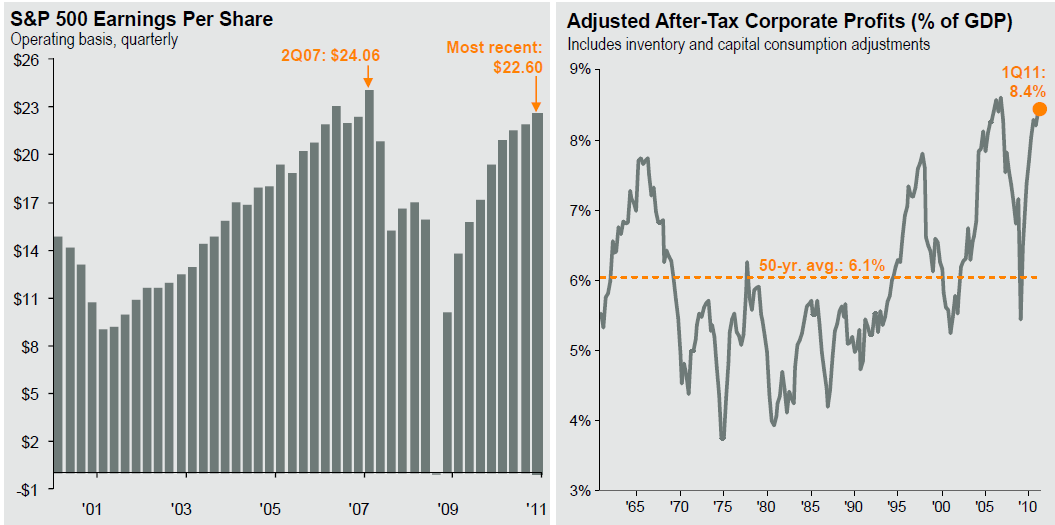
| Are We Nearing Peak Corporate Profits ? Posted: 01 Sep 2011 09:00 AM PDT Peak corporate profits should lead, under normal circumstances, to more hiring and Capex spending. However, we are not seeing enough of either. Will the corporate version of the Paradox of Thrift become a self-fulfilling prophesy? >
Source: JP Morgan funds |
| ISM better than feared but still sluggish Posted: 01 Sep 2011 08:02 AM PDT The Aug ISM remained surprisingly above 50 at 50.6. It’s better than expectations of 48.5 and fears of worse but down a touch from 50.9 in July. The level of 50.6 is still the weakest since July ’09. New Orders remained below 50 at 49.6 vs 49.2 in July and Backlogs too at 46 vs 45 in July. Production fell by 3.7 pts to below 50 at 48.6. Employment fell almost 2 pts to 51.8, the lowest since Nov ’09. Importantly, Export Orders fell 3.5 pts to 50.5, the lowest since July ’09. Inventories at the manufacturer level rose 3 pts to the most since Jan and were up 2.5 pts at the customer level but stayed below 50 at 46.5. Prices Paid fell 3.5 pts to the lowest since Nov ’09. Of the 18 industries surveyed, just 10 reported growth. The ISM gave a bottom line, “the overall sentiment is one of concern and caution over the domestic and international economic environment, which is affecting customers’ confidence and willingness to place orders, at least in the short term.” While the number was better than expected, this quote spells out the economic concerns and the ISM does capture all the new market turmoil experienced in August. |
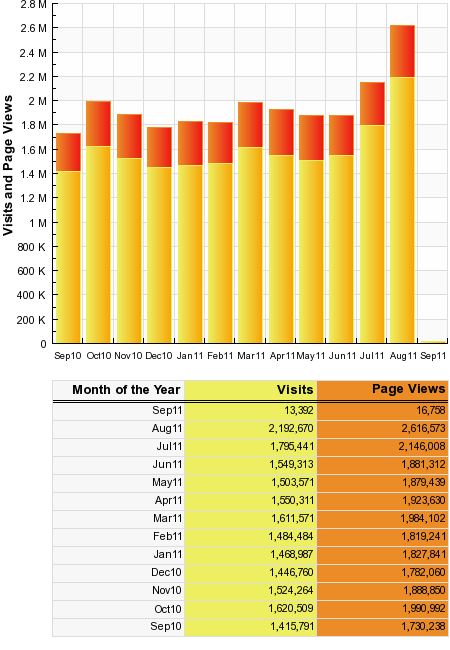
| Blog Traffic Goes (Short Term) Bullish in August Posted: 01 Sep 2011 07:30 AM PDT I am not particularly bullish these days — 50/50 stocks versus cash/bonds — and while we certainly could see a bounce up towards the 1250 level on the SPX, I am not sanguine about the next 2Qs of market performance. That said, the chart below may be a very short term, bullish indicator. As we have seen in the past, TBP traffic spikes are often accompany a substantial increase in nervousness. That can set the table for a decent bounce, but as the dates below confirm, it is typically short term in nature. More solid bottoms (i.e., 2 years versus 2 months) were more likely to be accompanied by complacency, not interest. >
via Site Meter > Previously: |
| Posted: 01 Sep 2011 06:15 AM PDT The latest adds to my Instapaper this morning:
What are you reading?
ELECTILE DYSFUNCTION: The inability to get aroused over any of the choices for President put forth so far by either party for the 2012 election year. |

| You are subscribed to email updates from The Big Picture To stop receiving these emails, you may unsubscribe now. | Email delivery powered by Google |
| Google Inc., 20 West Kinzie, Chicago IL USA 60610 | |



0 comments:
Post a Comment