


The Big Picture |

- Labor’s Dwindling Share of the Economy and the Crisis of Advanced Capitalism
- FHFA Lawsuit vs Bank of America, Merrill & Countrywide
- Protected: GS: State of Markets
- Succinct Summation of Week’s Events (9/2/11)
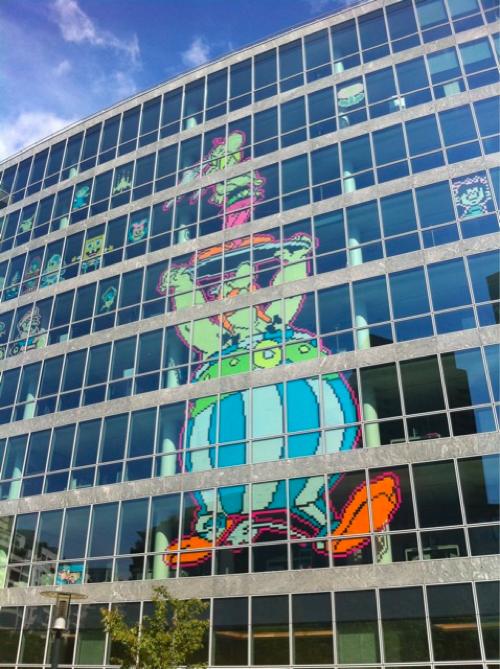
- Paris Post It Wars
- Are 83% Of Google+ Users Inactive?
- Bill Nye: Hurricane Irene evidence of climate change
- What Does Inflation Say About Risk On/Off?
- Mark Cuban, On the Record
- 10 End of Week AM Reads
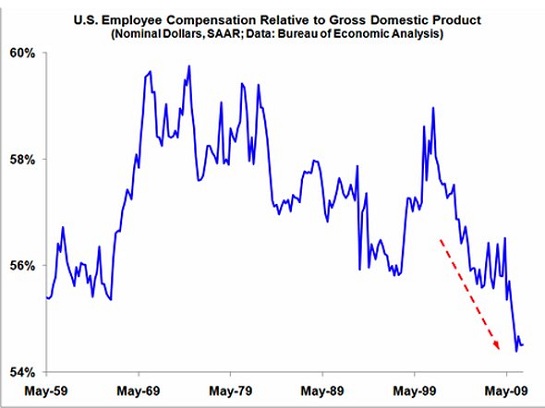
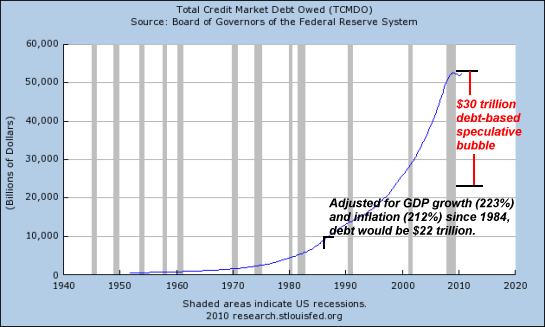
| Labor’s Dwindling Share of the Economy and the Crisis of Advanced Capitalism Posted: 02 Sep 2011 10:30 PM PDT Charles Hugh Smith publishes Foreclosure Crisis Weekly, dedicated to documenting the often-amazing foreclosure crisis. ~~~ All attempts to reform the Status Quo of advanced finance-based Capitalism will fail, as its historically inevitable crisis is finally at hand.It is self-evident that conventional economics has failed, completely, utterly and totally. The two competing cargo cults of tax cuts/trickle-down and borrow-and-spend stimulus coupled with monetary manipulation have failed to restore advanced Capitalism’s vigor, not just in America, but everywhere. Conventional econometrics is clueless about the root causes of advanced finance-based Capitalism’s ills. To really understand what’s going on beneath the surface, we must return to “discredited” non-quant models of economics: for example, Marx’s critique of monopoly/cartel, finance-dominated advanced Capitalism. (“Capitalism” is capitalized here to distinguish it from “primitive capitalism.”) All those fancy equation-based econometrics that supposedly model human behavior have failed because they are fundamentally and purposefully superficial: they are incapable of understanding deeper dynamics that don’t fit the ruling political-economy conventions. Marx predicted a crisis of advanced Capitalism based on the rising imbalance of capital and labor in finance-dominated Capitalism. The basic Marxist context is history, not morality, and so the Marxist critique is light on blaming the rich for Capitalism’s core ills and heavy on the inevitability of larger historic forces. In other words, what’s wrong with advanced Capitalism cannot be fixed by taxing the super-wealthy at the same rate we self-employed pay (40% basic Federal rate), though that would certainly be a fair and just step in the right direction. Advanced Capitalism’s ills run much deeper than superficial “class warfare” models in which the “solution” is to redistribute wealth from the top down the pyramid. This redistributive “socialist” flavor of advanced Capitalism has bought time–the crisis of the 1930s was staved off for 70 years–but now redistribution as a saving strategy has reached its limits. The other political-economic strategy that has been used to stave off the crisis is consumer credit: as labor’s share of the economy shrank, the middle class workforce was given massive quantities of credit, based on their earnings and on the equity of the family home. The credit model of boosting consumption has also run its course, though the Keynesian cargo cult is still busily painting radio dials on rocks and hectoring the Economic Gods to unleash their magic “animal spirits.” The third strategy to stave off advanced Capitalism’s crisis was to greatly expand the workforce to compensate for labor’s dwindling share of the economy. Simply put, Mom, Aunty and Sis entered the workforce en masse in the 1970s, and their earning power boosted household income enough to maintain consumption. That gambit has run out of steam as the labor force is now shrinking for structural reasons. Though the system is eager to put Grandpa to work as a Wal-Mart greeter and Grandma to work as a retail clerk, the total number of jobs is declining, and so older workers are simply displacing younger workers. The gambit of expanding the workforce to keep finance-based Capitalism going has entered the final end-game. Moving the pawns of tax rates and fiscal stimulus around may be distracting, but neither will fix advanced finance-based Capitalism’s basic ills. The fourth and final strategy was to exploit speculation’s ability to create phantom wealth. By unleashing the dogs of speculation via a vast expansion of credit, leverage and proxies for actual capital, i.e. derivatives, advanced finance-based Capitalism enabled the expansion of serial speculative bubbles, each of whcih created the illusion of systemically rising wealth, and each of which led to a rise in consumption as the “winners” in the speculative game spent some of their gains. This strategy has also run its course, as the public at last grasps that bubbles must burst and the aftermath damages everyone, not just those who gambled and lost. Two other essential conditions have also peaked: cheap energy and globalization, which opened vast new markets for both cheap labor and new consumption. As inflation explodes in China and its speculative credit-based bubbles burst, and as oil exporters increasingly consume their resources domestically, those drivers are now reversing. Advanced Capitalism is broken for reasons conventional economics cannot dare recognize, because it would spell the end of its intellectual dominance and the end of the entire post-war political-economic paradigm that feeds it. Let’s look at some charts to see what conventional economists must deny to keep their jobs. Take a look at this chart. What reality does it reflect? A failure to cut taxes enough? A failure to print enough money or extend enough credit? No. What it reflects is labor’s dwindling share of the economy.
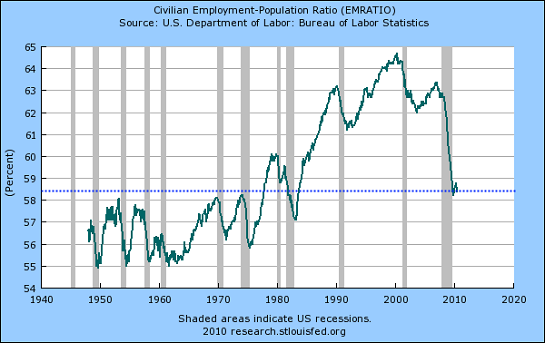
The structural reality is that employment is declining:
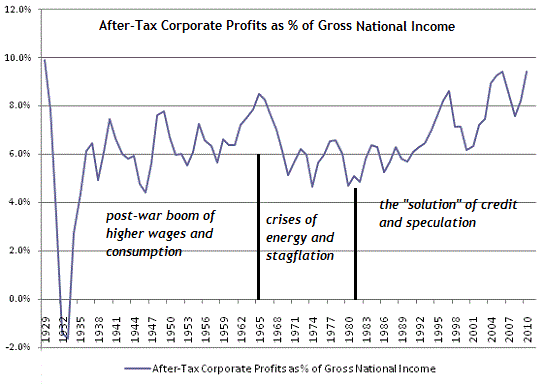
Meanwhile, after-tax corporate profits have steadily climbed to nearly 10% of the entire national income:
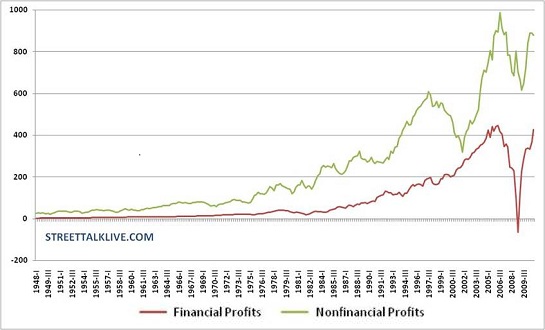
Note the recent rise of finance-based profits:
This chart leaves no doubt that the engines of the past 30 years “growth” and “prosperity” have been credit and credit-fueled speculation:
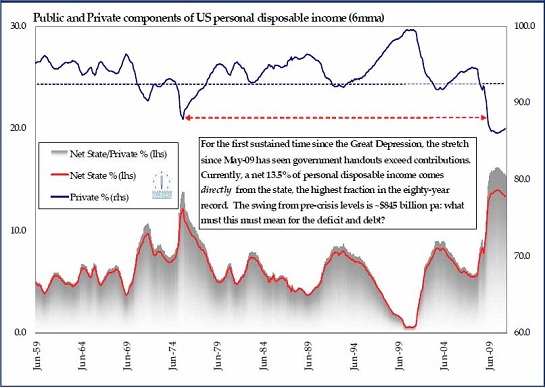
If we look at disposable income, we find that direct government transfers have masked the systemic erosion of labor’s earnings and employment:
Marx identified two critical drivers of advanced Capitalism’s final crisis: 1. Global Capital has the means and incentive to keep labor in surplus and capital scarce, which means that capital has pricing power and labor has none. The inevitable result of this is that wages, as measured in purchasing power, fall while the returns earned on capital rise. This establishes a self-reinforcing, inevitably destructive dynamic: once labor’s share of the national income falls below a critical threshold, labor can no longer consume enough or borrow enough to keep the economy afloat with its cash and credit-based consumption. We are at that point, but massive Federal borrowing and transfers are masking that reality for the time being. 2. The dual forces of competition and technology inevitably drive down the labor component of all manufactured goods and technology-based services. Mechanization, robotics and software have lowered the labor component of everything from running shoes to computer chips from $20 per item to $2 per item, and that process cannot be reversed. While the wage paid to the workforce designing and manufacturing the products and providing the services may actually rise, the slice of revenues given over to all labor continues shrinking. This is what I have constantly referred to (using Jeremy Rifkin’s excellent phrase) as “the end of work.” Put another way: the return on capital invested in techology greatly exceeds the return on labor. Industries and enterprises which fail to leverage capital invested in technology that lowers the labor component of their good/service eventually undergo rapid and inevitable creative destruction. We are about to witness this creative destruction in the labor-heavy industries of government, education and healthcare. Marx’s genius was to recognize the historical inevitability of these internal forces within advanced Capitalism. He also recognized the inevitability of finance-capital’s dominance of industrial capital–something we have witnessed in full flower over the past 30 years. Finance capital now dominates not just industrial capital but the machinery of governance, rendering real reform impossible. Instead, the Status Quo delivers up simulacrum “reform” which change nothing but the packaging of the Central State/Cartel Capitalism’s exploitation and predation. Add all this up and you have to conclude the final crisis of finance-based advanced Capitalism is finally at hand. All the “fixes” that extended its run over the past 70 years have run their course. Life will go on, of course, after the Status Quo devolves, and in my view, ridding the globe of financial predation and parasitism will be a positive step forward. The real solution is to understand advanced finance-based global Capitalism will unravel as a result of the internal dynamics described above, and be replaced with an economic and political Localism that I describe in my new book An Unconventional Guide to Investing in Troubled Times.I don’t claim these ideas are unique to me; many others have described the same dynamics and historical trends. |
| FHFA Lawsuit vs Bank of America, Merrill & Countrywide Posted: 02 Sep 2011 07:47 PM PDT While the Feds have been pressuring the State AGs about the misshapen, federally bailed out banks, perhaps they should have been more concerned about a legal team in DC. The Federal Housing Finance Agency (FHFA) is seeking to rescind numerous transactions, and is looking for additional claims, civil penalties and punitive damages in cases alleging misconduct. I presume the cases, filed on behalf of Fannie Mae and Freddie Mac, involve a fiduciary obligation to Fannie & Freddie (i.e., taxpayers) not the White House — hence, we shall see how this develops. Consider the numbers just versus Bank of America and holdings:
In addition to Bank of America/Merrill Lynch, the FHFA also filed complaints against JPMorgan, Citigroup, Goldman Sachs, Barclays, Nomura Holdings, HSBC Holdings, Societe Generale SA, Credit Suisse, Deutsche Bank and First Horizon National Corp in federal court in Manhattan.They also sued Ally Financial, Countrywide Financial Corp, General Electric Co. and Morgan Stanley in state court in Manhattan, and sued Royal Bank of Scotland Group Plc in federal court in Connecticut. There is a lot more here than meets the eye . . . |
| Protected: GS: State of Markets Posted: 02 Sep 2011 03:29 PM PDT |
| Succinct Summation of Week’s Events (9/2/11) Posted: 02 Sep 2011 12:30 PM PDT Succinct summation of week’s events: Positives:
Negatives:
|
| Posted: 02 Sep 2011 11:30 AM PDT |
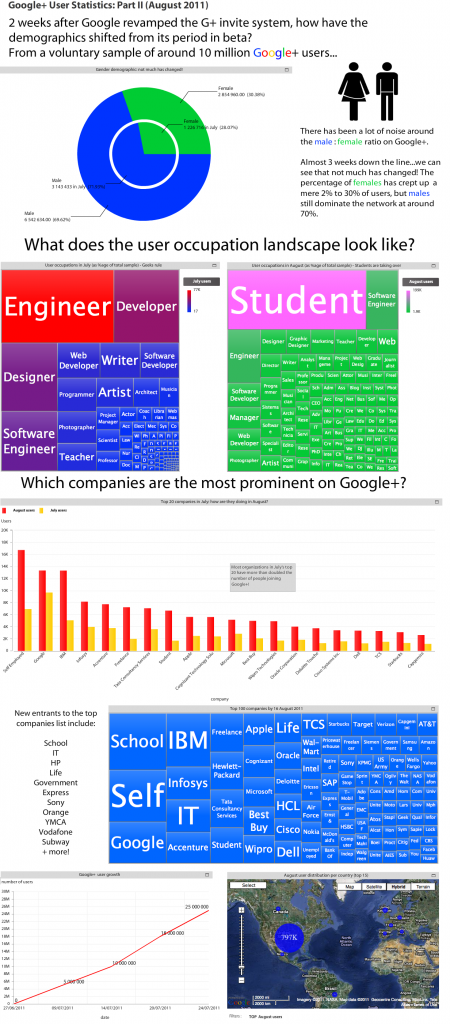
| Are 83% Of Google+ Users Inactive? Posted: 02 Sep 2011 11:00 AM PDT |
| Bill Nye: Hurricane Irene evidence of climate change Posted: 02 Sep 2011 09:00 AM PDT Source: |
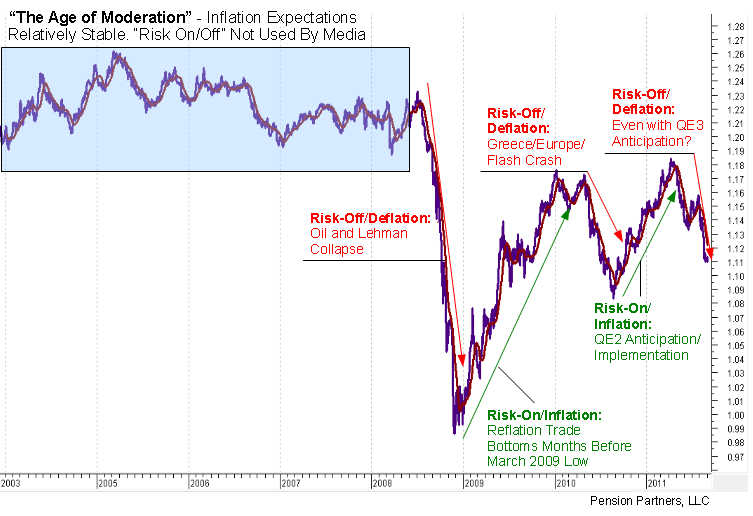
| What Does Inflation Say About Risk On/Off? Posted: 02 Sep 2011 08:45 AM PDT click for larger chart > Michael Gayed observes:
> ~~~ Michael A. Gayed, CFA is Chief Investment Strategist at Pension Partners, where he structures portfolios. Prior to this role, Michael served as a Portfolio Manager for a large international investment group, trading long/short investment ideas in an effort to capture excess returns. In 2007, he launched his own long/short hedge fund, using various trading strategies focused on taking advantage of stock market anomalies. Michael earned his B.S. from New York University, and is a CFA Charterholder. |
| Posted: 02 Sep 2011 08:00 AM PDT I’d like to tell you that he travels with an entourage, that he’s unapproachable, that you play by his rules. But I’ve never met a celebrity so honest, so unguarded, so willing to go on the record as Mark Cuban. He’s got no agenda, he’s just being him. Maybe you know him as the owner of the Dallas Mavericks, the NBA champs. Maybe you saw him on “Dancing With The Stars”. But to those paying attention, it was his huge financial victory selling Broadcast.com to Yahoo that put him on our radar…how did this happen? I hate to tell you, but rich guys are smart. The self-made ones. Those who inherit tend to piss it away, they just don’t know about hard work. And that’s what it takes to make it and keep it. So Mark graduates from college and moves to Indiana where he’s living in a veritable frat house, six guys, working as a bartender. So what does he do? He buys a Texas Instruments computer and learns how to program. Now let me be clear, he’s got no degree in computer science. He’s not being paid to learn. But he can see the future, and he wants to participate. Can you see where we’re going as opposed to where we’ve been? Are you willing to put in the hard work to get there? Hell, I’ll be honest, I was stunned Mark Cuban knew who I was, never mind wanted a meeting with me. To shoot the shit no less, with no agenda, because he thought it would be fun… I’m just a guy sitting in front of a computer screen in my underwear, how did this happen? Hard work and a paradigm shift. When I was printing my newsletter and sending it via snail mail, my audience was limited. But the Internet opened the world to me, and if I can just write something special enough, it’s astounding who I can reach. There are no limits online. Everybody’s got an e-mail address. Yes, doors are closed, but you have the key in your pocket, you can open them. And it doesn’t happen by knocking. It happens by creating. So Mark gets a gig selling software. And when he makes a $15,000 deal, with a $1500 commission, his boss fires him, for going out on a call instead of opening the store, a task he delegated to a coworker. If you play by the rules, you’re screwed. Successful people think for themselves. They may not break the law, they may not be dishonest, but if something doesn’t make sense, they say so and take action. Because if it doesn’t make sense to them, it doesn’t make sense to a whole lot of other people…and with these other free thinkers lies your future. So Mark went independent. Started his own firm, eventually sold out to CompuServe, owned by H&R Block, and took his two million and retired. Oh yeah, there was one good story just after the deal went down. How he was drunk in a bar with his buddies and he called American Airlines and bought a lifetime pass for himself and a partner. He was slurring his words, but they took his $125,000. And then he visited 11 countries and ended up in Manhattan Beach, taking acting lessons, meeting women. But he moved after driving his Lexus down La Cienega during the riots. To Hollywood. Where the building shook so hard two years later, during the Northridge quake, that he departed back to Dallas. And that’s where a buddy brought up the concept of listening to Indiana games, their mutual alma mater, in Texas. There came the birth of Broadcast.com, which was sold to Yahoo for in excess of five billion. But Mark couldn’t sell his stock immediately. So he took every dollar he had and hedged against the dot com crash. That’s twenty million in case you wanted to know. Yup, he’d grown his two into twenty, by trading technology stocks. You can’t have someone else manage your money, you’ve got to do it yourself. And yes, the market crashed. But even though six months went by, he couldn’t cash out right away because of the tax implications. So he got into LEAPS with Goldman Sachs and… I was stunned at the confidence. I was always taught there was someone else who knew, someone smarter, better trained. But Mark believes if he just concentrates and dedicates himself, he can play. And speaking of playing, he bought the Mavericks. Everybody said he overpaid, but Jerry Jones called him and said no. You can’t listen to the naysayers, you’ve got to do what’s right in your heart.
And now Mark is a contrary. He doesn’t want to be where everybody else is. He’s investing all the time, in new ideas, where no one else is playing. Because big wins are about risk. Which might be why the music business is in trouble, everybody’s playing it safe. And yes, he’s got the Gulfstream V. And yes he was on not only “Dancing With The Stars”, but “Entourage”. But Mark Cuban is just like you and me, a denizen of the Net, he’s hooked up, wired, he knows what’s going on. He uses a Sidekick, on T-Mobile. Why? Because of the keyboard, he rarely surfs the Net, but he taps out responses all day long. And he implored me to put all my e-mail in the cloud. He’s got all of his back to 1985, he uploaded it to Gmail, he demonstrated the instant access he had, the searchability. And he’s got tens of thousands of unread e-mails. But he spends hours combing over his incoming every day. You get two sentences. Complain, ask for a favor and he hits delete. Deliver a straight up business proposition, he might not only respond, he might invest, Mark’s accessible. And he went on and on about Twitter. How we all know what’s going on now. We see the highlights on the instant service. He talked about programming on HDNet, one of his companies. If they air something tweetworthy, viewership skyrockets! They had 125,000 viewers at one in the morning. Which is insane. Then again, air enough boobies and young men get titillated. And he said although the press constantly claims young kids aren’t on Twitter, he said everybody in the African-American community was. It was where information on basketball was exchanged. And he spoke about how every kid knows every lyric. They’ve got to know what Jay-Z and Kanye have to say about Weezy, and vice versa. And he believes newspapers survive, in a physical format. And he reads the “New York Times” as well as the “Wall Street Journal”. And he believes you can’t know everything, but you’ve got to be informed on what you sell, your brand. And you’ve got a question and Mark’s got an answer. Solving our nation’s economic problems? Tax the rich, but be smarter with government distributions. He’s also about tearing down vacant homes. It gives work to laborers and then when demand picks up, new homes have to be built! As for jobs… If only people were educated. There are $100,000 gigs in Silicon Valley there for the taking, as long as you know how to code. That’s not impossible, but are you willing to put in the effort? And we bonded over how we handle haters. Mark said he loves it, indicates he’s on the right path. And if you e-mail him three or four hundred times, he’s gonna send you a message that this e-mail address has been deleted. Just because you have access, that doesn’t mean you can abuse it. This guy was so smart and so informed I wanted to hand him the keys to the country. Not because we agreed on everything, but because he’s got no filter. What I mean by that is he’s not concerned with what everybody else thinks, his image, but what he believes is right. He knows the stock market cold. If you want to make money, that’s where it is. But he laments that Wall Street is not a haven of investment, that it’s a casino, where too many smart people go to get rich. If only the tax laws were changed to incentivize investment. What if you started a company and profits were tax free for five years? Just maybe all those Ivy League grads would create companies of value instead of working for banks trying to figure out another way to beat the system. And he would have talked all night. We went at it for two and a half hours and he proclaimed no agenda for the rest of the evening. Usually the rich and powerful are all about image, deigning to see you briefly, making you wait and ushering you out, signifying that you’re just not that important. And I won’t say that Mark made me feel important, that’s not his personality. He’s got that always on, ADD kind of vibe. His eyes wander, his neurons are firing. But if you stimulate him, he’ll stimulate you back. And this was the most stimulating conversation I’ve had all year. – http://www.twitter.com/lefsetz – http://www.lefsetz.com/lists/?p=subscribe&id=1 |
| Posted: 02 Sep 2011 07:30 AM PDT Wacky week to say the least. Some of my latest Instapaper adds below for your reading pleasure:
What are you reading? >
|











| You are subscribed to email updates from The Big Picture To stop receiving these emails, you may unsubscribe now. | Email delivery powered by Google |
| Google Inc., 20 West Kinzie, Chicago IL USA 60610 | |



0 comments:
Post a Comment