.

{2} GoogleTranslate (H)

English French German Spanish Italian Dutch Russian Portuguese Japanese Korean Arabic Chinese Simplified

Our New Stuff

{3} up AdBrite + eToro

Your Ad Here

Sunday, October 23, 2011

The Big Picture

The Big Picture


The Only Way to Save the Economy: Break Up the Giant, Insolvent Banks

Posted: 22 Oct 2011 09:48 PM PDT

Freda TooBig2Fail The Only Way to Save the Economy:  Break Up the Giant, Insolvent Banks
Painting by Anthony Freda: www.AnthonyFreda.com

The Government Created the Giant Banks

As MIT economics professor and former IMF chief economist Simon Johnson points out, the official White House position is that:

(1) The government created the mega-giants, and they are not the product of free market competition

(2) The White House needs to "regulate and oversee them", even though it is clear that the government has no real plans to regulate or oversee the banking behemoths

(3) Giant banks are good for the economy

This is false … giant banks are incredibly destructive for the economy.

We Do NOT Need the Big Banks to Help the Economy Recover

Do we need the Too Big to Fails to help the economy recover?

No.

The following top economists and financial experts believe that the economy cannot recover unless the big, insolvent banks are broken up in an orderly fashion:

  • Dean and professor of finance and economics at Columbia Business School, and chairman of the Council of Economic Advisers under President George W. Bush, R. Glenn Hubbard
  • The leading monetary economist and co-author with Milton Friedman of the leading treatise on the Great Depression, Anna Schwartz
  • Economics professor and senior regulator during the S & L crisis, William K. Black
  • Professor of entrepreneurship and finance at the Chicago Booth School of Business, Luigi Zingales

In addition, many top economists and financial experts, including Bank of Israel Governor Stanley Fischer – who was Ben Bernanke's thesis adviser at MIT – say that – at the very least – the size of the financial giants should be limited.

Even the Bank of International Settlements – the "Central Banks' Central Bank" – has slammed too big to fail. As summarized by the Financial Times:

The report was particularly scathing in its assessment of governments' attempts to clean up their banks. "The reluctance of officials to quickly clean up the banks, many of which are now owned in large part by governments, may well delay recovery," it said, adding that government interventions had ingrained the belief that some banks were too big or too interconnected to fail.

This was dangerous because it reinforced the risks of moral hazard which might lead to an even bigger financial crisis in future.

And as I noted in December 2008, the big banks are the major reason why sovereign debt has become a crisis:

BIS points out in a new report that the bank rescue packages have transferred significant risks onto government balance sheets, which is reflected in the corresponding widening of sovereign credit default swaps:

The scope and magnitude of the bank rescue packages also meant that significant risks had been transferred onto government balance sheets. This was particularly apparent in the market for CDS referencing sovereigns involved either in large individual bank rescues or in broad-based support packages for the financial sector, including the United States. While such CDS were thinly traded prior to the announced rescue packages, spreads widened suddenly on increased demand for credit protection, while corresponding financial sector spreads tightened.

In other words, by assuming huge portions of the risk from banks trading in toxic derivatives, and by spending trillions that they don't have, central banks have put their countries at risk from default.

Similarly, a study of 124 banking crises by the International Monetary Fund found that propping banks which are only pretending to be solvent hurts the economy:

Existing empirical research has shown that providing assistance to banks and their borrowers can be counterproductive, resulting in increased losses to banks, which often abuse forbearance to take unproductive risks at government expense. The typical result of forbearance is a deeper hole in the net worth of banks, crippling tax burdens to finance bank bailouts, and even more severe credit supply contraction and economic decline than would have occurred in the absence of forbearance.

Cross-country analysis to date also shows that accommodative policy measures (such as substantial liquidity support, explicit government guarantee on financial institutions' liabilities and forbearance from prudential regulations) tend to be fiscally costly and that these particular policies do not necessarily accelerate the speed of economic recovery.

***

All too often, central banks privilege stability over cost in the heat of the containment phase: if so, they may too liberally extend loans to an illiquid bank which is almost certain to prove insolvent anyway. Also, closure of a nonviable bank is often delayed for too long, even when there are clear signs of insolvency (Lindgren, 2003). Since bank closures face many obstacles, there is a tendency to rely instead on blanket government guarantees which, if the government's fiscal and political position makes them credible, can work albeit at the cost of placing the burden on the budget, typically squeezing future provision of needed public services.

The big banks have been bailed out to the tune of many trillions, dragging the economy down a bottomless pit from which we can't escape. See this, this, this and this. Unless we break them up, we will never escape.

If We Break Up the Giants, Smaller Banks Will Thrive … And Loan More to Main Street

Do we need to keep the TBTFs to make sure that loans are made?

Nope.

USA Today points out:

Banks that received federal assistance during the financial crisis reduced lending more aggressively and gave bigger pay raises to employees than institutions that didn't get aid, a USA TODAY/American University review found.

***

The amount of loans outstanding to businesses and individuals fell 9.1% for the 12 months ending Sept. 30, 2009, at banks that participated in TARP compared with a 6.2% drop at banks that didn't.

Dennis Santiago – CEO and Managing Director of Institutional Risk Analytics (Chris Whalen's company) – notes:

The really shocking numbers are in the unused line of credit commitments of banks to U.S. business. This is the canary number I like to look at because it is a direct expression of banking and finance confidence in Main Street industry. It's gone from $92 billion in Dec -2007 to just $24 billion as of Sep-2010. More importantly, the vast majority of this contraction of credit availability to American industry has been by the larger banks, C&I LOC from $87B down to $18.8B by the institutions with assets over $10B. Poof!

Fortune reports that smaller banks are stepping in to fill the lending void left by the giant banks' current hesitancy to make loans. Indeed, the article points out that the only reason that smaller banks haven't been able to expand and thrive is that the too-big-to-fails have decreased competition:

Growth for the nation's smaller banks represents a reversal of trends from the last twenty years, when the biggest banks got much bigger and many of the smallest players were gobbled up or driven under…

As big banks struggle to find a way forward and rising loan losses threaten to punish poorly run banks of all sizes, smaller but well capitalized institutions have a long-awaited chance to expand.

BusinessWeek notes:

As big banks struggle, community banks are stepping in to offer loans and lines of credit to small business owners…

At a congressional hearing on small business and the economic recovery earlier this month, economist Paul Merski, of the Independent Community Bankers of America, a Washington (D.C.) trade group, told lawmakers that community banks make 20% of all small-business loans, even though they represent only about 12% of all bank assets. Furthermore, he said that about 50% of all small-business loans under $100,000 are made by community banks…

Indeed, for the past two years, small-business lending among community banks has grown at a faster rate than from larger institutions, according to Aite Group, a Boston banking consultancy. "Community banks are quickly taking on more market share not only from the top five banks but from some of the regional banks," says Christine Barry, Aite's research director. "They are focusing more attention on small businesses than before. They are seeing revenue opportunities and deploying the right solutions in place to serve these customers."

Fed Governor Daniel K. Tarullo said:

The importance of traditional financial intermediation services, and hence of the smaller banks that typically specialize in providing those services, tends to increase during times of financial stress. Indeed, the crisis has highlighted the important continuing role of community banks…

For example, while the number of credit unions has declined by 42 percent since 1989, credit union deposits have more than quadrupled, and credit unions have increased their share of national deposits from 4.7 percent to 8.5 percent. In addition, some credit unions have shifted from the traditional membership based on a common interest to membership that encompasses anyone who lives or works within one or more local banking markets. In the last few years, some credit unions have also moved beyond their traditional focus on consumer services to provide services to small businesses, increasing the extent to which they compete with community banks.

Thomas M. Hoenig pointed out in a speech at a U.S. Chamber of Commerce summit in Washington:

During the recent financial crisis, losses quickly depleted the capital of these large, over-leveraged companies. As expected, these firms were rescued using government funds from the Troubled Asset Relief Program (TARP). The result was an immediate reduction in lending to Main Street, as the financial institutions tried to rebuild their capital. Although these institutions have raised substantial amounts of new capital, much of it has been used to repay the TARP funds instead of supporting new lending.

On the other hand, Hoenig pointed out:

In 2009, 45 percent of banks with assets under $1 billion increased their business lending.

45% is about 45% morethan the amount of increased lending by the too big to fails.

Indeed, some very smart people say that the big banks aren't really focusing as much on the lending business as smaller banks.

Specifically since Glass-Steagall was repealed in 1999, the giant banks have made much of their money in trading assets, securities, derivatives and other speculative bets, the banks' own paper and securities, and in other money-making activities which have nothing to do with traditional depository functions.

Now that the economy has crashed, the big banks are making very few loans to consumers or small businesses because they still have trillions in bad derivatives gambling debts to pay off, and so they are only loaning to the biggest players and those who don't really need credit in the first place. See this and this.

So we don't really need these giant gamblers. We don't really need JP Morgan, Citi, Bank of America, Goldman Sachs or Morgan Stanley. What we need are dedicated lenders.

The Fortune article discussed above points out that the banking giants are not necessarily more efficient than smaller banks:

The largest banks often don't show the greatest efficiency. This now seems unsurprising given the deep problems that the biggest institutions have faced over the past year.

"They actually experience diseconomies of scale," Narter wrote of the biggest banks. "There are so many large autonomous divisions of the bank that the complexity of connecting them overwhelms the advantage of size."

And Governor Tarullo points out some of the benefits of small community banks over the giant banks:

Many community banks have thrived, in large part because their local presence and personal interactions give them an advantage in meeting the financial needs of many households, small businesses, and agricultural firms. Their business model is based on an important economic explanation of the role of financial intermediaries–to develop and apply expertise that allows a lender to make better judgments about the creditworthiness of potential borrowers than could be made by a potential lender with less information about the borrowers.

A small, but growing, body of research suggests that the financial services provided by large banks are less-than-perfect substitutes for those provided by community banks.

It is simply not true that we need the mega-banks. In fact, as many top economists and financial analysts have said, the "too big to fails" are actually stifling competition from smaller lenders and credit unions, and dragging the entire economy down into a black hole.

The Failure to Break Up the Big Banks Is Causing Rampant Fraud

USPrime Freda The Only Way to Save the Economy:  Break Up the Giant, Insolvent Banks

Painting by Anthony Freda: www.AnthonyFreda.com

Top economists and experts on fraud say that fraud is not only widespread, it is actually the business model adopted by the giant banks. See this, this, this, this, this and this.

In addition, Richard Alford – former New York Fed economist, trading floor economist and strategist – showed that banks that get too big benefit from "information asymmetry" which disrupts the free market.

Nobel prize winning economist Joseph Stiglitz noted in September that giants like Goldman are using their size to manipulate the market:

"The main problem that Goldman raises is a question of size: 'too big to fail.' In some markets, they have a significant fraction of trades. Why is that important? They trade both on their proprietary desk and on behalf of customers. When you do that and you have a significant fraction of all trades, you have a lot of information."

Further, he says, "That raises the potential of conflicts of interest, problems of front-running, using that inside information for your proprietary desk. And that's why the Volcker report came out and said that we need to restrict the kinds of activity that these large institutions have. If you're going to trade on behalf of others, if you're going to be a commercial bank, you can't engage in certain kinds of risk-taking behavior."

The giants (especially Goldman Sachs) have also used high-frequency program trading which not only distorted the markets – making up more than 70% of stock trades – but which also let the program trading giants take a sneak peak at what the real (aka "human") traders are buying and selling, and then trade on the insider information. See this, this, this, this and this. (This is frontrunning, which is illegal; but it is a lot bigger than garden variety frontrunning, because the program traders are not only trading based on inside knowledge of what their own clients are doing, they are also trading based on knowledge of what all other traders are doing).

Goldman also admitted that its proprietary trading program can "manipulate the markets in unfair ways". The giant banks have also allegedly used their Counterparty Risk Management Policy Group (CRMPG) to exchange secret information and formulate coordinated mutually beneficial actions, all with the government's blessings.

In other words, a handful of giants doing it, it can manipulate the entire economy in ways which are not good for the American citizen.

And the political system.  No wonder Nobel prize-winning economist Paul Krugman thinks that we have to break up the big banks to stop their domination of the political process.

The Failure to Break Up the Big Banks Is Dooming Us to a Derivatives Depression

All independent experts agree that unless we rein in derivatives, will have another – bigger – financial crisis.

But the big banks are preventing derivatives from being tamed.

We have also pointed out that derivatives are still very dangerous for the economy, that the derivatives "reform" legislation previously passed has probably actually weakened existing regulations, and the legislation was "probably written by JP Morgan and Goldman Sachs".

As I noted last year:

Harold Bradley – who oversees almost $2 billion in assets as chief investment officer at the Kauffman Foundation – told the Reuters Global Exchanges and Trading Summit in New York that a cabal is preventing swap derivatives from being forced onto clearing exchanges:

There is no incentive from the moneyed interests in either Washington or New York to change it…

I believe we are in a cabal. There are five or six players only who are engaged and dominant in this marketplace and apparently they own the regulatory apparatus. Everybody is afraid to regulate them.

That's bad enough.

But Bob Litan of the Brookings Institute wrote a paper (here's a summary) showing that – even if real derivatives legislation is ever passed – the 5 big derivatives players will still prevent any real change. James Kwak notes that Litan is no radical, but has previously written in defense in financial "innovation".

Here's a good summary from Rortybomb, showing that this is yet another reason to break up the too big to fails:

Litan is worried about the "Dealer's Club" of the major derivatives players. I particularly like this paper as the best introduction to the current oligarchy that takes place in the very profitable over-the-counter derivatives trading market and credit default swap market. [Litton says]:

I have written this essay primarily to call attention to the main impediments to meaningful reform: the private actors who now control the trading of derivatives and all key elements of the infrastructure of derivatives trading, the major dealer banks. The importance of this "Derivatives Dealers' Club" cannot be overstated. All end-users who want derivatives products, CDS in particular, must transact with dealer banks…I will argue that the major dealer banks have strong financial incentives and the ability to delay or impede changes from the status quo — even if the legislative reforms that are now being widely discussed are adopted — that would make the CDS and eventually other derivatives markets safer and more transparent for all concerned…

Here, of course, I refer to the major derivatives dealers – the top 5 dealer-banks that control virtually all of the dealer-to-dealer trades in CDS, together with a few others that participate with the top 5 in other institutions important to the derivatives market. Collectively, these institutions have the ability and incentive, if not counteracted by policy intervention, to delay, distort or impede clearing, exchange trading and transparency

Market-makers make the most profit, however, as long as they can operate as much in the dark as is possible – so that customers don't know the true going prices, only the dealers do. This opacity allows the dealers to keep spreads high…

In combination, these various market institutions – relating to standardization, clearing and pricing – have incentives not to rock the boat, and not to accelerate the kinds of changes that would make the derivatives market safer and more transparent. The common element among all of these institutions is strong participation, if not significant ownership, by the major dealers.

So Bob Litan is waving a giant red flag that the top dealer-banks that control the CDS market can more or less, through a variety of means he lays out convincingly in the paper, derail or significantly slow down CDS reform after the fact if it passes.

***

If you thought we'd at least get our arms around credit default swap reform from a financial reform bill, you should read this report from Litan as a giant warning flag. In case you weren't sure if you've heard anyone directly lay out the case on how the market and political concentration in the United States banking sector hurts consumers and increases systemic risk through both political pressures and anticompetitive levels of control of the institutions of the market, now you have. It's not Matt Taibbi, but it's much further away from a "everything is actually fine and the Treasury is in control of reform" reassurance. Which should scare you, and give you yet another good reason for size caps for the major banks.

53246864840716464 2380196514216991388?l=georgewashington2.blogspot The Only Way to Save the Economy:  Break Up the Giant, Insolvent BanksMoreover, the big banks are still dumping huge amounts of their toxic derivatives on the taxpayer. And see this.

And the extreme concentration of power and control over the entire global economy of a handful of large banks means that the entire system is extremely vulnerable.

Why Aren't They Be Broken Up?

So what is the real reason that the TBTFs aren't being broken up?

Certainly, there is regulatory capture, cowardice and corruption:

  • Joseph Stiglitz (the Nobel prize winning economist) said recently that the U.S. government is wary of challenging the financial industry because it is politically difficult, and that he hopes the Group of 20 leaders will cajole the U.S. into tougher action

Guess which institutions are among the biggest lobbyists and campaign-finance contributors? Surprise! None other than the TBTFs [too big to fails].

  • Manhattan Institute senior fellow Nicole Gelinas agrees:

    The too-big-to-fail financial industry has been good to elected officials and former elected officials of both parties over its 25-year life span

  • Investment analyst and financial writer Yves Smith says:

    Major financial players [have gained] control over the all-important over-the-counter debt markets…It is pretty hard to regulate someone who has a knife at your throat.

  • William K. Black says:

    There has been no honest examination of the crisis because it would embarrass C.E.O.s and politicians . . .Instead, the Treasury and the Fed are urging us not to examine the crisis and to believe that all will soon be well. There have been no prosecutions of the chief executives of the large nonprime lenders that would expose the "epidemic" of fraudulent mortgage lending that drove the crisis. There has been no accountability…

    The Obama administration and Fed Chairman Ben Bernanke have refused to investigate the nature and causes of the crisis. And the administration selected Timothy Geithner, who with then Treasury Secretary Paulson bungled the bailout of A.I.G. and other favored "too big to fail" institutions, to head up Treasury.

    Now Lawrence Summers, head of the White House National Economic Council, and Mr. Geithner argue that no fundamental change in finance is needed. They want to recreate a secondary market in the subprime mortgages that caused trillions of dollars of losses.

    Traditional neo-classical economic theory, particularly "modern finance theory," has been proven false but economists have failed to replace it. No fundamental reform can be passed when the proponents are pretending that there really is no crisis or need for change.

  • Harvard professor of government Jeffry A. Friedensays:

    Regulatory agencies are often sympathetic to the industries they regulate. This pattern is so well known among scholars that it has a name: "regulatory capture." This effect can be due to the political influence of the industry on its regulators; or to the fact that the regulators spend so much time with their charges that they come to accept their world view; or to the prospect of lucrative private-sector jobs when regulators retire or resign.

  • Economic consultant Edward Harrison agrees:Regulating Wall Street has become difficult in large part because of regulatory capture.

But there is an even more interesting reason . . .

The number one reason the TBTF's aren't being broken up is [drumroll] . . . the 'ole 80′s playbook is being used.

As the New York Times wrote in February:

In the 1980s, during the height of the Latin American debt crisis, the total risk to the nine money-center banks in New York was estimated at more than three times the capital of those banks. The regulators, analysts say, did not force the banks to value those loans at the fire-sale prices of the moment, helping to avert a disaster in the banking system.

In other words, the nine biggest banks were all insolvent in the 1980s.

Indeed, Richard C. Koo – former economist at the Federal Reserve Bank of New York and doctoral fellow with the Fed's Board of Governors, and now chief economist for Nomura – confirmed this fact last year in a speech to the Center for Strategic & International Studies. Specifically, Koo said that -after the Latin American crisis hit in 1982 – the New York Fed concluded that 7 out of 8 money center banks were actually "underwater" and "bankrupt", but that the Fed hid that fact from the American people.

So the government's failure to break up the insolvent giants – even though virtually all independent experts say that is the only way to save the economy, and even though there is no good reason not to break them up – is nothing new.

William K. Black's statement that the government's entire strategy now – as in the S&L crisis – is to cover up how bad things are ("the entire strategy is to keep people from getting the facts") makes a lot more sense.

Google and Your Memory

Posted: 22 Oct 2011 01:00 PM PDT

Click to enlarge graphic:

Source:
Google and Your Memory
Online Colleges
September 19, 2011

Is Occupy Wall Street: Just Noise?

Posted: 22 Oct 2011 10:00 AM PDT

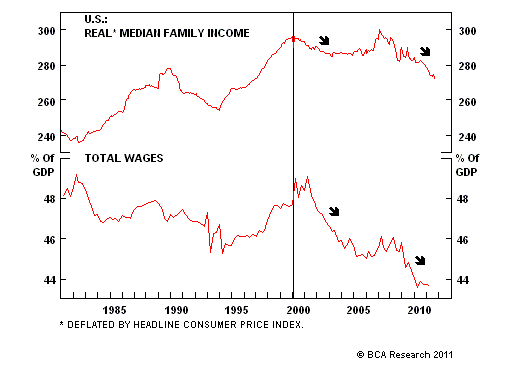
According to a Global Investment Strategy Special Report, the Occupy Wall Street movement symbolizes the fact that political extremism is rapidly becoming mainstream.

But is it really extremism?

Consider the following, from BCA:

The Occupy Wall Street movement is rooted in the secular decline of the American middle class. Judging from the GINI coefficient, the distribution of income is more unequal in the U.S. than OECD countries in general. Moreover, real wage growth in the U.S. has stagnated since 2000, while education and healthcare costs have soared. High education costs have serious social repercussions since they are a strong drag on upward class mobility.

While it is currently impossible to boil down the Occupy Wall Street movement to a single issue, it is a symptom of deepening social strife, political polarization and spreading discontent in the U.S. These are ingredients that, if left unchecked, can lead to potentially radical shifts in policy made to score political points with the extremes, rather than to address underlying economic problems. Both the extreme right and left of the political spectrum will be energized by genuine social discontent – which can nonetheless translate into completely opposing policy preferences – leading to further political polarization. If the clash between left and right intensifies, policy making will become even more difficult. This would mean a heightened political and policy risk premium on equity prices among all G7 markets.

Dropbox startup lessons learned 2011

Posted: 22 Oct 2011 09:00 AM PDT

Dropbox startup lessons learned 2011
View more presentations from Eric Ries

A Historical Look at CEO Pay

Posted: 22 Oct 2011 07:30 AM PDT

The Great Recession Marches On

Posted: 22 Oct 2011 07:15 AM PDT

The Great Recession Marches On
by Peter T. Treadway
The Dismal Optimist

~~~

Demand Side Blind Alleys – When Will They Ever Learn?

Almost on a daily basis, whether from American politicians or European publications like the Financial Times, we are bombarded with calls for more government driven demand side stimuli. The fact that these have not worked so well in no way seems to bother their proponents. The US Federal government debt continues to careen upward and another $1.3 trillion dollar deficit was just racked up for fiscal 2011. Bernanke is rapidly reaching the point where the Fed cannot raise interest rates – the effect on the government budget would be too great. Not to worry apparently. Print money and manipulate interest rates – QEI, QEII, Operation Twist – is demand side stimulus number one. There seems to be no concern that government printing money out of thin air will eventually destroy the US dollar and distort the allocation of resources. "Not worth a Continental" was a saying that came out of America's wild printing of fiat money (called Continentals) in 1775 and history may repeat itself. Only in 1775 America was fighting a war. The Austrian School observation that the Fed's manipulation of interest rates is a version of central planning and price controls is regarded as quackery. Demand side stimulus number two is spending more government money on boondoggle projects like high speed rail to nowhere, financed by printing money or increasing government debt. Again there is no concern that the return on this government spending might be negative.

Since Keynes and the Great Depression, macroeconomics has been all about demand side management. Keynesian orthodoxy dictates that if the consumer stumbles, the government must rush in to take his or her place with monetary and fiscal stimuli, no matter how economically stupid. Unfortunately in a debt/deflation global environment which we are now in, demand stimulus is an unproductive waste of resources and is hitting or will hit a bond market wall.

What are needed are two things – debt/entitlement defaults and supply side measures that stimulate growth.

It sounds awful I know. But in my opinion defaults—in the broad sense of reneging on obligations including but not limited to legal defaults– will turn out to be the only option for all the advanced countries. Promises that never should have been made ultimately will not be kept. As I wrote last time and have now been convinced to write a book about, the age of defaults is upon us.

Supply side measures are something most macro economists – with a few exceptions – never consider. By supply side I mean those rules, regulations, laws and taxes that hold back economic growth. Supply side measures are growth enhancers and would include:

  1. A simplified tax code that maximizes revenue and does not punish the successful. Raising taxes in the midst of a recession, as is now being tried in Greece, is simply the wrong approach.
  2. Reform and liberalization of the labor markets. This is particularly important in Europe which suffers from rigid labor laws. German labor reforms under former Chancellor Gerhard Schroeder have been cited as a major reason for increased German productivity over the last few years.
  3. The removal of massive regulatory burdens and government bureaucracies supporting them. The recent media report that the government-based Washington DC area now has the highest income of any area in the United States is not good news. (I am told by people in the energy field that the US is now swimming in oil and natural gas thanks to new discoveries and new technologies. But the current US Administration is blocking their development).
  4. The removal of barriers to commerce such as protectionist tariff and non-tariff regulations etc.
  5. The elimination of government subsidies to pet industries be they green or gray.
  6. A privatized approach to education to train people to compete in the globalized, technologically accelerating, highly competitive twenty first century world. For the US, with its U6 16.5% unemployment rate and its growing population of thus far academically and income-wise underperforming minorities, this is crucial

The Problem Isn’t the Euro

My views on the euro haven't changed. The euro will survive. History, technology, proximity – all favor the common European currency. The euro is not the real problem. The real problem is excessive debt and unfunded entitlements combined with unfavorable demographics and a socialist, anti-growth mentality in virtually all countries.

It makes a difference how Greece is dealt with. I wrote in this column over a year ago that Greece should be allowed to default just as US states did in the 1840s. Agreed, a onetime bank bailout of Greek banks may be necessary. But let Greece be rejected by the markets and not live on grudging handouts from the Germans.

One may ask: how can the problems of this small country of eleven million people drag on and on as it has? The simple answer is that the Europeans don't trust markets and have only gradually come to face the fact that Greece is hopelessly insolvent and that default is the only sensible option. But it goes way beyond that. Spain, Ireland, Portugal and Italy are lined up right behind Greece as potential problem countries. And Belgium and France are not that far behind. Italy and Spain in particular face formidable government debt refunding schedules in 2012.

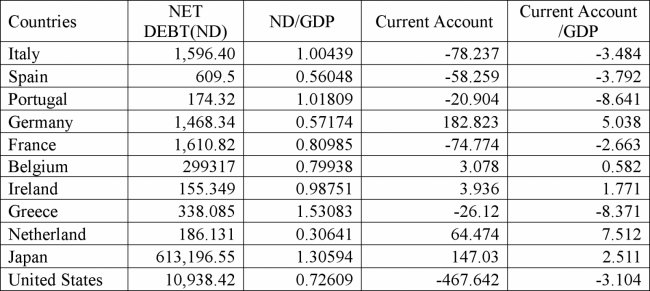
Greece fortunately is sui generis. There is not an indicator you can name that Greece is not in a category by itself. For example as the table below shows, according to IMF estimates for 2011 Greece's net debt to GDP is an astounding 1.53% (and the IMF debt estimates for Greece are actually lower than other sources) and it is running current account deficit which is 8.3% of GDP. Its primary budget is in deficit and it is in the midst of a deep recession. Twenty percent of Greeks apparently "work" for the government. Not only has that but Greece historically been a serial defaulter, as Rogoff and Reinhart report. Greece was in default more or less continuously from 1800 until after WWII. The mindset and the institutions are socialist, not supply side. The outlook for Greece under the European imposed austerity plans is bleak. The rioting in Athens is understandable but a totally useless approach to Greece's problems. Any ambitious Greek twenty one year old, unless his or her father is a shipping magnate, should be thinking of emigrating.

None of the other European countries are as bad as Greece. At least not yet. But their cost of borrowing has been rising and the ECB has had to buy their debt. Contagion is an ever present danger. If one or more of these countries require major future bailouts and/or face default, Europe has a major banking crisis.

I would make the following points:

  1. The European governments will be bailing out their own banks because their banks own their governments' defaulting bonds. This circularity becomes a problem if the countries themselves are downgraded or denied market access. Or if Germany and a few other solid countries are the only available source of bailout money.
  2. It has been proposed that the so-called European Financial Stability Fund act as a guarantor for the 20% of new issues by the weaker European countries. This strikes me as totally misguided. If for example the EFSF guarantees 20% of new Italian issues, then what about all the Italian bonds(and there are lots of them) currently stuffed in (mostly Italian) banks which do not have this guarantee. This sounds like a recipe for a banking crisis.
  3. The EFSF is touted as an AAA borrower. For how long? Cure leverage with leverage? Create a debt financed monster that invests in what will be sovereign junk bonds?
  4. European banks have little chance of raising capital in the markets and will have no choice but to sell assets and shrink their balance sheets. Not exactly a plus for their earnings and a big negative for growth.
  5. Bondholders of defaulting Greek debt will be one of the early casualties in the coming age of defaults.
  6. One thing seems likely. The Europeans will come up with some kind of solution for Greece, no matter how stupid it is the stock markets will probably rally. Buy now, cry later.

Time: 2011 Units: National Currency  Scale: Billions Source: IMF

Source:
The Dismaloptimist
The Great Recession Marches On
by Peter T. Treadway
October 21, 2011

10 Weekend Reads

Posted: 22 Oct 2011 04:40 AM PDT

Some reads to start off your weekend:

Liz Ann Sonders: Welcome to the Machine: High-Frequency Trading Domination (Schwab)
Merkel: Value Versus Growth (Aleph Blog)
Picerno: Awkward History Lessons for Fed Haters (Capital Spectator)
• Big-name money gurus aren't too big to fail (Market Watch)
• Don't Blink! The Hazards of Confidence (NYT)
Michael Kinsley: Four Iron-Clad Demands for Occupy Wall Street (Bloomberg)
• Herd analysts are putting lipstick on every pig (The Globe and Mail) see also Analyzing the Analysts: When Do Recommendations Add Value? (American Finance Association)
• US Businesses Not Being Strangled By Regulation And Taxation, World Bank Says (Forbes)
• What We Can Learn from Germany: How Countries With Publicly Owned Banks Do Better Than America (AlterNet) see also Struggling French Banks Fought to Avoid Oversight (WSJ)
• America’s Emptiest Cities, 2011 (Yahoo Finance)

What are you reading?

>

The Buffett Tax

Ferrari 458 Italia: $225,325 plus $57,000 in options

Posted: 22 Oct 2011 04:30 AM PDT

My New Birthday present is here!

Ferrari 458 At a glance
Engine: 4.5-liter V-8 with 562 horsepower and 398 pound-feet of torque.
Transmission: Seven-speed double-clutch automated manual with paddle shifters.
Speed: 0 to 60 mph in about 3.2 seconds.
Gas mileage per gallon: 12 city; 18 highway.
Price as tested: $282,563.
Best feature: The joyous sound.
Worst features: The cost of ownership; fear of bikes.
Target buyer: The driver who likes to elicit comments.

You know that is not true because I would never buy any car in that ugly gray, and I prefer 3 pedals and a stick over those damned paddle shifters . . .

>
Ferrari 458 Italia
>
Ferrari 458 Italia
>
Ferrari 458 Italia
>

Source:
My $283,000 Roaring Ferrari Slams N.Y. Streets
Jason H. Harper
Bloomberg, Oct 19, 2011 7:01 PM ET   
http://www.bloomberg.com/news/2011-10-19/my-283-000-roaring-ferrari-slams-new-york-city-streets-jason-h-harper.html

Bloomberg: Ritholtz on Fed Policy, Economy, OWS

Posted: 22 Oct 2011 04:12 AM PDT

Barry Ritholtz, chief executive officer of FusionIQ, talks about the impact of Federal Reserve monetary policy on the U.S. economy. Ritholtz also discusses the Occupy Wall Street protests. He speaks with Matt Miller on Bloomberg Television’s “Bottom Line.”

Oct. 21 (Bloomberg)

.

0 comments:

Post a Comment

previous home Next

{8} chatroll


{9} AdBrite FOOTER

{8} Nice Blogs (Adgetize)