


The Big Picture |

- Night Sweats of a Money Manager
- Top Fraud Prosecutor: The Criminals Can Be Forced to Disgorge their Ill-Gotten Gains INCLUDING Bonuses
- Yet Another Look at FDIC Bank Failures
- Patent Wars?
- Advertising: The Labors of Hercules
- It’s All Connected: An Overview of the Euro Crisis
- Repairing Infrastructure Can Help Economy
- The Myth Of the Chinese Soft Landing
- Meteor, Milky Way and Northern Lights
- There’s Enough Math in Finance Already. What’s Missing is Imagination.
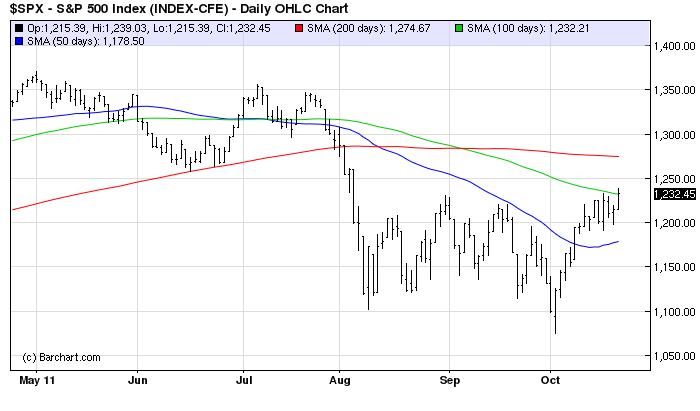
| Night Sweats of a Money Manager Posted: 24 Oct 2011 01:00 AM PDT With about 40 minutes of trading, the S&P500 has pierced its 1230-33 resistance (which includes the 100-day moving average) though has come in a little from its morning high. Closing above the 100-day at 1232 will be an important win for the bulls. Lots of performance anxiety out there in the under invested crowd. Here is a great quote from a money manager/trader we know well,
Couldn't capture the frustration and fear of missing the boat here any better. And the longs are worried that this may be a bull trap. That's part of the reason why markets are so volatile. Nobody knows for certain what the future holds and that is what makes markets. The levels to watch on the upside for the S&P are today's intraday high of 1239.03; 1243, .618 fib retracement of August-October sell-off; and 1257.64, the break-even for 2011 and level where money will be forced in. The 1274.67, the 200-day, which will probably be slightly lower by year-end. Stay tuned.
|
| Posted: 23 Oct 2011 10:00 PM PDT Yes We Can … Recover Fraudulently-Earned MoneyNicholas Taleb said recently that the bankers "hijacked the American economy," and should not have received $2.2 trillion bonus payouts they did. Taleb lamented:
I've previously argued that the government could use existing laws to force ill-gotten gains to be disgorged (see this and this), fraudulent transfers to be voided and – perhaps – even bonuses gained at the expense of taxpayers clawed back. To find out whether or not Taleb is right, I spoke with the country's top white collar crime expert – who put over 1,000 top S&L executives in jail for fraud (professor of law and economics Bill Black). I asked Professor Black what, exactly, current fraud laws allow to be disgorged. For example, I asked Black whether or not bonuses given out based on fraudulent Ponzi schemes and manipulation of a company's accounting books could be disgorged. And I asked hims to estimate how much could – hypothetically, if prosecutors and judges did their job – collectively be recouped for the American people? Professor Black informed me that the proceeds of fraud can be recovered, including bonuses earned through fraudulent activity. He said that the amount which could be recouped could amount to tens of billions of dollars per prosecution, if the evidence of wrongdoing was there. Ten billion here and ten billion there could add up to some real money. Prosecuting fraud and recovering ill-gotten games could make the giant banks whose very size is ruining the economy (what Black calls "Systemically Dangerous Institutions" or SDIs) a little smaller, and to help pay down our national debt a little bit in the process. And because fraud caused the Great Depression and the current economic crisis, and the economy cannot stabilize until the rule of law is restored, and criminal fraud on Wall Street is prosecuted, suing to recoup criminally-gotten gains is the best thing we can do for our economy. And since rampant inequality leads to unstable economies and depressions, recouping some of the ill-gotten gains from the Wall Street fraudsters will help reduce inequality without raising taxes. |
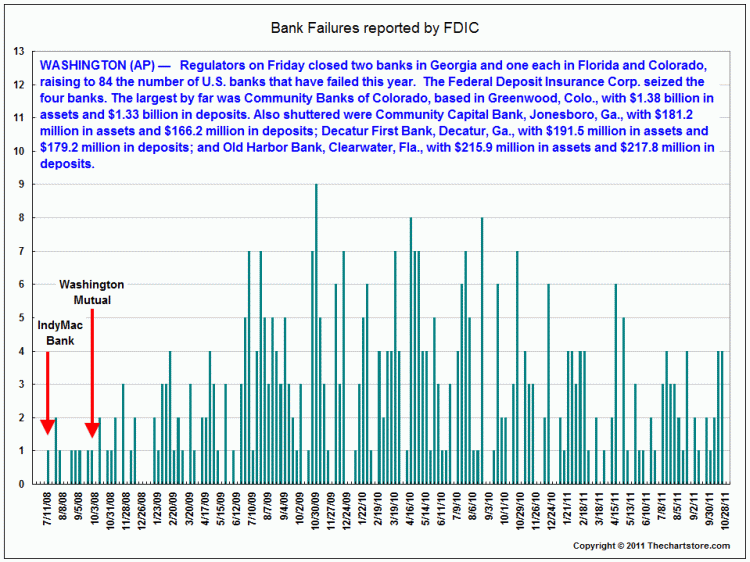
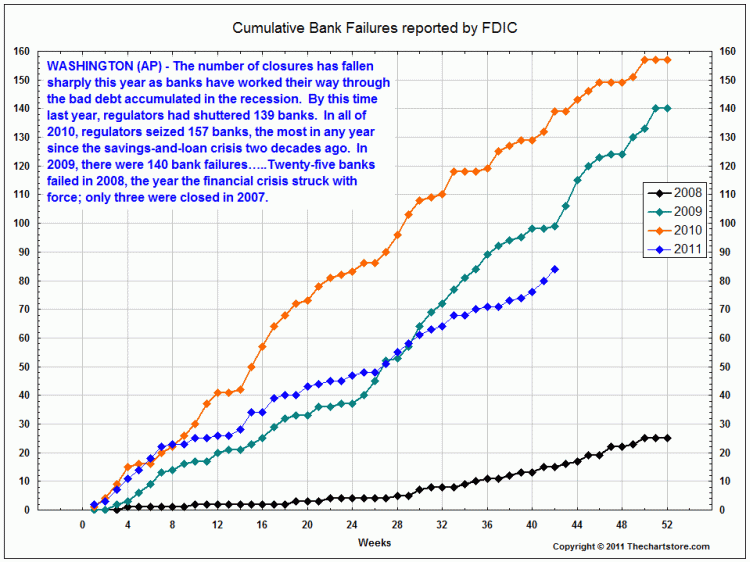
| Yet Another Look at FDIC Bank Failures Posted: 23 Oct 2011 03:30 PM PDT Here is yet another in our all-too-regular continuing series, courtesy of Ron Griess of The Chart Store: >
|
| Posted: 23 Oct 2011 01:30 PM PDT I find it interesting to see the debate framed in terms of huge companies battling over inventions — but to me, the much bigger concern is when giant firms rip off the smaller inventor, who often cannot afford to prosecute their claims. > Hat tip IP Metrics |
| Advertising: The Labors of Hercules Posted: 23 Oct 2011 11:00 AM PDT The labors of Heracles View more presentations from Antonis Kocheilas |
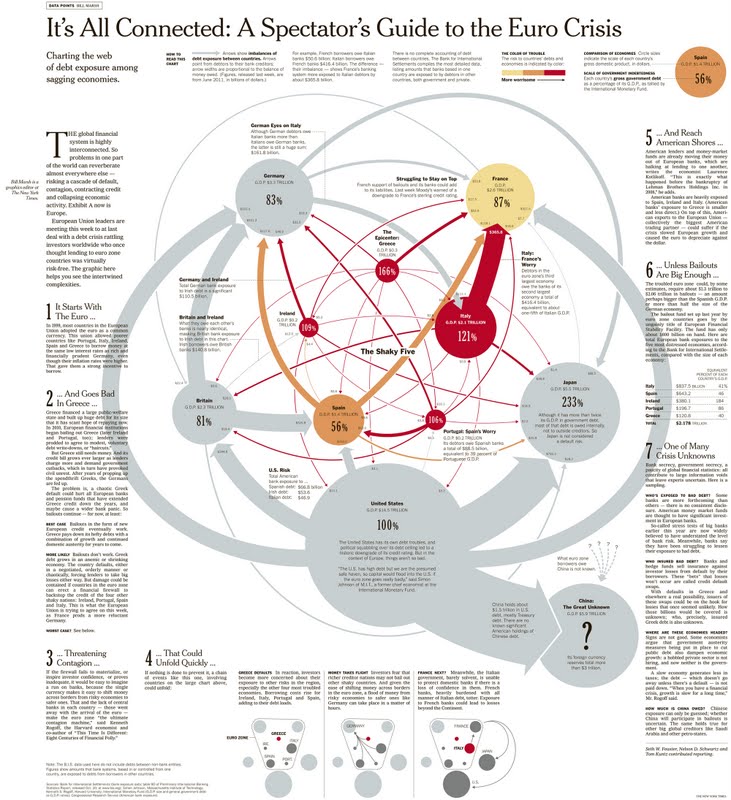
| It’s All Connected: An Overview of the Euro Crisis Posted: 23 Oct 2011 09:00 AM PDT |
| Repairing Infrastructure Can Help Economy Posted: 23 Oct 2011 06:00 AM PDT
>
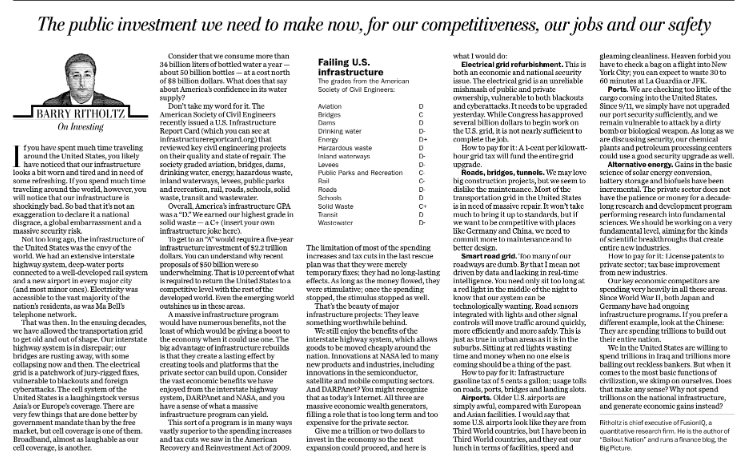
The print version had the somewhat alarmist (but accurate) headline The public investment we need to make now, for our competitiveness, our jobs and our safety; the online version is the brief but also accurate hedder Repairing infrastructure can help repair economy. Here’s an excerpt from the column:
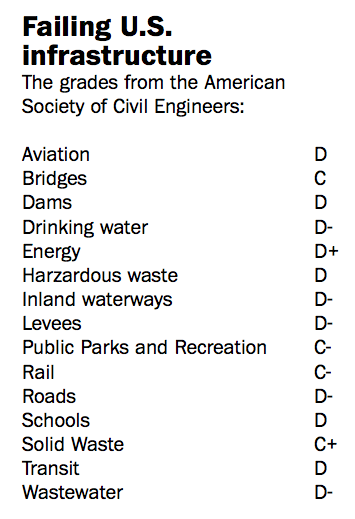
The Post also included a scorecard of the US infrastructure from American Society of Civil Engineers – seeing it laid out like this is very telling:
> If we are going to be deficit spending — and that is the US history of the past 40 years — then let’s leave behind an infrastructure that the private sector can build on. That is far more productive than giving trillions of dollars to reckless bankers, tax cuts for the wealthiest Americans, or a war of choice in Iraq. Instead, we can create a country that equals the best of Germany, Japan and China. The alternative is the sort of Austery that is leading to an entire continental recession in Europe. The choice is ours . . . > Source: Washington Post Sunday, October 23 2011 page G6 (PDF) |
| The Myth Of the Chinese Soft Landing Posted: 23 Oct 2011 05:15 AM PDT
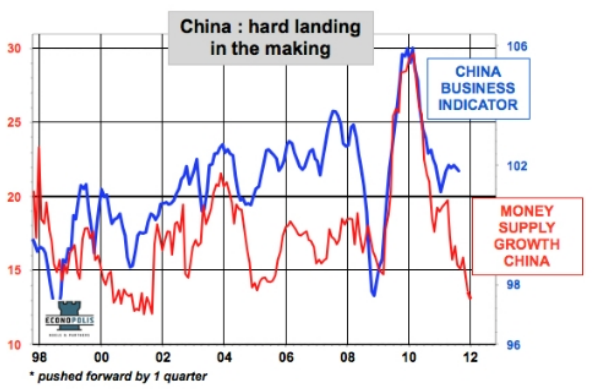
> From Econoshock in Belgium, comes this look at a potential Chinese hard landing:
Last year, reliable Chinese statistics topped the list, but there are now at least 2 reliable Chinese statistics and -unfortunately- only 1 AAA country. The two reliable Chinese statistics are : 1. Power output (electricity) 2. Money supply Forget most of the other data in China: GDP numbers for instance are notoriously unreliable. The rumours of an economic slowdown in China have been circulating for a while. Idle buildings and capacity overhang are some of the warning signs of the Chinese economy. But now a new and more alarming warning sign has turned on: money supply has collapsed in recent quarters. The growth of money supply is closely related with credits and hence infrastructural activity and fixed investments in general. The Chinese banks have put the brake on new loans, and as a result, activity will start to slow more markedly in coming months. Analysts have so far stated that China will experience a soft landing. But the chart is a serious indication that there is no such thing as a soft Chinese landing. > Source: |
| Meteor, Milky Way and Northern Lights Posted: 23 Oct 2011 04:30 AM PDT Here is another view of that meteor tearing through an aurora (shown previously here) An Amateur photographer, Tommy Eliassen, composed the image in Ifjord, Finnmark, Norway. Eliassen made the photo on Sept. 25 using a Nikon D700 with a wide angle lens and long exposures between 25-30 seconds: > Source: MSNBC |
| There’s Enough Math in Finance Already. What’s Missing is Imagination. Posted: 23 Oct 2011 03:00 AM PDT Emanuel Derman | Big Think Author, Professor of Financial Engineering, Columbia University October 21, 2011 Emanuel Derman: In some sense, all of finance is about imagination because finance is about saying, what should something be worth today based on what I think is going to happen in the future? Nobody knows what's going to happen in the future. And so all financial models are specifying in some way an imagined future and then saying, if that future is true, what should I pay for something today? And so for example, if you're building an option model, you're saying, what will volatility be in the future? And given my estimate of volatility in the future, I can value an option today. If you're looking at CDO's, which sort of came in a cropper in the big financial crisis, essentially human beings are saying, what will housing prices do in the future? What will defaults on loans be and defaults on mortgages be? And given my imagined scenario for the future, what should The big failures, I think, are failures of imagination, not of mathematics. The big mistakes are when you don't' think of something that does come to fruition eventually. When I was in graduate school, I went to see a movie the night before my qualifying exams called, "Bedazzled" with Peter Cook and Dudley Moore. It's about 40 years old, but I think it was remade a few years ago. Dudley Moore – I think they're both dead now, Dudley Moore and Peter Cook – he was a short-order cook at a Wimpy's in London and he's in love with the waitress that serves him. Peter Cook plays the devil and offers him seven chances to seduce the waitress in exchange for his soul. And so he agrees. And then he tries to specify the circumstances under which he will be with the waitress. And so the first time, he says something like, he'd like to be in a fancy castle in Oxfordshire and with her and both of them in love with each other and both of them wealthy. And the devil snaps his fingers, and there they are in this castle and they're around the billiard table and they're in love with each other, but she's married to the owner of the castle and he's just a guest. And she has scruples, so she's not willing to get involved with him. And in every scenario he tries of these seven scenarios he gets it wrong. In the last one he asks if they can both just be somewhere quiet with nobody to interfere with them and nobody talking, and they make them both nuns in a sort of Trappist monastery. And so his imagination can never specify precisely enough the future that he'd like to have. And I think that's sort of what goes wrong with a lot of financial models. You can't really write down one short description of all the things that markets may do in the future. |



| You are subscribed to email updates from The Big Picture To stop receiving these emails, you may unsubscribe now. | Email delivery powered by Google |
| Google Inc., 20 West Kinzie, Chicago IL USA 60610 | |



0 comments:
Post a Comment