


The Big Picture |

- Conversations with Great Minds with David Stockman
- Will Greece Pull an Iceland?
- 7 Billion: How Did We Get So Big So Fast?
- Mid-Week PM Reads
- Should You Invest in Groupon IPO?
- The UN Predicts The World’s Population Explosion
- More on FOMC
- NASA: Working on Tractor Beams
- FOMC speaks, Evans says do more
- Mike Mayo’s Exile on Wall Street
| Conversations with Great Minds with David Stockman Posted: 03 Nov 2011 03:08 AM PDT Tonight we have a special edition of Conversations with Great Minds is David Stockman. He is a former United States congressman – representing the state of Michigan – who was elected to three terms before stepping down to head up the Office of Management and Budget under President Ronald Reagan in 1981. He is credited with writing the Reagan Budget – and continued his work on federal budgeting through 1985. After leaving politics, David Stockman pursued a career in investment banking and joined Blackstone Group as one of its earliest partners. He is the author of the book, “Triumph of Politics: How the Reagan Revolution Failed” and his new book – tentatively titled “The Triumph of Crony Capitalism” – will explore how crony capitalism reached a peak during the recent financial meltdown. David talk to Thom about Reagan would be raising taxes right now, the Republican party has gone crazy and we need to get control of the Fed. Part II |
| Posted: 02 Nov 2011 10:30 PM PDT Iceland Told the Banks to Pound Sand … And Thereby Saved Its EconomyIceland told the banks to pound sand. And Iceland's economy is doing much better than virtually all of the country's who have let the banks push them around. Barry Ritholtz noted in May:
Bloomberg pointed out in February:
Even the IMF praises Iceland's strategy:
Greece Faces the Same ChoiceAs Robert Reich notes, the same choice – telling the foreign banks to pound sand or caving in – is now faced by Greece:
|
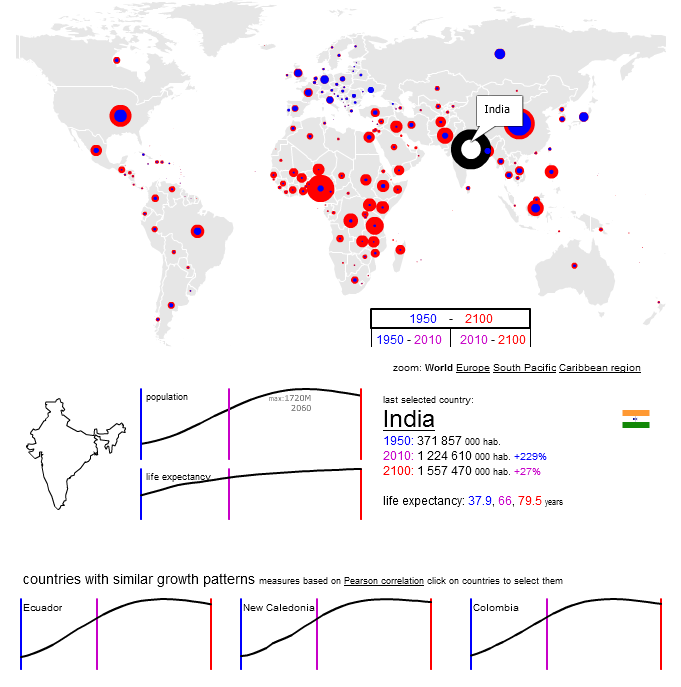
| 7 Billion: How Did We Get So Big So Fast? Posted: 02 Nov 2011 02:30 PM PDT It was just over two centuries ago that the global population was 1 billion — in 1804. But better medicine and improved agriculture resulted in higher life expectancy for children, dramatically increasing the world population, especially in the West. As higher standards of living and better health care are reaching more parts of the world, the rates of fertility — and population growth — have started to slow down, though the population will continue to grow for the foreseeable future. U.N. forecasts suggest the world population could hit a peak of 10.1 billion by 2100 before beginning to decline. But exact numbers are hard to come by — just small variations in fertility rates could mean a population of 15 billion by the end of the century.
|
| Posted: 02 Nov 2011 02:30 PM PDT My afternoon train reading:
What are you reading?
|
| Should You Invest in Groupon IPO? Posted: 02 Nov 2011 01:00 PM PDT |
| The UN Predicts The World’s Population Explosion Posted: 02 Nov 2011 11:30 AM PDT Click on countries to select: Source: |
| Posted: 02 Nov 2011 11:00 AM PDT Two more things on the FOMC. With all the tough talk from Fed Pres Fisher on current Fed policy and his stated distaste for QE2, timeline on a near zero fed funds rate and OT, he decided not to dissent today. Neither did Plosser and Kocherlakota. Thus, any hawkishness and reservations that they have expressed with their previous dissents doesn’t square with their vote for current policy. Also, with Bernanke’s press conference, the Fed will reveal new economic forecasts on growth and inflation for the next few years but if there is one thing everyone should know by now, never pay attention to them because they are rarely correct. |
| NASA: Working on Tractor Beams Posted: 02 Nov 2011 10:29 AM PDT ‘Tractor beams — the ability to trap and move objects using laser light — are the stuff of science fiction, but a team of NASA scientists has won funding to study the concept for remotely capturing planetary or atmospheric particles and delivering them to a robotic rover or orbiting spacecraft for analysis. This animation shows how a hypothetical future mission might eventually employ tractor beam technology.’
Hat tip boingboing |
| FOMC speaks, Evans says do more Posted: 02 Nov 2011 09:21 AM PDT After saying that economic growth remains slow in Sept, the FOMC today said “growth strengthened somewhat in Q3, reflecting in part a reversal of the temporary factors that had weighed on growth earlier in the year.” They also cited household spending that “increased at a somewhat faster pace in recent months.” Other comments on the economy are similar to the Sept statement. On inflation, they still have no worries and said again “inflation appears to have moderated since earlier in the year as prices of energy and some commodities have declined from their peaks.” Thus, the Fed is on record saying that $93 crude oil is not inflationary because its below its 2011 high of $115. They should explain that to main street. On OT and MBS purchases, they remain on track with what as announced in Sept. Evans, wildly dovish, wanted more accommodation and that reveals nothing new about him as he hinted at it in a talk a few weeks ago. What he thinks more accommodation will do is worth asking but Turullo, Dudley and Yellen are close to QE3 too and be sure Bernanke is also. QE3 is thus a matter of time, not if with this Fed. Two more things on the FOMC. With all the tough talk from Fed Pres Fisher on current Fed policy and his stated distaste for QE2, timeline on a near zero fed funds rate and OT, he decided not to dissent today. Neither did Plosser and Kocherlakota. Thus, any hawkishness and reservations that they have expressed with their previous dissents doesn’t square with their vote for current policy. Also, with Bernanke’s press conference, the Fed will reveal new economic forecasts on growth and inflation for the next few years but if there is one thing everyone should know by now, never pay attention to them because they are rarely correct. |
| Mike Mayo’s Exile on Wall Street Posted: 02 Nov 2011 09:00 AM PDT Mike Mayo, bank analyst at Credit Agricole Securities USA, talks about his new book, “Exile on Wall Street: One Analyst’s Fight to Save the Big Banks from Themselves.” He speaks with Tom Keene and Christine Harper on Bloomberg Television’s “Surveillance Midday.” Source: Bloomberg Nov. 1 2011 |


| You are subscribed to email updates from The Big Picture To stop receiving these emails, you may unsubscribe now. | Email delivery powered by Google |
| Google Inc., 20 West Kinzie, Chicago IL USA 60610 | |



0 comments:
Post a Comment