


The Big Picture |

- Municipal Bankruptcies
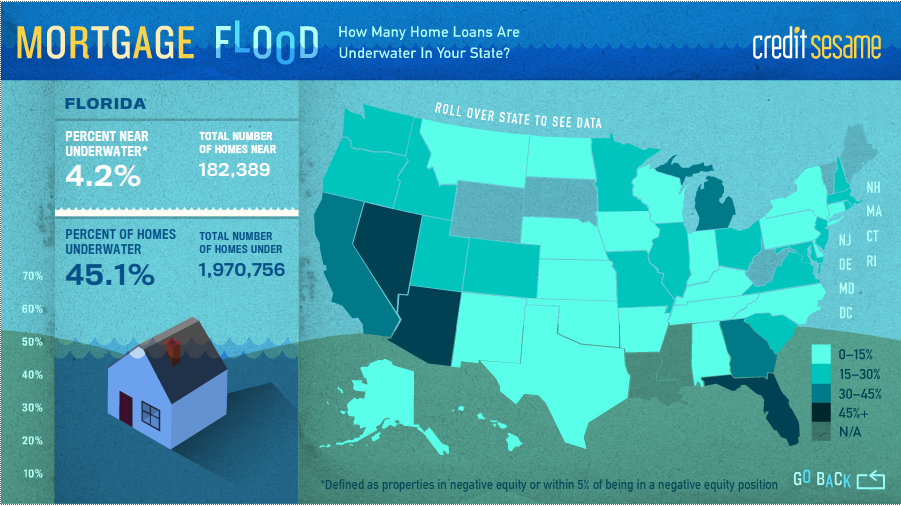
- How Many Mortgages are Underwater in Your State?
- E-Trade Baby Has a Bad Day in Market
- Did U.S. Tax Policies Increase Economic Inequality?
- 10 Thursday PM Reads
- Those MF Global MFs!
- The Small-Large-Europe Disconnect
- Rickards: The Next Global Crisis, Currency Wars, Have Already Begun
- Dudley again talking QE3
- The Housing Crash Was Caused by MTV Cribs
| Posted: 17 Nov 2011 10:30 PM PST Municipal Bankruptcies ~~~ "Assured Guaranty Ltd., the only active municipal bond insurer, said it will reconsider guaranteeing public bonds in states without procedures for reviewing and approving local bankruptcy petitions. "Local governments must recognize their responsibilities to live up to the promises made by current and former duly elected officials,'' Assured Chief Executive Officer Dominic Frederico said on a conference call with investors and analysts. "The term full faith and credit must have meaning and challenges via bankruptcy or other legal maneuvers to negotiated contracts can't be accepted.'' Assured backed $731.8 million of debt sold by Jefferson County, and guaranteed or reinsured debt sold as part of an incinerator expansion in Harrisburg, Frederico said the guarantor was "disappointed'' with Jefferson County commissioners' decision to file for bankruptcy after a tentative deal struck in September that would have cut the amount owed on debt tied to the county's sewer system failed. He blamed "local politics'' in Harrisburg for impeding "practical and fair solutions'' to the city's financial problems." Bloomberg Brief-Municipal Market, 11-16-11 "New Jersey won't approve Chapter 9 bankruptcy filings by distressed municipalities, according to Thomas Neff, director of the state Division of Local Government Services. New Jersey law requires state approval of all municipal bankruptcies, Neff said in an interview at a conference of mayors in Atlantic City. His division would look to use state aid and possible takeovers of city finances to avert such filings, he said. "It's more likely to snow in July than for us to approve a bankruptcy,'' Neff said. "I can't even see myself posting it for consideration.'' Bloomberg Brief-Municipal Market, 11-16-11 Many readers have asked for our perspective on the Chapter 9 Municipal Bankruptcy of Jefferson County, Alabama. Others have e-mailed us concerning Harrisburg, Pennsylvania. Over the course of the year, my colleague John Mousseau and I have written about these situations. Our view remains that these are one-off events brought about by failures of the local political systems and disappointing governance. Sometimes corruption is added to that toxic combination. We argue that most Munis are mostly safe most of the time. The key is to research them and understand the construction of each of these idiosyncratic credits. Specific bankruptcies, like Jeffco and Harrisburg, are the final actions of a process that began several years previously. They were the result of poor decision making on the part of elected public officials. However, not every bad Muni deal ends in a bankruptcy. Many can be worked out. In those cases the political officials realize that avoidance of bankruptcy is "less worse" than choosing what appears politically to be an easy way out; they are mistakes that were made either by the elected officials or others involved in the process. In an excellent piece of research, Natalie Cohen, Senior municipal-bond analyst at Wells Fargo, has discussed Chapter 9 municipal bankruptcy in detail. She argues whether or not systemic problems exist. She offers advice on how one can "spot these problems ahead of time." Natalie is a skilled, seasoned professional. Her work, delivered in a matter-of-fact manner, is clearly superb. Natalie has been kind enough to permit us to post her piece as a guest submission on our website. Here is the PDF link. We recommend readers interested in the workings and outcomes of municipal bankruptcies to spend a few minutes in this in-depth research effort. ~~~ David R. Kotok, Chairman and Chief Investment Officer |
| How Many Mortgages are Underwater in Your State? Posted: 17 Nov 2011 08:21 PM PST |
| E-Trade Baby Has a Bad Day in Market Posted: 17 Nov 2011 07:19 PM PST |
| Did U.S. Tax Policies Increase Economic Inequality? Posted: 17 Nov 2011 04:00 PM PST Source: NPR |
| Posted: 17 Nov 2011 01:30 PM PST Here is your afternoon train reading
What are you reading? >
|
| Posted: 17 Nov 2011 11:30 AM PST We have a good friend with money tied up in the MF Global debacle. As of November 1st, he had close to $100K in his "segregated" futures account with no open positions (BR: Not FU money, but real cash nonetheless). He says the MF Global website is shut down and the phones don't ring when he calls. This guy was a "big swinging Richard" at one of Wall Street's biggest firms and now trades his own account. Here is his letter of rebuke to MF Global, which he passed on to us. Can you tell he is a little peeved?
|
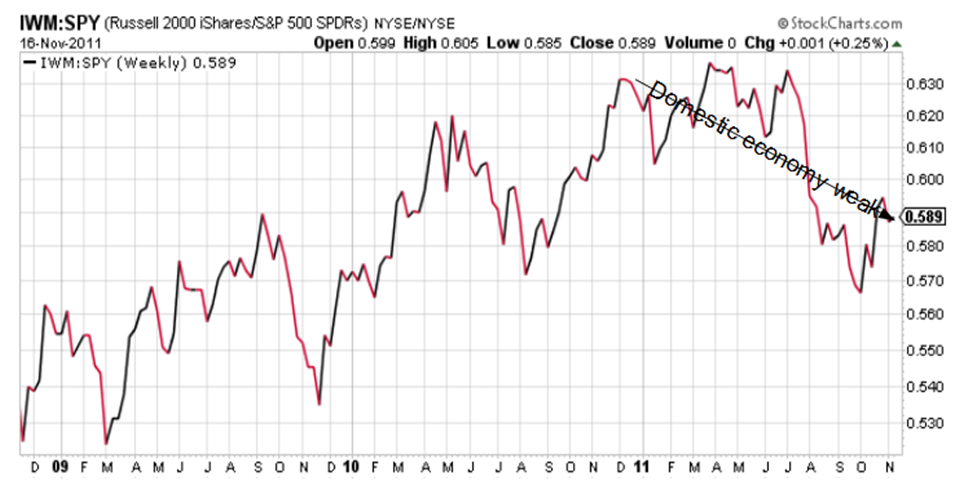
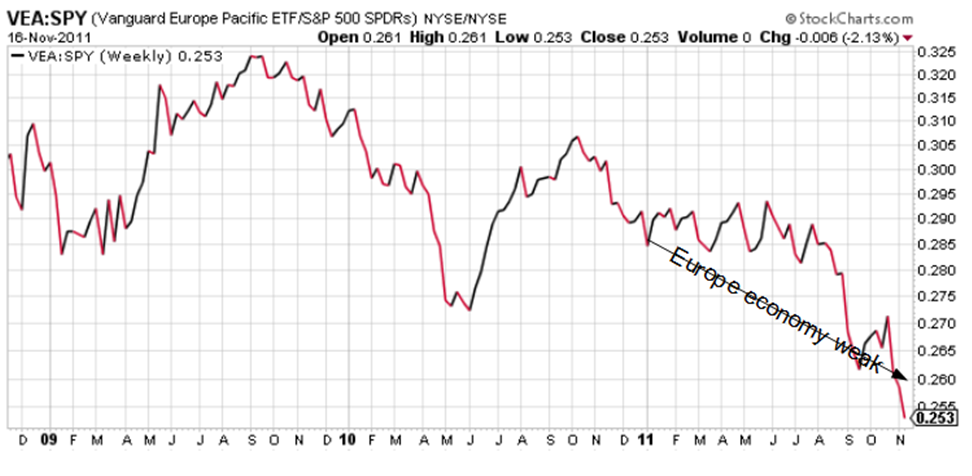
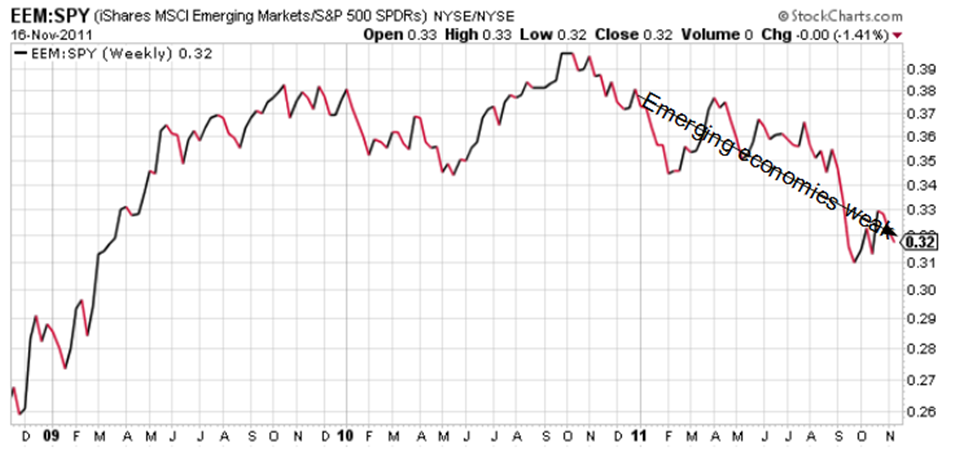
| The Small-Large-Europe Disconnect Posted: 17 Nov 2011 11:00 AM PST The Small-Big/Domestic-International Disconnect I tend to focus my attention on market internals through relative price ratio analysis to identify if certain consistent messages are occurring beneath the market’s surface. Intermarket analysis, which attempts to look within and across markets, requires analyzing not just a single sector or asset class, but several to see if investors are consciously or unconsciously sending messages through price movement. This has certainly been a tumultuous year because of lingering fears over Europe, but despite the volatility, the S&P 500 as of writing has essentially gone no where (SPY, the S&P 500 ETF, is literally up about 0.08%). The Russell 2000 (IWM), however, for the year has fared worse, down about 5.9% and strongly underperforming. If you believe that markets here in the U.S. have been suffering because of economic concerns over the Eurozone, that spread differential should not make any sense. Consider the following. From a market-cap perspective, small-cap stocks (IWM) tend to be more sensitive to the domestic economy than anything happening overseas. Intuitively this should make sense because globalization is driven by the biggest and most cash-rich companies in the world. In contrast, large-cap stocks (SPY) actually have quite a bit of exposure to overseas markets, with some estimates suggesting about half of the S&P 500′s revenue coming from outside the U.S. Well wait a minute – if the volatility is being caused because of Eurozone recession/depression/implosion concerns, then why are large-cap companies which have so much exposure to revenue coming from overseas markets outperforming small-cap companies which are more sensitive to the U.S? Could it be that broad market averages are unjustified at these levels given conflicting messages from Europe, Emerging Markets, and U.S. small-cap stocks? Small/Big (IWM/SPY) Price Ratio Europe/U.S. (VEA/SPY) Price Ratio Emerging/U.S. (EEM/SPY) Price Ratio >~~~ Michael A. Gayed, CFA is Chief Investment Strategist at Pension Partners, where he structures portfolios. Prior to this role, Michael served as a Portfolio Manager for a large international investment group, trading long/short investment ideas in an effort to capture excess returns. In 2007, he launched his own long/short hedge fund, using various trading strategies focused on taking advantage of stock market anomalies. Michael earned his B.S. from New York University, and is a CFA Charterholder. |
| Rickards: The Next Global Crisis, Currency Wars, Have Already Begun Posted: 17 Nov 2011 10:48 AM PST |
| Posted: 17 Nov 2011 10:30 AM PST It of course remains to be seen what the FOMC decides to do, if anything, at the Dec 13th meeting but Fed Vice Chairman Dudley again is laying QE3 on the table. “I am deeply unhappy with the current forecast of prolonged high unemployment, and will continue to review whether there is more that we could do that would bring more benefit than cost.” “We could purchase more longer term financial assets…If additional asset purchases were deemed appropriate, it might make sense to do much of this in the MBS market. This would have a greater direct impact on the housing market and would be less likely to disrupt market functioning compared with further purchases in the Treasury market.” Currently, the average 30 yr mortgage rate is 4.02% according to bankrate.com, just 2 bps from multi decade lows. Notwithstanding this extraordinarily low rate, for those that can get it, Dudley is of the same mindset of Bernanke and Yellen on policy and it’s this extremely dovish trio that are calling the shots. In terms of the market, whether its noise of super committee standstill or something else, the moves today will be exaggerated due to SPX option expiration tomorrow where the open interest is large at the 1200 line. Peter Boockvar |
| The Housing Crash Was Caused by MTV Cribs Posted: 17 Nov 2011 09:29 AM PST Fascinating back and forth in last night’s discussion of what Causation actually is. I want to respond broadly to some of the advocates who still seem to be missing the concept of Proximate Cause. We can substitute all sorts of things in the general statement “The housing boom and bust was caused by ____” — but only if you don’t care about things like proximity or statistical validity. Indeed, if I were to ignore the hard data and focus on the squishy narrative, I end up with tracing the blame to one simple source: MTV Cribs. The series showcased the huge, luxurious homes of the rich and famous in music, film, and sports. It was watched by young, easily influenced kids who would soon be out on their own, buying Cribs that they themselves could not afford. Even worse, MTV Cribs was imitated by lots of other property porn shows on HGTV (Designed to Sell, House Hunters, Dream House, Extreme Homes) or TLC (Trading Spaces), or the Discovery channel. But it all traces back to Cribs . . . <Sarcasm Mode Off> |

| You are subscribed to email updates from The Big Picture To stop receiving these emails, you may unsubscribe now. | Email delivery powered by Google |
| Google Inc., 20 West Kinzie, Chicago IL USA 60610 | |



0 comments:
Post a Comment