


The Big Picture |

- Eliot Spitzer: “In retrospect, I wish we had put more people in handcuffs.”
- Central Banks’ Latest Move Shows Desperation
- Intervention Rally: Good, Bad or Ugly?
- 10 Mid-Week PM Rally Reads
- Coordinated Central Bank Action on Currency Swaps
- Ritholtz Slams Paulson, Lauds Judge for Denying SEC-Citi Deal
- When Will Housing Hit Bottom?
- IPO: Go, No-Go?
- Case-Shiller Bubbliciousness
- China to maintain tight monetary policy into 2012 – oh yeah?
| Eliot Spitzer: “In retrospect, I wish we had put more people in handcuffs.” Posted: 01 Dec 2011 01:30 AM PST
Visit msnbc.com for breaking news, world news, and news about the economy
FULL TRANSCRIPT: ELIOT SPITZER: There was an amazing piece of journalism that came out yesterday which analyzed the magnitude of the loans that have been made by the feds to the banks. The six big banks in particular got over $400 billion of secret loans, most of which we had not heard about. Now, at the time these banks were getting these loans, they were claiming to be in great financial shape. So why were the loans made? Is there a tension between the public statements being made by the CEO's of the banks– DYLAN: Let's stop there. It's very clear there's an anecdote, Bank of America, we can reference all these things, where those bank CEO's are saying explicitly, 'this is a sound financial institution,' at the exact moment that they are drawing against the U.S. taxpayer at its central bank, into the hundreds of billions of dollars, now we are learning, going into the trillions. What is the answer to that question? Which is, can I go out and say that and do this? ELIOT SPITZER: The answer is no. And if you or I did that, if you or I went to a bank – DYLAN: Or went to our shareholders. ELIOT SPITZER: Or made any public statement, knowing it to be false, we'd be in handcuffs. So the question I have is, look, we don't know a lot of these facts. Let's predicate — there are 100 uncertainties, but where is the inquiry right now about all the statements being made by the CEO's, CFO's none of which revealed these enormous loans. DYLAN: Let me ask you a question to play devil's advocate. Is there integrity in my saying, as the CEO of Bank of America that my financial institution is healthy, knowing that I've got, let's say $80 billion out to the Federal Reserve, because it is healthy, because I have $80 billion from this Federal Reserve? ELIOT SPITZER: It depends where and when and how those loans were made. If, at the moment you went to the Fed and said, we know we've got a mortgage overhang, because our mortgage exposure is $2 trillion, and therefore we're insolvent and we're illiquid, "help!" And at that very moment, you're saying, we're a stable, sound institution, yes, you're misrepresenting in a way that's fundamentally actionable and should be the subject of civil and perhaps criminal investigations. SUSAN DEL PERCIO: But when you talk about, for example, civil action, or even if you're looking to prosecute, as Attorney General, you went after a lot of these folks. And you settled a lot of cases. And some of them settled because they didn't even want to have the PR that you were investigating. But now maybe in retrospect or if you were giving an Attorney General advice now, would you look and say, maybe we should show that there are serious consequences. Because the fines were really just a matter or a cost of doing business. Would you look at it differently now? ELIOT SPITZER: Yes, well, we brought more cases and that's why I lost a few friends along the way on Wall Street, which was unfortunate, but the reality and so be it. The decision by Judge Rakov yesterday to throw out and reject the SEC settlement, because he said not enough facts were presented to the court, and this notion that banks will be permitted to say "neither admit nor deny," as though somehow, yeah, we'll pay the fine, but really we did nothing wrong, that should come to an end. SUSAN: But it's a settlement? ELIOT SPITZER: No, he rejected the settlement. Judge Rakov said, we're beyond the point where recidivist institutions that time and time again, and when I started doing this back in '98, we brought some big cases and said, "okay, you've got a problem, are you going to learn?" And they said yes. In retrospect, they haven't. No question about it. In retrospect, I wish we had put more people in handcuffs. I don't mind saying it, because the banks didn't learn the lesson. Judge Rakov, arguably the most important person in the capital markets right now, because he has set a new bar. He has done something critically important, to say, I won't let you just internalize as a cost of doing business through fines and other small reparations massive structural fraud. And I think what he is doing redefines the way the SEC will have to operate, justifies a lot of the aggressive stuff we did. I'm all for it. My hat goes off to Judge Rakov. He's a critically important guy. DYLAN: Were you to be Attorney General today, what would your view be of either prosecuting or investigating Jon Corzine or MF Global relative to the blending of firm assets and customer assets? ELIOT SPITZER: Let me be careful here for the following reasons. John has been a friend. I've always liked him. I want that to be out there, full disclosure, which is a critically important thing in every domain. I still have a hard time believing that John ever would have sanctioned using customer segregated money, the money that is in customer accounts to cover margin calls for MF Global. If that happened, people should go to jail. It is simply not acceptable. Now, there may be paperwork that permitted them to dip into those funds, if it was properly collateralized. This moment of crisis, it's hard to see how that happened. I think John is an honorable guy, he's an aggressive trader. I don't see how you can be leveraged 44 to 1 and be betting on sovereign debt in Europe. Leverage is great on the way up, not so good on the way down. I don't get it as a business model, but I think we have to wait and see how the facts come out. JIMMY WILLIAMS: So, all right. so we give these banks the money, right? and then we tell them, in TARP. — now, there's all this other new stuff. DYLAN RATIGAN: TARP was the tip. TARP is what we tossed them as the tip. It's what you tip them at the garage — that was a $700 billion — the was just the side money so you can go to a party. JIMMY WILLIAMS: So we gave them more. The whole point was, all right, you've got to go and go loan this money out. ELIOT SPITZER: Right. JIMMY WILLIAMS: I would be — I would be interested in knowing how much money was loaned out. DYLAN RATIGAN: We do know. The lending was off the cliff, down. JIMMY WILLIAMS: So why aren't we forcing them to do refinancing of mortgages? ELIOT SPITZER: you're asking — i know, behind that innocent question, right. You're asking the question that goes to the heart of my grievance with Tim Geithner from the very first moment. It was that night we needed to solve the institutions and the solvency of our nights, it was that we got nothing back. He never once said, we will save you if you agree to reform the system, solve the mortgage crisis, lend to small and medium-sized businesses that will create jobs. There was never any of the conditionality that we do. The IMF has done it for 30 years with every other country in the world. Tim knows that. He was there. I don't get this. KAREN FINNEY: So just quickly, speaking about the IMF, and it makes me think of Europe, and we know that, I guess my question would be, can you talk a little bit about what you see happening on the horizon with Europe? And what is the exposure of the American banks and should we expect that all over again, we're going to have a crisis should they go into crisis? ELIOT SPITZER: You're asking me? I have no idea. I'll be the first one to tell you, I don't have the foggiest idea what is going to happen in Europe. I see the stock market here gyrating up and down, 400 points either direction, because somebody makes an offhand comment and things are good, things are bad. DYLAN RATIGAN: Can I ask you a specific question to that end? I have not been able to find a single human being in the world who can tell us what the risk is in Europe, for the simple reason that the risk marketplace, which is the credit default swap market, exists in secret, and it is mathematically impossible for you or anybody else to define what the risk is! ELIOT SPITZER: Dylan, there was a great article by Gretchen Morgenson about two or three Sundays ago in The New York Times where she dug into the credit default swap market,and how the market is looking at these various sovereign debt issues, and what she found is that the committee that determines whether there's been a technical default that would trigger the obligation to pay has determined that the 50% write-down isn't a default. DYLAN RATIGAN: Oh, I know. ELIOT SPITZER: They said, oops, we don't want to pay. DYLAN RATIGAN: The point is the actual system by which we are managing our global risk, because it's done in secret – ELIOT SPITZER: Correct. DYLAN RATIGAN: It is impossible for the biggest and most powerful banker in the world to be able to know what the risk is, correct? ELIOT SPIZER: Yes, but here's another measure. Put credit default swaps aside for a moment. If you look at the actual interest rate that's now being paid by the Italian government, it is poking through 7%. That's not sustainable for a government. When you begin to see Italian Spanish debt hitting that level, crisis is afoot. |
| Central Banks’ Latest Move Shows Desperation Posted: 30 Nov 2011 10:00 PM PST Latest Move Shows DesperationThe coordinated swap line bailout by the Federal Reserve Bank of Canada, the Bank of England, the Bank of Japan, the European Central Bank, and the Swiss National Bank- and China's reduction of reserve requirements by .5% – shows desperation. (For background on swap lines, see this, this and this.) The Street notes:
In a separate article, The Street points out:
Ron Paul said today:
As I noted last year:
Indeed, the fact that China coordinated its big cut in reserve requirements on the same day that the big Western central banks and Japan extended swap lines shows the magnitude of panic among world economic leaders. But At Least a Handful of Insiders Will Make Out Like BanditsJim Quinn writes:
Indeed, just as with Hank Paulson's little tip to the big boys – which is nothing new – some insiders probably made a killing by being tipped off about the swap lines. See this and this. This isn't a financial crisis … it's a bank robbery. |
| Intervention Rally: Good, Bad or Ugly? Posted: 30 Nov 2011 05:30 PM PST At times, I have described Good News as Bad — meaning that is could encourage the Fed withdrawing its accommodation, raising rates, pressuring margins, earnings and equity prices. Today’s coordinated central bank intervention is the opposite: A Euro-zone bank on the verge of collapse prompted this extraordinary action. So this a case where the news is so Bad it becomes Good for stocks: The financial system is so (choose 1 or more) vulnerable / compromised / inter-related / fragile that it required the Bank of Canada, the Bank of England, the Bank of Japan, the European Central Bank, the Federal Reserve, and the Swiss National Bank to coordinate a joint liquidity event. So Bad News (near collapse) becomes Good News (equity rally). The volume was so-so, except for the end of month/quarter buy on close surge; Monday’s volume was light as well. So this runs to 1250, maybe even 1300. Does it have legs? Will the surge suck the traders in (or trade the suckers in?) Of course, these actions reflect the underlying weakness, and adds to the eventual bill to be paid (interest and penalties continue to accrue). But tonight, we drink ! |
| Posted: 30 Nov 2011 01:45 PM PST My afternoon train reading on this day when stocks had their biggest rally since March 2009:
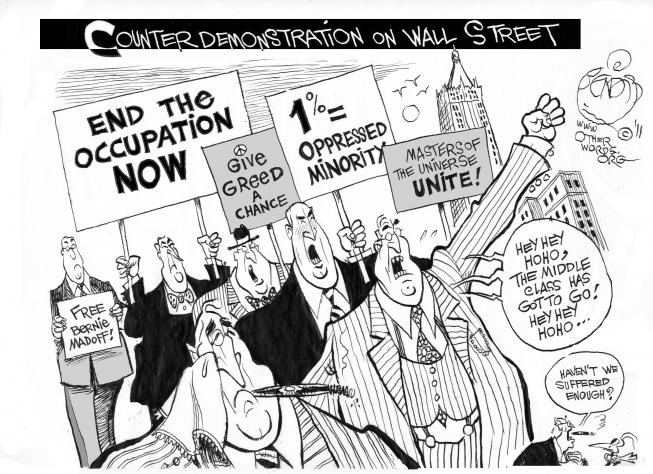
What are you reading? > Source: Khalil Bendib |
| Coordinated Central Bank Action on Currency Swaps Posted: 30 Nov 2011 01:28 PM PST The Bank of Canada, the Bank of England, the Bank of Japan, the European Central Bank, the Federal Reserve, and the Swiss National Bank are today announcing coordinated actions to enhance their capacity to provide liquidity support to the global financial system. The purpose of these actions is to ease strains in financial markets and thereby mitigate the effects of such strains on the supply of credit to households and businesses and so help foster economic activity. These central banks have agreed to lower the pricing on the existing temporary U.S. dollar liquidity swap arrangements by 50 basis points so that the new rate will be the U.S. dollar overnight index swap (OIS) rate plus 50 basis points. This pricing will be applied to all operations conducted from December 5, 2011. The authorization of these swap arrangements has been extended to February 1, 2013. In addition, the Bank of England, the Bank of Japan, the European Central Bank, and the Swiss National Bank will continue to offer three-month tenders until further notice. As a contingency measure, these central banks have also agreed to establish temporary bilateral liquidity swap arrangements so that liquidity can be provided in each jurisdiction in any of their currencies should market conditions so warrant. At present, there is no need to offer liquidity in non-domestic currencies other than the U.S. dollar, but the central banks judge it prudent to make the necessary arrangements so that liquidity support operations could be put into place quickly should the need arise. These swap lines are authorized through February 1, 2013. Federal Reserve Actions The Federal Open Market Committee has authorized an extension of the existing temporary U.S. dollar liquidity swap arrangements with the Bank of Canada, the Bank of England, the Bank of Japan, the European Central Bank, and the Swiss National Bank through February 1, 2013. The rate on these swap arrangements has been reduced from the U.S. dollar OIS rate plus 100 basis points to the OIS rate plus 50 basis points. In addition, as a contingency measure, the Federal Open Market Committee has agreed to establish similar temporary swap arrangements with these five central banks to provide liquidity in any of their currencies if necessary. Further details on the revised arrangements will be available shortly. U.S. financial institutions currently do not face difficulty obtaining liquidity in short-term funding markets. However, were conditions to deteriorate, the Federal Reserve has a range of tools available to provide an effective liquidity backstop for such institutions and is prepared to use these tools as needed to support financial stability and to promote the extension of credit to U.S. households and businesses. See also: Frequently Asked Questions: Foreign Currency Liquidity Swaps |
| Ritholtz Slams Paulson, Lauds Judge for Denying SEC-Citi Deal Posted: 30 Nov 2011 01:00 PM PST Source: |
| Posted: 30 Nov 2011 11:00 AM PST Source: |
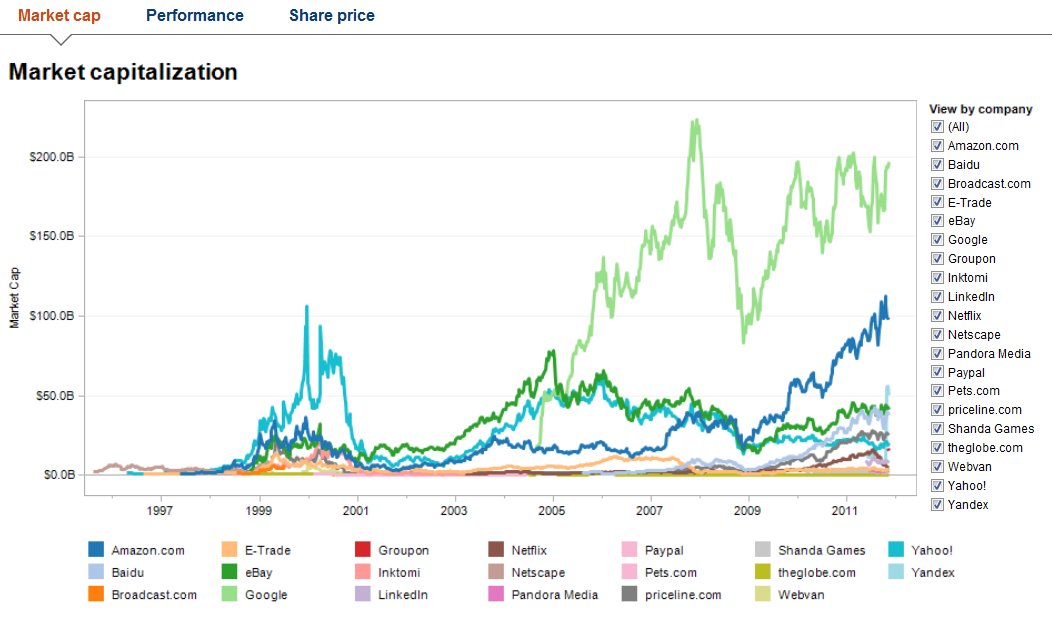
| Posted: 30 Nov 2011 09:30 AM PST Interesting chart via the WSJ about IPOS — which often capture the public’s attention, despite their being less than reliable investment:
> Click for interactive chart: Source: |
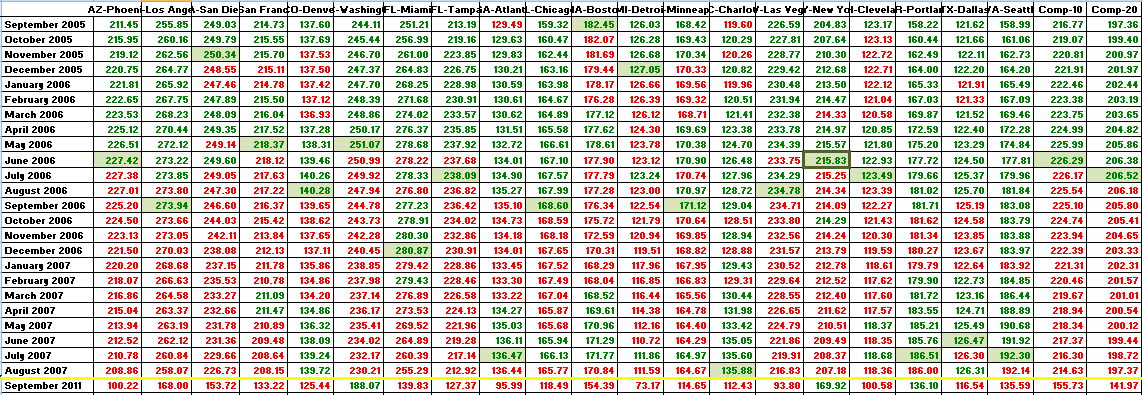
| Posted: 30 Nov 2011 08:00 AM PST “It’s a little known fact,” as Cliff Clavin would tell us, “that the first city to have its housing bubble burst was Boston.” How appropriate, eh? Since no one lives in either Composite10 or Composite20, below is a portion of a spreadsheet I maintain chronicling the popping of the bubble (this is on a NSA basis) in each of the 20 metro areas. Boston kicked things off in September 2005 (peak cells shaded with green), and city after city crested and began its decline over the next two years, ending with Charlotte in August 2007. (Green text signifies an uptick from the prior month, red text a downtick.) The last row — beneath the yellow line — is the most recent CS print. It’s interesting, still, to see the most recent prints versus the peak values. (Click through for ginormous — necessary to really see the numbers)
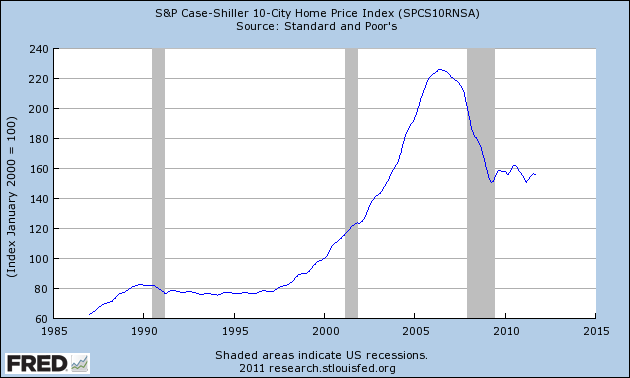
(Source: S&P Case-Shiller. All cities indexed to 100 at January 2000)
|
| China to maintain tight monetary policy into 2012 – oh yeah? Posted: 30 Nov 2011 07:55 AM PST Kiron Sarkar is an investor and advisor in London. Formerly in the M&A dept of N M Rothschild in London, he was head of M&A of Rothschild (Hong Kong) and worked on their international privatisation team. He worked as privatisation adviser to the UK Governments Know How Fund. Most recently, he was European Head of Media, Tech and Telecoms at CIBC World markets. Kiron has acted as a lead adviser in respect of over US$150bn of deals and has worked globally in both developed and emerging markets. More grim news (with sharply lower equity markets) from China. My friend, Ari Merenstein (whose analysis is amongst the best I’ve seen) summarises it impeccably – the Chinese may have left it too late to embark on monetary easing – by the way, I would bet that monetary easing is inevitable, even though a Central Bank adviser suggested that tight monetary policy will continue next year. However, my friends at Brown Brothers Harriman suggest that Mr Xia Bin’s (the PBoC adviser) comments seem to have been misinterpreted. Just when the Euro Zone seems to be coming to a sort of conclusion (I’m still uber cautious – it’s the Euro Zone/ECB/EU after all), China pops up. Bad news for the A$ and the miners – my way of playing a short China strategy + global markets generally. Exports to Europe, from China, are collapsing, shipping sources report- no great surprise and don’t expect a recovery any time soon. The Shanghi markets closed down 3.3% today; The FT reports that Indian companies are facing difficulties, indeed a number of companies are defaulting on their forex loans – apparently they have mismatched forex borrowings with Rupee assets. Classic economics 101 is DON’T DO THAT – must not have been translated into Hindi. India’s GDP growth slipped to 6.9% (on an annualised basis) for the Q to September – the first time GDP has been below 7.0% since June 2009. I regret to say, I cant see the upside – unfortunately more downside – don’t forget, when my Indian friends get worried (as they are right now), watch out. Cant see the RBI maintaining its tight monetary policy, though inflation (currently, the fastest in the BRIC’s) is nowhere under control. Indian Rupee – not quite as bad as the (likely, soon to be introduced) Drachma, but……; Mr Noyer a French member of the ECB – soon to have a colleague appointed to the ECB board, reports that the economic situation in Europe has worsened significantly over the last year. Sacre Bleu – quelle surprise – I think not. However, the much more important issue is that Mr Noyer, his colleague and a host of other ECB voting members are going to vote for – you guessed it – ECB bond buying/QE and, in due course, assuming much tighter and verifiable fiscal controls within the Euro Zone (including penalties for non compliance), will be supportive of EURO BONDS;
Greece is to get its next tranche of aid by mid December, reports Mr Junker. Well yes, but, as usual, expect the usual Greek dramatics the next time around. At some stage, the chances that the Euro Zone will pull the plug, is pretty high, I would have thought – and rightly so. Greece is simply not worth the trouble and will never play ball; Mr Regling, the head of the EFSF suggests that it is impossible to provide a number for the size of the (non bazooka) EFSF – not impossible, Mr Regling, just that it’s nowhere the amount initially suggested. The Dutch talk about 2 – 21/2 times leverage by the way – the trend is clearly that the “firepower” of the EFSF is heading southwards. The hottest telephone line is that between the Euro Zone as a Ms Lagarde at the IMF. Personally, I continue to believe that the IMF will become involved, in spite of a number of you being tres/uber (my linguistic skills end there) sceptical. Great article my Ambrose Evans-Pritchard in the Telegraph. To summarise, Euro Zone money supply is tanking – the 3 main indicators, M1, M2 and M3 are declining in absolute terms, particularly in Southern European countries. M3 is closely watched by the ECB – apparently it has contracted by E59bn to E9.78tr – banks are contracting their balance sheets, basically. M1 in Greece on an annualised basis (using the last 6 months data) is down 20.7%, 16.3% in Portugal, 11.8% in Ireland, 8.1% in Spain and 6.7% in Italy. Fantastic article by Martin Wolf in the FT today re the Euro Zone. He advocates a CREDIBLE commitment to halt contagion – Germany please note; the Euro Zone must have policies for economic growth and adjustment – Germany please note; and longer term reforms are necessary, though not if Germany insists on fiscal discipline, above all, in all that matters – Germany please note. Interestingly, German October retail sales rose by more than forecast in October (+0.7% from September, as opposed to the just +0.1% expected). Good news, but German consumers are notorious for being ultra cautious at the first sign of a slowdown – and boy oh boy, one’s coming; Have had time to review the UK Autumn Statement – bleak news – another Threats of downgrades to the whole Euro Zone, the US (Fitch), the UK etc, etc. A simple question, which counties will be AAA rated at the beginning of 2013?. European markets have opened lower. The Euro, well its lower, below In spite of all the problems, Oil remains well supported. I appreciate that Saudi Arabia has advised that it will not increase production (Saudi Arabia needs high Oil price to pay for the bribes it has offered to its citizens to avoid social tensions). Internet playing up again. Better finish this off, before I get yet another power cut/total Internet failure here in Goa. However, still buying on dips !!!!! |

| You are subscribed to email updates from The Big Picture To stop receiving these emails, you may unsubscribe now. | Email delivery powered by Google |
| Google Inc., 20 West Kinzie, Chicago IL USA 60610 | |



0 comments:
Post a Comment