


The Big Picture |

- Occupy Movement . . . Gaining Strength?
- 10 Tuesday PM Reads
- Media Appearance: Dylan Ratigan Show (12/6/11)
- After Banks’ Mistakes, Homeowners Pick Up Pieces
- Wall Street’s Recidivists
- Astronomers Find Biggest Black Holes Yet
- European Banks Reluctant To Lend To One Another
- Howard Davies on Europe’s Debt Crisis, Solutions
- QOTD: Ratings Agencies Jobs
- 10 Tuesday AM Reads
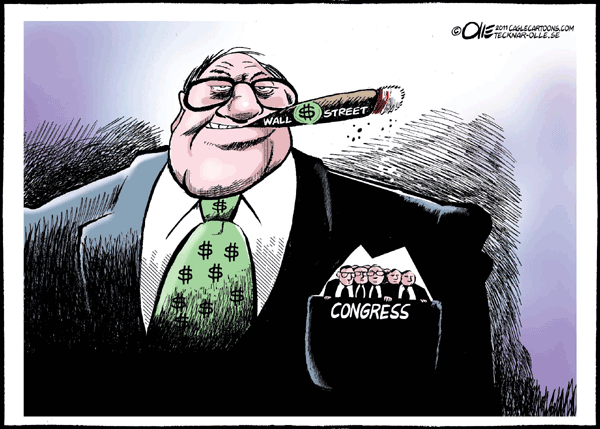
| Occupy Movement . . . Gaining Strength? Posted: 06 Dec 2011 07:33 PM PST OWS: Down, But Not Out …While some might assume that the Occupy movement is dead – given that scenes of large protests have been absent from the news recently – but the truth is quite different. The city of Cleveland has passed a resolution endorsing the Occupy movement, calling on congress to reform financial regulations, and to prosecute the big banks. The vote passed 18-1. Other cities have passed similar resolutions. As Zero Hedge notes today:
Richard Eskow writes:
(If you are understandably squeamish about deadbeats not honoring their debts, please read this.) Occupy is also attempting to shut down all West Coast ports on December 12th. Occupy protesters have started to arrive in Washington, D.C. to protest political corruption, and are aiming for one million tents set up by January 17th. A top Republican strategist – and the world's top expert on framing mainstream Republican ideas in language which persuades people, Frank Luntz – said (via Think Progress):
(The other top framing expert – George Lakoff, a liberal – supports OWS.) Ron Paul also respects the Occupy movement: And Democrats are feeling the anger of the Occupy protesters as well, given their complicity in selling out the people to benefit the big banks and support for police state tactics against the American people. While police have resorted to brutal military tactics to try to shut down the protests, such tactics have drawn world-wide condemnation, including condemnation from the United Nations, former police chiefs (and see this), and the inventor of pepper spray. And do you know how the police have denied protesters the use of megaphones as a way to try to silence them (hence the famous "Human Mic")? There's a new iPhone App the 'Inhuman Microphone' which circumvents the megaphone ban by unifying all the smart phone speakers into one voice. So Occupy is down, but not out … and arguably growing stronger than ever. This posting includes an audio/video/photo media file: Download Now |
| Posted: 06 Dec 2011 01:30 PM PST Afternoon LIRR reading:
What are you reading? >
via WSJ |
| Media Appearance: Dylan Ratigan Show (12/6/11) Posted: 06 Dec 2011 01:00 PM PST
> This afternoon ~4:15pm we will be discussing the EuroZone, Derivatives and Swaps. Bullet points:
More to come later. > |
| After Banks’ Mistakes, Homeowners Pick Up Pieces Posted: 06 Dec 2011 12:30 PM PST
|
| Posted: 06 Dec 2011 11:30 AM PST Wall Street firms continue to look at SEC settlements as the cost of doing business. Despite promises to not repeat the same law, they seem to run afoul again and again. Here is the NYT analysis of Securities and Exchange Commission documents showing 51 repeat violations since 1996 by a handful of firms. Bank of America and Citigroup are tied for the lead (six repeat violations), while Merrill Lynch and UBS share 3rd and 4th place (five apiece). >
Source: Wall Street's Repeat Violations, Despite Repeated Promises |
| Astronomers Find Biggest Black Holes Yet Posted: 06 Dec 2011 11:00 AM PST
An artist’s conception of stars moving in the central regions of a giant elliptical galaxy that harbors a black hole. |
| European Banks Reluctant To Lend To One Another Posted: 06 Dec 2011 09:30 AM PST
> Banks in the EU seem to be going to their central banks a lot more frequently then they used to:
It is amazing how fragile trust can be . . . > |
| Howard Davies on Europe’s Debt Crisis, Solutions Posted: 06 Dec 2011 09:23 AM PST Howard Davies, former deputy governor of the Bank of England and former director of the London School of Economics, talks about the outlook for a resolution to Europe’s sovereign-debt crisis. Davies speaks with Erik Schatzker and Sara Eisen on Bloomberg Television’s “InsideTrack.”
On Merkel and Sarkozy’s latest proposals to resolve the EU debt crisis: “They’ve still not got there. There has been a lot more lunches than concrete agreements…It’s a huge gastronomic investment going on in France.” “I think yesterday’s package is about trying to persuade German politicians and German voters that they have done enough on the fiscal tightness in discipline and on the austerity f On Germany’s attitude towards the EU: “The German attitude is that if they bail out people, what’s to stop them doing the same thing again? That is the moral hazard argument.” “The ECB problem is a slightly different one. It would be fine for the European Central Bank to say, ok, we’ll go and buy Italian debt, but at the moment we know that would just stack up losses on the balance sheet of the ECB. Who would pay for those? Ultimately there has to be a European finance minister. Ultimately it comes back to us taxpayers to fill in a hole if they buy stuff for more than it’s worth.” On whether it’s a good idea for banks to get bailed out and not take losses on European debt: “I think it probably is. I know it sticks in the craw somewhat to say, Let’s bail the bankers out of this. The difficulty is regulators and the central banks did actually tell the banks that these were safe assets. The regulators told the banks that they ought to be holding more sovereign debt and that was counted as AAA and solid liquidity.” “I think it’s wrong to try to deal with the sovereign debt problem via the banking system. I think you have to deal with it direct, rather than telling the banks that they have to take all these write-offs and load themselves up with new capital.” On what would happen if S&P downgrades the eurozone: “There is still one AAA credit and I used to represent it officially because the UK is not on this list. I don’t quite know why, to be frank.” “As we saw in the S&P case in the United States, it doesn’t necessarily make that much difference if a AAA goes down. It didn’t disturb the markets a great deal in this country, I don’t think. If they do it to everybody and they simply say there is just greater uncertainty about sovereigns in the rest of the world, I’m not sure that will make a huge amount of difference.” |
| Posted: 06 Dec 2011 07:30 AM PST What is the function of Ratings Agencies? The answer to that question was most pithily expressed thusly: might
Sourced from Brookings |
| Posted: 06 Dec 2011 06:30 AM PST My morning reading material:
What are you reading? > |







| You are subscribed to email updates from The Big Picture To stop receiving these emails, you may unsubscribe now. | Email delivery powered by Google |
| Google Inc., 20 West Kinzie, Chicago IL USA 60610 | |



0 comments:
Post a Comment