


The Big Picture |

- How Can We Photograph Human Behavioral Errors?
- 10 Mid-Week PM Reads
- IMF Denies
- another IMF story
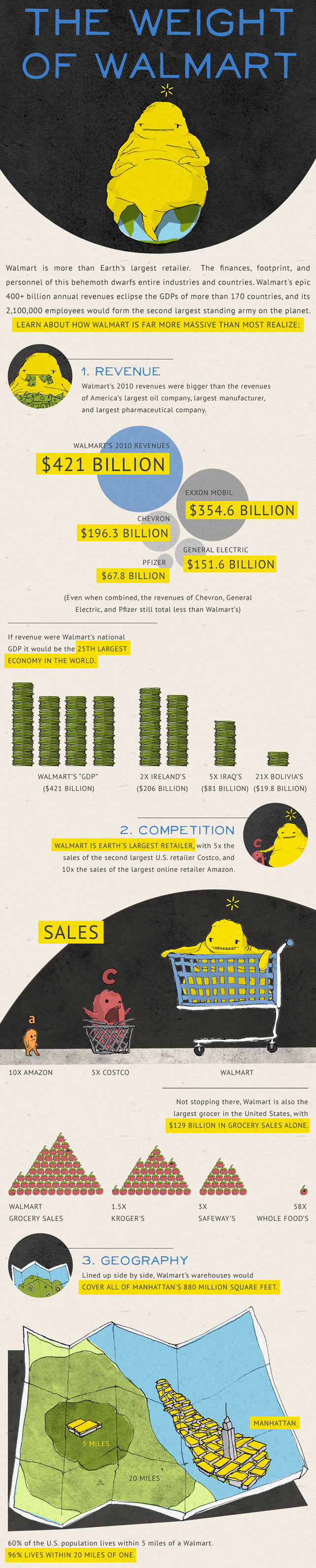
- Walmart Dwarfs Entire Industries And Nations
- Trading Rules, Aphorisms & Books (Updated)
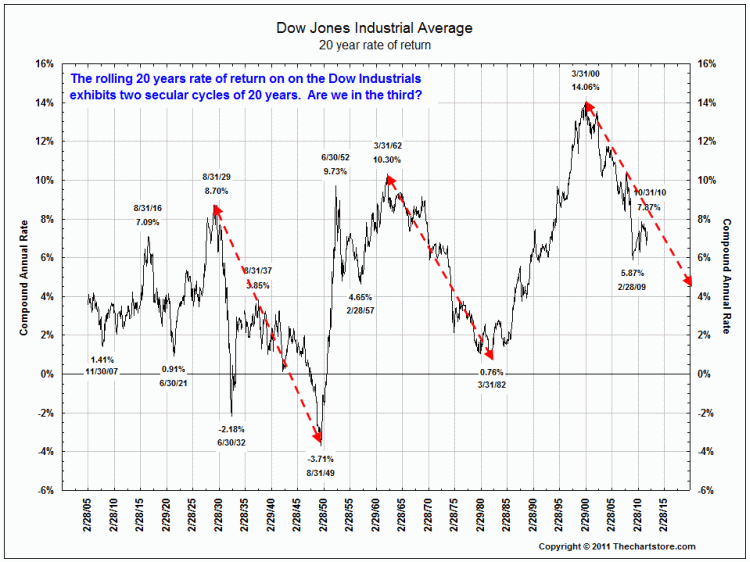
- 20 Year Rolling Returns DJIA
- QOTD: Give a man a gun . . .
- Ratigan: Inside the Unregulated Shadow Swaps Market
- Bernanke Letter to Congress re: Bloomberg Article
| How Can We Photograph Human Behavioral Errors? Posted: 07 Dec 2011 05:55 PM PST Regular readers know I am a huge fan of behavioral economics and cognitive foibles. I spoke recently to someone about some of my favorite errors — one of the questions that came up was how can we depict these biases, cognitive deficits, and wetware deficiencies in a photograph. Most of what I think of as investor errors are rather internalized — excess optimism, selective perception, confirmation bias, flawed belief systems, unwarranted assumptions, etc. Gary Larson of the Far Side had some great visuals, but i am somewhat stymied. Short of someone with a thought balloon over their head revealing their own bias, how can this be shown? Any ideas? |
| Posted: 07 Dec 2011 01:30 PM PST My afternoon train reading:
What are you reading? |
| Posted: 07 Dec 2011 01:05 PM PST *IMF DENIES REPORT OF NEW $600B LENDING PLAN: CNBC |
| Posted: 07 Dec 2011 12:45 PM PST *G-20 CONSIDERING $600B IMF LENDING PROGRAM FOR EUROPE: NIKKEI |
| Walmart Dwarfs Entire Industries And Nations Posted: 07 Dec 2011 12:30 PM PST |
| Trading Rules, Aphorisms & Books (Updated) Posted: 07 Dec 2011 12:00 PM PST Last year, I put together a full run of Trading Rules & Aphorisms. Here is the latest updated version:
My (Ritholtz) own rules
After this run, I plan on updating this list every quarter . . . Books after the jump
Then go to these books — they cover trading and markets generally:
Another good book is When to Sell by Justin Mamis. Published in 1970s, it is filled with good observations about developing a sell strategy. If you want some book ideas for Technicals, have a go at these:
Don't think you need a full reference library; any pair of these books should do. Last, there are a full run of books here: |
| Posted: 07 Dec 2011 09:00 AM PST Fascinating chart from Ron Griess of the Chart Store looking at the Dow Jones Industrial Average, via a 20 year rolling return. The key takeaway is that buying equities when 20 year rolling returns are high is ill advised; making purchases when when 20 year rolling returns are flat to negative seems to generate excellent performance numbers . . . > 20 Year Rolling Returns DJIAclick for larger chart |
| Posted: 07 Dec 2011 07:30 AM PST A friend sends this quote, which I really like but have been unable to verify:
Can any one confirm that is a real quote by Mr. Trotter? |
| Ratigan: Inside the Unregulated Shadow Swaps Market Posted: 07 Dec 2011 07:15 AM PST
Visit msnbc.com for breaking news, world news, and news about the economy
>>> well, we’re back and breaking down the dark, unregulated world of swaps. we started yesterday defining what a credit default swap is, and really, broadly, with bill fleckenstein, what a swap is. think of it like an unregulated insurance product, where you can bet on whether people, businesses, or even nations will default on future loan payments. our goal with these segments is to help prepare you for the release of our book,” greedy bastard$!” next month. today we’re talking about why the unregulated swaps market and its $700 trillion — $700 trillion — it dwarfs every other liability that we have — is so dangerous and so devious. and more importantly, what we can do about it. you might find the answer remarkably simple. let’s bring in henry blodgett, editor and chief of the business insider, and barry ritholtz with phusion iq. henry, i’ll start with you. we’ve watched basically every financial security in the world posted to enexchange, traded publicly, it becomes a more transparent, it becomes a narrower spread, means it’s cheaper and easier to transact in, and we have this one market, which happens to be the largest market on planet earth, that is traded in complete blackness with no capital required if you’re a aaa financial institution. is there any possibility benefit to keeping that market in the blackness? >> not unless you work on wall street, which is a huge benefit, obviously, there. no, they obviously should be regulated, they should be disclosed, first and foremost, so we can actually assess how much risk is at stake. that’s what killed us in the financial crisis. we had no idea what the collateral requirements were for, who had bet what, and so forth. you just can’t know. so they obviously should be disclosed. >> why, barry, is having an exchange, or any any marketplace, so beneficial? >> well, a number of reasons. keep in mind that swaps and other derivatives are unique animals in the financial world. stocks, bonds, options, mutual funds, futures. everything else is required to be traded on an exchange, have reserve requirements, the exchanges make sure that the people who are actually trading these instruments have sufficient capital requirements, they’re capable of meeting margin calls. they have the ability to stand behind the trades. when you have the exchange there, someone is guaranteeing that when the bill comes due, someone is able to make that payment. that doesn’t take place with derivatives. and that is, by design of a legislative act that was passed in 2000. >> and why would they design it in that way? in other words, what benefit — if we’re a capitalist country that believes that we want to have this public marketplace, for any financial security, and really have capital required for consumers to buy things or for banks to lend things, and we want to deploy that capital in collaboration to create value, to solve problems, how does creating this secret market with no capital help us become what we claim to aspire to, henry? >> well, you kind of answered your own question there, exactly. it’s a secret market. it’s just easier. these are very complex instruments. they have all sorts of trigger points. the idea that you would have to disclose every single one of them if you’re a massive global financial firm is frightening. and you also fear you’re opening up your books so everyone can vet against you. you don’t want to have that happen. but as we’ve seen, and we’ve had a big test case, the current situation just does not work. so you have to disclose what’s going on. >> the fact of the matter is that we went from fractions to decimals in the stock market, barry. when the bloomberg terminals came back out going to the early 1980s, and what that did to bond market spreads. the profitability of a financial business simply ain’t what it used to be. how much of a threat to the profitability of a jpmorgan or another western financial institution would crushing the margins a la the decimalization of the stock market be in the swaps market? how damaging would that be? >> well, there’s two things you have to keep in mind to answer that question. first, there’s a huge problem with the swaps market, as it exists today, because there are no real reserve requirements. the risk against counterparties is tremendous. hey, ask aig how it worked out to write $3 trillion in swaps with zero reserves. didn’t work out too well for them. that’s number one. number two, you know, banking and wall street used to be the servant of the rest of the economy. but wall street existed in order to help bring companies public, to provide financial services, and banking services to the rest of the productive economy. and what’s happened over the past 20, 30 years is the tail has begun to wag the dog. financial services became an end unto itself. and so i don’t have a problem going back to boring banking, when they did simple stuff, they borrowed at 3%, they lent at 6%, and they were out on the golf course at 3:00. >> very quickly, last question to both of you. what is the danger to all of us in our currency, in our productivity, in our employment, in our social stability of continuing to ignore this problem and not address it, hen henry? >> we’re exactly where we were before. nothing has changed. as barry said, there are no reserve requirements. we have no idea what’s on the books of banks. we’re set up to do exactly the same thing again. i think that’s why you saw the entire reserve of world banks freak out and say, oh, my goodness, what’s going on in europe, we’ve got to step in. >> the only thing i would disagree with henry about, the only thing that’s changed is that bankers know, hey, if we really screw up badly, the government is there to backstop us, so let’s take as much as risk as we want. it’s worse than it was in ’08. >> i think henry gave you a too tuche on that one. check out both of these gentleman’s work, henry at the business insider or barry at the fusion iq. we’ve posted a blog called leverage: the dynamite strapped to our markets. check it out at |
| Bernanke Letter to Congress re: Bloomberg Article Posted: 07 Dec 2011 06:38 AM PST |


| You are subscribed to email updates from The Big Picture To stop receiving these emails, you may unsubscribe now. | Email delivery powered by Google |
| Google Inc., 20 West Kinzie, Chicago IL USA 60610 | |



0 comments:
Post a Comment