


The Big Picture |

- U.S. Exposure to Europe – Unknowns Unknowns
- GOP Candidates Seek to Pin Crisis on Govt
- Home sales bounce but off lower levels
- Retail Rematch: Jeff Macke vs Barry Ritholtz
- Blame Twitter (Yet Another Correlation Analysis)
- Home sales bounce but off lower levels
- Big Picture Conference, with Doug Kass
- Fireside Chat with Doug Kass
- Mid-Week AM Reads
- Santa brings a lot of cash
| U.S. Exposure to Europe – Unknowns Unknowns Posted: 21 Dec 2011 07:00 PM PST
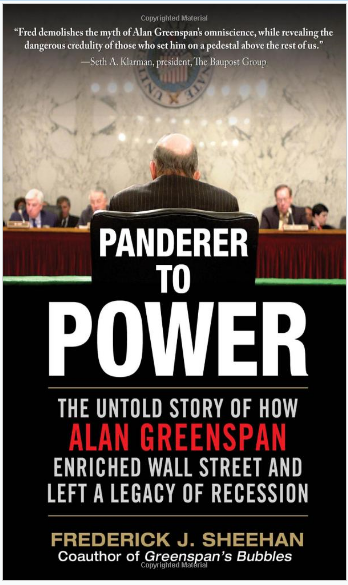
His new book, Panderer for Power: The True Story of How Alan Greenspan Enriched Wall Street and Left a Legacy of Recession, was published by McGraw-Hill in November 2009. He was Director of Asset Allocation Services at John Hancock Financial Services in Boston. In this capacity, he set investment policy and asset allocation for institutional pension plans. ˜˜˜ U.S. Exposure to Europe – Unknowns Unknowns [T]here are known knowns; there are things we know we know. We also know there are known unknowns; that is to say we know there are some things we do not know. But there are also unknown unknowns – there are things we do not know we don’t know. ” -Former United States Secretary of Defense Donald Rumsfeld, February 12, 2002 There were reasons to criticize Donald Rumsfeld’s turn as Defense Secretary but this was not one of them, even though the media quoted and re-quoted this most sensible approach to uncertainty as proof of a retarded intellect. As Eurocrats dissemble (see: The Rotten Heart of Europe & l), ratios that quantify U.S. financial system exposure to European insolvency are dated, even as they are published. Credit default swaps or loans may have been traded in the interim, may have been hedged, or may have slithered from For-Profit-or-Bailout Banks onto the Federal Reserve balance sheet (i.e., nuclear-waste securities). Aggregate bank balance-sheet figures may be gross or net (and we debate whether gross or net is the more consequential measure), may be the tip of an iceberg compared to submerged, off-balance-sheet liabilities, and ultimately, we do not know the timing of the Fed’s $5 trillion academically certified money dump into the banking system. These limitations have been compounded by a recently revealed “unknown unknown,” at least to most of us. On December 7, 2011, Reuters published “MF Global and the Great Re-Hypothecation Scandal” Reuters’ reporter Christopher Elias opened: “A legal loophole in international brokerage regulations means that few, if any, clients of MF Global are likely to get their money back.” (Re-hypothecation will be described below.) Some lessons here: First, if not for the money stolen from MF Global’s customers, Reuters probably would not have set Elias on the trail to re-hypothecation. Second, it is when good credit is receding that such scandals come to light. (Madoff.) If not for the slide in European sovereign bond prices (the route by which MF Global’s CEO leveraged and bet the solvency of his firm), MF Global would not have disappeared. Third, and very much related to the previous point, the world’s good collateral shrinks by the hour. Fourth, the supposed bond “guarantees” that authorities bray about are a chimera. Quoting Elias: “Backed by the European Financial Stability Facility (EFSF), it was a clever bet (at least in theory) that certain Eurozone bonds would remain default free whilst yields would continue to grow.” The EFSF is backed by words, not assets. The more that governments and international bodies vote to back spiraling guarantees, the less their guarantees are worth. Thus: good collateral as a percentage of paper and paper promises shrinks. Fifth, and very much related to points two through five, it is only the spiraling of financial leverage that prevents the financial economy from collapsing. Re-hypothecation is a revelation in financial leverage. Most readers understand “hypothecation,” even if they never heard the word. Elias explains: “By way of background, hypothecation is when a borrower pledges collateral to secure a debt. The borrower retains ownership of the collateral but is ‘hypothetically’ controlled by the creditor, who has a right to seize possession if the borrower defaults.” An example would be an investor who holds a margin account with a broker. If the value of the assets (shares of IBM) fall to a certain point, the broker requires that the investor put more money into the account. If the client does not put the required money into the account, the broker has the right to sell shares of IBM. The cash received in the sale restores the minimum level of equity required by the broker. Elias explains the process as follows: “In the U.S., this legal right takes the form of a lien…. A simple example of a hypothecation is a mortgage, in which a borrower legally owns the home, but the bank holds a right to take possession of the property if the borrower should default.” Now we get to the scary part. Re-hypothecation, explains Elias: “occurs when a bank or broker re-uses collateral posted by clients… to back the broker’s own trades and borrowings. The practice of re-hypothecation runs into the trillions of dollars and is perfectly legal.” He quantifies the legal scam: “Prior to Lehman Brothers collapse, the International Monetary Fund (IMF) calculated that U.S. banks were receiving $4 trillion worth of funding by re-hypothecation, much of which was sourced from the UK. With assets being re-hypothecated many times over (known as ‘churn’), the original collateral being used may have been as little as $1 trillion – a quarter of the financial footprint created through re-hypothecation.” Hot off the press (dated December 2011) is an IMF report: The Nonbank-Bank Nexus and the Shadow Banking System Authors Zoltan Pozsar and Manmohan Singh give an example of how re-hypothecation works (on page 11 of the paper). A dealer holds a Treasury security as collateral which “comes with the rights for the dealer to repledge it.” The dealer uses this collateral as his (the dealer’s) collateral with an asset manager. The asset manager “may re-use the Treasury security to post collateral with another dealer…” On it goes, each party in turn using the same Treasury security as collateral. The IMF authors proffer: “Since these transactions are underpinned by a single piece of collateral, such daisy-chains may be referred to as dynamic chains.” They may also be referred to as an illusion of credit that nonetheless has inflated asset prices from Shanghai apartments to Apple common stock to European and U.S. Too-Levered-To-Die Banks. Pozsar and Singh write the traditional thinking of how banks fund themselves “ignores the significant funding that banks receive from the asset management complex” that permit “both individual banks and the banking system as a whole [to] quickly lever up.” Understanding this lends credibility to MF Global Chief Executive Officer Jon Corzine’s statements before Congress that he does not know where his clients’ money is. Pozsar and Singh write: “The securities that asset managers invest on behalf of households are seldom left lying around passively in portfolios. In order to capture their value as collateral, securities are routinely lent out for use in the shadow banking system, a fact few households, whose securities are ultimately being lent, are oblivious to.” [My italics, should you have nodded off during all the IMF talk. - FJS] It is generally believed that U.S. banks are in much better shape than European banks today. Of what value is this? Back to Pozsar & Singh: “The repeated use of… collateral facilitates system-lubrication [and] also the build-up of leverage-like collateral chains between banks and managers.” A down drift of collateral values, which should be expected since there is no value to the compounded layers, may be a reason European banks are in such dire straits. (European Central Bank President Mario Draghi to the European Parliament on Thursday, December 1, 2011: “We are aware of the scarcity of eligible collateral.”) Bloomberg reported on December 13, 2011: “EU Banks Selling ‘Crown Jewels’…” The banks are selling some of their most profitable arms (lines of business) to raise cash. Is this the fire sale of the century? Probably not. Selling profitable lines at discounts to their fair value today drags down prices which may lead to another round of discount sales, at even lower prices tomorrow. Distorted pricing of assets by a leveraged financial system with few real assets has led to some strange observations. Izabella Kaminska reports in the Financial Times (alphaville) that it is not regulators or authorities, but “the markets themselves… [that] are demanding a re-collateralization in all funding areas.” She notes: “[T]he latest trend towards gold collateralized bank loans shows in some ways the market is demanding the recollateralization of credit with gold.” Kaminska notes: “Gold is switching places with [U.S.] Treasuries as the ultimate form of security.” It is surprising U.S. Treasuries still hold that princely position. The FDIC is now guaranteeing $53 trillion (not billion, but: trillion) of Bank of America’s (transferred from its Merrill Lynch subsidiary) credit default swaps. This maneuver was executed by the Federal Reserve. This is both reprehensible and meaningless. Assume a 25% default rate on the credits and that Bank of America also defaults. A $13 trillion tax on Americans to make good on our guarantee is meaningless, other than to induce an immediate credit downgrade to F-. Speaking of the Fed, specifically of Federal Reserve Chairman Ben Bernanke, he told Congress on November 2, 2011, that MF Global had been approved as a primary dealer by the New York Federal Reserve, “but we are not the regulators of MF Global,” nor is there any reason the Fed should be overseers or regulators to such a firm. Authors Poszar and Singh placed dealers at the heart of the re-hypothecation racket. Oh, Ben! Aggressively stupid to the end. From the close on November 30, 2011, to December 12, 2011, (when Kaminska wrote), the spot gold price fell about $90, from $1,746 to $1,659. Kaminska explained why: Right now: “Banks don’t need gold as much as they need cash.” (This relative lack of need for gold is what she refers to below as “surplus gold.”) As has been written many times “gold is the ultimate form of payment,” and so it is being lent by banks “for its use as a funding instrument: collateral.” Gold now is being lent by banks (repoed) at a negative rate. “The more negative the rate, the higher the cost of funding using the collateral.” Kaminska concludes: “With surplus gold being put into the system, the price of gold has no choice but to stall.” Maybe Kaminska should have considered another possibility: as the panic for collateral worsens, the price might continue to fall. In fact, over the past two days (December 12 to December 14), gold has fallen another $90, to $1,567 (as this is written). If Kaminska’s analysis is correct, the price of gold could spring back up, with alacrity. With the European banking system near collapse, we may soon find just how exposed is the U.S. banking system to continental credit, credit default swaps, and “repeated use of… collateral facilitates system-lubrication [and] the build-up of leverage-like collateral chains between banks and managers.” There is no question that, if it was within their power, the Eurocrats would have absorbed every last bond and bank loan on a bank balance sheet that is trading at a discount. “Oh,” they must be wishing “if only we had the arrogated authority of Federal Reserve Chairman Ben Bernanke.” They know that when (not if) the Federal Reserve chairman is in a similar position to theirs, he will beckon $5 trillion of funny money into existence. This would exceed his authority, but after members of a Congressional committee read him the riot act, they will thank him for saving the system, even as the inflation rate passes 30% during the hearing, and he will be Time magazine’s Hero-of-the-Year again. As for the Eurocrats, they will find a way to do the same. They must: otherwise the pampered satraps in Brussels will have to move home and pay taxes. But could this “known known” (speaking of both the U.S. and Europe) be a miscalculation? That is to say, could the parties mentioned miscalculate and not act in time to pump up the sinking structure of leveraged ether? Possibly so. There is precedence. Benjamin Anderson, economist at the Chase Bank from 1920 to 1939, wrote about two such misjudgments in the 1930s, in his highly recommended book, Economics and the Public Welfare: A Financial and Economic History of the United States, 1914-1946. On May 12, 1931, “there came an unexpected run on Oesterreichische-Credit-Anstalt,” a large Austrian bank. To be noted: (1) Oesterreichische-Credit-Anstalt was forced into a merger with a weaker bank in 1929. This might be analogous to Bank of America’s acquisition of Countrywide Financial, and, (2) quoting Anderson: “The Austrian government guaranteed certain of the investments.” (Oh, those government guarantees again!), but “the merged bank had been inadequately financed… the big merged institution was still insolvent.” Just as in Europe today: how good is the credit (collateral) of the guarantor? The bulk of a sovereign state’s collateral is future tax revenues. From Greece to the United States, this does not inspire confidence today. On May 14, 1931, the Bank for International Settlements coordinated support by central banks. “This made a great show of international cooperation… but the effect was bad when eleven central banks were providing among them only $5.6 million. Creditors grew more frightened, rather than less. If the thing were to be done at all, it should have been done adequately. The first principal of bank loans in a crisis is that if the borrower needs $100,000 to save him, you give him $100,000 or you give him nothing at all. You don’t give him $20,000.” Here, as described above, is where the U.S. (today) can hyper-inflate at will, while Europe is encumbered. Back to Anderson and 1931: “Panics are not dealt with effectively through delay, through public discussion, and through fighting for position. A loan of $25 million made promptly at the first sign of panic would probably have stopped it. There came a time when $100 million would not stop it. By the time the Austrian government on May 29, [1931], voted the guarantee of $150 million, the credit of the Austrian government was so shaken that no one cared about the pledge. When on June 6, 1931, the Bank for International Settlements arranged to give a… 100 million shilling credit [$14 million - FJS] to Austria, the Austrian financial disaster was very little helped thereby.” German banks endured a run on June 1, 1930. “In the beginning of the run on Germany, again the effort of international banking cooperation was made. Again $100 million promptly provided by concerted action of British, American, and French banks, publicly announced and instantly made available, could have stopped the crisis. A month later $500 million would not have been sufficient.” There were squabbles: It is “in the French character and the French tradition that immediate acceptance of a contract proposed by another party is out of the question…. France delayed, and France delayed to long…. The German people, as well as foreign creditors, were engaged in the run on German banks.” France was not the only culprit. Anderson criticizes New York bankers for being too timid and too late. This was not the end for German banks. Publicized meetings among government authorities and official proclamations dragged into 1932: the Euro summits of the day. Hope sprang eternal that a reconstruction of German debts (and war repatriations) could be managed, but it was not to be. Anderson observed (literally: he was confidant to participants) that “governments move slowly and politicians look to the next election.” He concluded: “If the governments had acted that winter, Hitler would never have come to power, and we should have saved the democratic regime of Germany.” This was an unknown unknown. |
| GOP Candidates Seek to Pin Crisis on Govt Posted: 21 Dec 2011 11:15 AM PST Interesting article in Bloomberg looking at the GOP candidates who have decided to get off of the reality train:
There are lots of details in the article, discussing the facts. I was looking for someone to vote for other than Obama in the next election. I hoped Mitt Romney might be that candidate. But reality has left his presidential campaign — He just lost my vote . . . > Source: |
| Home sales bounce but off lower levels Posted: 21 Dec 2011 09:49 AM PST Nov Existing Home Sales totaled 4.42mm annualized, well below expectations of 5.05mm but due to major revisions to the last few years, it's unlikely that today’s estimate was based on the new methodology. Figures since 2007 were revised sharply lower as expected as a “divergence developed over time between sales reported by MLSs and sales determined by a US census benchmark.” Oct sales in particular were revised to 4.25mm from 4.97mm. Nov sales, after the revisions, are the best since Jan but well below the above 5mm pace in some months in 2011 that was originally reported. In fact, the only month that saw sales above 5mm homes after the bust was in Nov ’09 as people took advantage of the expiring home buying tax credit. The NAR said there were no changes to home prices or month’s supply. Month’s supply fell to 7 from 7.7 in Oct and the lowest since Nov ’09. The median home price at $164,200 is a touch below the average ytd. Distressed sales accounted for 29% of total sales vs 28% in Oct and 33% in Nov ’10 and 1st time buyers totaled 35% vs 34% in Oct and 32% in Nov ’10. Bottom line, notwithstanding the sharp downward revisions in the calculation of the amount of existing homes sold since 2007, the pace of sales is trying to scratch out a bottom and inventory levels are getting close to longer term averages. Also, while home prices are not done going down, most of the declines seen over the past few years are probably in. With this all said, it will still be many years before we’ll see a sustained improvement in both prices and the level of sales. Remember, land prices in Tokyo fell for 17 straight years. They have lost population over this time we know while the US continues to build households but my point is that downward cycles post credit bubble do last many years. |
| Retail Rematch: Jeff Macke vs Barry Ritholtz Posted: 21 Dec 2011 09:30 AM PST Jeff Macke admits how terribly wrong he was, offers up a humble mea culpa, a supplicates himself before me: . . . Or not~! Source: Retail Rematch: Jeff Macke vs Barry Ritholtz |
| Blame Twitter (Yet Another Correlation Analysis) Posted: 21 Dec 2011 08:30 AM PST |
| Home sales bounce but off lower levels Posted: 21 Dec 2011 08:15 AM PST Nov Existing Home Sales totaled 4.42mm annualized, well below expectations of 5.05mm but due to major revisions to the last few years, its unlikely that today’s estimate was based on the new methodology. Figures since 2007 were revised sharply lower as expected as a “divergence developed over time between sales reported by MLSs and sales determined by a US census benchmark.” Oct sales in particular were revised to 4.25mm from 4.97mm. Nov sales, after the revisions, are the best since Jan but well below the above 5mm pace in some months in 2011 that was originally reported. In fact, the only month that saw sales above 5mm homes after the bust was in Nov ’09 as people took advantage of the expiring home buying tax credit. The NAR said there were no changes to home prices or month’s supply. Month’s supply fell to 7 from 7.7 in Oct and the lowest since Nov ’09. The median home price at $164,200 is a touch below the average ytd. Distressed sales accounted for 29% of total sales vs 28% in Oct and 33% in Nov ’10 and 1st time buyers totaled 35% vs 34% in Oct and 32% in Nov ’10. Bottom line, notwithstanding the sharp downward revisions in the calculation of the amount of existing homes sold since 2007, the pace of sales is trying to scratch out a bottom and inventory levels are getting close to longer term averages. Also, while home prices are not done going down, most of the declines seen over the past few years are probably in. With this all said, it will still be many years before we’ll see a sustained improvement in both prices and the level of sales. Remember, land prices in Tokyo fell for 17 straight years. They have lost population over this time we know while the US continues to build households but my point is that downward cycles post credit bubble do last many years. |
| Big Picture Conference, with Doug Kass Posted: 21 Dec 2011 07:30 AM PST All of The Big Picture Conference videos are now available on Fora.tv Watch all of the Big Picture Conference for $39.95 or choose just the speakers you want to see on FORA.tv |
| Posted: 21 Dec 2011 07:15 AM PST |
| Posted: 21 Dec 2011 07:00 AM PST My reads to start the day:
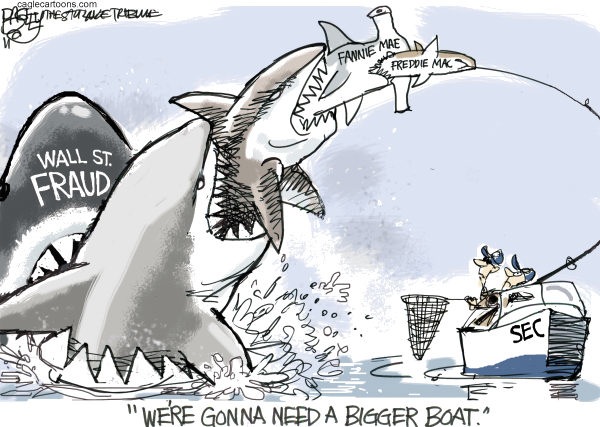
What are you reading? > We’re Gonna Need A Bigger Boat! |
| Posted: 21 Dec 2011 05:11 AM PST Santa Clause came to town a few days early in the form of the ECB lending a greater than expected 489b euros to 523 European banks for three years. About 200b of this will be new money as the balance is being rolled from maturing loans. This is the ECB’s version of QE as new money is being injected into the balance sheet’s of banks and we’ll soon see what banks do with the money. Again, this is a liquidity event and does nothing to change the debt and long term growth challenges that many countries in Europe have faced for a years. Santa will come back in Feb for an encore performance with another 3 yr offering. Maybe a sell on the news, the euro basis swap is wider by 4 bps after falling 24 bps over the previous 3 days. Spanish and Italian bonds are also lower after the sharp gains, mostly on the short end, over the past week. In Asia, most markets rallied, especially the South Korean Kospi which was up 3%, gaining back all of Monday’s losses. The Shanghai index continues to lag, falling another 1%. In the US, the MBA said the avg 30 mortgage rate fell to 4.08% from 4.12%, another multi decade low but purchases still fell to a 5 week low, down 4.9% and refi’s fell by 1.6%. Newsletter writers aren’t swayed by European problems as II said Bulls rose to 48.4 from 45.3, the highest since July while Bears remained unchanged at 30.5. |


| You are subscribed to email updates from The Big Picture To stop receiving these emails, you may unsubscribe now. | Email delivery powered by Google |
| Google Inc., 20 West Kinzie, Chicago IL USA 60610 | |



0 comments:
Post a Comment