


The Big Picture |

- Better to keep your mouth shut and be thought a fool…
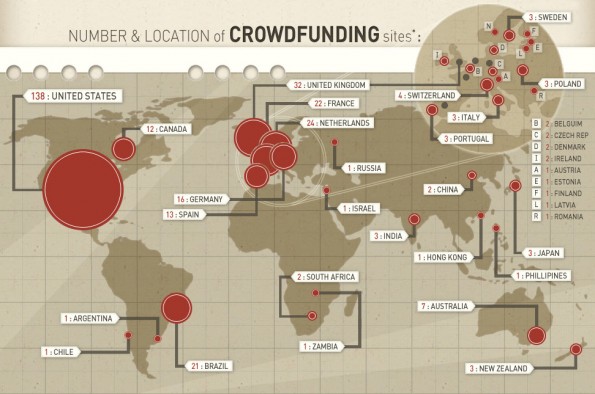
- An Intro to Crowdfunding
- IBD: That Damn Ritholtz is a Member of the Media Elite!
- Case Shiller: Home Prices Fell 3.4% Year-over-Year
- Confidence boosted by labor market improvement
- RJD2 – Ghostwriter
- S&P/CS hpi lower again
- 10 Tuesday AM Reads
- Asset Safety in the post-MF Global World
- SEC Goes Quant
| Better to keep your mouth shut and be thought a fool… Posted: 27 Dec 2011 05:00 PM PST …than to open it and remove all doubt.Invictus here. I usually know exactly where I’m going when I sit down to write a post — some numbers tell me a story that I think would be interesting to be share. Not so this time.
I’ve wondered often and aloud what it takes these days for an individual to be discredited. The answer seems to be that it is simply not possible. Being wrong — about anything and everything — no longer carries any consequences whatsoever. On many levels, it’s quite remarkable. As it relates to economics, stories about hyperinflation, sky-high interest rates, rampant government spending, expansionary austerity, an economic plan that will get the unemployment rate to 2.8%, etc., etc., have been making (or made) the rounds for the past few years. Yet the purveyors of these fictions lose no credibility and somehow maintain their status as experts, continuing to appear on business television shows and on op-ed pages nationwide. (Post-market on Friday, December 23, Bloomberg Television trotted out Harry “Roaring 2000′s” Dent, for example. How’d that call work out?) Paul Krugman has railed about all this countless times, most recently here, and he has a very valid point. But Rush Limbaugh has now taken it all to a new level by demonstrating a mind-numbing cluelessness about one of the most fundamental of our employment statistics, the unemployment rate. Mr. Limbaugh did not just twist, distort, or massage statistics (though he most certainly did do those things), he displayed an abject ignorance of what the BLS measures and how it is measured. In an error-laden, wince-inducing screed that was somewhat painful to read, Rush explains to his Dittoheads that the government manipulates its economic releases to make them administration-friendly. (Of course, that being the case, he does not tell us why, three years into the current administration, the unemployment rate is not a second-term-insuring 5 percent instead of 8.6, but never mind that.) In the hope of maintaining my sanity, I’ll confine myself to the most egregious assertion in Rush’s comedy of errors (emphasis mine):
If you’re thinking, “Hey, Invictus, the payroll number comes from the Establishment Survey and the Unemployment Rate from the Household Survey,” congratulations, you know more about how BLS does its job than Rush Limbaugh. Try as I might to think of something funny to say about this, words escape me. What is there to say? Millions (tens of millions?) of people listen to this man, and in all likelihood believe what he said, despite the fact that his claim is wholly, totally without any merit whatsoever because he conflated the two surveys to simply fabricate a narrative — the narrative being that a modest rise in payrolls could cause an outsize decline in the unemployment rate. So, the question then becomes, did he know what he was doing and just not care, or did he simply opine ignorantly on a topic about which he clearly knows nothing? Honestly, as jaded as I have become, this one threw even me for a bit of a loop. For those who are going to accuse me of picking on Rush, I’ll simply say this: Find me other examples of such blatant intellectually dishonesty and I’ll criticize those, too. If there are any Rush defenders in the audience, please drop it in comments — I’m tired of the market volatility and could use both a break and a laugh. |
| Posted: 27 Dec 2011 11:30 AM PST |
| IBD: That Damn Ritholtz is a Member of the Media Elite! Posted: 27 Dec 2011 09:00 AM PST Hey, looks who attacking me now! A reader sent me this from the Editorial Board of Investors Business Daily — I guess I must have touched hit a nerve. And even better, lil’ ole me is now described as a member of the “media elite:”
Despite the enormous respect I had for William O’Neil as a market analyst, I stopped reading IBD a decade ago. Their editorial policy was so off the rails that it made me wonder if I could trust their reportage. Anytime you folks at IBD would like to have a live, fair, public debate moderated by neutral judges, let me know. I’d be happy to participate in a discussion about this issue. Chris Whalen and Josh Rosner have suggested putting together a causes of the crisis debate (I sarcastically described it as flat earth loons versus a data driven analysis), but there is merit in that idea. On my squad I select Bill Black and Mike Konczal, with a research team of Yves Smith, David Min, William Cohan and Janet Tavakoli. I am sure there are more folks to add to this, but that’s the debate squad I would go with. |
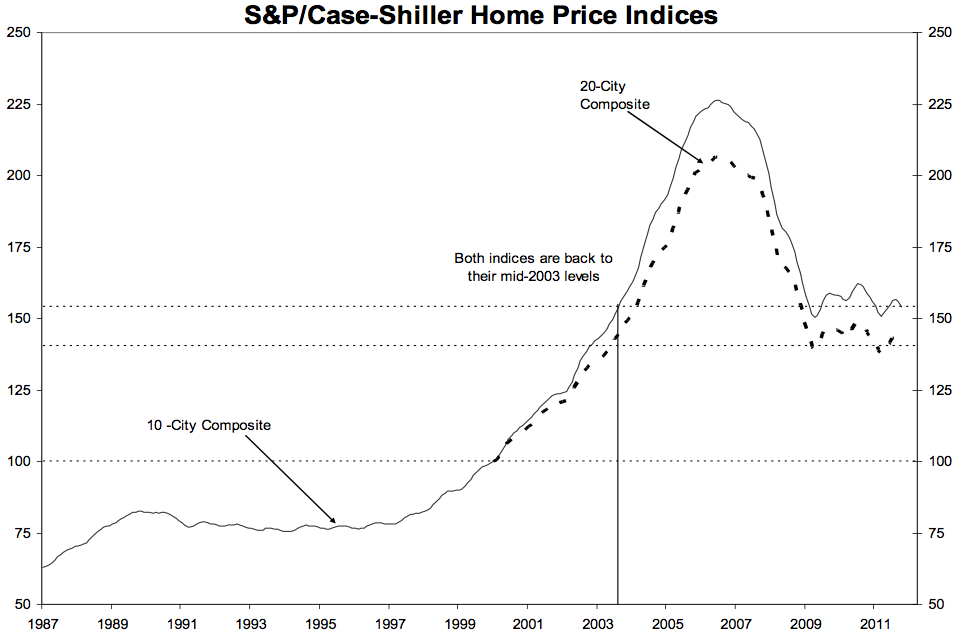
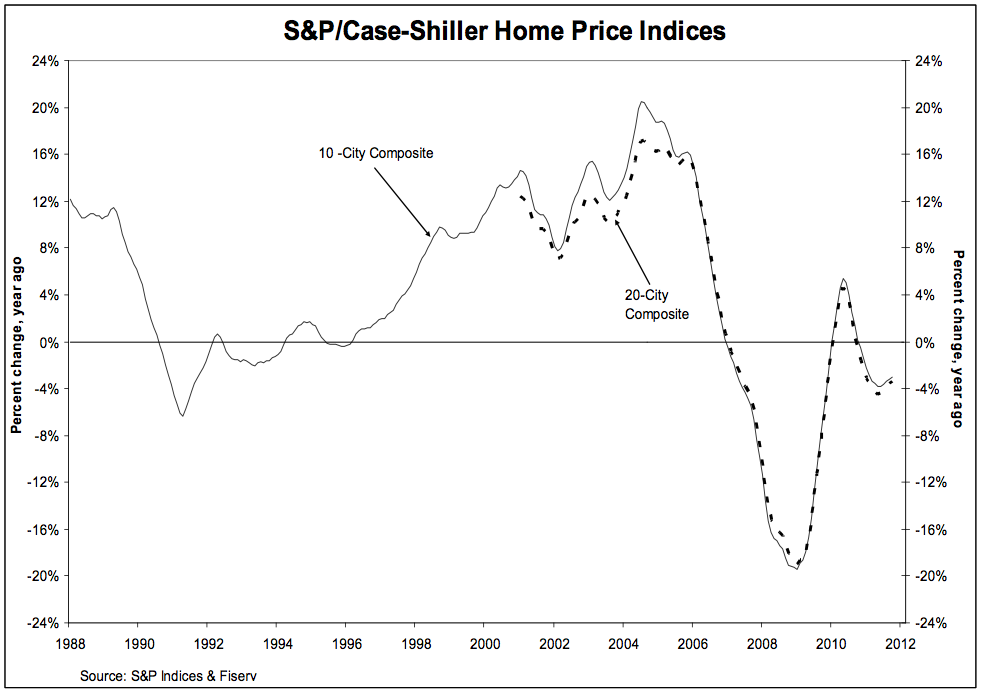
| Case Shiller: Home Prices Fell 3.4% Year-over-Year Posted: 27 Dec 2011 07:30 AM PST U.S. home prices fell ~1.2% respectively in October versus September, with 19 of 20 cities covered by the indices decreasing over the month. Year over year drops of the 10- and 20-City Composites fell -3.0% and -3.4% respectively versus October 2010. As of October 2011, average home prices across the U.S. are back to their mid-2003 levels. (See chart below) Measured from their June/July 2006 peaks, the peak-to-current declines for the 10-City Composite & 20-City Composite are -31.9% and -32.1%, respectively. > click for larger chart
> More charts after the jump
> ~~~ Year over Year Percentage Price Change in Case Shiller Home Price Index > ~~~ 20 Metropolitan Region Monthly changes |
| Confidence boosted by labor market improvement Posted: 27 Dec 2011 07:25 AM PST The Dec Conference Board Consumer Confidence figure was 64.5, better than expectations of 58.9 and up from 55.2 in Nov. It’s the best level since April and was led by a 10 pt jump in the Expectations component while the Present Situation still rose a good 8.4 pts to the highest since Sept ’08. Encouragingly, those that said jobs were Plentiful rose to the most since Jan ’09 while those that said jobs were Hard To Get fell to the least since Jan ’09. There was also an improvement in the answers to the Business Conditions questions both currently and with the outlook. Those that plan to buy a home within 6 months rose a touch but to the most since May but those that plan to buy an auto fell to the lowest since Oct ’10. Those that plan on taking a vacation rose to the best in a year. One year inflation expectations fell to 5.4% from 5.6% to the lowest of the year and coincident with the lowest gasoline prices since Feb. Bottom line, while the move higher in confidence is good to see, especially around the holidays, at 64.5 it is still almost half the 10 yr high of 111.9 in July ’07 (of course just as everything was about to change). But, importantly there seems to have been an improvement in the labor market as seen in today’s answers and also in the level of initial jobless claims over the past 3 weeks. |
| Posted: 27 Dec 2011 06:30 AM PST I cannot get this song out of my head. It has a cinematic quality I keep envisioning. Maybe someone gets out of bed, gets dressed, walks down the street — it has a good strutting rhythm. Or perhaps after suffering years of abuse, the main character finally tells his boss to shove it, or whatnot — and walks away as the horns come in. Roll credits. Anyway, it has a nice vibe to it ~~~ Click for ear worm: |
| Posted: 27 Dec 2011 06:17 AM PST The Oct S&P/CS 20 city home price index fell by 3.4% y/o/y, more than expectations of a decline of 3.2%. The index itself fell to the lowest since March ’03 on a seasonally adjusted basis. Sequentially, prices fell .62%. Of the 20 cities, Detroit and Washington DC again led the gains y/o/y. Price declines were led by Atlanta, Las Vegas, and Minneapolis. Bottom line, with prices now double dipping, the question is of course when will this end and that won’t likely be until more of the foreclosure backlogs get worked off. With this said, prices are already down 33% from the highs in ’06 and thus likely reflects most of the declines that will be seen in this cycle but as seen in Japan, just because prices may soon stop falling doesn’t mean they are headed straight back up again. |
| Posted: 27 Dec 2011 06:00 AM PST What? You are working this week? That sucks. Let these reads ease your work-related troubles:
WTF are you doing at work reading? > |
| Asset Safety in the post-MF Global World Posted: 27 Dec 2011 05:30 AM PST Asset Safety in the post-MF Global World ~~~ We wish our clients, referring consultants, professional colleagues, friends, and all of our readers a happy holiday season and a healthy new year. We also encourage them to ask very hard questions as they work to keep their money and investments safe. We start this yearend message with a reminder of who we are. We are a separate account manager. That is why we do independent research. We look at what rating agencies say, but we make our own evaluations about credit issues. We do not take custody of clients' funds. We favor a three-silo approach to money management: we believe that custody, advice, and transactions should all be separately accounted for and independent of each other. That advice would have avoided Madoff, Nadel, and MF Global. It also requires the investor to dig deep into the account arrangement that he/she uses. We look at the world as an organization of interdependencies. Some are negative and some are positive. They are intertwined. They come in all sizes and shapes. We are using these metaphors to describe the global construction of finance, economics and government. In today's world there is no complete isolation, not in Russia (Putin protests), not in Syria (City of Homs), not even in despotic North Korea. In today's world, one may deceive, steal or oppress but one cannot permanently hide. We start with a perspective articulated by Tommaso Padoa-Schioppa five months before his death. See the Per Jacobsson Lecture, Basel, June 27, 2010 (hat tip Steve Ganns). Google will take you to the full text and to the Padoa-Schioppa bio. With brilliantly constructed prose, Padoa-Schioppa said: "Humans sharing common interests constitute groups of different sizes on a scale that goes from the condominium to the population of the world. Goods like a garden, the judiciary system, navigation on the Rhine, or the biosphere, are 'public' for jurisdictions such as a town, a country, a continent, or the planet. "It follows that also government – as provider of public goods – needs to be constructed at different jurisdictions and to refer to different constituencies. Government must be plural and multi-level. The Jacobin aspiration to concentrate public power in the hands of a single ruler produces both oppression and ineffectiveness. "The present crisis stems largely from the inconsistency between the increasingly cross-national span of markets – be it regional or global – and the persistently national span of government: lack of an international monetary order providing a degree of macroeconomic discipline, regulatory competition among financial centers to attract bits of global financial industry, etc. This defective aspect of the relationship between markets and government – one of the most important flaws in the market-government nexus leading to the crisis – cannot be simplistically described as a 'lack' or an 'excess' of government. The defect lies in the level rather than in the quantum of government and has deep roots in the field of practices and in that of ideas." Wow! If ever we saw a summary of interdependence issues applicable to the global financial arena, this is it. Moreover, it only took him three paragraphs. We will leave you to ponder this, dear reader, and will move on with this as a context. Here is some specific food for thought as we enter the New Year. We offer these citations and examples to the many readers who inquired about our writings on MF Global, on rating agencies, on the Fed's primary dealers and on the state of the financial world. Those commentaries are archived at www.cumber.com. On August 3, 2011 (notice the date) Moody's wrote the following as part of a credit report on MF Global. "In summary, there are clear positive indicators of management's ability to execute." Moody's then reaffirmed the Baa2 rating and said, "MF Global recently obtained the Primary Dealer status with the Federal Reserve Bank of New York. Achieving this milestone is a credit positive because it should 1) broaden MF Global's secured funding base, 2) add positive momentum to its brand and franchise building efforts, and 3) expand the size and capital efficiency of its US treasuries trading operation." Moody's had earlier affirmed the Baa2 rating, on February 3. Remember that the Fed maintains that primary dealer status confers no special financial creditworthiness and that the primary dealer designation should not infer it. The Fed specifically disclaims special status. Obviously, a rating agency thinks differently. Perhaps the Fed will take note during the New Year, as it considers the damage that has been done since the Greenspan-Corrigan decision (1992) to remove Fed surveillance of primary dealers. On December 13, 2010, Standard and Poor's rated MF Global BBB- with a "stable outlook." S&P said, "The company has been in a prolonged turn-around mode for the past two years, but we consider the most recent strategic plan of the new CEO Jon Corzine to be sound. This plan focuses on developing the firm’s historic broker model into more of a broker-dealer model, which should eventually increase and diversify revenue and lead to better profitability." So, 2011 witnessed the MF Global saga. The firm became a primary dealer with the Federal Reserve, had its investment-grade rating reaffirmed, and then blew up. What does that say about positive and negative interdependencies and "level" vs. "quantum" of government? Tommaso, we offer you posthumous praise and wonder if your spiritual ears must be ringing. We have written extensively about the hypothecation issue and will introduce some further evidence below. Let's close the rating agency discussion with the following sarcastic quote. "The function of a ratings agency is to visit the field at the end of the battle and shoot the wounded." – John Heimann (former US Comptroller of the Currency), spring, 1998; source, Brookings (hat tip, Barry Ritholtz). Readers may note that the Global Interdependence Center is hosting a conference on rating agencies, February 29 in Philadelphia. See www.interdependence.org for details. Now, on to explaining why we are so harsh on the City of London and why we see hypothecation as such a huge risk. We believe that no new safety became available in the City between the Lehman debacle and the MF global affair. Here is an example of a government (the UK) saying something is unsustainable and then doing nothing about it. Tommaso's level and quantum are both violated. The interdependencies are clearly negative. Proof follows. Reuters reported that, "Under the U.S. Federal Reserve Board’s Regulation T and SEC Rule 15c3-3, a prime broker may re-hypothecate assets to the value of 140% of the client’s liability to the prime broker. For example, assume a customer has deposited $500 in securities and has a debt deficit of $200, resulting in net equity of $300. The broker-dealer can re-hypothecate up to $280 (140 per cent. x $200) of these assets. But in the UK, there is absolutely no statutory limit on the amount that can be re-hypothecated. In fact, brokers are free to re-hypothecate all and even more than the assets deposited by clients. Instead, it is up to clients to negotiate a limit or prohibition on re-hypothecation. On the above example a UK broker could, and frequently would, re-hypothecate 100% of the pledged securities ($500)." More from Reuters: "Under subtle brokerage contractual provisions, U.S. investors can find that their assets vanish from the U.S. and appear instead in the UK, despite contact with an ostensibly American organization. Potentially as simple as having MF Global UK Limited, an English subsidiary, enter into a prime brokerage agreement with a customer, a U.S. based prime broker can immediately take advantage of the UK's unrestricted re-hypothecation rules. In fact this is exactly what Lehman Brothers did through Lehman Brothers International." Here is the actual text of a paragraph from an MF Global account document executed with a client. "7. Consent To Loan Or Pledge You hereby grant us the right, in accordance with Applicable Law, to borrow, pledge, repledge, transfer, hypothecate, rehypothecate, loan, or invest any of the Collateral, including, without limitation, utilizing the Collateral to purchase or sell securities pursuant to repurchase agreements [repos] or reverse repurchase agreements with any party, in each case without notice to you, and we shall have no obligation to retain a like amount of similar Collateral in our possession and control." Source: Thomson Reuters, "MF Global and the great Wall St re-hypothecation scandal" Reuters' research noted that "Once in the system collateral is being pledged and re-pledged over and over again either through sale and repurchase agreements or re-hypothecation as demonstrated by a review of SEC filings. For instance, Goldman Sachs disclosed recently that it had re-pledged $18.03 billion of collateral received as at September 2011, Oppenheimer Holdings re-pledged approximately $255.4 million of its own customers' securities in the same period, Canadian Imperial Bank of Commerce re-pledged $72 billion in client assets, Credit Suisse sold or re-pledged CHF $332 billion of assets (received under resale agreements, securities lending and margined broker loans), Royal Bank of Canada re-pledged $53.8 billion of $126.7 billion available for re-pledging, Knight Capital Group delivered or re-pledged $1.17 billion of financial instruments received, Interactive Brokers re-pledged or re-sold $7.9 billion of $16.7 billion available to re-sell or re-pledge, Wells Fargo re-pledged $19.6 billion as at September 2011 of collateral received under resale agreements and securities borrowings, JP Morgan sold or re-pledged $410 billion of collateral received under customer margin loans, derivative transactions, securities borrowed and reverse repurchase agreements and Morgan Stanley re-pledged $410 billion of securities received." Here is a paragraph of text from the detailed margin-account disclosure agreement of Morgan Stanley Smith Barney: "We may borrow money to lend to you or other margin clients and pledge your securities as collateral for such loans. You authorize us to lend any security in the margin credit portion of your Account, together with all attendant rights of ownership, either separately or together with the assets of other margin clients, to us or to others without notice to you. In connection with such loans, and securities loans made to you to facilitate short sales, we are authorized to receive and retain certain benefits, including interest on your collateral posted for such loans, to which you may not be entitled. In addition, we may receive compensation in connection with such loans. In some circumstances, such loans may limit your ability to exercise voting rights of the securities lent, either in whole or in part." Source: http://www.morganstanleyindividual.com/customerservice/disclosures. Note: this is not unique to MSSB. Nearly all firms have similar language. The client enters into this agreement by doing nothing. To avoid it the client has to opt out. Here is the line of text used in the account document. "Please note that you are automatically requesting margin privileges unless you check the 'NO MARGIN' Box." This safety-threatening risk is manageable if the client is alert and informed. Limit brokerage to a cash account. Set up custody in a way that does not give the custodian permission to use the assets. Deny the ability to lend or hypothecate. But the client or the investment adviser needs to be alert. Also, note that there is usually a cost attached to the secure safekeeping of assets. Firms try to induce you to allow hypothecation because they make money off of your assets when they use them. It is worth paying for independent safety, in our opinion. At Cumberland, we use several custodians, including major brokerage firms and banks. We strive to set up these accounts around the principle of three silos. We recognize that there are times when clients need to use margin in order to borrow. That is okay as long as it is monitored. And when you pay back the loan, you can revoke the margin agreement if you do not plan to borrow again. In other words, pay attention to these details and take nothing for granted. Let's wish for better regulation and more transparency and honest execution in the new year. Maybe it will even happen in the UK. The world is a dangerous place these days. Vigilance is called for. Interdependencies are both positive and negative. On that note, we reaffirm our best wishes for the New Year. We do not plan to drink and drive. We equate drunken driving to asset placement where there is open-ended hypothecation risk. You may survive but the danger is high. Stay safe and have a happy New Year. ~~~ David R. Kotok, Chairman and Chief Investment Officer |
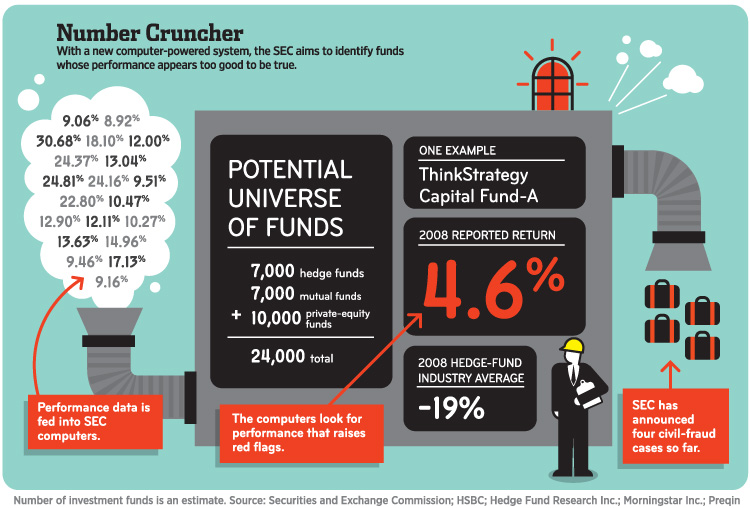
| Posted: 27 Dec 2011 03:54 AM PST I was pleasantly surprised this morning to see a WSJ article that suggests the SEC is beginning to use the tools of Quantitative Research in its enforcement: SEC Ups Its Game to Identify Rogue Firms. This is a positive step for enforcing the laws governing markets. Recall 3 years ago, we asked if the SEC did Quantitative Research?
Then again two years ago, during the option backdating scandal, we noted the advantages of using quant tools for law enforcement:
Mathematics provides an ability to sift through mountains of data to find anomalous results — whether you are looking for Alpha or Felons, it matters not. I am pleased to see that the SEC is adopting useful, cost-effective techniques. The bottom line is that the prosecutors whoa re charged with enforcing the rules have not been using the most current tools of the trade. If this process continues to change — prosecutors actually pursuing criminals — perhaps we might begin to see investor confidence return to markets. Yes, this is only a small step — real improvement remains a long way off. But the camel’s nose is now in the tent, with more enforcement tools to follow. > > Previously: Mathematical Proof: Companies Manage Earnings (February 13th, 2010) SEC Budget vs Wall Street Spending (March 9th, 2011) Source: |


| You are subscribed to email updates from The Big Picture To stop receiving these emails, you may unsubscribe now. | Email delivery powered by Google |
| Google Inc., 20 West Kinzie, Chicago IL USA 60610 | |



0 comments:
Post a Comment