


The Big Picture |

- Objective Comparison of the U.S. to Regimes Labeled Repressive
- 10 Monday PM Reads
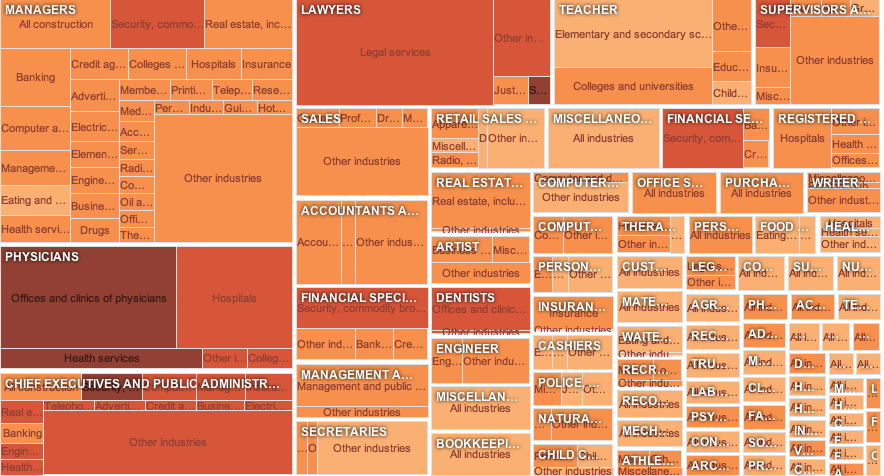
- Top 1% Employment
- Highlight of the Golden Globes: Felicity Huffman & William Macy golden globes Sing
- Germans try to rescue the negotiations with Greek private sector bondholders
- How Much of US Consumables Are Made in China?
- The U.S. Content of “Made in China”
| Objective Comparison of the U.S. to Regimes Labeled Repressive Posted: 16 Jan 2012 10:30 PM PST How Does America Compare to China, Iran, Saudi Arabia and Other Repressive Regimes?Top constitutional law expert Jon Turley notes in a must-read Washington Post article called "We are no longer the land of the free" (I have edited slightly to remove parentheses in several places):
Professor Turley stresses the fact that it is the ability of powerful men to make arbitrary decisions which defines an authoritarian country:
In fact, we go from the land of the free to tyranny the moment we go from a nation of laws to a nation of powerful men arbitrarily making laws in secret. Indeed, Bush and Obama have claimed some tyrannical powers that even Hitler and Stalin never claimed. As I pointed out last month, many American leaders appear to be consciously copying China:
|
| Posted: 16 Jan 2012 03:22 PM PST Some reads to end the 3 day weekend:
What are you reading? >
|
| Posted: 16 Jan 2012 10:30 AM PST Pretty interesting interactive chart — very, very reminiscent of Catherine Mulbrandon’s presentation at the Big Picture conference. > Click for interactive chart: Source: The Top 1 Percent: What Jobs Do They Have? |
| Highlight of the Golden Globes: Felicity Huffman & William Macy golden globes Sing Posted: 16 Jan 2012 09:56 AM PST I Tivo’d the Golden Globes last night, and its playing in the background while I do some work. This was the highlight of the show:
(sorry bout the pre-roll, but this was the only clean copy I could find — the other version has an errant track in he background, ruining it) |
| Germans try to rescue the negotiations with Greek private sector bondholders Posted: 16 Jan 2012 06:15 AM PST China’s forex reserves declined for the 1st time in more than 10 years. Forex reserves as at 31st December fell to US$3.18tr, from US$3.2tr on 30th September. Further declines are likely. The PBoC warned of the likelihood of large capital withdrawals this year. Previous speculative inflows are likely to become outflows, which will slow down (and indeed could well reverse) the Yuan’s appreciation against the US$. SAFE (State Administration of Foreign Exchange) also states that forex inflows will drop sharply this year. There is speculation that the Chinese authorities may widen the Yuan’s trading band – currently 0.5% above or below a daily reference rate (against the US$) set by the PBoC; London is to become an offshore trading centre for the Yuan, as talks between the UK and Hong Kong (which currently is the largest offshore Yuan trading centre) continue, in particular, to implement clearing and settlement systems, market liquidity and the development of new Yuan products. The Yuan was used to settle just 0.7% of Chinese trade in the 1st half of 2010 – this increased to 9.0% in the 1st half of 2011.. The move will help to increase the Yuan become a large global currency (Source FT), with talk of full convertibility by 2014/15. Personally, I believe talk of Yuan convertibility is way too premature; Bloomberg reports that Chinese 4th Q 2011 GDP may slow to the lowest level in 10 Q’s. No great surprise if that’s the case. The 1st half of 2012 is going to be tough for China – a lot depends on the US and Europe; Saudi Arabia stated that it wished to stabilise Oil prices around US$100, adding that it had sufficient capacity (3mn bpd ie up to 12.5mn bpd, from the current 9.5mn bpd) to meet any loss of Iranian exports, following the introduction of additional sanctions The recent ECB 3 year LTRO facility has expanded the ECB’s balance sheet to E2.73tr, or nearly 30% of the Euro Zone’s GDP – and that’s before the next 3 year LTRO on 29th Feb (take up is expected to be significant – quite likely even higher than the E489bn last time around in my humble opinion, particularly as collateral rules have been relaxed and the haircut on Sovereign bonds is much lower than should be the case), which will increase the ECB’s balance sheet size to well above E3tr – will far exceed the FED’s; Last month, S&P reported that the French downgrade could reduce the current E440bn lending capacity of the EFSF by roughly 1/3rd to just E293bn. The EFSF’s existing commitments to Greece, Ireland and Portugal amount to approximately E250bn, which leaves just E43bn for other Euro Zone countries, bank recaps, etc, etc….. Oops. S&P is to deliver its verdict on the EFSF shortly. I can’t see the Euro Zone countries increasing their guarantees to the fund, especially following Fridays credit downgrade of France and Austria. As a result, it is likely that the Euro Zone will be forced to accept a lower credit rating (probably the same as France’s ie AA+), as to maintain the current AAA rating would reduce the EFSF’s lending capacity by E169bn, according to RBS. However, the bottom line remains the same – the EFSF/ESM does not have sufficient resources. In theory, if the other credit agencies retain their AAA rating, the EFSF/ESM could remain AAA rated, I suppose (need to check), but I cant believe that the other ratings agencies (Moody’s, in particular) wont reconsider their ratings in due course, if not at this stage, particularly as they are to review France’s this Q (see below) . The EFSF is scheduled to sell up to E1.5bn of 6 month bills this week, by the way – should be OK, given the LTRO. Following last Friday’s breakdown of negotiations between private sector bondholders and the Greek authorities (together with other parties, including the IMF), Greece could well be the 1st European country to default in 60 years, though I believe that current negotiations with bondholders will result in an deal being reached. The problem appears to be the interest rate on the new 30 year bond to be issued to the bondholders – the IMF is seeking a lower (2.0%) coupon, though the bondholders want 4.0%+, with an opportunity of a higher rate if Greece’s economy improves in due course. Greek officials report that talks are expected to resume on Wednesday, with a deal expected to be completed weeks ahead of the maturity of a E14.5bn Greek Sovereign bond on 20th March. However, believing the Greeks has proved to be a particularly dangerous and, indeed, extremely costly pastime. Further Euro Zone/IMF support (the 2nd EU/IMF E130bn bail out package) for Greece is conditional on a deal being agreed with the private sector bondholders on PSI – the intent is to reduce the E205bn of outstanding debt held by private investors by some 50% or E100bn – somewhat more (60%+) on an NPV basis – STILL NOT ENOUGH.
The ECB refuses (officially) to contemplate a haircut on its holdings of Greek bonds – well they can take that position, but is it credible? I think not. Apparently, there were discussions (no decision was reached though) at last Thursday ECB meeting about the possibility of the ECB agreeing to a haircut on its holdings of Greek bonds (estimated to be between E40bn – E50bn) purchased under it’s SMP programme. Furthermore, there are (unconfirmed) reports that the Euro Zone national central banks will accept a haircut of between 25% – 30% on Greek bonds bought before the SMP, though they will be compensated by their governments if they face losses. However, haircuts on bond holdings do not mean that the size of the losses to Euro Zone national Central banks/ECB will be equivalent to the % haircut, as Greek bonds would have been purchased at below par. (Source Credit Suisse). Optically, a better option than Euro Zone Governments having to provide additional funds for Greece (politically impossible in any case), particularly if the haircuts do not result in actual losses. However, it will set a precedent which Portugal (at the very least) will follow. The bottom line is that a Greek default becomes more and more likely as every day goes by. The current EU/IMF E130bn bail out package is insufficient and I cant see Euro Zone countries wishing to increase their commitments, as suggested by the IMF. Indeed, the IMF are becoming increasingly sceptical as to whether the 2nd bail out package of E130bn (agreed in late October 2011) will be sufficient – which, off course, it is not. Apparently, the IMF has warned Euro Zone politicians that Greece’s fiscal and economic position is worse than was expected – what a surprise – I think not. They propose either a larger haircut on private sector bondholders, or the Euro Zone Central banks/ECB accepting haircuts on their holdings of bonds (see above) and/or additional aid from Euro Zone countries – their (Christine Lagarde) suggestion is that Greece needs several 10′s of billions of Euro’s of additional funds, on top of the E130bn bail out package proposed !!!! Some hope of Euro Zone countries providing more funds. Increasingly, senior politicians within Euro Zone cry out “enough is enough” and talk openly about a Greek default. It is inevitable, in my humble view – the only issue is when and certainly not if, even if the current negotiations with private sector bondholders are “successful” – which, at the end of the day, remains the most likely scenario. A Greek newspaper reports that, following a review by Blackrock, Greek banks need a further E15bn to adequately provide for non performing loans !!!!. The Greek Finance Minister stated that Greek banks would need E40bn to enable them to be recapitalised. Well, may I suggest that the Greeks sell some of their gold reserves and use the funds to recapitalise their own banks. Greece’s debt, even based on the assumption that a deal is completed with private sector bondholders, will remain unsustainable (the current optimistic projections, which the IMF is backing off, predict Greek debt to GDP will remain around 120% in 2020) and, as we all know, the Greeks will NEVER meet their commitments. Far better for the Euro Zone to allow Greece to default, move on and, in particular, adopt measures to avoid contagion spreading to other Euro Zone countries. However, senior German politicians are flying to Athens to rescue the negotiations, in an attempt to kick the can down the road, yet again. The real concern (for the EU/Germany/France, etc) is that the Euro Zone has no credible measures in place to stem contagion (following a Greek default) from spreading to other countries – Portugal being the next obvious target – its 10 year bond yield rose by over 100 bps today, following its downgrade to junk by S&P last Friday – a 40%+ haircut is inevitable. The resources available to the EFSF/ESM are totally inadequate for its intended task – and that was before the impact of last Friday’s downgrade by S&P. That’s when the ECB will have to step in, in my humble view; The ECB is reported to be buying Italian and Spanish bonds today; As you know, I believe that the ECB will introduce QE. However, there is an interesting (alternative?) option for the ECB. The ECB’s recent 3 year LTRO has reduced short term Euro Zone Sovereign debt yields significantly and in a very short period of time – indeed by more than most, including myself, would have expected. Having seen the result, the ECB could introduce a longer term (say 5 year, possibly even longer) LTRO, which should reduce medium term (possibly even longer term) Euro Zone Sovereign debt yields. Essentially, the ECB could, as a result, claim (as they are at present) that they are just assisting Euro Zone banks (which is their responsibility) and not acting as lender of last resort to Euro Zone Sovereigns and/or introducing QE – which clearly they are with the introduction of the recent 3 year LTRO and would be even further if they were to introduce a longer term LTRO – its just that the ECB would get the banks to act on their behalf. However, I believe that the major banks will find it difficult to admit to an increase in their holdings of Euro Zone Sovereign debt – the smaller ones and especially those in trouble will have no qualms playing the carry trade, irrespective of the associated risks. Analysts are likely to view an increase in Euro Zone Sovereign debt exposure (particularly of certain countries) by banks as negative (with adverse consequences for their share price), in spite of the obvious carry trade benefits, once again, ex the associated risks. In addition, I don’t believe that regulators will accept Sovereign debt as zero weighted for the purposes of calculating RWA (risk weighted assets), which will negatively impact capital ratios, if banks buy Sovereign debt. The Euro Zone/ECB have proved to be less than transparent and, as a result, the above must remain a credible option. It is tantamount to further QE, though the ECB will say otherwise. In any event, if introduced, it just will reconfirm my bullish views on European financials (especially UK financials), particularly those that do not need to raise capital – don’t forget the life insurance companies as well; Spain’s autonomous regions have continued spending – the main reason for the 2011 budget deficit increasing to a forecast 8.0% – indeed, it will be higher. However, the new Spanish administration wants to force the regions to submit spending plans to Central authorities in advance – clearly being resisted by the regions. In addition, the Central administration proposes to introduce legislation which will include a spending limit for each region, which each region can decide how to spend. Sanctions for those who breach their deficit targets is proposed. Not going to be easy. I repeat, Spain is in serious trouble; Moody’s announced today that it will review its “stable outlook” on France’s AAA rating in the 1st Q – not great for Mr Sarkozy’s chances of reelection as President. They add that a deterioration in France’s debt metrics, combined with the potential for an increase in contingent liabilities, are adding pressure to their existing outlook. Furthermore, France has less room to manoeuvre on public finances than it had in 2008. Ominously, Moody’s states that France’s AAA rating could come under pressure if debt to GDP rises and/or if the Euro Zone crisis worsens – both of which are inevitable, in my humble view; The main Asian markets (ex India which was modestly higher on the day as wholesale inflation came in at +7.3% YoY, from +9.1% in November – a 2 year low) closed over 1.0% lower today. However, European markets are flat to slightly higher (and improving), having opened lower in response to S&P downgrade after market hours last Friday. The S&P news was widely leaked/anticipated and, indeed, turned out to be not as bad as feared. The Euro is slightly lower (US$1.2667) than Friday’s close – a lower Euro will be of significant help to the Euro Zone. All in all, not too bad at all. Brent is trading around US$110 – without fears of, inter alia, military intervention re Iran, it would be much lower. The main US markets are closed today. Wow, European markets are now higher, with even the Euro picking up slightly (US$1.2681) – I feel a further Euro short coming on. |
| How Much of US Consumables Are Made in China? Posted: 16 Jan 2012 05:00 AM PST Wanna start an interesting discussion at a dinner party? Ask people how much of what we consume in the US comes from or is manufactured in China. Over the weekend, I had a discussion with a chum from UBS about wide public misconceptions. My example was the idea China is the primary funder of US deficits (They actually fund between 7.5-9.5%). We all kicked around others — where we get our oil, religion & science, source of fiscal deficits, belief in Angels, Laffer Curve, supply side economics, water consumption, etc. — but the most interesting one is how much of our consumption is from China. A quick search turned up this Federal Reserve Bank of San Francisco research report: The U.S. Content of "Made in China." What did they find?
The Fed researchers fastidiously backed their with deep lots of data sourced from BEA, BLS, and the U.S. Census Bureau. Their conclusion was a surprisingly low number — I would have guessed closer to 10%. But i cannot argue with their data or methodology. Perhaps a reason for believing China’s share of the US consumer market is how often we see the Made in China label. They dominate the toys, clothing and electronics that get sold in stores like Wal-Mart and Target and Toys-R-Us. Morgan Housel explained:
We also spend far more on others than we realize: Housing, Commodities (especially Food and Energy) and Services (Health Care, Financial, Accounting, Education etc.). Housel noted that in 2010, “we spent 34% of their income on housing, 13% on food, 11% on insurance and pensions, 7% on health care, and 2% on education. Those categories alone make up nearly 70% of total spending, and are comprised almost entirely of American-made goods and services.” That’s one more piece of misinformation put the rest. Now if we can only do something about the Laffer Curve . . . >
> Previously Sources: 3 Misconceptions That Need to Die |
| The U.S. Content of “Made in China” Posted: 16 Jan 2012 04:19 AM PST The U.S. Content of "Made in China" ~~~ Goods and services from China accounted for only 2.7% of U.S. personal consumption expenditures in 2010, of which less than half reflected the actual costs of Chinese imports. The rest went to U.S. businesses and workers transporting, selling, and marketing goods carrying the “Made in China” label. Although the fraction is higher when the imported content of goods made in the United States is considered, Chinese imports still make up only a small share of total U.S. consumer spending. This suggests that Chinese inflation will have little direct effect on U.S. consumer prices. The United States is running a record trade deficit with China. This is no surprise, given the wide array of items in stores labeled "Made in China." This Economic Letter examines what fraction of U.S. consumer spending goes for Chinese goods and what part of that fraction reflects the actual cost of imports from China. We perform a similar exercise to determine the foreign and domestic content of all U.S. imports. In our analysis, we combine data from several sources: Census Bureau 2011 U.S. International Trade Data; the Bureau of Labor Statistics 2010 input-output matrix; and personal consumption expenditures (PCE) by category from the U.S. national accounts of the Commerce Department's Bureau of Economic Analysis. We use the combined data to answer three questions: • What fraction of U.S. consumer spending goes for goods labeled "Made in China" and what fraction is spent on goods "Made in the USA"? • What part of the cost of goods "Made in China" is actually due to the cost of these imports and what part reflects the value added by U.S. transportation, wholesale, and retail activities? That is, what is the U.S. content of "Made in China"? • What part of U.S. consumer spending can be traced to the cost of goods imported from China, taking into account not only goods sold directly to consumers, but also goods used as inputs in intermediate stages of production in the United States? Share of spending on "Made in China" Although globalization is widely recognized these days, the U.S. economy actually remains relatively closed. The vast majority of goods and services sold in the United States is produced here. In 2010, imports were about 16% of U.S. GDP. Imports from China amounted to 2.5% of GDP. Table 1
Table 1 shows our calculations of the import content of U.S. household consumption of goods and services. A total of 88.5% of U.S. consumer spending is on items made in the United States. This is largely because services, which make up about two-thirds of spending, are mainly produced locally. The market share of foreign goods is highest in durables, which include cars and electronics. Two-thirds of U.S. durables consumption goes for goods labeled "Made in the USA," while the other third goes for goods made abroad. Chinese goods account for 2.7% of U.S. PCE, about one-quarter of the 11.5% foreign share. Chinese imported goods consist mainly of furniture and household equipment; other durables; and clothing and shoes. In the clothing and shoes category, 35.6% of U.S. consumer purchases in 2010 was of items with the "Made in China" label. Local content of "Made in China" Obviously, if a pair of sneakers made in China costs $70 in the United States, not all of that retail price goes to the Chinese manufacturer. In fact, the bulk of the retail price pays for transportation of the sneakers in the United States, rent for the store where they are sold, profits for shareholders of the U.S. retailer, and the cost of marketing the sneakers. These costs include the salaries, wages, and benefits paid to the U.S. workers and managers who staff these operations. Table 1 shows that, of the 11.5% of U.S. consumer spending that goes for goods and services produced abroad, 7.3% reflects the cost of imports. The remaining 4.2% goes for U.S. transportation, wholesale, and retail activities. Thus, 36% of the price U.S. consumers pay for imported goods actually goes to U.S. companies and workers. This U.S. fraction is much higher for imports from China. Whereas goods labeled "Made in China" make up 2.7% of U.S. consumer spending, only 1.2% actually reflects the cost of the imported goods. Thus, on average, of every dollar spent on an item labeled "Made in China," 55 cents go for services produced in the United States. In other words, the U.S. content of "Made in China" is about 55%. The fact that the U.S. content of Chinese goods is much higher than for imports as a whole is mainly due to higher retail and wholesale margins on consumer electronics and clothing than on most other goods and services. Total import content of U.S. PCE Not all goods and services imported into the United States are directly sold to households. Many are used in the production of goods and services in the United States. Hence, part of the 88.5% of spending on goods and services labeled "Made in the USA" pays for imported intermediate goods and services. To properly account for the share of imports in U.S. consumer spending, it's necessary to take into account the contribution of these imported intermediate inputs. We use input-output tables to compute the contribution of imports to U.S. production of final goods and services. Combining the imported share of U.S.-produced goods and services with imported goods and services directly sold to consumers yields the total import content of PCE. Table 1 also shows total import content as a fraction of total PCE and its subcategories. When total import content is considered, 13.9% of U.S. consumer spending can be traced to the cost of imported goods and services. This is substantially higher than the 7.3%, which includes only final imported goods and services and leaves out imported intermediates. Imported oil, which makes up a large part of the production costs of the "gasoline, fuel oil, and other energy goods" and "transportation" categories, is the main contributor to this 6.6 percentage point difference. Figure 1
The total share of PCE that goes for goods and services imported from China is 1.9%. This is 0.7 percentage point more than the share of Chinese-produced final goods and services in PCE. This difference is mainly due to the use of intermediate goods imported from China in the U.S. production of services. Figure 1 plots the total and Chinese import content of U.S. PCE over the past decade. The import content of PCE has been relatively constant at between 11.7% and 14.2%. Import content peaked in 2008 at 14.2%, which was probably due to the spike in oil prices at the time. The share of imports in PCE is slightly lower than in GDP as a whole because the import content of investment goods turns out to be twice as high as that of consumer goods and services. The fraction of import content attributable to Chinese imports has doubled over the past decade. In 2000, Chinese goods accounted for 0.9% of the content of PCE. In 2010, Chinese goods accounted for 1.9%. The fact that the overall import content of U.S. consumer goods has remained relatively constant while the Chinese share has doubled indicates that Chinese gains have come, in large part, at the expense of other exporting nations. Broader implications The import content of U.S. PCE attributable to imports from China is useful in understanding where revenue generated by sales to U.S. households flows. It is also important because it affects to what extent price increases for Chinese goods are likely to pass through to U.S. consumer prices. China's 2011 inflation rate is close to 5%. If Chinese exporters were to pass through all their domestic inflation to the prices of goods they sell in the United States, the PCE price index (PCEPI) would only increase by 1.9% of this 5%, reflecting the Chinese share of U.S. consumer goods and services. That would equal a 0.1 percentage point increase in the PCEPI. The inflationary effects would be highest in the industries in which the share of Chinese imports is highest—clothing and shoes, and electronics. In fact, recent data show accelerating price increases for these goods compared with other goods. However, it does not seem that so far Chinese exporters are fully passing through their domestic inflation. In May 2011, prices of Chinese imports only increased 2.8% from May 2010. This is partly because a large share of Chinese production costs consists of imports from other countries. Xing and Detert (2010) demonstrate this by examining the production costs of an iPhone. In 2009, it cost about $179 in China to produce an iPhone, which sold in the United States for about $500. Thus, $179 of the U.S. retail cost consisted of Chinese imported content. However, only $6.50 was actually due to assembly costs in China. The other $172.50 reflected costs of parts produced in other countries, including $10.75 for parts made in the United States. Conclusion Figure 2
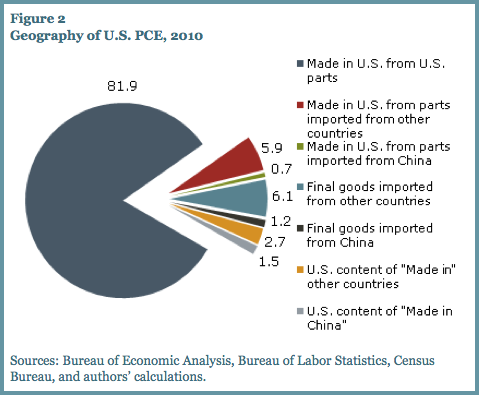
Figure 2 shows the share of U.S. PCE based on where goods were produced, taking into account intermediate goods production, and the domestic and foreign content of imports. Of the 2.7% of U.S. consumer purchases going to goods labeled "Made in China," only 1.2% actually represents China-produced content. If we take into account imported intermediate goods, about 13.9% of U.S. consumer spending is attributable to imports, including 1.9% imported from China. Since the share of PCE attributable to imports from China is less than 2% and some of this can be traced to production in other countries, it is unlikely that recent increases in labor costs and inflation in China will generate broad-based inflationary pressures in the United States. Galina Hale is a senior economist in the Economic Research Department of the Federal Reserve Bank of San Francisco. Bart Hobijn is a senior research advisor in the Economic Research Department of the Federal Reserve Bank of San Francisco. References Bureau of Labor Statistics. 2010. “Inter-industry relationships (Input/Output matrix).” U.S. Census Bureau. 2011. “U.S. International Trade Data.” Xing, Yuqing, and Neal Detert. 2010. “How the iPhone Widens the United States Trade Deficit with the People's Republic of China.” Asian Development Bank Institute Working Paper 257. More Economic Letters » |

 Sources: Bureau of Economic Analysis, Bureau of Labor Statistics, Census Bureau, and authors' calculations.
 Sources: Bureau of Economic Analysis, Bureau of Labor Statistics, Census Bureau, and authors' calculations.
| You are subscribed to email updates from The Big Picture To stop receiving these emails, you may unsubscribe now. | Email delivery powered by Google |
| Google Inc., 20 West Kinzie, Chicago IL USA 60610 | |



0 comments:
Post a Comment